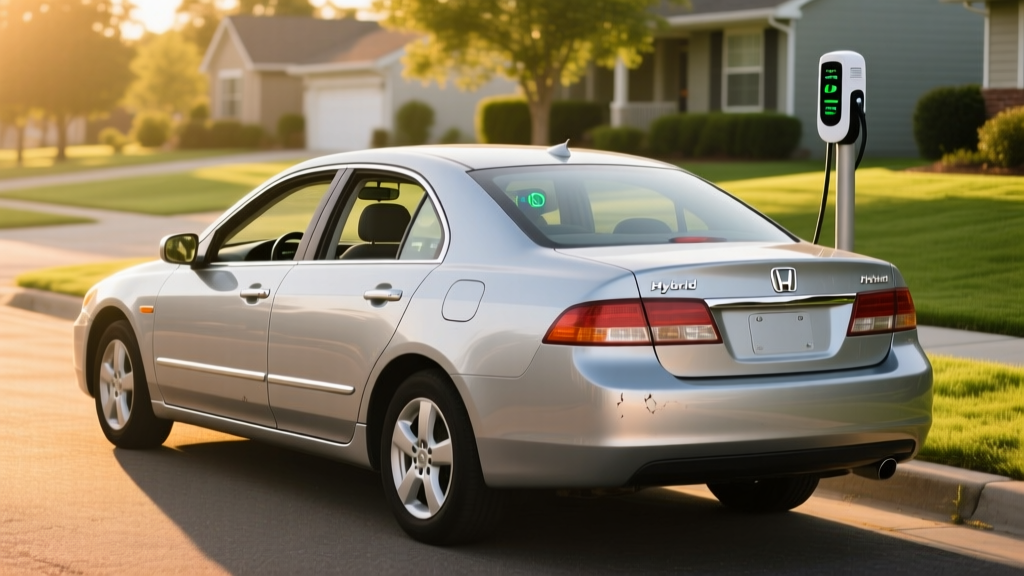
The 2006 Honda Accord Hybrid occupies a unique place in electrified-vehicle history. As one of the first mainstream gasoline-electric sedans sold in the United States, it arrived years before the Toyota Prius became a household name and decades before today's plug-in hybrids and full EVs dominated showrooms. For buyers researching used hybrids on a tight budget, or enthusiasts curious about Honda's Integrated Motor Assist (IMA) system, this car still generates questions. Here's a data-driven look at what the 2006 Accord Hybrid actually delivers — and where it stands against modern alternatives.
2006 Honda Accord Hybrid: Quick Specs at a Glance
| Spec | Value |
|---|---|
| Powertrain | 3.0L V6 + IMA electric motor (HEV) |
| Combined Horsepower | 255 hp @ 6,000 rpm |
| Combined Torque | 232 lb-ft @ 5,000 rpm |
| Transmission | 5-speed automatic |
| EPA City MPG | 29 mpg |
| EPA Highway MPG | 37 mpg |
| EPA Combined MPG | 32 mpg |
| Hybrid Battery | NiMH, ~0.7 kWh (nominal) |
| Plug-In Charging | No — conventional HEV |
| 0–60 mph | ~7.2 seconds |
| Original MSRP | $29,995 (2006) |
| Current Used Price (2026 est.) | $3,500–$6,500 |
HEV vs PHEV: Where the 2006 Accord Hybrid Fits
Before evaluating this car, it's critical to understand what it is — and what it isn't.
Conventional Hybrid (HEV) — 2006 Accord Hybrid
The 2006 Accord Hybrid is a conventional hybrid electric vehicle (HEV). It pairs a gasoline engine with a small electric motor and a nickel-metal hydride (NiMH) battery pack. The battery recharges exclusively through regenerative braking and the engine — you never plug it in. There is no electric-only driving range to speak of; the motor assists the engine during acceleration and enables cylinder deactivation (Variable Cylinder Management, or VCM) during cruising.
Plug-In Hybrid (PHEV) — Modern Example
A plug-in hybrid like the 2026 Toyota RAV4 Prime carries a much larger battery (~18.1 kWh), offers 42 miles of electric-only range, and can be charged from a wall outlet or public charger. PHEVs bridge the gap between HEVs and full EVs.
Battery Electric Vehicle (BEV)
A full EV like the Tesla Model Y or Hyundai Ioniq 5 runs entirely on electricity with no gasoline engine, typically offering 250–320+ miles of EPA range and requiring regular plug-in charging.
Bottom line: The 2006 Accord Hybrid is strictly an HEV. If you're looking for electric-only commuting or plug-in capability, this isn't the vehicle.
Fuel Economy: EPA Numbers and Real-World MPG
| Driving Condition | EPA Estimate | Real-World Expectation |
|---|---|---|
| City | 29 mpg | 27–31 mpg |
| Highway | 37 mpg | 33–38 mpg |
| Combined | 32 mpg | 29–34 mpg |
According to fueleconomy.gov, the 2006 Accord Hybrid achieves 29 city / 37 highway / 32 combined mpg. These figures were impressive for a midsize V6 sedan in 2006, when the conventional V6 Accord managed roughly 21/30/24 mpg.
Real-world context for 2026 buyers: As a used vehicle approaching 20 years old, actual fuel economy will depend heavily on the condition of the IMA battery pack, engine maintenance, and driving habits. Owners on fuel-economy tracking platforms like Fuelly report averages clustering around 28–30 mpg combined, with highway-heavy commutes occasionally hitting the mid-30s. A degraded hybrid battery will reduce the system's ability to assist the engine and enable VCM cylinder deactivation, potentially dropping real-world MPG by 2–4 mpg below EPA estimates.
Compared to a 2026 Toyota Camry Hybrid (51/53/52 mpg EPA), the Accord Hybrid's efficiency is clearly dated. But against a 2006 gasoline-only V6 Accord, the hybrid version saved roughly 8 mpg combined — a meaningful 33% improvement at the pump.
Powertrain Deep Dive: Honda's IMA System
The 2006 Accord Hybrid uses Honda's Integrated Motor Assist (IMA) system, fundamentally different from Toyota's Hybrid Synergy Drive (HSD) used in the Prius and Camry Hybrid.
How IMA Works
Honda's IMA places a thin electric motor (approximately 15 kW / 20 hp) between the 3.0L V6 engine and the transmission. Unlike Toyota's system, the IMA motor cannot propel the car on electric power alone — it only assists the gasoline engine during acceleration and recovers energy during braking. The system's primary fuel-saving tricks are:
- Cylinder deactivation (VCM): The V6 can shut down three or four cylinders during light-load cruising, running on as few as two cylinders.
- Idle stop: The engine shuts off at stops and restarts seamlessly via the IMA motor.
- Regenerative braking: Kinetic energy recharges the NiMH battery during deceleration.
Power Output
The 3.0L V6 alone produces 240 hp. Combined with the IMA motor's assist, total system output reaches 255 hp and 232 lb-ft of torque — making this one of the most powerful hybrids available in 2006. The 5-speed automatic transmission is conventional, not a CVT or planetary gearset like Toyota's eCVT.
Performance is genuinely brisk for a midsize sedan of this era, with 0–60 mph in approximately 7.2 seconds. The trade-off is that the IMA system's fuel-economy gains are modest compared to Toyota's full-parallel hybrid approach, which can operate in EV mode at low speeds.
Hybrid Battery: Lifespan, Warranty, and Replacement Cost
Original Battery Warranty
Honda originally warranted the IMA battery for 8 years / 80,000 miles (10 years / 150,000 miles in California and states adopting CARB emissions standards). For a 2006 model, this factory warranty expired no later than 2016.
NiMH Battery Degradation
The 2006 Accord Hybrid's NiMH battery pack stores approximately 0.7 kWh of energy — tiny by modern standards (a 2026 PHEV carries 15–20 kWh; a full EV carries 60–100 kWh). This small capacity means the battery cycles frequently but at shallow depth, which is generally favorable for NiMH longevity.
However, NiMH batteries are sensitive to heat and age. Most 2006 Accord Hybrids still on the road in 2026 are on their second or even third IMA battery pack. Common failure symptoms include:
- IMA warning light on the dashboard
- Reduced fuel economy (loss of assist and VCM functionality)
- Recalibration events (battery gauge dropping and recharging rapidly)
- Failed emissions tests in states requiring OBD-II readiness
Battery Replacement Cost
As of 2026, replacement options include:
- OEM Honda remanufactured pack: $2,000–$3,000 (parts + labor at a dealer)
- Aftermarket remanufactured pack: $1,200–$2,000 (third-party suppliers)
- Used/salvage pack: $300–$600 (risky — unknown remaining life)
- Grid charger reconditioning: $100–$300 for a DIY grid charger to balance and revive cells — a popular enthusiast fix that can extend battery life by 1–3 years
Given that the car itself is worth roughly $3,500–$6,500, a full OEM battery replacement can consume 30–80% of the vehicle's value. This is the single biggest financial risk of owning a 2006 Accord Hybrid.
Reliability and Common Issues
The 2006 Accord Hybrid's J30A V6 engine is part of Honda's well-regarded J-series family, known for longevity when properly maintained. The conventional mechanical components — transmission, suspension, brakes — share parts with the mainstream Accord and are straightforward to service.
The primary reliability concern is the IMA system. Beyond battery degradation, known issues include:
- IMA motor failure: Rare but expensive; the motor is integrated into the transmission bell housing.
- BCM (Body Control Module) issues: Can cause IMA system communication errors.
- VCM-related oil consumption: Cylinder deactivation can lead to increased oil consumption and, in some cases, piston ring wear. Honda issued service bulletins addressing excessive oil use on J-series VCM engines.
- Motor mount wear: The additional torque from the IMA system accelerates engine mount degradation.
For a 20-year-old vehicle, overall reliability is heavily dependent on maintenance history. A well-maintained example with a recently replaced IMA battery and documented oil-change intervals can be dependable daily transportation. A neglected example with the original battery is a project car, not a commuter.
Tax Credits and Incentives in 2026
The 2006 Honda Accord Hybrid does not qualify for the current federal §30D Clean Vehicle Credit. This credit applies only to new plug-in electric vehicles (BEVs and PHEVs) meeting battery-sourcing, MSRP, and buyer-income requirements as outlined on irs.gov.
When new, the 2006 Accord Hybrid did qualify for a federal tax credit of up to $1,300 under the Energy Policy Act of 2005 — but that credit has long since expired and was never available to subsequent used-car owners.
There is also no federal used-EV credit for this vehicle. The §25E used clean vehicle credit (up to $4,000) applies only to used BEVs and PHEVs, not conventional HEVs. State incentives vary by jurisdiction, but most state hybrid incentives have similarly sunset or apply only to plug-in vehicles. Check your state's energy office for any remaining programs.
Who Should Buy the 2006 Accord Hybrid (and Who Shouldn't)
Pros
- Strong V6 performance (255 hp) with hybrid fuel savings
- Comfortable, spacious midsize sedan with Accord's well-regarded ride quality
- Low purchase price ($3,500–$6,500 used)
- No plug-in charging required — fuel it like a regular gas car
- Proven J-series engine with widespread parts availability
Cons
- IMA battery replacement risk ($1,200–$3,000)
- Fuel economy (32 mpg combined) far behind modern hybrids (50+ mpg)
- No electric-only driving capability
- Factory warranty fully expired; no tax credits available
- VCM-related oil consumption concerns
- Dated interior technology and safety features by 2026 standards
Choose the 2006 Accord Hybrid if:
- You need an ultra-cheap commuter car and can accept the IMA battery risk
- You want hybrid fuel savings without ever plugging in
- You're mechanically inclined and willing to DIY battery reconditioning or replacement
- You value V6 power in a hybrid package (rare even today)
Look at a modern hybrid or PHEV instead if:
- You want 50+ mpg combined (2026 Camry Hybrid, Hyundai Sonata Hybrid)
- You want electric-only commuting with a PHEV (Toyota Prius Prime, RAV4 Prime)
- You want current safety tech (AEB, lane-keeping, adaptive cruise) and warranty coverage
- You want to minimize long-term maintenance risk on a daily driver
Frequently Asked Questions
How many MPG does the 2006 Honda Accord Hybrid get?
The EPA rates the 2006 Accord Hybrid at 29 city / 37 highway / 32 combined mpg. Real-world averages for well-maintained examples typically fall between 28–30 mpg combined, with highway driving occasionally reaching the mid-30s. A degraded IMA battery can reduce these figures by 2–4 mpg.
Does the 2006 Accord Hybrid need to be plugged in?
No. This is a conventional hybrid (HEV), not a plug-in hybrid (PHEV). The battery charges through regenerative braking and the gasoline engine. You fuel it exactly like a standard gasoline car.
Can the 2006 Accord Hybrid drive on electric power alone?
No. Honda's IMA system provides electric motor assist to the V6 engine but cannot propel the vehicle independently. Unlike Toyota's Hybrid Synergy Drive or modern PHEVs, there is no EV-only mode.
Is the 2006 Honda Accord Hybrid reliable?
The underlying J30A V6 engine and 5-speed automatic are reliable when maintained. The main risk is the IMA battery pack, which is likely at or past its useful life on a 20-year-old vehicle. Budget $1,200–$3,000 for a replacement if the IMA system fails. VCM-related oil consumption is also a known issue worth monitoring.
What does it cost to replace the hybrid battery?
An OEM remanufactured IMA battery runs $2,000–$3,000 installed at a dealership. Aftermarket remanufactured packs cost $1,200–$2,000. DIY enthusiasts sometimes use grid chargers ($100–$300) to recondition and extend the life of the existing pack, though results vary.
Does the 2006 Accord Hybrid qualify for any tax credit?
No. The federal §30D new clean vehicle credit and the §25E used clean vehicle credit both require a plug-in vehicle (BEV or PHEV). As a conventional HEV, the 2006 Accord Hybrid is ineligible for any current federal EV or hybrid tax incentive.
How does it compare to a modern hybrid like the 2026 Camry Hybrid?
The 2026 Toyota Camry Hybrid achieves 51/53/52 mpg EPA — roughly 60% better combined fuel economy than the 2006 Accord Hybrid. Modern hybrids also offer full-parallel systems with EV-only low-speed driving, current safety technology (automatic emergency braking, lane-keeping assist), and full factory warranties including 10-year/150,000-mile hybrid battery coverage. The trade-off is price: a new Camry Hybrid starts around $30,000, versus $3,500–$6,500 for a used 2006 Accord Hybrid.
Should I buy this or a full EV?
If you have reliable home charging access, commute under 250 miles round-trip, and can spend $25,000+, a used or new BEV will deliver dramatically lower per-mile fuel costs and zero tailpipe emissions. If your budget is under $7,000, you lack charging access, or you regularly drive long distances in areas with sparse charging infrastructure, the 2006 Accord Hybrid (or a similarly priced used conventional car) remains a pragmatic choice — just budget for the IMA battery.