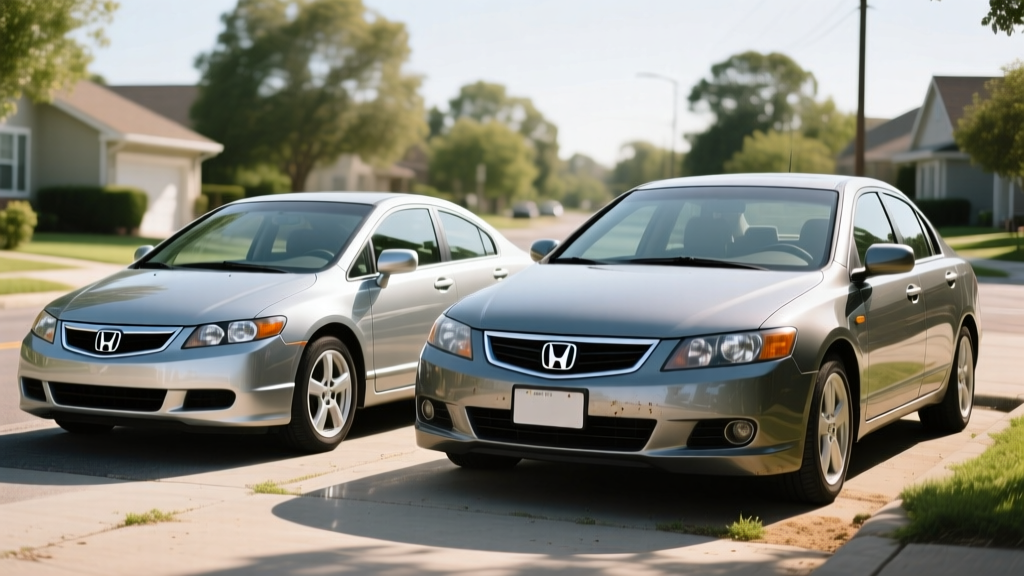
If you're searching for a 05 Honda hybrid, you're likely evaluating one of two pioneering models: the 2005 Honda Civic Hybrid or the 2005 Honda Accord Hybrid. Both were early milestones in Honda's Integrated Motor Assist (IMA) program — a mild-hybrid system that paired a gasoline engine with a small electric motor to squeeze extra efficiency from conventional powertrains. More than two decades later, these cars are still on the road, still being bought and sold in the used market, and still generating questions from cost-conscious commuters.
This guide covers exact EPA fuel economy figures, real-world MPG expectations, the IMA battery's lifespan and replacement cost, and whether a 2005 Honda hybrid still makes financial sense in 2026 — or whether a modern hybrid, PHEV, or full EV is the smarter buy.
Which 05 Honda Hybrid Models Exist?
Honda offered two hybrid vehicles for the 2005 model year, each targeting a different buyer:
| Specification | 2005 Honda Civic Hybrid | 2005 Honda Accord Hybrid |
|---|---|---|
| Body Style | 4-door sedan | 4-door sedan |
| Hybrid System | IMA (Integrated Motor Assist) | IMA (Integrated Motor Assist) |
| Engine | 1.3L inline-4 (i-DSI) | 3.0L V6 (i-VTEC with VCM) |
| Electric Motor | 15 kW (20 hp) brushless DC | 15 kW (20 hp) brushless DC |
| Combined Horsepower | 93 hp @ 5,700 rpm | 255 hp @ 5,800 rpm |
| Combined Torque | 105 lb-ft @ 3,300 rpm | 253 lb-ft @ 4,800 rpm |
| Transmission | CVT (continuously variable) | 5-speed automatic |
| Hybrid Battery | NiMH, ~5.5 Ah (132 cells) | NiMH, ~5.5 Ah (132 cells) |
| Drivetrain | Front-wheel drive | Front-wheel drive |
| Curb Weight | ~2,690 lbs | ~3,501 lbs |
| Original MSRP (2005) | ~$20,140 | ~$29,995 |
Key distinction: Both are conventional hybrids (HEVs), not plug-in hybrids (PHEVs). They recharge their small nickel-metal hydride (NiMH) batteries entirely through regenerative braking and the gasoline engine. There is no plug, no electric-only driving mode, and no external charging capability.
2005 Honda Hybrid EPA MPG vs. Real-World Fuel Economy
| Model | EPA City | EPA Highway | EPA Combined | Real-World Expectation |
|---|---|---|---|---|
| 2005 Civic Hybrid (CVT) | 48 MPG | 47 MPG | 47 MPG | 38–44 MPG (aged battery) |
| 2005 Accord Hybrid | 29 MPG | 37 MPG | 32 MPG | 26–32 MPG |
Source: fueleconomy.gov (U.S. EPA)
Why Real-World MPG Often Falls Short on 20-Year-Old Hybrids
The Civic Hybrid's EPA sticker of 47 MPG combined was impressive in 2005 — and it still holds up against many modern non-hybrid compacts. However, real-world owners in 2026 should expect 38–44 MPG for a well-maintained example, and potentially lower if the IMA battery has degraded. Here's why:
- NiMH battery degradation: After 15–20 years, the original NiMH pack loses capacity. The electric motor assists less, forcing the 1.3L engine to work harder, especially in city stop-and-go traffic where hybrid efficiency matters most.
- Engine wear and carbon buildup: Two decades of operation means worn piston rings, clogged EGR passages, and degraded oxygen sensors — all of which reduce combustion efficiency.
- CVT fluid condition: The Civic's CVT relies on Honda HMMF (Honda Multi-Matic Fluid). Neglected fluid changes increase internal friction and reduce the transmission's efficiency.
- Tire pressure and alignment: Rolling resistance from underinflated tires or poor alignment can shave 1–3 MPG — a larger percentage hit on a high-efficiency vehicle.
The Accord Hybrid, designed more for power-assisted performance than maximum fuel economy, tends to stay closer to its EPA numbers because its V6 engine and larger displacement are less dependent on the electric motor for baseline efficiency.
How Hybrids Often Beat EPA in City Driving (When New)
When the IMA system is fully functional, Honda's 2005 hybrids — like most HEVs — can exceed their EPA city rating. This is because regenerative braking recaptures energy that conventional cars waste as heat, and the electric motor's torque assist is most valuable at low speeds. A Civic Hybrid with a fresh battery and clean engine can still return 48–52 MPG in warm-weather city driving.
HEV vs. PHEV vs. Full EV: Where the 05 Honda Hybrid Fits
Understanding the 2005 Honda hybrid's place in today's electrified landscape requires a clear breakdown of the three main categories:
| Feature | HEV (2005 Honda Hybrid) | Modern PHEV (e.g., 2026 Toyota RAV4 Prime) | Full BEV (e.g., 2026 Tesla Model 3) |
|---|---|---|---|
| Plug Required? | No — self-charging | Yes — plug for EV range | Yes — plug always |
| Electric-Only Range | 0 miles (motor assists only) | ~42 miles | ~340 miles (full battery) |
| Fuel Source | Gasoline only | Gasoline + electricity | Electricity only |
| Typical Combined MPG/MPGe | 32–47 MPG | 38 MPG (gas) / 94 MPGe (electric) | 130+ MPGe |
| Battery Size | ~0.5 kWh (NiMH) | ~18.1 kWh (Li-ion) | ~60–82 kWh (Li-ion) |
| Home Charging | Not applicable | Level 1 (120V) or Level 2 (240V) | Level 2 recommended |
| DC Fast Charging | No | Varies (some models) | Yes (150–250+ kW) |
| Federal Tax Credit (§30D) | Not eligible | Up to $7,500 (if eligible) | Up to $7,500 (if eligible) |
| Used Price Range (2026) | $2,500–$6,500 | $25,000–$45,000 | $18,000–$45,000 |
The 2005 Honda hybrid occupies a specific niche: ultra-low entry cost, no plug needed, simple ownership. It's a stepping stone for drivers who want better fuel economy without any lifestyle change — no charging, no range planning, no electrical upgrades.
IMA Battery Lifespan, Reliability, and Replacement Cost
The single biggest concern for any 05 Honda hybrid buyer in 2026 is the IMA battery. Here's what you need to know:
Original Honda IMA Battery Warranty
Honda originally warranted the IMA battery for 8 years / 80,000 miles (10 years / 150,000 miles in California and states that adopted CARB emissions standards). For a 2005 model, factory warranty coverage expired no later than 2015 in most states. Any battery failure today is an out-of-pocket expense.
How Long Does the IMA Battery Last?
Original NiMH IMA packs in 2005 Civic and Accord hybrids typically lasted 8–12 years or 100,000–150,000 miles before significant degradation. By 2026, most surviving examples are on their second or even third battery. Common failure symptoms include:
- IMA warning light illuminated on the dashboard
- Reduced assist: The electric motor stops providing torque boost, making the car feel sluggish
- Recalibration loops: The battery gauge drops and recharges erratically
- Check Engine codes: P1447, P1449, or P1600 related to battery module deterioration
IMA Battery Replacement Cost (2026 Estimates)
| Option | Cost Range | Notes |
|---|---|---|
| New OEM Honda IMA battery | $2,000–$3,500 (if available) | Limited availability; Honda may no longer stock NiMH packs for 2005 models |
| Refurbished/remanufactured pack | $900–$1,800 | Third-party suppliers; quality varies widely |
| Used pack from salvage yard | $300–$700 | Highest risk — unknown remaining lifespan |
| Grid charger + conditioning | $150–$400 (DIY) | Can extend life of a degrading pack but won't fix dead cells |
| Aftermarket lithium conversion | $1,500–$2,800 | Some shops offer Li-ion drop-in replacements with better longevity |
Critical context: On a 2005 Civic Hybrid with a current market value of $3,000–$5,000, a $2,000+ battery replacement represents 40–65% of the vehicle's value. This is the primary economic risk of owning an early hybrid in 2026.
Overall Vehicle Reliability
Beyond the IMA battery, the 2005 Civic Hybrid's 1.3L i-DSI engine and CVT are generally reliable if maintained. The Accord Hybrid's 3.0L V6 (shared with the non-hybrid Accord) is a proven engine, though the cylinder deactivation system (VCM) can cause oil consumption issues at high mileage — a known Honda V6 concern of this era. According to NHTSA records, neither model has an unusual concentration of safety recalls specific to the hybrid system.
Does the 2005 Honda Hybrid Qualify for Any Tax Credits?
No. The 2005 Honda Civic Hybrid and Accord Hybrid do not qualify for the current federal EV tax credit under IRS §30D. Here's why:
- §30D applies to plug-in vehicles only: The federal credit requires a minimum battery capacity of 7 kWh and the ability to be recharged from an external source. The 2005 Honda hybrids have ~0.5 kWh NiMH packs that charge only from the engine and regenerative braking.
- The original hybrid credit expired: When these vehicles were new, a separate federal tax credit of up to $2,100 (Civic) or $2,600 (Accord) existed under the Energy Policy Act of 2005. That credit phased out for Honda in 2008 after the manufacturer hit the 60,000-unit cap.
- Used EV credit (§25E): The used clean vehicle credit (up to $4,000) also requires the vehicle to be a qualified plug-in EV or fuel cell vehicle. Conventional HEVs are excluded.
Source: IRS.gov — Clean Vehicle Credits
The only potential financial benefit is at the state level. A handful of states (notably California's former Clean Vehicle Rebate) offered rebates for hybrids when new, but these have long expired. No current state or federal incentive applies to a 2005 Honda hybrid purchase in 2026.
Who Should Buy a 05 Honda Hybrid — and Who Shouldn't?
Pros — Reasons to Buy
- Ultra-low purchase price: $2,500–$6,500 puts you in a fuel-efficient daily driver with no car payment
- No charging required: Ideal for apartment dwellers or anyone without access to a plug
- Strong city MPG: The Civic Hybrid still delivers 38–48 MPG in stop-and-go traffic when the IMA system is healthy
- Simple maintenance: No complex turbo, no high-voltage Li-ion system, no thermal management pumps — straightforward Honda engineering
- Proven parts availability: Suspension, brakes, and engine components are shared with the high-volume non-hybrid Civic/Accord
Cons — Reasons to Think Twice
- IMA battery is a ticking expense: A $1,500–$3,500 replacement can total the car economically
- No tax credits or incentives: Zero federal or state purchase assistance
- Safety technology gap: No electronic stability control (standard on Civic Hybrid only from 2006+), no airbags beyond front dual-stage, no collision mitigation
- Highway MPG is unremarkable: At 70+ mph, the Civic Hybrid's advantage over a modern non-hybrid compact narrows significantly
- Age-related wear: At 21 years old, rubber bushings, seals, hoses, and wiring harnesses are reaching end-of-life regardless of mileage
Choose the 05 Honda Civic Hybrid If:
- You need a sub-$5,000 commuter car for city driving under 40 miles round-trip
- You have no access to home or workplace charging
- You're comfortable with the risk of a potential IMA battery replacement
- You can inspect or test the IMA system before purchase (check for recalibration loops and warning lights)
Consider a Modern Alternative If:
- You want warranty coverage and modern safety (automatic emergency braking, lane keeping, blind-spot monitoring)
- You drive significant highway miles — a 2026 Toyota Corolla Hybrid (52 MPG combined, $23,500 MSRP) offers similar efficiency with full warranty
- You have home charging access and want electric-only commuting — a used PHEV like the 2019–2022 Toyota Prius Prime (25 miles EV range, ~$16,000–$22,000 used) gives plug-in benefits at moderate cost
- You want tax credit eligibility — a new PHEV or BEV may qualify for up to $7,500 under §30D, subject to MSRP caps, income limits, and battery sourcing rules per IRS guidelines
Pre-Purchase Checklist for a 2005 Honda Hybrid
If you've decided a 05 Honda hybrid fits your budget and needs, follow this inspection framework before handing over cash:
- Check the IMA battery state: Start the car and watch the IMA charge gauge. If it fluctuates wildly or shows "recal" behavior (dropping to near-empty then recharging), the battery is degraded.
- Pull OBD-II codes: A $20 code reader can reveal P1447/P1449 (battery module deterioration) or P1600 (IMA system malfunction) — deal-breakers unless a replacement is budgeted.
- Verify IMA battery replacement history: Ask for receipts. A documented replacement within the last 3–5 years is a strong positive.
- Test the auto-stop feature: The Civic Hybrid should shut off the engine at a complete stop and restart seamlessly when you lift off the brake. If auto-stop is disabled or fails to activate, the IMA system may be compromised.
- Inspect CVT operation (Civic): Acceleration should be smooth and linear. Any shuddering, hesitation, or whining suggests CVT wear.
- Check for VCM-related oil consumption (Accord): Ask the owner about oil burn rate. Excessive consumption (1 quart per 1,000 miles or less) points to VCM-related piston ring issues.
- Rust inspection: At 21 years old, inspect subframe, rocker panels, and wheel arches — especially in rust-belt states.
Frequently Asked Questions
How many MPG does the 2005 Honda Civic Hybrid get?
The EPA rates the 2005 Civic Hybrid at 48 city / 47 highway / 47 combined MPG. In real-world 2026 driving with an aging NiMH battery, expect 38–44 MPG combined. A freshly serviced example with a healthy IMA battery can still achieve 48+ MPG in warm-weather city driving.
How many MPG does the 2005 Honda Accord Hybrid get?
The EPA rates it at 29 city / 37 highway / 32 combined MPG. The Accord Hybrid prioritized V6 power (255 hp) over maximum efficiency. Real-world figures cluster around 26–32 MPG depending on driving style and battery health.
Is the 2005 Honda Hybrid a plug-in?
No. Both the 2005 Civic Hybrid and Accord Hybrid are conventional hybrids (HEVs). They use a small NiMH battery that charges only through regenerative braking and the gasoline engine. There is no plug, no charging port, and no electric-only driving mode.
How long does the IMA battery last, and what does replacement cost?
Original IMA batteries lasted roughly 8–12 years or 100,000–150,000 miles. Replacement costs in 2026 range from $300 (used salvage) to $3,500 (new OEM, if available), with refurbished packs in the $900–$1,800 range. The original 8-year/80,000-mile warranty expired long ago.
Is a 2005 Honda hybrid reliable?
The underlying powertrains (Civic's 1.3L engine, Accord's 3.0L V6) are fundamentally reliable Honda designs. The main reliability risk is the IMA NiMH battery, which is now past its expected lifespan on any original pack. Budget for a battery replacement or confirm a recent replacement before purchasing.
Does the 2005 Honda Hybrid qualify for any tax credit?
No. The current federal §30D clean vehicle credit applies only to plug-in electric vehicles with at least 7 kWh of battery capacity. The original hybrid tax credit (up to $2,600) that applied when these cars were new expired for Honda in 2008. No current federal or state incentive is available for purchasing a 2005 Honda hybrid in 2026.
Should I buy a 2005 Honda hybrid or a newer used EV?
It depends on your budget and charging access. If you can spend $15,000–$25,000 and have home Level 2 charging, a used EV (2018–2022 Nissan Leaf, Chevy Bolt, or Tesla Model 3) offers dramatically lower operating costs, zero tailpipe emissions, and modern safety features. If your budget is strictly under $6,000 and you lack charging access, the 2005 Civic Hybrid remains a practical — if aging — high-MPG option.