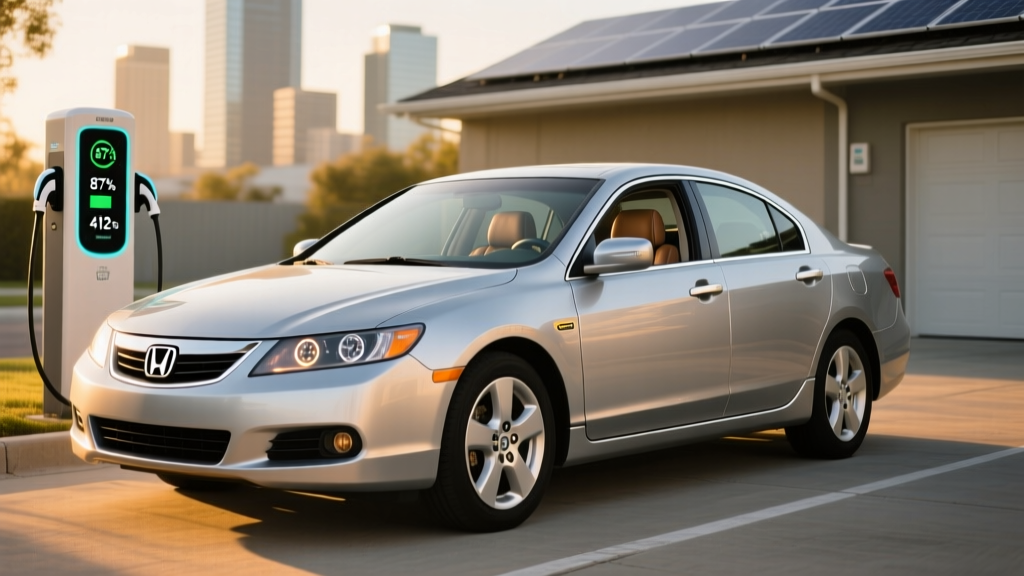
The First Mainstream Hybrid Sedan: 2005 Honda Accord Hybrid at a Glance
The 2005 Honda Accord Hybrid holds a unique place in automotive history. It was Honda's first hybrid sedan and one of the earliest hybrid vehicles available from a mainstream automaker in the United States. Built on Honda's Integrated Motor Assist (IMA) platform — the same architecture used in the original Insight and Civic Hybrid — the Accord Hybrid paired a 3.0-liter V6 engine with a thin electric motor sandwiched between the engine and transmission. The result was a full-size sedan that delivered modest fuel-economy gains over its gasoline-only counterpart while retaining the driving feel Honda was known for.
Two decades later, the 2005 Accord Hybrid exists almost entirely in the used-car market. With examples selling for $2,000–$5,000 depending on condition and mileage, it attracts buyers looking for an inexpensive, fuel-efficient commuter or hybrid-curious drivers testing the waters before committing to a modern PHEV or full EV. This review breaks down the real-world ownership picture in 2026 — fuel economy, IMA battery health, reliability data, and how this early hybrid stacks up against what's available today.
| Specification | 2005 Honda Accord Hybrid |
|---|---|
| Powertrain | 3.0L V6 + IMA electric motor |
| Combined Horsepower | 255 hp @ 6,000 rpm |
| Transmission | 5-speed automatic |
| EPA MPG (City / Hwy / Combined) | 30 / 37 / 33 (original EPA); revised to ~25 / 34 / 28 |
| Hybrid System | Honda IMA (mild hybrid, HEV) |
| Battery Type | Nickel-Metal Hydride (NiMH) |
| Battery Capacity | ~0.6 kWh (nominal) |
| Plug-In Charging | No — regenerative braking only |
| Electric-Only Driving | Not capable |
| 0–60 mph | ~7.2 seconds |
| Curb Weight | ~3,500 lbs |
| Original MSRP | ~$30,140 |
| 2026 Used Price Range | $2,000–$5,000 |
Understanding the IMA System: Mild Hybrid, Not a Full Hybrid
Before evaluating the Accord Hybrid's efficiency, it's critical to understand what Honda's IMA system actually does — and what it doesn't do. The 2005 Accord Hybrid is a conventional hybrid electric vehicle (HEV), specifically a mild hybrid. It is not a plug-in hybrid (PHEV) and cannot be plugged into any external power source.
| Feature | HEV (2005 Accord Hybrid) | PHEV (e.g., 2026 Honda Accord PHEV — not sold in US) | Full EV (BEV) |
|---|---|---|---|
| Plugs in to charge? | No | Yes | Yes |
| Electric-only driving? | No | Yes (20–50 mi typical) | Yes (200–400+ mi) |
| Gasoline engine? | Yes (primary power) | Yes (backup + highway) | No |
| Battery size | ~0.6 kWh | 15–25 kWh typical | 50–100+ kWh |
| Regenerative braking? | Yes | Yes | Yes |
| Tax credit eligible? | No | Possibly (§30D) | Possibly (§30D) |
The IMA motor provides three functions: it assists the gasoline engine during acceleration (reducing fuel consumption), it enables regenerative braking to recapture kinetic energy, and it allows the engine to shut off at idle (stop-start). The electric motor alone cannot propel the car — it only supplements the V6. This is fundamentally different from Toyota's Hybrid Synergy Drive (used in the Camry Hybrid), which can move the vehicle short distances on electric power alone at low speeds.
Honda also incorporated Variable Cylinder Management (VCM), which deactivates three of the six cylinders under light-load cruising conditions. This cylinder-deactivation system contributed more to the Accord Hybrid's fuel-economy advantage than the electric motor itself.
Fuel Economy: EPA Numbers vs. Real-World MPG
The 2005 Accord Hybrid's fuel economy story requires context. When it launched, Honda advertised EPA ratings of 30 city / 37 highway / 33 combined MPG — figures that generated significant controversy. The EPA subsequently revised its testing methodology in 2008, and the retroactive adjusted ratings for this vehicle dropped to approximately 25 city / 34 highway / 28 combined MPG.
| Driving Condition | EPA Rating (Revised) | Real-World Expectation (2026 Owner Reports) |
|---|---|---|
| City | 25 MPG | 23–27 MPG |
| Highway | 34 MPG | 30–35 MPG |
| Combined | 28 MPG | 25–30 MPG |
According to data aggregated by fueleconomy.gov, real-world owner submissions for the 2005 Accord Hybrid cluster around 25–28 MPG combined, which aligns closely with the revised EPA estimate. Several factors influence where individual owners fall within that range:
- IMA battery health: A degraded NiMH battery reduces regenerative braking effectiveness and electric assist, dropping fuel economy by 1–3 MPG.
- Driving style: The IMA system rewards gentle acceleration. Aggressive driving bypasses the electric assist and relies entirely on the V6.
- VCM operation: Cylinder deactivation works best on flat, steady-speed highway cruising. Hilly terrain or frequent speed changes keep all six cylinders active.
- Tire and maintenance condition: On a 20-year-old vehicle, worn spark plugs, dirty air filters, and underinflated tires compound efficiency losses.
For comparison, the conventional 2005 Honda Accord V6 (non-hybrid) was rated at approximately 21 city / 30 highway / 24 combined (revised). The hybrid's advantage was roughly 4 MPG combined — meaningful but not transformative. Modern hybrids like the 2026 Toyota Camry Hybrid achieve 52 MPG combined, illustrating how far the technology has progressed.
Battery Health, Replacement Costs, and Warranty
The single biggest concern for any buyer considering a 2005 Accord Hybrid in 2026 is the nickel-metal hydride (NiMH) IMA battery. This pack was originally warrantied for 8 years / 80,000 miles (10 years / 150,000 miles in CARB states). Every original warranty has long since expired.
IMA Battery Fast Facts
- Original chemistry: Nickel-Metal Hydride (NiMH)
- Original warranty: 8 yr / 80,000 mi (federal); 10 yr / 150,000 mi (CARB states)
- Current warranty status: Expired on all 2005 models
- Expected original lifespan: 10–15 years / 120,000–180,000 miles before significant degradation
- Replacement cost (2026): $1,500–$3,000 (remanufactured pack + labor)
- New OEM pack: Discontinued or extremely limited availability; $3,000–$4,500 if sourced
NiMH batteries degrade more predictably than early lithium-ion packs, but after 20 years, virtually every original IMA battery in a 2005 Accord Hybrid has either been replaced or is operating at significantly reduced capacity. Symptoms of a degraded IMA battery include:
- Frequent "IMA" warning light on the dashboard
- Reduced regenerative braking (the charge gauge rarely reaches full)
- Noticeable drop in fuel economy (2–4 MPG loss)
- Engine not shutting off at idle (stop-start disabled)
- Reduced acceleration assist, making the car feel sluggish
The aftermarket support ecosystem for IMA battery replacement remains active in 2026, though it's shrinking as these vehicles age. Companies like BumbleBee Batteries and various hybrid-specialty shops offer remanufactured NiMH packs in the $1,500–$2,500 range installed. Some owners opt for DIY replacement, which can bring costs below $1,000 for a refurbished pack, but the labor involves high-voltage components and should not be attempted without proper training.
A growing trend among owners is the IMA delete or bypass — disabling the hybrid system entirely and driving the car as a conventional V6 Accord. This eliminates battery-replacement costs but forfeits the fuel-economy benefit and may trigger emissions-compliance issues in states with strict inspection requirements.
Powertrain Performance and Driving Impressions
The 2005 Accord Hybrid was, by the standards of its era, a quick and refined sedan. The 3.0-liter V6 produced 240 hp on its own, and the IMA motor contributed an additional 15 hp (for a combined 255 hp) along with a useful torque boost at low RPMs. Honda positioned this car as a performance-oriented hybrid — the opposite of the Toyota Prius's efficiency-first philosophy.
The 0–60 mph time of approximately 7.2 seconds was competitive with the non-hybrid Accord V6 and quicker than most four-cylinder midsize sedans of the time. The electric motor's torque fill masked the V6's slight hesitation off the line, and the transition between electric assist and pure gasoline power was generally smooth.
However, the IMA system's limitations become apparent under sustained load. On long highway grades or when merging onto fast-moving freeways, the small battery depletes quickly and the electric assist drops away, leaving the V6 to work alone. The 5-speed automatic transmission (Honda did not offer the hybrid with a manual) is adequate but lacks the responsiveness of modern 8- and 10-speed units.
Ride quality, steering feel, and cabin noise are consistent with the seventh-generation Accord platform — competent, comfortable, and unremarkable. The hybrid-specific instrumentation includes an IMA assist/charge gauge and an instant fuel-economy display, which were novel features in 2005.
Pricing, Tax Credits, and Total Cost of Ownership in 2026
The 2005 Honda Accord Hybrid originally retailed for approximately $30,140 — a roughly $3,000 premium over the comparably equipped Accord V6 EX-L. In 2026, used examples trade in a wide range depending on condition:
- High-mileage / project condition (150,000+ mi): $1,500–$2,500
- Average condition (100,000–150,000 mi): $2,500–$4,000
- Low-mileage / excellent condition (under 80,000 mi): $4,000–$6,000
Tax Credit Eligibility
The 2005 Honda Accord Hybrid does not qualify for any current federal tax credit. Under IRS §30D Clean Vehicle Credit rules, only new plug-in electric vehicles (PHEVs and BEVs) meeting specific battery-sourcing, critical-mineral, MSRP cap, and buyer income requirements are eligible. Conventional hybrids (HEVs) that cannot be plugged in have never qualified for the §30D credit.
Some states historically offered rebates for hybrid purchases, but these programs have largely sunset or shifted focus to plug-in vehicles. Check your state's current energy-office website for any remaining incentives, but expect none for a 20-year-old used HEV.
Five-Year Ownership Cost Estimate
| Cost Category | Estimated 5-Year Cost |
|---|---|
| Purchase price (average condition) | $3,000 |
| IMA battery replacement (if needed) | $2,000 |
| Fuel (12,000 mi/yr @ 27 MPG, $3.50/gal) | $7,778 |
| Insurance (liability-only, older vehicle) | $3,000–$4,500 |
| Maintenance & repairs (age-related) | $3,000–$5,000 |
| Total estimated 5-year cost | $18,778–$22,278 |
The wildcard in any older vehicle budget is maintenance. A 20-year-old Honda V6 will need suspension components, brakes, timing belt service (if not already done), and general wear-item replacement regardless of hybrid status. Budget an additional $500–$1,000/year beyond typical maintenance for age-related surprises.
Reliability Record and Known Issues
The seventh-generation Honda Accord (2003–2007) has a strong overall reliability reputation, and the hybrid variant shares most of its mechanical components with the well-regarded V6 Accord. However, several model-specific issues deserve attention:
- IMA battery failure: As discussed, this is the most common and most expensive hybrid-specific repair. Budget for it.
- VCM-related oil consumption: The cylinder-deactivation system can cause uneven wear on piston rings, leading to oil burning in higher-mileage examples. Honda issued technical service bulletins for this issue. Check for excessive oil consumption during a pre-purchase inspection.
- Automatic transmission: The 2003–2005 Accord V6 automatic transmissions had a known failure-prone history. While Honda extended warranties and issued recalls for some model years, any surviving 2005 should have documented transmission service or replacement.
- Hybrid system warning lights: Beyond the IMA battery, the DC-DC converter and IMA motor can fail, though these are less common than battery issues.
According to NHTSA records, the 2005 Accord Hybrid has a modest number of recalls and complaints relative to its production volume, with most complaints clustering around the IMA system and transmission — consistent with the known issues above.
Pros
- Low purchase price in 2026 ($2,000–$5,000)
- Strong Honda V6 reliability (non-hybrid components)
- Quick for its era (255 hp, 7.2s 0–60)
- No plug-in charging required — fuel and go
- Comfortable midsize sedan with good cargo space
- Aftermarket IMA battery replacements still available
Cons
- Modest fuel-economy gain over non-hybrid V6 (~4 MPG)
- IMA battery replacement cost ($1,500–$3,000) often exceeds vehicle value
- No electric-only driving capability
- Outdated safety tech (no ESC standard, no backup camera)
- No federal or state tax credits available
- Parts availability shrinking as the model ages
- Transmission reliability concerns on early build dates
2005 Accord Hybrid vs. Modern Alternatives: Which Should You Choose?
The honest assessment for a 2026 buyer is that the 2005 Honda Accord Hybrid makes sense only in a narrow set of circumstances. Here's a decision framework:
Choose the 2005 Accord Hybrid if:
- Your total budget is under $5,000 and you need a reliable commuter sedan
- You drive mostly city miles where regenerative braking and idle stop-start provide the most benefit
- You're mechanically inclined and comfortable with DIY maintenance on aging vehicles
- You want to experience hybrid ownership at minimal cost before committing to a newer PHEV or EV
Choose a modern hybrid (e.g., 2026 Toyota Camry Hybrid, 52 MPG combined) if:
- You can afford $28,000+ and want warranty coverage, modern safety tech, and double the fuel economy
- You plan to keep the vehicle for 5+ years and want predictable maintenance costs
Choose a PHEV (e.g., 2026 Toyota RAV4 Prime, 42 mi electric range) if:
- You have home charging access and a short commute that fits within the electric-only range
- You want to drive on electricity most days but need gasoline flexibility for road trips
- You may qualify for the §30D federal tax credit (up to $7,500, subject to income, MSRP, and sourcing rules)
Choose a full EV (e.g., 2026 Hyundai Ioniq 6, 361 mi EPA range) if:
- You have reliable home Level 2 charging
- Your daily driving is under 250 miles and you rarely take long road trips
- You want the lowest per-mile fuel cost and minimal drivetrain maintenance
The efficiency gap between a 2005 mild hybrid and a 2026 full hybrid is enormous. The current Toyota Camry Hybrid delivers 52 MPG combined — nearly double the Accord Hybrid's real-world 27 MPG. That difference translates to roughly $800–$1,000 per year in fuel savings at current gasoline prices, which alone can offset a significant portion of a new hybrid's monthly payment.
Frequently Asked Questions
How many MPG does the 2005 Honda Accord Hybrid get?
The revised EPA rating is approximately 25 city / 34 highway / 28 combined MPG. Real-world owner reports cluster around 25–28 MPG combined, with some owners seeing up to 30 MPG on highway-heavy commutes and others dropping to 22–23 MPG in aggressive city driving or with a degraded IMA battery.
Can the 2005 Accord Hybrid be plugged in to charge?
No. The 2005 Accord Hybrid is a conventional hybrid (HEV), not a plug-in hybrid (PHEV). It charges its small NiMH battery exclusively through regenerative braking and the gasoline engine. There is no charging port and no electric-only driving mode.
How much does it cost to replace the IMA battery?
In 2026, a remanufactured IMA battery pack installed by a hybrid specialist typically costs $1,500–$2,500. A new OEM pack, if available, can cost $3,000–$4,500 but is increasingly difficult to source. DIY replacement with a refurbished pack can cost $800–$1,200 but involves working with high-voltage components.
Does the 2005 Honda Accord Hybrid qualify for any tax credit?
No. The federal §30D Clean Vehicle Credit applies only to new plug-in electric vehicles (PHEVs and BEVs) meeting battery-sourcing, MSRP, and buyer-income requirements. Conventional hybrids that cannot be plugged in are not eligible. The original $30D hybrid tax credit that existed in 2005–2006 (up to $650 for this model) expired long ago.
Is the 2005 Accord Hybrid reliable?
The non-hybrid mechanical components (V6 engine, suspension, brakes) carry Honda's strong reliability reputation. The primary reliability risk is the IMA battery, which is likely at or past its service life on any original pack. The automatic transmission on 2003–2005 Accords also has a known failure history. A thorough pre-purchase inspection focusing on these two systems is essential.
How does the 2005 Accord Hybrid compare to the Toyota Prius of the same era?
The 2005 Prius (second generation) was a full hybrid capable of electric-only driving at low speeds and achieved approximately 46 MPG combined (revised EPA). The Accord Hybrid offered more power and a larger cabin but delivered roughly 28 MPG combined — a significant gap. The Prius's Toyota Hybrid Synergy Drive was a more advanced and effective system than Honda's IMA, and this technology gap is reflected in both fuel economy and long-term hybrid-system reliability.
What should I check before buying a used 2005 Accord Hybrid?
Prioritize these items during a pre-purchase inspection: (1) IMA battery state of health — ask for a diagnostic scan showing battery capacity and any stored IMA codes; (2) transmission condition — check for shuddering, slipping, or harsh shifts; (3) oil consumption — verify the engine isn't burning excessive oil due to VCM-related ring wear; (4) maintenance records — timing belt, water pump, and transmission fluid changes should be documented; (5) rust and structural condition, especially in salt-belt states.