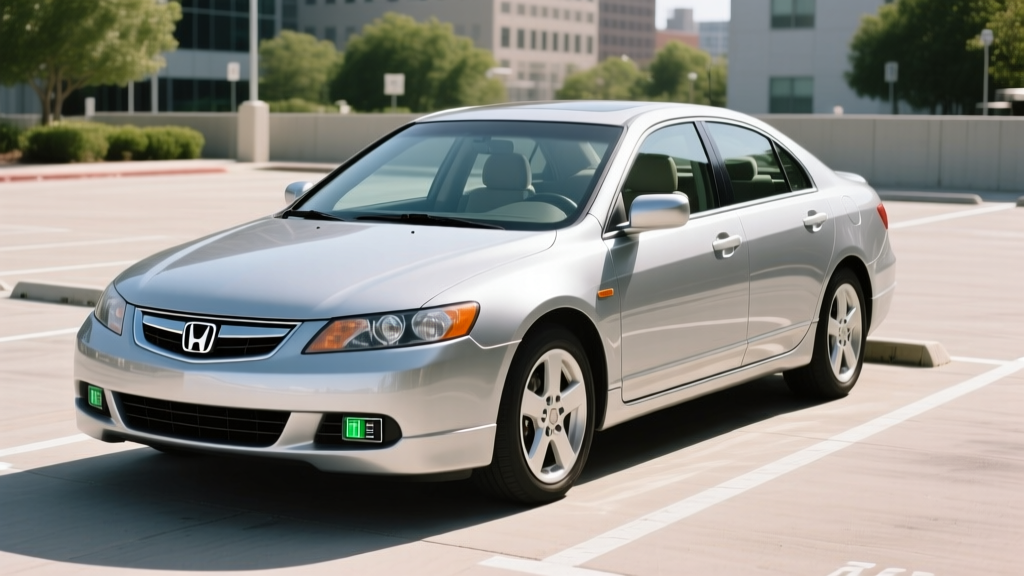
The Pioneer That Started It All: 2005 Honda Accord Hybrid at a Glance
Long before plug-in hybrids and 300-mile EVs became mainstream, Honda introduced one of the first mass-market hybrid sedans in the United States: the 2005 Honda Accord Hybrid. Built on the seventh-generation Accord platform, it paired a 3.0-liter V6 with Honda's Integrated Motor Assist (IMA) system — a belt-driven electric motor sandwiched between the engine and transmission. For buyers in 2026 researching this model on the used market, the key questions are practical: What MPG does it actually deliver? How long does the IMA battery last? And at what price does a 20-year-old hybrid still make financial sense?
This guide covers the exact EPA figures, real-world fuel economy expectations, IMA battery longevity data, replacement costs, and a clear framework for deciding whether the 2005 Accord Hybrid fits your commute — or whether a modern hybrid, PHEV, or full EV is a better investment.
EPA Fuel Economy and Real-World MPG
The 2005 Honda Accord Hybrid was rated by the EPA under the older, more generous testing methodology that was revised in 2008. Those original stickers read 30 mpg city / 37 mpg highway / 33 mpg combined. However, when the EPA re-evaluated this model under the current testing cycle (which better reflects real-world driving with air conditioning, cold starts, and aggressive acceleration), the numbers dropped significantly.
| Driving Cycle | City | Highway | Combined |
|---|---|---|---|
| Original 2005 EPA Sticker | 30 mpg | 37 mpg | 33 mpg |
| Revised EPA (current methodology) | 25 mpg | 34 mpg | 28 mpg |
| Real-world owner average (Fuelly data) | 22–26 mpg | 29–33 mpg | 24–28 mpg |
According to fueleconomy.gov, the revised combined rating is 28 mpg. In practice, most owners reporting on fuel-tracking platforms average between 24 and 28 mpg combined, with highway-heavy commutes occasionally reaching the low 30s. City driving in stop-and-go traffic allows the IMA system to recapture more energy through regenerative braking, but the 3.0L V6 still consumes more fuel at idle and low speeds than a modern four-cylinder hybrid.
Important distinction: The 2005 Accord Hybrid is a conventional hybrid (HEV), not a plug-in hybrid (PHEV). It has no electric-only driving range, no charging port, and no plug. The IMA system assists the gasoline engine and recovers energy during braking — it never drives the car on electricity alone. If you need electric-only commuting, you need a PHEV (like the current Toyota Prius Prime or Honda Clarity PHEV) or a full battery-electric vehicle.
How the IMA Powertrain Works
Honda's Integrated Motor Assist system in the 2005 Accord is fundamentally different from the full-hybrid systems used by Toyota's Hybrid Synergy Drive or modern Honda two-motor setups. Here's the hardware:
| Specification | 2005 Honda Accord Hybrid |
|---|---|
| Engine | 3.0L V6 i-VTEC |
| Engine Output | 240 hp @ 6,000 rpm / 212 lb-ft @ 5,000 rpm |
| Electric Motor (IMA) | 15 hp / 65 lb-ft assist |
| Combined System Output | 255 hp (peak, not additive) |
| Transmission | 5-speed automatic |
| IMA Battery | NiMH (Nickel-Metal Hydride), ~0.5 kWh (nominal) |
| Drivetrain | Front-wheel drive |
| 0–60 mph | ~7.0 seconds |
| Curb Weight | ~3,500 lbs |
The IMA motor is a thin, brushless DC unit mounted directly on the crankshaft between the engine and transmission. It provides torque fill during acceleration (Honda marketed this as "V6 power with 4-cylinder fuel economy"), enables idle stop at traffic lights, and regenerates energy during deceleration. Unlike Toyota's system, the IMA motor cannot propel the car independently — the engine must always be running or ready to engage.
One notable feature: Honda's Variable Cylinder Management (VCM) could deactivate three of the six cylinders under light-load cruising, running the engine as a three-cylinder to save fuel. This was an early form of cylinder deactivation and contributed to the highway MPG advantage.
IMA Battery Lifespan, Warranty, and Replacement Cost
The most common concern for any used hybrid buyer is battery longevity. The 2005 Accord Hybrid uses a relatively small nickel-metal hydride (NiMH) battery pack located behind the rear seat. Here's what two decades of data tell us:
Original Battery Warranty: Honda warranted the IMA battery for 8 years / 80,000 miles (extended to 10 years / 150,000 miles in California Air Resources Board states including CA, NY, MA, and others adopting CARB standards).
Real-World Lifespan: Most IMA batteries in the 2005 Accord Hybrid began showing capacity loss or failure between 100,000 and 150,000 miles, or roughly 8–12 years of typical use. Some units lasted beyond 180,000 miles; others failed earlier, particularly in hot climates where NiMH cells degrade faster.
Replacement cost in 2026:
- OEM Honda IMA battery (dealer installed): $2,000–$3,000 (parts and labor), though Honda no longer actively stocks new units for this model year.
- Aftermarket refurbished/remanufactured IMA battery: $800–$1,500 from suppliers like Bumblebee Batteries or Hybrid Automotive. These use reconditioned NiMH cells and are the most common choice for owners keeping an older Accord Hybrid on the road.
- DIY cell replacement: Some owners replace individual NiMH D-cells within the IMA pack for $200–$400 in parts, but this requires moderate electrical skill and is not recommended without proper training.
Signs of IMA battery failure: The IMA warning light on the dash, reduced fuel economy (loss of regen and assist), the battery gauge dropping rapidly, or the system refusing to provide electric assist during acceleration. A failed IMA battery won't strand you — the V6 will still run the car — but you'll lose the hybrid fuel-economy benefit and idle-stop functionality.
Pricing and Tax Credit Eligibility
The 2005 Honda Accord Hybrid originally carried an MSRP of approximately $29,995 — a premium of roughly $3,000–$4,000 over the equivalent V6 Accord EX. It qualified for a modest federal tax credit of $650 under the pre-2009 hybrid incentive structure (long since expired).
Used-market pricing in 2026: Expect to pay between $2,500 and $5,500 for a 2005 Accord Hybrid in drivable condition, depending on mileage, battery health, and regional demand. Low-mileage examples (under 80,000 miles) with a recently replaced IMA battery can command the upper end of that range.
Federal tax credit status: The 2005 Accord Hybrid does not qualify for the current IRS §30D Clean Vehicle Credit. That credit applies only to new EVs and PHEVs meeting battery-sourcing, MSRP, and buyer-income requirements, or to used EVs/PHEVs priced at $25,000 or less under the §25E used-vehicle credit. Conventional hybrids (HEVs) have never qualified for §30D. Per IRS guidelines, only plug-in vehicles with sufficient battery capacity are eligible. No federal incentive applies to this purchase.
Hybrid vs. PHEV vs. EV: Which Fits Your Situation?
If you're cross-shopping a used 2005 Accord Hybrid against modern alternatives, here's a practical decision framework:
Choose the 2005 Accord Hybrid If:
- Your budget is under $5,000 and you need a reliable commuter sedan now
- You drive 10,000–15,000 miles/year and want 25–28 mpg combined without plugging in
- You have no access to home or workplace charging (no plug needed)
- You're comfortable with potential IMA battery replacement costs ($800–$1,500)
- You value the V6's passing power (255 hp) over maximum efficiency
Choose a Modern Hybrid, PHEV, or EV If:
- Modern HEV (e.g., 2026 Toyota Camry Hybrid, 51 mpg combined): You want double the fuel economy with current safety tech and a full factory warranty
- PHEV (e.g., 2026 Toyota Prius Prime, 44 mi electric-only): You have home charging and a short commute — drive on electricity daily, use gas only for road trips
- Full EV (e.g., 2026 Hyundai Ioniq 6, 361 mi EPA range): You want zero tailpipe emissions, minimal maintenance, and access to the §30D tax credit (up to $7,500 for qualifying new EVs)
The math is straightforward: a 2026 Camry Hybrid LE at ~$29,000 delivers 51 mpg combined versus the 2005 Accord Hybrid's 28 mpg. Over 15,000 miles per year at $3.50/gallon, the Camry saves roughly $950 annually in fuel alone — enough to offset its higher purchase price within a few years versus a $4,000 Accord Hybrid. Add in modern AEB, lane-keeping, and adaptive cruise control, and the value proposition shifts further toward new.
Reliability and Known Issues
The seventh-generation Accord (2003–2007) has a strong reputation for mechanical durability. The J30 V6 engine is known to exceed 250,000 miles with routine maintenance. Specific issues to watch for on the Hybrid variant include:
- IMA battery degradation: As discussed, the primary hybrid-specific expense. Budget $1,000–$1,500 for a refurbished replacement if the original is still in the car.
- VCM-related oil consumption: Variable Cylinder Management can cause oil burning over time as piston rings wear unevenly from frequent cylinder deactivation. Check oil level frequently.
- Automatic transmission: The 5-speed automatic in this generation had a better record than the problematic 2003–2004 units, but high-mileage examples should be checked for smooth shifting and fluid condition.
- Idle-stop system: The IMA-enabled auto stop/start at traffic lights can cause premature wear on the starter motor and battery if the IMA pack is weak.
For safety context, the 2005 Accord earned a 5-star frontal crash rating from NHTSA and was an IIHS Top Safety Pick in its class, though it lacks modern active-safety features like automatic emergency braking, blind-spot monitoring, or lane-departure warning.
Frequently Asked Questions
How many MPG does the 2005 Honda Accord Hybrid get?
The revised EPA rating is 25 city / 34 highway / 28 combined mpg. Real-world owners typically report 24–28 mpg combined, with highway-heavy driving occasionally reaching the low 30s. This is notably less than modern hybrids like the 2026 Camry Hybrid (51 combined) or Prius (57 combined).
Does the 2005 Accord Hybrid need to be plugged in?
No. It is a conventional hybrid (HEV), not a plug-in hybrid. The small NiMH battery charges only through regenerative braking and the gasoline engine. There is no charging port and no electric-only driving capability.
How far can it drive on electric power alone?
It cannot. The IMA system only assists the gasoline engine — it never propels the car independently. Zero miles of electric-only range. If electric-only commuting is your goal, look at PHEVs like the Prius Prime (44 miles electric) or a full EV.
Is the 2005 Accord Hybrid reliable, and what does a battery replacement cost?
The V6 powertrain and chassis are mechanically robust, often exceeding 200,000 miles. The IMA battery is the primary wear item, typically lasting 100,000–150,000 miles. Refurbished replacement batteries cost $800–$1,500 installed. The car remains drivable with a failed IMA battery, but fuel economy drops to that of a standard V6 Accord (~22 mpg combined).
Does the 2005 Accord Hybrid qualify for any tax credit?
No. The original $650 federal hybrid credit expired years ago, and conventional hybrids have never qualified for the current IRS §30D Clean Vehicle Credit, which applies only to plug-in EVs and PHEVs meeting specific battery-sourcing, MSRP, and buyer-income requirements. No federal tax incentive applies to purchasing this vehicle in 2026.
What should I check before buying a used 2005 Accord Hybrid?
Verify the IMA battery health (ask for a scan-tool readout of battery state of health), check for the IMA warning light, confirm the idle-stop system engages at red lights, inspect for VCM-related oil consumption (burning oil between changes), and review transmission shift quality. A pre-purchase inspection by a Honda-savvy mechanic is strongly recommended at this vehicle's age.