Why the 2004 Honda Civic Hybrid Still Matters
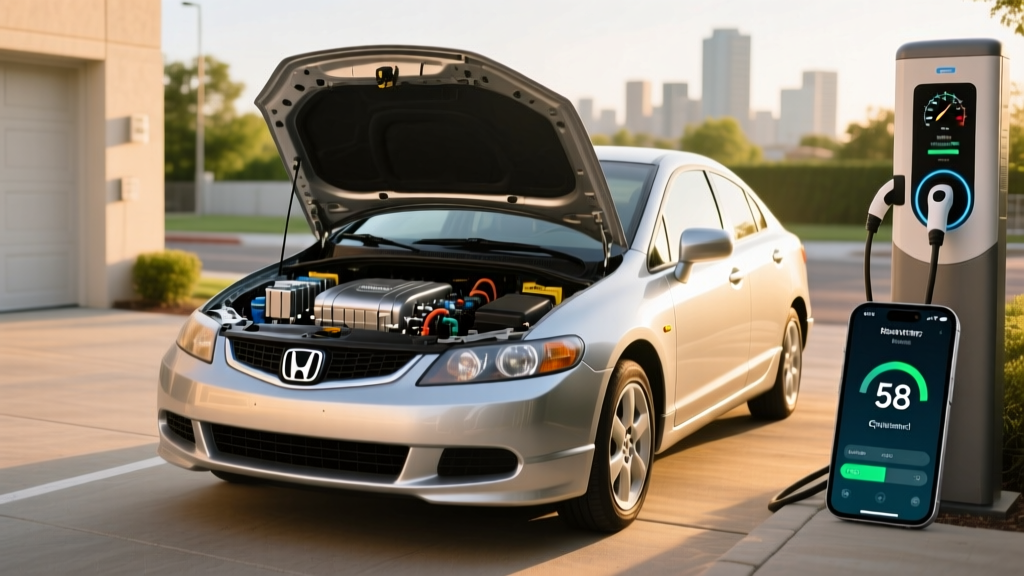
Long before plug-in hybrids and 300-mile EVs, the 2004 Honda Civic Hybrid was one of the first mass-market hybrid cars sold in the United States. Alongside the Toyota Prius, it introduced American drivers to gasoline-electric propulsion at an affordable price point. Honda's Integrated Motor Assist (IMA) system paired a 1.3-liter lean-burn engine with a thin electric motor sandwiched between the engine and transmission, delivering fuel economy that still holds up two decades later.
In 2026, this car occupies a specific niche: ultra-low-cost commuter transportation for buyers who want hybrid efficiency without the upfront price of a modern PHEV or BEV. Used examples regularly sell for $2,000–$5,000 depending on mileage and battery condition. But owning a 20-year-old hybrid comes with real trade-offs — particularly around the aging nickel-metal hydride (NiMH) traction battery. This guide breaks down the numbers you need before buying or continuing to drive one.
2004 Honda Civic Hybrid: Core Specifications
| Specification | 2004 Honda Civic Hybrid (CVT) |
|---|---|
| Powertrain | 1.3L i-DSI 4-cylinder + IMA electric motor |
| Combined Horsepower | 93 hp @ 5,700 rpm (engine + motor) |
| Engine Output | 85 hp @ 5,700 rpm |
| Electric Motor Output | 13 hp (10 kW) assist |
| Transmission | Continuously Variable Transmission (CVT) |
| Traction Battery | NiMH, ~0.3 kWh (nominal) |
| Battery Cells | 132 D-cell NiMH modules in series |
| EPA Fuel Economy (City) | 48 MPG |
| EPA Fuel Economy (Highway) | 47 MPG |
| EPA Fuel Economy (Combined) | 47 MPG |
| Fuel Tank | 13.2 gallons |
| Total Driving Range | ~620 miles (EPA combined) |
| 0–60 mph | ~11.5 seconds |
| Original MSRP (2004) | $19,950 |
| Used Price Range (2026) | $2,000–$5,000 |
Sources: EPA Fuel Economy Guide — 2004 Honda Civic Hybrid, Honda press archives.
Fuel Economy: EPA Sticker vs. Real-World MPG
The 2004 Civic Hybrid's EPA ratings were revised under the 2008 methodology update that brought all sticker numbers closer to real-world driving. Under the original pre-2008 testing, Honda advertised 49 city / 51 highway. The revised figures — which are what you'll see on fueleconomy.gov today — settle at 48 city / 47 highway / 47 combined MPG.
Real-World Fuel Economy Observations
Owner-reported data on Fuelly and hybrid forums paints a consistent picture:
- City driving (stop-and-go): 42–50 MPG. The IMA system recaptures energy under braking and provides electric assist on acceleration, which is where hybrids shine. Short trips with a warm engine yield the best numbers.
- Highway cruising (65–75 mph): 40–46 MPG. The lean-burn 1.3L engine is efficient, but the IMA motor provides minimal assist at steady speed. Aerodynamic drag and the CVT's high-rpm drone on inclines reduce efficiency.
- Cold weather (below 40°F): 35–42 MPG. The engine runs richer during warm-up, the NiMH battery is less efficient at low temperatures, and cabin heating draws additional load.
- Aggressive driving / mountain terrain: 33–40 MPG. The small battery depletes quickly under heavy load, and the gasoline engine carries the full burden.
Real-World MPG Summary: Expect 40–46 MPG combined in normal mixed driving with a healthy battery. That's slightly below the 47 MPG EPA sticker but still exceptional for a gasoline car — and competitive with many 2026 non-hybrid compacts.
Understanding the IMA Hybrid System (HEV, Not PHEV)
The 2004 Civic Hybrid is a conventional hybrid electric vehicle (HEV). It is not a plug-in hybrid (PHEV) and cannot be plugged in. This is a critical distinction that still confuses some used-car shoppers.
| Feature | 2004 Civic Hybrid (HEV) | Modern PHEV (e.g., 2026 Prius Prime) |
|---|---|---|
| Plug-in Charging | No — charges via engine and regenerative braking only | Yes — Level 1 (120V) or Level 2 (240V) |
| Electric-Only Range | ~1 mile at very low speed (motor assist only, no EV mode) | 35–45 miles on battery alone |
| Battery Capacity | ~0.3 kWh NiMH | 13.6 kWh lithium-ion |
| Total System HP | 93 hp | 220+ hp |
| Federal Tax Credit | Expired (was $2,100 in 2004–2007) | Up to $7,500 under §30D (subject to income/MSRP/sourcing rules) |
| Regenerative Braking | Yes — mild regen, no one-pedal driving | Yes — stronger regen, some offer one-pedal mode |
Honda's IMA system is a "mild hybrid" architecture. The electric motor cannot propel the car on its own under normal conditions — it assists the gasoline engine during acceleration, enables idle stop (engine shuts off at red lights), and captures energy during braking. The 144-volt NiMH battery pack stores recovered energy. This is fundamentally different from Toyota's Hybrid Synergy Drive (used in the Prius), which can drive short distances on electric power alone.
Battery Lifespan, Degradation, and Replacement Costs
The NiMH traction battery is the single biggest ownership question for any 2004 Civic Hybrid buyer. These packs were designed for a 10-year, 150,000-mile service life under warranty, but we are now well past that window.
Original Battery Warranty: 8 years / 80,000 miles (10 years / 150,000 miles in CARB states like California, New York, and Massachusetts). This warranty expired for all 2004 models by 2014 at the latest.
Current Status: Any 2004 Civic Hybrid on the road in 2026 is either running on its original (likely degraded) battery or has had a replacement installed at owner expense.
Signs of IMA Battery Degradation
- IMA warning light on dashboard: The most common indicator. Triggers when the battery management system detects voltage imbalance across the 132 NiMH cells.
- Reduced fuel economy: A degraded battery provides less assist, forcing the gasoline engine to work harder. Owners report drops from 45 MPG to 35–38 MPG.
- Frequent recalibrations: The IMA system periodically runs a full charge-discharge cycle to recalibrate the battery's state of charge. Frequent recalibrations (visible on the charge indicator) signal cell imbalance.
- Loss of idle stop: The system disables auto-stop when battery health drops below a threshold.
- 12V battery drain: A failing IMA battery can cause the DC-DC converter to overwork, leading to premature 12V auxiliary battery failure.
Battery Replacement Options and Costs (2026)
| Option | Cost Range | Warranty | Notes |
|---|---|---|---|
| New OEM Honda IMA Battery | $2,500–$3,500 (if still available) | Typically 1 year | Honda has discontinued some older IMA packs; availability is limited |
| Refurbished / Reconditioned Pack | $800–$1,500 | 6–12 months | Third-party shops replace weak cells; quality varies widely |
| Aftermarket New NiMH Pack | $1,200–$2,000 | 1–3 years | Companies like BumbleBee Batteries and Dorman offer compatible packs |
| Individual Cell Grid-Charging / Balancing | $150–$400 (DIY: ~$100 for a grid charger) | None | Can extend life of a mildly degraded pack; does not fix dead cells |
| Used Salvage Yard Pack | $200–$500 | None | High risk — unknown remaining life; a gamble |
Key insight: A grid charger (such as those sold by EvOffer or built DIY) can periodically balance the NiMH cells and extend battery life. Many Civic Hybrid owners in the hybrid forums swear by annual grid-charging as preventive maintenance. However, once individual cells have failed internally, no amount of balancing will restore full capacity — replacement is the only fix.
Is Battery Replacement Worth It?
This is the economic question that defines used hybrid ownership. A $1,500 aftermarket battery installed in a $3,000 car represents a 50% increase in total investment. Whether it's worth it depends on:
- Annual mileage: At 15,000 miles/year and 45 MPG, you burn ~333 gallons. At $3.50/gallon, that's $1,166/year in fuel. A comparable non-hybrid getting 30 MPG would cost $1,750/year — a $584 annual savings. The battery replacement pays for itself in roughly 2.5–3 years.
- How long you plan to keep the car: If you'll drive it 3+ more years, replacement makes financial sense. If you're planning to upgrade within a year, selling the car as-is (with a disclosed IMA issue) may be more practical.
- Overall vehicle condition: The Civic is known for durable engines and transmissions. If the rest of the car is solid — no rust, good CVT, clean interior — investing in a new battery extends a reliable commuter.
Reliability and Known Issues Beyond the Battery
The 2004 Civic Hybrid's gasoline engine and CVT are generally robust, but a few known issues deserve attention:
- CVT shudder/judder: Some owners report vibration during low-speed acceleration. Honda issued a software update for the CVT control module; check whether it was applied. In rare cases, CVT replacement is needed ($2,000–$3,500).
- Motor mount wear: The additional torque from the IMA motor puts stress on engine mounts. Clunking or excessive vibration at idle can indicate worn mounts ($200–$400 to replace).
- Idle stop system issues: The auto-stop feature relies on the IMA battery, the brake light switch, and various sensors. A faulty brake light switch (a $15 part) can disable idle stop.
- Catalytic converter theft: Like many older vehicles, the Civic Hybrid's catalytic converter contains precious metals and is a theft target. Replacement cost: $800–$1,500.
- Rust: Check the rear wheel arches, rocker panels, and undercarriage — especially in salt-belt states. Structural rust is a safety and inspection concern.
Overall, NHTSA records show relatively few complaints for the 2004 Civic Hybrid compared to other vehicles of its era, with most complaints centered on the IMA battery system.
Tax Credits and Incentives: What Applies in 2026?
The 2004 Honda Civic Hybrid originally qualified for a federal tax credit of up to $2,100 under the Energy Policy Act of 2005 (for purchases made in 2006–2007; the credit phased out after Honda hit 60,000 cumulative hybrid sales). That credit is long expired and has no bearing on used purchases today.
Under current IRS §30D rules, the federal clean vehicle credit of up to $7,500 applies only to new qualifying plug-in electric vehicles (BEVs and PHEVs) that meet battery sourcing, critical mineral, MSRP cap ($55,000 for sedans, $80,000 for SUVs/trucks), and buyer income limits. The 2004 Civic Hybrid does not qualify — it is a conventional HEV, not a plug-in vehicle.
The used clean vehicle credit (§25E) offers up to $4,000 (30% of sale price, capped at $4,000) for used BEVs and PHEVs purchased from a dealer for $25,000 or less. Again, conventional hybrids like this Civic are excluded. No federal tax credit or incentive applies to purchasing a used 2004 Civic Hybrid in 2026.
Federal Incentive Eligibility — 2004 Civic Hybrid:
- ❌ New Clean Vehicle Credit (§30D): Not eligible — not a plug-in vehicle
- ❌ Used Clean Vehicle Credit (§25E): Not eligible — not a plug-in vehicle
- ❌ Original Hybrid Tax Credit: Expired (ended 2007–2008)
- ⚠️ State incentives: Some states offer used-car rebates or emissions-reduction programs — check your state's environmental agency
Who Should Consider the 2004 Civic Hybrid in 2026?
Pros
- 40–47 MPG real-world — still competitive with new non-hybrid compacts
- Ultra-low purchase price ($2,000–$5,000)
- Proven Honda reliability for engine and chassis components
- No plug-in charging required — works with any gas station
- Low insurance costs due to low vehicle value
- Lightweight and easy to park in urban environments
Cons
- IMA battery is 20+ years old — replacement likely needed or already done
- No electric-only driving capability (not a PHEV)
- Slow acceleration (11.5 sec 0–60) — merging onto highways requires planning
- No modern safety features (no ESC standard, no backup camera, basic airbags)
- Minimal infotainment — no Bluetooth, no USB, no smartphone integration
- No federal tax credit or incentive available
- Parts availability declining for IMA-specific components
Choose the 2004 Civic Hybrid if: You need the cheapest possible high-MPG commuter, you're comfortable with basic transportation, you can verify the IMA battery health (or budget for replacement), and you drive primarily in city/suburban conditions where hybrid efficiency shines.
Choose a modern PHEV (e.g., 2026 Prius Prime, 2026 RAV4 Prime) if: You have home charging access and want 35–45 miles of electric-only commuting, modern safety tech (AEB, lane-keep, blind-spot monitoring), available tax credits, and a full warranty.
Choose a full BEV (e.g., 2026 Chevy Equinox EV, Tesla Model 3) if: You have reliable home Level 2 charging, want zero tailpipe emissions, minimal maintenance, and your daily driving stays within 250+ miles of range.
Choose a conventional gas car if: You drive mostly highway miles (where hybrid advantages shrink), you want a simple powertrain with no high-voltage battery concerns, and you're buying in the $3,000–$5,000 used range but prefer something newer.
Hybrid vs. PHEV vs. EV: Which Fits Your Situation?
The 2004 Civic Hybrid represents one end of the electrification spectrum — a small-battery, no-plug, engine-dominant design. Here's how it compares to the broader landscape in 2026:
| Factor | Conventional HEV (like this Civic) | PHEV (e.g., Prius Prime) | Full BEV (e.g., Model 3) |
|---|---|---|---|
| Upfront Cost (Used/New) | $2,000–$5,000 (used) | $32,000–$42,000 (new, before credit) | $35,000–$55,000 (new, before credit) |
| Fuel/Energy Cost per Mile | ~$0.08/mi (gas at $3.50, 45 MPG) | ~$0.04/mi electric, $0.08/mi gas | ~$0.04/mi (home charging at $0.14/kWh) |
| Home Charging Needed? | No | Recommended but not required | Essential (Level 2 strongly recommended) |
| Electric-Only Range | None (assist only) | 35–50 miles | 250–350 miles total |
| Maintenance | Standard ICE + hybrid battery risk | Standard ICE + larger battery warranty | Minimal — no oil, no spark plugs, brake regen extends pad life |
| Tax Credit Potential | None | Up to $7,500 (§30D, if eligible) | Up to $7,500 (§30D, if eligible) |
| Best For | Budget commuters, no charging access | Short electric commutes + road trip flexibility | Daily drivers with home charging, lowest operating cost |
Frequently Asked Questions
How many MPG does the 2004 Honda Civic Hybrid get?
The EPA rates it at 48 city / 47 highway / 47 combined MPG (revised methodology). In real-world mixed driving with a healthy IMA battery, expect 40–46 MPG combined. City driving tends to yield higher numbers due to regenerative braking and idle stop, while sustained highway speeds above 70 mph and cold weather reduce efficiency.
Is the 2004 Civic Hybrid a plug-in hybrid?
No. It is a conventional hybrid (HEV). You never plug it in. The small NiMH battery charges solely through the gasoline engine and regenerative braking. It cannot drive on electric power alone except for brief, low-speed coasting moments.
How much does it cost to replace the IMA battery?
Aftermarket replacement NiMH packs run $1,200–$2,000 including basic installation. Refurbished packs cost $800–$1,500. OEM Honda packs, if still obtainable, can exceed $2,500. A DIY grid charger ($100–$150) can help maintain a mildly degraded pack but won't fix dead cells.
How long do IMA batteries typically last?
The original Honda warranty covered the battery for 8 years / 80,000 miles (10 years / 150,000 miles in CARB states). In practice, many original packs lasted 120,000–180,000 miles before significant degradation. A quality aftermarket replacement should deliver 80,000–120,000 miles with proper care — avoiding frequent deep discharges and extreme heat exposure.
Does the 2004 Civic Hybrid qualify for any tax credit in 2026?
No. The original federal hybrid tax credit (up to $2,100) expired after 2007. Current federal incentives under §30D (new clean vehicles) and §25E (used clean vehicles) apply only to plug-in electric vehicles (BEVs and PHEVs), not conventional hybrids. No federal tax benefit exists for purchasing this car in 2026.
Is the CVT transmission reliable?
The CVT in the 2004 Civic Hybrid is generally durable with regular fluid changes (Honda HMMF fluid, every 30,000–60,000 miles). Some owners report a low-speed shudder that may be addressed by a PCM software update or a drain-and-fill fluid change. Complete CVT failures are uncommon but can cost $2,000–$3,500 to replace.
Can I still get parts and service for the 2004 Civic Hybrid?
Mechanical parts for the Civic platform (brakes, suspension, engine components) remain widely available. IMA-specific parts — the battery pack, the IMA motor, the IMA inverter — are becoming scarier through Honda dealerships. Independent hybrid specialists and online communities (CivicHybridForum, CleanMPG) are valuable resources for sourcing parts and DIY guidance.
Should I buy a 2004 Civic Hybrid or a newer used hybrid?
If your budget is strictly under $5,000, the 2004 Civic Hybrid offers outstanding MPG for the price — provided you budget $1,000–$2,000 for a potential battery replacement. If you can stretch to $8,000–$12,000, a 2010–2015 Toyota Prius or Honda Insight offers more modern safety features, better parts availability, and a newer battery with more remaining life. Above $15,000, consider a 2017+ Prius or a used PHEV like the Chevrolet Volt.
Note: This article reflects data and market conditions as of 2026. Used vehicle prices, parts availability, and tax credit rules are subject to change. Always verify battery health with an OBD-II scan tool capable of reading IMA-specific data (such as an OBDLink CX with the Hybrid Assistant app) before purchasing any used hybrid.