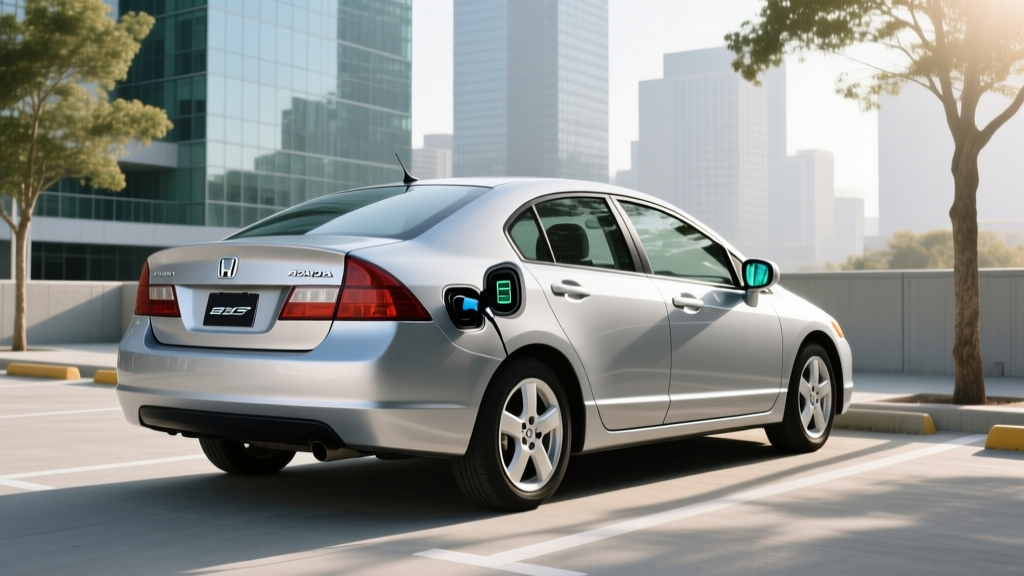
The 2004 Honda Civic Hybrid was one of the first mainstream gasoline-electric hybrids sold in the United States, arriving in a market where the Toyota Prius was still finding its footing. Over two decades later, buyers and enthusiasts still search for the 04 Civic Hybrid — whether as a budget commuter, a used-car reliability case study, or a benchmark for how far hybrid technology has come. This guide breaks down the real-world fuel economy, the Integrated Motor Assist (IMA) battery system, long-term reliability data, and whether this early hybrid still makes sense as a daily driver in 2026.
2004 Honda Civic Hybrid: Core Specifications
| Specification | 2004 Honda Civic Hybrid (Manual) | 2004 Honda Civic Hybrid (CVT) |
|---|---|---|
| Powertrain Type | Conventional Hybrid (HEV) | Conventional Hybrid (HEV) |
| Gas Engine | 1.3L inline-4 (i-DSI VTEC) | 1.3L inline-4 (i-DSI VTEC) |
| Engine HP | 85 hp @ 5,700 rpm | 85 hp @ 5,700 rpm |
| Electric Motor | IMA (Integrated Motor Assist), 13 hp | IMA (Integrated Motor Assist), 13 hp |
| Combined System HP | ~93 hp | ~93 hp |
| IMA Battery | NiMH, ~0.35 kWh (nominal) | NiMH, ~0.35 kWh (nominal) |
| Transmission | 5-speed manual | Continuously Variable (CVT) |
| 0-60 mph | ~11.0 seconds | ~12.5 seconds |
| Curb Weight | ~2,579 lbs | ~2,601 lbs |
| Original MSRP | ~$19,900 | ~$19,900 |
| 2026 Used Price Range | $1,500 – $4,500 (depending on condition/mileage) | |
EPA Fuel Economy vs. Real-World MPG
The 2004 Civic Hybrid's fuel economy ratings have an important caveat: Honda originally advertised aggressive MPG figures, but the EPA revised its testing methodology in 2008, retroactively lowering many hybrid ratings from that era. Below are the official EPA figures as currently listed on fueleconomy.gov.
| Transmission | City MPG | Highway MPG | Combined MPG |
|---|---|---|---|
| 5-Speed Manual | 47 | 48 | 47 |
| CVT Automatic | 48 | 47 | 47 |
Real-world expectations: Owners consistently report 38–44 MPG combined in mixed driving. The manual transmission version tends to hit the high end of that range when driven with light throttle and moderate speeds. Highway cruising at 75+ mph drops efficiency to roughly 35–38 MPG due to the car's aerodynamics and the IMA system's limited assistance at sustained high speeds. In city stop-and-go traffic — where regenerative braking and electric motor assist shine — some drivers see 45+ MPG.
Cold weather (below 35°F) reduces fuel economy by roughly 5–8 MPG due to longer warm-up cycles, thicker fluids, and reduced battery efficiency in the NiMH pack. This is consistent with all hybrids from this era.
Understanding the IMA Hybrid System: HEV, Not PHEV
Critical distinction: The 2004 Honda Civic Hybrid is a conventional hybrid (HEV), not a plug-in hybrid (PHEV). It does not plug in. It cannot drive on electric power alone. The IMA system is a mild hybrid architecture — the electric motor assists the gasoline engine but cannot propel the car independently.
- HEV (this car): Charges its small battery through regenerative braking and the gas engine. No plug. No electric-only range.
- PHEV (e.g., modern Toyota RAV4 Prime): Has a larger battery (typically 15–20 kWh), plugs into a wall outlet, and can drive 25–45 miles on electricity alone before the gas engine starts.
- BEV (e.g., Tesla Model 3): Fully electric. No gas engine. 250–400 miles of range. Requires plug-in charging.
The Civic Hybrid's IMA system works as follows: a thin electric motor sandwiched between the engine and transmission provides up to 13 hp of assist during acceleration. During deceleration and braking, the motor acts as a generator, recovering kinetic energy into the nickel-metal hydride (NiMH) battery pack located behind the rear seat. At idle, the engine shuts off (auto-stop) to save fuel, then restarts seamlessly when you release the brake.
This is a fundamentally different approach from Toyota's Hybrid Synergy Drive (used in the Prius), which can move the car at low speeds on electric power alone. Honda's IMA prioritizes simplicity and low weight over electric-only capability.
IMA Battery Lifespan, Degradation, and Replacement Cost
Original warranty: Honda warranted the IMA battery for 8 years / 80,000 miles (10 years / 150,000 miles in California and states adopting CARB emissions standards). By 2026, all factory warranty coverage has expired for every 2004 Civic Hybrid on the road.
Expected lifespan: Real-world data from owner forums and repair shops shows IMA batteries lasting between 100,000 and 160,000 miles before significant degradation triggers a check-engine light or reduced assist. Some units have exceeded 200,000 miles; others failed before 80,000. Climate matters — hot climates (Arizona, Texas) accelerate NiMH degradation.
Replacement cost (2026):
- Remanufactured IMA battery (aftermarket): $800 – $1,400 installed
- New OEM Honda IMA battery: $2,000 – $3,200 (limited availability; Honda has discontinued some part numbers)
- DIY grid charger / battery rebalancing: $100 – $300 (temporary fix that can extend life by 1–3 years)
A common failure mode for the 04 Civic Hybrid's IMA battery is cell imbalance — individual NiMH cells within the pack degrade at different rates, causing the battery management system to flag the pack as faulty. Some owners use aftermarket "grid chargers" to periodically rebalance cells, which can delay replacement. However, this is a maintenance workaround, not a permanent fix.
If you're buying a used 2004 Civic Hybrid in 2026, ask whether the IMA battery has been replaced. A car with a new or remanufactured battery is significantly more valuable than one running on the original 22-year-old pack.
Reliability and Common Issues Beyond the Battery
The 7th-generation Civic platform (2001–2005) is generally regarded as reliable, though it has known trouble spots:
- CVT transmission (automatic models): Early Honda CVTs from this era have a higher failure rate than the 5-speed manual. Shuddering during acceleration, delayed engagement, and eventual belt wear are documented issues. Honda issued extended warranties on some CVT units. The manual transmission is far more durable.
- Auto-stop system failures: The idle-stop feature depends on the IMA battery state of charge. A degraded battery disables auto-stop, reducing city fuel economy by 3–5 MPG.
- 12V auxiliary battery: Like all cars, the 12V starter battery needs replacement every 4–6 years. In the Civic Hybrid, a weak 12V battery can also cause IMA system errors.
- Motor mount wear: The hybrid's additional electric motor torque and auto-stop cycling put extra stress on engine mounts. Clunking or vibration at idle may indicate worn mounts ($200–$400 to replace).
- Rust: In salt-belt states, subframe and rocker panel corrosion is the most common reason these cars are retired. Inspect underneath before purchasing.
Overall, the 2004 Civic Hybrid is a moderately reliable used car — more fragile than a conventional Civic of the same year (due to IMA and CVT complexity) but less problematic than many early-2000s European or American compacts. The manual-transmission version with a replaced IMA battery is the most robust configuration.
Does the 2004 Civic Hybrid Qualify for Any Tax Credits?
No. The 2004 Honda Civic Hybrid does not qualify for any current federal tax credit. Here's why:
- The IRS §30D Clean Vehicle Credit applies only to new plug-in electric vehicles (PHEVs and BEVs) with sufficient battery capacity. Conventional hybrids (HEVs) have never qualified for §30D.
- The original $650–$1,700 federal tax credit available for the Civic Hybrid when it was new (under pre-2006 energy legislation) expired long ago.
- The Used Clean Vehicle Credit (up to $4,000 or 30% of sale price under §25E) requires the vehicle to be a plug-in EV or fuel cell vehicle. HEVs are excluded.
- Some states previously offered hybrid purchase rebates, but nearly all have been discontinued or redirected to plug-in vehicles.
If you're shopping for a hybrid with tax-credit eligibility, you'll need to look at new or used plug-in hybrids (PHEVs) or battery-electric vehicles (BEVs).
Who Should Buy the 2004 Civic Hybrid in 2026?
Reasons to Buy
- Extremely low purchase price ($1,500–$4,500)
- 38–44 real-world MPG saves $600–$900/year vs. a 25-MPG compact
- Simple mechanicals — any independent shop can service it
- Lightweight (2,600 lbs) means low tire and brake wear
- Manual transmission option for enthusiasts
- No charging infrastructure needed
Reasons to Skip
- IMA battery replacement likely needed ($800–$3,200)
- CVT reliability concerns (automatic models)
- No electric-only driving capability
- Minimal safety features (no ESC, side airbags were optional)
- Aged interior, limited cargo space (battery eats trunk room)
- No tax credits or incentives available
Best for: Budget-conscious commuters driving 15,000+ miles/year in urban or suburban environments who want maximum fuel economy without plug-in infrastructure. The manual-transmission Civic Hybrid is the enthusiast's pick — engaging to drive and mechanically simpler than the CVT.
Better alternatives in 2026: If your budget allows $12,000–$20,000, a 2016–2020 Toyota Prius delivers 52+ MPG with a more reliable hybrid system, modern safety features, and better parts availability. If you have home charging access, a used PHEV like the Chevrolet Volt (35–53 miles electric range) or a new Toyota Prius Prime (44 miles EV range, $33,445 MSRP) offers electric commuting with gas backup.
Frequently Asked Questions
How many MPG does the 2004 Honda Civic Hybrid get?
The EPA rates the 04 Civic Hybrid at 47 MPG combined (47 city / 48 highway for the CVT; 48 city / 47 highway for the manual). Real-world owners report 38–44 MPG combined depending on driving style, climate, and battery health. Highway driving at 75+ mph yields 35–38 MPG.
How far can it go on electric only?
Zero miles. The 2004 Civic Hybrid is a conventional HEV, not a plug-in hybrid. The IMA electric motor only assists the gas engine during acceleration — it cannot propel the car on its own. If you want electric-only driving, you need a PHEV or BEV.
Is the 2004 Civic Hybrid reliable?
Moderately reliable. The 1.3L engine and manual transmission are durable, but the IMA battery typically needs replacement between 100K–160K miles ($800–$3,200), and the CVT automatic transmission has documented failure rates. Rust and age-related wear are now the primary concerns for a 22-year-old vehicle.
What does an IMA battery replacement cost?
A remanufactured aftermarket IMA battery costs $800–$1,400 installed. A new OEM Honda battery runs $2,000–$3,200, though availability is declining. DIY grid charging and cell rebalancing can cost $100–$300 and extend battery life by 1–3 years as a stopgap.
Does the 2004 Civic Hybrid qualify for a tax credit?
No. Federal tax credits under IRS §30D and §25E apply only to plug-in electric vehicles (PHEVs and BEVs). Conventional hybrids like the Civic Hybrid are not eligible for any current federal or state purchase incentives.
Hybrid vs. PHEV vs. EV — which should I choose?
Choose a conventional hybrid (HEV) like the Civic Hybrid if you want maximum MPG with zero lifestyle change — no plugging in, no range anxiety, just fill up with gas. Choose a PHEV if you have home charging and want 25–45 miles of electric commuting with gas-engine backup for road trips. Choose a BEV if you want zero tailpipe emissions, the lowest per-mile fuel cost, and have reliable charging access. In 2026, a PHEV offers the best balance for most buyers with home charging.