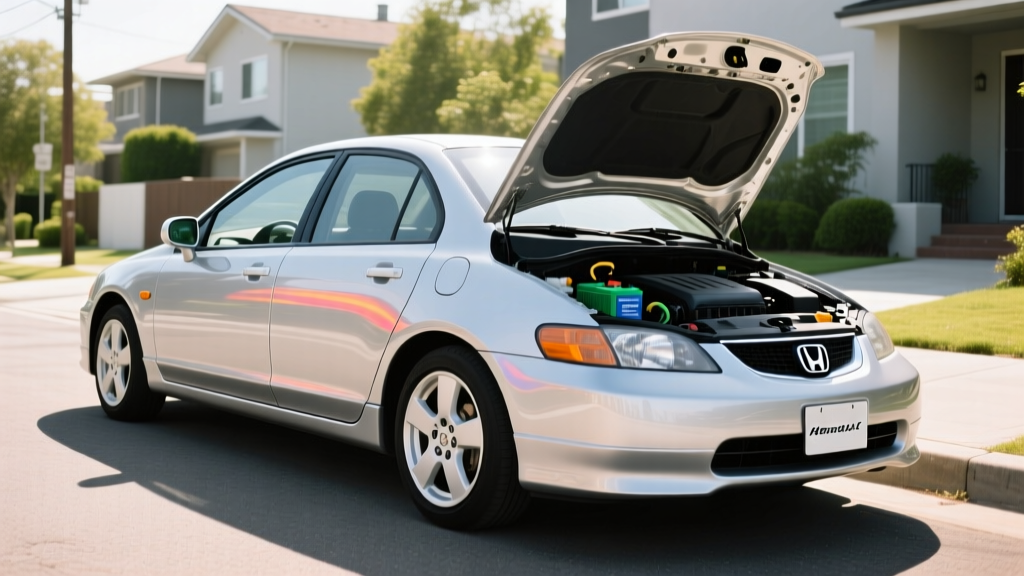
Before Toyota's Prius dominated American driveways and long before plug-in hybrids and 300-mile EVs hit the market, Honda quietly launched one of the first mass-market hybrid sedans in the United States: the 2003 Honda Civic Sedan Hybrid. Powered by Honda's Integrated Motor Assist (IMA) system, this compact sedan promised dramatically improved fuel economy without sacrificing the Civic's reputation for practicality. More than two decades later, it remains a fascinating case study in early hybrid engineering — and a benchmark for understanding how far electrified powertrains have come.
This guide examines the 2003 Civic Hybrid's specifications, real-world fuel economy, battery longevity, ownership costs, and where it fits in today's landscape of HEVs, PHEVs, and full EVs.
HEV vs PHEV: Understanding What the 2003 Civic Hybrid Actually Is
The 2003 Honda Civic Sedan Hybrid is a conventional hybrid electric vehicle (HEV). It is not a plug-in hybrid (PHEV), and it cannot be charged from an external power source. The car generates all its electrical energy through regenerative braking and the gasoline engine itself.
| Feature | HEV (2003 Civic Hybrid) | PHEV (e.g., 2026 Toyota Prius Prime) | BEV (e.g., 2026 Tesla Model 3) |
|---|---|---|---|
| Plug-in charging | No | Yes | Yes |
| Electric-only range | ~0 miles (motor assists only) | ~40-45 miles | 250-350+ miles |
| Battery size | ~0.3 kWh (NiMH) | ~13.6 kWh (Li-ion) | 60-82 kWh (Li-ion) |
| Gasoline engine | Yes (primary) | Yes (backup) | No |
| Federal tax credit (§30D) | No | Up to $7,500* | Up to $7,500* |
*§30D credit eligibility depends on MSRP caps, buyer income limits, and battery-sourcing requirements per current IRS rules. See IRS.gov for details.
Honda's IMA system pairs a small electric motor sandwiched between the engine and transmission to assist the gasoline engine during acceleration and to recapture energy during braking. The electric motor cannot propel the car on its own at meaningful speeds — a key distinction from modern PHEVs and full EVs.
Fuel Economy: EPA Ratings and Real-World MPG
The headline number that sold the 2003 Civic Hybrid was its fuel economy. Here are the official EPA estimates as listed on fueleconomy.gov:
| Configuration | City MPG | Highway MPG | Combined MPG |
|---|---|---|---|
| 2003 Civic Hybrid (5-speed manual) | 46 | 51 | 48 |
| 2003 Civic Hybrid (CVT automatic) | 47 | 48 | 47 |
| 2003 Civic LX (gas, manual, for comparison) | 29 | 38 | 33 |
Real-World MPG: What Owners Actually Report
The 2003 Civic Hybrid's EPA numbers were impressive for their era — and notably, the manual-transmission version posted a higher highway figure than city, which is characteristic of early IMA systems that provided less low-speed electric assist than modern hybrid setups.
In real-world ownership, most drivers reported combined fuel economy in the 38-44 MPG range, with some achieving the EPA sticker numbers under ideal conditions (flat terrain, moderate temperatures, gentle acceleration). Cold weather and aggressive driving could drop figures into the mid-30s. This is a common pattern with early hybrids: the EPA test cycles of that era sometimes overstated real-world efficiency, a methodology the EPA reformed in 2008.
Even at 40 MPG combined, the 2003 Civic Hybrid delivered roughly 21% better fuel economy than its gas-only Civic sibling — a meaningful savings at any fuel price.
Powertrain and Performance Specs
| Specification | 2003 Honda Civic Hybrid |
|---|---|
| Engine | 1.3L inline-4 (i-DSI lean-burn) |
| Engine horsepower | 85 hp @ 5,700 rpm |
| Electric motor | IMA permanent-magnet (10 kW / 13 hp) |
| Combined system output | ~93 hp |
| Combined torque | ~122 lb-ft (with IMA assist) |
| Transmission | 5-speed manual or CVT |
| 0-60 mph | ~11.5 seconds (estimated) |
| Drivetrain | Front-wheel drive |
| Curb weight | ~2,570 lbs |
| Fuel tank | 13.2 gallons |
| Total range (est.) | ~530-630 miles |
The 1.3L i-DSI (intelligent Dual Sequential Ignition) engine was an engineering curiosity: it used two spark plugs per cylinder and a lean-burn combustion strategy to maximize thermal efficiency. The IMA motor, while modest at 13 hp, filled in torque gaps during acceleration and enabled idle-stop — the engine would shut off at red lights and restart seamlessly when the driver released the brake. This idle-stop feature, novel in 2003, is now ubiquitous across nearly all hybrids and many conventional vehicles.
Battery Technology, Warranty, and Replacement Costs
| Battery Detail | Specification |
|---|---|
| Chemistry | Nickel-Metal Hydride (NiMH) |
| Capacity | ~0.3 kWh (nominal) |
| Voltage | ~144V pack |
| Original warranty | 8 years / 80,000 miles (10 yr / 150,000 mi in CARB states) |
| Replacement cost (remanufactured) | $1,500 - $2,500 |
| Replacement cost (new OEM) | $2,500 - $4,000 (if available) |
How Long Does the IMA Battery Last?
The NiMH battery pack in the 2003 Civic Hybrid was designed for longevity, and many original packs lasted 120,000-150,000 miles before significant capacity loss. However, by 2026, virtually every surviving 2003 Civic Hybrid has had at least one battery replacement or recalibration.
Common IMA battery failure symptoms include:
- IMA warning light on the dashboard
- Reduced fuel economy (loss of regen and assist)
- Idle-stop no longer engaging
- Reduced acceleration performance
Several aftermarket suppliers offer remanufactured NiMH packs for $1,500-$2,500 installed. Some owners have opted for "grid charger" maintenance — periodically balancing the NiMH cells with an external charger — to extend pack life, a practice well-documented in Honda hybrid owner communities.
Is the 2003 Civic Hybrid Reliable?
Mechanically, the 2003 Civic Hybrid inherits the Civic platform's strong reliability record. The 1.3L engine is under-stressed and long-lived. The CVT transmission in this generation is a conventional unit (not the problematic start-clutch design found in the first-generation Insight) and has proven durable with proper fluid changes.
The primary reliability concern is the IMA battery — an expected wear item on any 20+ year-old hybrid. Budget $1,500-$2,500 for a replacement pack if the original or previous replacement is near end-of-life.
Pricing, Tax Credits, and Ownership Economics
The 2003 Honda Civic Hybrid originally carried an MSRP of approximately $19,995 — roughly a $3,000-$4,000 premium over a comparably equipped gas Civic LX. That premium was partially offset by fuel savings and, at the time, a federal income tax deduction for clean-fuel vehicles (a predecessor to today's §30D credit).
Does the 2003 Civic Hybrid Qualify for Any Tax Credit Today?
No. The 2003 Civic Hybrid does not qualify for the current federal §30D New Clean Vehicle Credit. That credit applies only to new vehicles purchased new, and it has specific requirements around battery sourcing, MSRP caps, and buyer income limits. The used-EV credit (§25E) also does not apply because the vehicle must be at least two model years old and have a sale price under $25,000, but it also requires the vehicle to be a qualified plug-in EV or fuel cell vehicle — and the 2003 Civic Hybrid is a conventional HEV with no plug-in capability.
For current §30D and §25E rules, consult IRS.gov's clean vehicle credits page.
Used Market Pricing (2026)
As of 2026, a 2003 Civic Hybrid in running condition typically trades between $2,000 and $5,500 depending on mileage, condition, and whether the IMA battery has been recently replaced. Low-mileage, well-maintained examples command the upper end. At this price point, it's strictly a budget commuter or a collector curiosity.
Who Should Consider This Hybrid — And Who Shouldn't
Pros
- Excellent fuel economy for its era (38-48 MPG combined)
- Low purchase price on the used market
- Proven Civic reliability and parts availability
- No plug-in charging required — works like a normal car
- Historically significant as an early mass-market hybrid
Cons
- Modest performance (93 hp combined, ~11.5s 0-60)
- IMA battery replacement likely needed ($1,500-$2,500)
- No electric-only driving capability
- Outdated safety features (no ESC, limited airbags vs. modern cars)
- No tax credit eligibility
- Lean-burn engine can be sensitive to fuel quality
Choose This Hybrid If:
- You need a dirt-cheap, ultra-efficient commuter car and can verify the IMA battery's health
- You're a hybrid technology enthusiast interested in early IMA engineering
- You want maximum MPG without ever plugging in
Look at a Modern Alternative If:
- Safety is a priority — a 2026 Toyota Prius or Honda Accord Hybrid offers vastly superior crash protection and ADAS features
- You want warranty coverage and modern tech
- You're considering a PHEV for electric-only commuting (the 2003 Civic Hybrid offers zero EV range)
Hybrid vs PHEV vs EV: Which Fits You Today?
The 2003 Civic Hybrid represents the starting point of a spectrum that now extends to full battery-electric vehicles. Here's how to decide which powertrain type fits your needs in 2026:
| Factor | HEV (Conventional Hybrid) | PHEV (Plug-In Hybrid) | BEV (Full Electric) |
|---|---|---|---|
| Home charging needed? | No | Recommended (Level 2) | Essential |
| Typical efficiency | 45-57 MPG combined | 35-50 MPG + 25-50 mi EV | 100-140 MPGe |
| Fuel/energy cost per mile | ~$0.08-$0.10 | ~$0.04-$0.10 | ~$0.03-$0.06 |
| Best for | No charging access, long trips | Short EV commute + road trips | Home charging, daily driving |
| Federal credit available? | No | Up to $7,500 (§30D) | Up to $7,500 (§30D) |
Modern HEVs like the 2026 Toyota Prius (57 MPG combined EPA) have dramatically surpassed the 2003 Civic Hybrid's efficiency. PHEVs like the Prius Prime add 44 miles of electric-only range. And BEVs eliminate gasoline entirely. The 2003 Civic Hybrid proved the concept; today's vehicles have perfected it.
Legacy and Lessons for Modern Hybrid Buyers
The 2003 Honda Civic Sedan Hybrid's IMA system taught the industry several enduring lessons:
- Idle-stop works. Honda's early implementation proved that shutting off the engine at stops saves meaningful fuel and restarts seamlessly — now standard on virtually every hybrid and many conventional vehicles.
- Small batteries can make a big difference. A 0.3 kWh NiMH pack, paired with a lean-burn engine, delivered 40+ MPG. Modern hybrids use 1-2 kWh packs with far more sophisticated motor-generators.
- Battery longevity matters. Honda's 8-year/80,000-mile hybrid battery warranty set a standard that persists today (most 2026 hybrids still carry 8-10 year battery warranties).
- Parallel hybrid architectures scale. The IMA concept — a thin motor between engine and transmission — evolved into Honda's current two-motor i-MMD system used in the Accord Hybrid and CR-V Hybrid.
For buyers researching the 2003 Civic Hybrid as a used purchase, the key takeaway is simple: verify the IMA battery condition, budget for replacement if needed, and understand that you're buying a historically important but technologically dated vehicle. For anyone seeking maximum efficiency in 2026, modern hybrids, PHEVs, and EVs offer dramatically better performance, safety, and economy.
Frequently Asked Questions
How many MPG does the 2003 Honda Civic Hybrid get?
The EPA rated the 2003 Civic Hybrid at 46 city / 51 highway / 48 combined MPG (manual) and 47 city / 48 highway / 47 combined MPG (CVT). Real-world owners typically report 38-44 MPG combined depending on driving style and conditions.
Can the 2003 Civic Hybrid drive on electric power alone?
Effectively, no. The IMA system's 13 hp electric motor assists the gasoline engine but cannot propel the car independently at normal driving speeds. This is a key difference from modern PHEVs and EVs.
Is the 2003 Honda Civic Hybrid reliable?
The mechanical components (engine, transmission, chassis) are reliable and parts are widely available. The primary concern is the NiMH IMA battery pack, which is a wear item on any 20+ year-old vehicle. Budget $1,500-$2,500 for a remanufactured replacement if the battery has not been recently serviced.
What does it cost to replace the hybrid battery?
Remanufactured NiMH IMA battery packs for the 2003 Civic Hybrid typically cost $1,500-$2,500 installed. New OEM packs, if still available through Honda, may cost $2,500-$4,000. Third-party shops and hybrid specialists often offer the best pricing.
Does the 2003 Civic Hybrid qualify for a tax credit?
No. The federal §30D credit applies only to new qualifying plug-in vehicles. The §25E used-vehicle credit also does not apply to conventional (non-plug-in) hybrids. Check IRS.gov for current credit eligibility rules.
How does the 2003 Civic Hybrid compare to a modern hybrid?
A 2026 Toyota Prius achieves 57 MPG combined (vs. ~48 EPA for the 2003 Civic Hybrid), produces 196 hp (vs. ~93 hp), includes advanced safety systems (automatic emergency braking, lane-keeping), and comes with an 8-year/100,000-mile hybrid battery warranty. The efficiency gap has widened in favor of modern designs despite two decades of increasing vehicle weight and safety equipment.
Should I buy a 2003 Civic Hybrid or a modern used hybrid?
Unless you're on an extremely tight budget (under $5,000) or collecting early hybrid history, a 2015+ used Toyota Prius, Honda Accord Hybrid, or Hyundai Ioniq will offer better fuel economy, far superior safety features, remaining warranty coverage, and modern infotainment — typically for $8,000-$15,000.