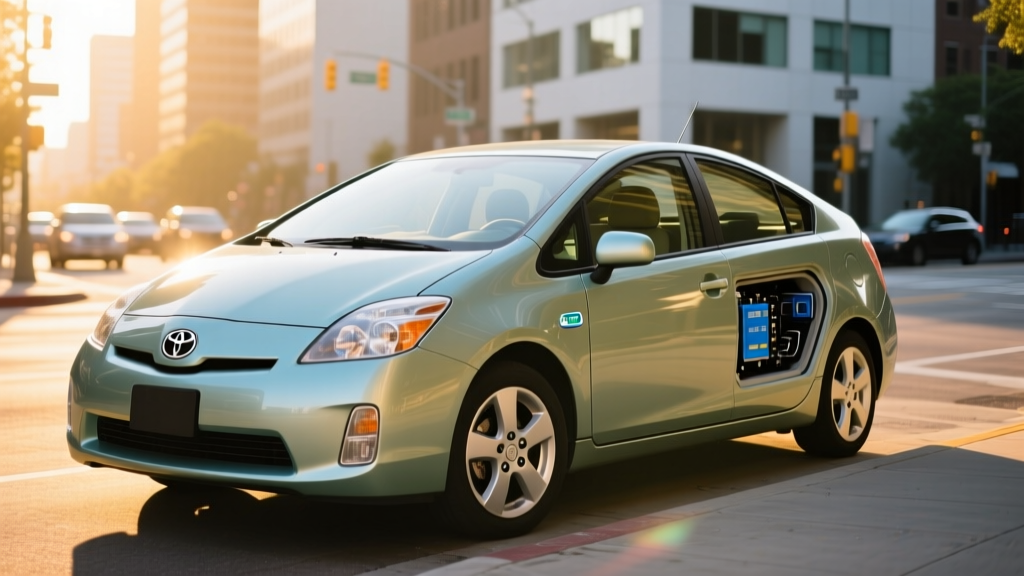
The phrase "2002 Toyota hybrid" points to exactly one vehicle: the first-generation Toyota Prius (model code NHW11), sold in the United States for the 2001–2003 model years. It was the car that introduced the hybrid powertrain to mainstream American buyers, pairing a 1.5-liter gasoline engine with an electric motor and a compact nickel-metal hydride (NiMH) battery pack. More than two decades later, enthusiasts, budget commuters, and EV-curious shoppers still search for this car — often as an ultra-cheap entry into hybrid ownership or as a curiosity piece in Toyota's electrification timeline.
This guide breaks down the 2002 Prius with the same data-driven rigor we apply to modern EVs and PHEVs: exact EPA MPG figures, real-world fuel economy, battery longevity, replacement costs, and a clear-eyed look at who this car still serves in 2026 — and who should look at a modern hybrid or plug-in hybrid instead.
HEV vs PHEV: Where the 2002 Prius Fits
Conventional Hybrid (HEV): The 2002 Toyota Prius is a conventional hybrid. It has no plug, no electric-only driving range to speak of, and a very small battery (~1.3 kWh total capacity, with only a fraction usable). The gasoline engine and regenerative braking keep the battery charged. You never plug it in.
Plug-in Hybrid (PHEV): Modern PHEVs like the 2026 Toyota Prius Prime offer 40+ miles of electric-only range, a charge port (Level 2 AC, and in some models DC fast charging), and larger battery packs (13–18 kWh). They qualify for federal tax credits under IRS §30D when battery-sourcing and income requirements are met.
Key distinction: The 2002 Prius is strictly an HEV. It cannot be plugged in, has no meaningful electric-only mode, and does not qualify for any current federal EV or PHEV tax credit.
Fuel Economy: EPA MPG and Real-World Numbers
The EPA rated the 2002 Toyota Prius at fuel economy figures that still impress for a 20-plus-year-old vehicle. According to fueleconomy.gov, the official ratings are:
| Metric | EPA Rating |
|---|---|
| City MPG | 52 |
| Highway MPG | 45 |
| Combined MPG | 48 |
Real-World MPG vs EPA Sticker
Hybrid owners frequently report that real-world city driving can meet or even slightly exceed the EPA city rating, because stop-and-go traffic maximizes regenerative braking and electric-motor assist. Highway driving, however, often falls short of the 45 MPG sticker — particularly at sustained speeds above 70 mph, where aerodynamic drag dominates and the small engine works harder.
Expect the following in actual driving:
- City (stop-and-go, under 45 mph): 48–54 MPG
- Highway (65–75 mph sustained): 38–43 MPG
- Mixed driving (realistic daily commute): 42–48 MPG
- Cold weather (below 35°F): Subtract 5–10% due to engine warm-up cycles and reduced battery efficiency
For context, a 2026 Toyota Prius LE hybrid achieves an EPA-rated 57 MPG combined — nearly 20% more efficient than the 2002 model, thanks to advances in engine thermal efficiency, lighter battery packs, and improved aerodynamics.
Powertrain Specs: Engine, Motor, and Battery
| Specification | 2002 Toyota Prius (NHW11) |
|---|---|
| Engine | 1.5L inline-4 (1NZ-FXE), Atkinson cycle |
| Engine horsepower | 70 hp @ 4,500 rpm |
| Electric motor output | 44 hp (33 kW) |
| Combined system output | ~100 hp |
| Transmission | Continuously Variable (eCVT / planetary gearset) |
| Battery chemistry | Nickel-Metal Hydride (NiMH) |
| Battery capacity (total) | ~1.3 kWh |
| Battery voltage | 273.6V nominal |
| Plug-in capable? | No (HEV only) |
| Electric-only range | Less than 1 mile at very low speed |
| 0–60 mph | ~13.0 seconds |
| Curb weight | ~2,765 lbs |
| Fuel tank | 11.9 gallons |
| Total driving range (est.) | ~530–570 miles |
The 2002 Prius uses Toyota's Hybrid Synergy Drive (HSD) system, which couples the gasoline engine and electric motor through a planetary gearset — effectively a power-split device that functions as a continuously variable transmission. This is the same fundamental architecture used in every Prius since, though modern versions are far more powerful and efficient.
The 1.3 kWh NiMH battery pack is tiny by today's standards (a 2026 Prius Prime PHEV carries a 13.6 kWh lithium-ion pack). Its job is to buffer energy from regenerative braking and provide short bursts of electric-motor assist — not to drive the car on electricity alone.
Battery Lifespan, Reliability, and Replacement Cost
Original warranty: Toyota covered the 2002 Prius hybrid battery for 8 years / 100,000 miles (10 years / 150,000 miles in CARB states). That warranty expired long ago for every surviving example.
Battery lifespan reality: The NiMH pack in the NHW11 Prius typically lasts 150,000–200,000 miles or 15–20 years under normal use. Many first-gen Prius vehicles have had at least one battery replacement by now. Heat is the primary enemy — cars in hot climates (Arizona, Texas) tend to see earlier degradation.
Replacement cost (2026):
- New OEM Toyota battery: ~$2,000–$2,500 (installed at a dealer)
- Refurbished/remanufactured pack: ~$800–$1,400 (installed at an independent hybrid shop)
- Individual module replacement: ~$300–$600 if only a few cells have failed (a common repair for this generation)
Reliability note: The 2002 Prius powertrain is generally robust, but at 20+ years old, expect age-related failures beyond the hybrid battery: the transaxle, 12V auxiliary battery, brake actuator, and combination meter (dashboard display) are known wear items. Parts availability is declining as the model ages out of Toyota's supply chain.
Pricing in 2026: What Does a 2002 Prius Cost?
The 2002 Toyota Prius has an original MSRP of approximately $19,995. In today's used market, prices vary dramatically based on condition and mileage:
- High-mileage driver (180,000+ miles, fair condition): $1,500–$3,000
- Average condition (120,000–160,000 miles): $3,000–$5,500
- Low-mileage survivor (under 80,000 miles, excellent): $5,500–$9,000+
Tax Credit Eligibility
The 2002 Toyota Prius does not qualify for any current federal tax credit. The IRS §30D new clean vehicle credit applies only to new PHEVs and BEVs meeting battery-sourcing, MSRP cap, and buyer income requirements. The used EV credit (§25E, up to $4,000) applies only to used BEVs and PHEVs — not conventional hybrids. No federal incentive exists for purchasing a used HEV.
Some states may offer inspection exemptions or HOV lane access for hybrids, but these programs have largely sunset for older vehicles. Check your state's DMV for any remaining benefits.
Pros and Cons: The 2002 Prius in 2026
Pros
- Excellent city fuel economy (48–54 MPG real-world)
- Very low purchase price ($2,000–$5,000 for most examples)
- Proven, simple hybrid system — well understood by independent shops
- Low annual fuel cost at ~45 MPG combined
- Historical significance as Toyota's US hybrid pioneer
Cons
- Slow acceleration (13-second 0–60 mph) — unsafe for some merging situations
- No modern safety features (no ESC standard, no airbags beyond front, no backup camera)
- Hybrid battery likely needs replacement if original
- Declining parts availability for a 24-year-old vehicle
- No plug-in capability, no electric-only range
- Cramped interior and limited cargo space vs modern Prius
- No federal or state tax incentives
2002 Prius vs Modern Hybrid vs PHEV vs Full EV
If you're researching the 2002 Toyota hybrid, you're likely weighing it against other electrified options. Here's a decision framework:
| Factor | 2002 Prius (HEV) | 2026 Prius LE (HEV) | 2026 Prius Prime (PHEV) | 2026 Tesla Model 3 (BEV) |
|---|---|---|---|---|
| Combined MPG / MPGe | 48 MPG | 57 MPG | 52 MPG + 127 MPGe | |
| Electric-only range | ~0 mi | ~0 mi | 44 mi | |
| Combined HP | ~100 hp | 196 hp | 220 hp | 271 hp |
| Purchase price | $2,000–$5,500 | ~$29,445 | ~$33,445 | ~$40,630 |
| Federal tax credit | None | None | Up to $7,500* | Up to $7,500* |
| Safety tech | Minimal | TSS 3.0 (AEB, LKA, ACC) | TSS 3.0 | Autopilot (L2), AEB |
| Battery warranty | Expired | 10 yr / 150,000 mi | 10 yr / 150,000 mi | 8 yr / 120,000 mi |
*Federal tax credit eligibility under IRS §30D depends on buyer income, vehicle MSRP caps, battery component sourcing, and point-of-sale transfer rules. Verify current-year rules at irs.gov.
Who Should Buy the 2002 Toyota Hybrid — and Who Shouldn't
Choose the 2002 Prius if:
- You need the absolute cheapest fuel-efficient car possible (under $4,000 entry)
- You drive primarily in the city at low speeds where hybrid efficiency shines
- You have access to a mechanic familiar with first-gen Prius hybrid systems
- You want a historically significant vehicle as a secondary commuter or project car
Look at a modern hybrid, PHEV, or EV instead if:
- You need modern safety features (automatic emergency braking, lane-keeping, backup camera)
- You drive significant highway miles (modern hybrids and EVs are far more efficient at speed)
- You want electric-only commuting (consider a PHEV like the Prius Prime or a full BEV)
- You want warranty coverage and reliable parts availability
- You qualify for the federal tax credit — a new PHEV or BEV may cost less per mile than restoring an aging 2002 hybrid
Frequently Asked Questions
How many MPG does the 2002 Toyota Prius get?
The EPA rates the 2002 Prius at 52 city / 45 highway / 48 combined MPG. Real-world mixed driving typically yields 42–48 MPG, with city driving sometimes reaching 50+ MPG thanks to regenerative braking. Highway driving at 70+ mph often drops to 38–43 MPG.
Can the 2002 Prius drive on electric power only?
Not meaningfully. The 2002 Prius is a conventional hybrid (HEV) with a ~1.3 kWh NiMH battery. It can creep at very low speeds on electric power for a fraction of a mile, but it has no plug and no usable electric-only range. For electric-only commuting, you need a PHEV (like the Prius Prime, with 44 miles of EV range) or a full BEV.
Is the 2002 Toyota hybrid reliable?
The powertrain is fundamentally robust — Toyota's hybrid system proved durable well beyond expectations. However, at 24 years old, age-related failures are the primary concern: the hybrid battery, transaxle, brake actuator, and combination meter are known wear items. Reliability in 2026 depends more on maintenance history and whether the battery has been replaced than on the original design.
What does a replacement hybrid battery cost for the 2002 Prius?
A new OEM battery from Toyota runs $2,000–$2,500 installed. Refurbished packs from independent hybrid specialists cost $800–$1,400 installed. Individual module replacement (repairing only the failed cells) can cost $300–$600. Given the car's low market value, a full OEM replacement often exceeds the vehicle's worth — making refurbished packs or module-level repair the economically rational choice.
Does the 2002 Toyota Prius qualify for any tax credit?
No. The federal §30D clean vehicle credit applies only to new qualifying PHEVs and BEVs. The §25E used clean vehicle credit applies to used BEVs and PHEVs priced under $25,000 — not to conventional hybrids. The 2002 Prius is an HEV and is ineligible for any federal purchase incentive. State-level incentives for hybrids have largely expired.
How does the 2002 Prius compare to the current-generation Prius?
The 2026 Prius LE delivers 57 MPG combined (vs 48), 196 hp (vs ~100), Toyota Safety Sense 3.0 with automatic emergency braking and lane-keeping, a modern infotainment system, and a 10-year/150,000-mile hybrid battery warranty. It starts at ~$29,445. The efficiency gap is roughly 20%, but the safety, performance, and technology gap is enormous.
Is buying a 2002 Prius a good idea in 2026?
As an ultra-budget commuter car in good condition with a recently replaced battery, it can still deliver excellent fuel economy at a rock-bottom price. But the lack of modern safety features, declining parts availability, and age-related reliability concerns make it a risky daily driver. Most buyers will be better served by a 2010+ Prius (third generation, ~$6,000–$10,000) that offers better safety, a more refined hybrid system, and stronger parts support — or a new 2026 Prius if budget allows.