If you've been searching for a 2002 Toyota Camry Hybrid, here's the short answer: it doesn't exist and never did. Toyota did not offer a hybrid Camry in 2002 — or anywhere close to that model year. The Camry Hybrid didn't arrive until the 2007 model year, and it has evolved dramatically since. If you're seeing a listing for a "2002 Camry Hybrid," it's either a mislabeled conventional gas Camry or a scam.
That said, the search tells us you're interested in Toyota's hybrid reliability and fuel economy. So let's set the record straight on Toyota's hybrid timeline, then give you a deep-dive on the 2026 Toyota Camry Hybrid — the current-generation model that actually delivers on the promise a 2002 buyer might have imagined: 50+ MPG, proven reliability, and a battery warranty that outlasts most ownership cycles.
Why There Was No 2002 Toyota Camry Hybrid
Toyota launched the world's first mass-produced hybrid, the Prius, in Japan in 1997 and in the U.S. for the 2001 model year. That first-generation Prius (XW10) produced just 70 combined horsepower and achieved roughly 41 MPG combined — groundbreaking at the time, but it was a compact liftback, not a midsize sedan.
In 2002, Toyota's U.S. hybrid lineup consisted of exactly one vehicle: the Prius. The Camry was in its fifth generation (XV30) and was offered exclusively with 2.4L four-cylinder (157 hp) or 3.0L V6 (192 hp) gasoline engines. Toyota's Hybrid Synergy Drive technology wasn't yet adapted for a larger, more powerful sedan platform.
The first Camry Hybrid debuted for the 2007 model year as a 2007 model, pairing a 2.4L Atkinson-cycle four-cylinder with an electric motor for 192 combined horsepower and an EPA-rated 34 MPG combined — a number that seems modest today but was exceptional for a midsize sedan in 2006-2007.
2026 Toyota Camry Hybrid: Current-Gen Specs at a Glance
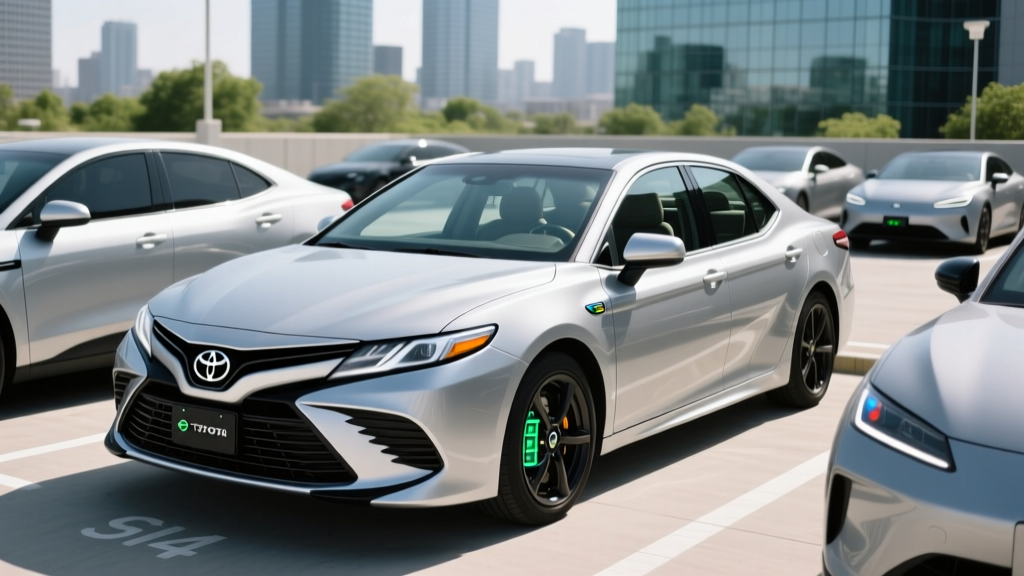
The current (ninth-generation, XV80) Camry was redesigned for the 2025 model year and continues into 2026 with Toyota's fifth-generation hybrid system. For 2025-2026, every Camry is a hybrid — Toyota dropped the gas-only powertrain entirely, a significant shift that signals where the midsize sedan market is heading.
| Spec | FWD Models | AWD Models |
|---|---|---|
| Powertrain | 2.5L 4-cyl + 2 electric motors | 2.5L 4-cyl + 3 electric motors (rear e-motor) |
| Combined Horsepower | 225 hp | 232 hp |
| EPA City MPG | 53 | 51 |
| EPA Highway MPG | 50 | 49 |
| EPA Combined MPG | 51 | 50 |
| 0–60 mph | ~7.1 sec | ~6.9 sec |
| Hybrid Battery | Lithium-ion, ~1.6 kWh (self-charging HEV) | |
| Drivetrain | Front-wheel drive | Electronic AWD |
| Starting MSRP (LE trim) | ~$29,495 (destination included) | |
Source: fueleconomy.gov and Toyota Motor North America. Verify trim-level pricing with your dealer, as MSRP can shift mid-model-year.
HEV vs. PHEV: What the Camry Hybrid Actually Is
This is where buyer confusion creeps in, so let's be precise:
Conventional Hybrid (HEV) — The Camry Hybrid is an HEV. It uses a small battery (roughly 1.6 kWh) that charges through regenerative braking and the gasoline engine. You never plug it in. The electric motor assists the engine during acceleration and enables brief low-speed electric-only driving (typically under 1 mile at very low speeds). The result is dramatically improved fuel economy without any change to your fueling routine.
Plug-In Hybrid (PHEV) — A PHEV has a much larger battery (typically 10–20 kWh) that you do plug in, giving 25–45 miles of electric-only range before the gas engine engages. Toyota's PHEV offering is the RAV4 Prime (42 miles electric-only, 94 MPGe). The Prius Prime offers up to 44 miles of electric-only range. Toyota does not currently offer a Camry PHEV in the U.S.
Battery Electric Vehicle (BEV) — A full EV like the Tesla Model 3 or Hyundai Ioniq 6 has no gasoline engine at all. It runs entirely on a large battery pack (60–100+ kWh) and must be charged from an external source.
Bottom line: The 2026 Camry Hybrid is a self-charging HEV. No plug, no charging cable, no range anxiety. You fill it with gas and drive — it just uses far less of it.
Real-World MPG: What Owners Actually See
Toyota's EPA ratings of 51/50/51 (city/highway/combined for FWD) are among the most achievable in the industry, and many owners report exceeding them in city driving. Here's why:
City driving favors hybrids. The Camry's hybrid system shuts off the engine at stops, recovers energy during braking, and uses the electric motor for low-speed acceleration — the exact conditions where conventional gas cars waste the most fuel. In stop-and-go urban traffic, 53–57 MPG is commonly reported by owners on forums like CleanMPG and Toyota Nation.
Highway driving is closer to the sticker. At sustained 70–80 mph speeds, the electric motor contributes less and the 2.5L engine does most of the work. Expect 46–50 MPG on the highway, roughly matching the EPA estimate.
Cold weather penalty is modest. Unlike full EVs, which can lose 20–30% of range in freezing temperatures, the Camry Hybrid's fuel economy drops roughly 5–10% in winter. The engine runs more frequently to provide cabin heat, reducing electric-assist time. Expect 45–48 MPG combined in sub-30°F conditions.
Hybrid Battery Warranty & Replacement Cost
Toyota covers the Camry Hybrid's battery with a 10-year/150,000-mile warranty (in all 50 states, for 2020 and newer models — previously 10 years/150,000 miles applied only in CARB states). This is one of the longest hybrid battery warranties in the industry.
Real-world longevity data is excellent. Taxi fleets and high-mileage owners routinely report original hybrid batteries lasting 200,000–300,000 miles with minimal degradation. The lithium-ion pack in the current-gen Camry is smaller and less stressed than the large packs in full EVs, contributing to its longevity.
Out-of-warranty replacement cost: A new OEM hybrid battery for the Camry runs approximately $2,500–$4,000 installed at a Toyota dealer. Refurbished/reconditioned packs are available for $1,500–$2,500 from third-party specialists. For context, this is far less than an EV traction battery replacement ($10,000–$20,000+).
Does the Camry Hybrid Qualify for a Federal Tax Credit?
No. Under current IRS §30D Clean Vehicle Credit rules, conventional hybrids (HEVs) do not qualify for the federal tax credit. The credit applies only to plug-in electric vehicles — BEVs and PHEVs with a minimum battery capacity of 7 kWh that meet sourcing, MSRP, and buyer-income requirements.
Since the Camry Hybrid is a self-charging HEV with no plug and a ~1.6 kWh battery, it is ineligible for:
- The $7,500 new clean vehicle credit (§30D)
- The $4,000 used clean vehicle credit (§25E)
- The commercial clean vehicle credit (§45W)
If federal incentives are a priority, you'd need to look at a PHEV like the Toyota RAV4 Prime (which may qualify depending on battery sourcing and your income) or a full BEV like the Tesla Model 3 or Hyundai Ioniq 5.
State incentives: Some states offer their own rebates for hybrids, though these are increasingly rare as programs shift toward plug-in vehicles. Check your state's energy office or DMV website for current programs. A few states offer reduced registration fees or HOV lane access for hybrids — verify locally, as rules vary by jurisdiction.
Camry Hybrid vs. Full EV vs. Gas: Which Is Right for You?
Choose the Camry Hybrid (HEV) If:
- You want 50+ MPG without changing your fueling habits
- You lack access to home or workplace charging
- You take frequent long road trips and don't want to plan around charging stops
- You want a lower purchase price ($29,495 vs. $40,000+ for most EVs)
- You live in an area with limited public charging infrastructure
- You plan to keep the car 10+ years and value Toyota's reliability track record
Choose a Full EV (BEV) If:
- You can install a Level 2 home charger (240V)
- Your daily commute is under 250 miles round-trip
- You want to eliminate gasoline costs entirely
- You qualify for the $7,500 federal tax credit (income and sourcing rules apply)
- You want lower maintenance costs (no oil changes, fewer moving parts)
- You value instant torque and one-pedal driving
The Camry Hybrid occupies a pragmatic middle ground. It delivers hybrid fuel savings without requiring any infrastructure investment or behavioral change. For apartment dwellers, street parkers, and frequent road-trippers, it's often the most realistic path to cutting fuel costs.
What About a Used Camry Hybrid?
If you were searching for a "2002 Camry Hybrid" because you want a cheap, reliable used hybrid, here's what actually exists on the used market:
- 2007–2011 Camry Hybrid (2nd gen): 34 MPG combined, 192 hp. Nickel-metal hydride (NiMH) battery. High-mileage examples available for $5,000–$9,000. Watch for battery degradation on high-mileage units — replacement runs $2,000–$3,500.
- 2012–2014 Camry Hybrid (3rd gen): 40 MPG combined, 200 hp. Still NiMH. Better fuel economy, more refined system. $8,000–$13,000 used.
- 2015–2024 Camry Hybrid (prior gen): 44–52 MPG combined depending on year and trim. Transitioned to lithium-ion battery in later years. Widely available certified pre-owned with remaining hybrid battery warranty.
- 2025–2026 Camry Hybrid (current gen): 51 MPG combined, 225–232 hp, lithium-ion, all-new platform.
The oldest Camry Hybrid you can buy is a 2007 model — five years later than the 2002 you may have been looking for.
Frequently Asked Questions
Did Toyota ever make a 2002 Camry Hybrid?
No. The first Camry Hybrid was introduced for the 2007 model year. In 2002, Toyota's only U.S. hybrid was the first-generation Prius. Any listing advertising a "2002 Camry Hybrid" is incorrect or fraudulent.
How many MPG does the 2026 Toyota Camry Hybrid get?
The EPA rates the 2026 Camry Hybrid FWD at 53 city / 50 highway / 51 combined MPG. AWD models are rated at 51/49/50 MPG. Real-world owners frequently exceed the city estimate in stop-and-go driving, seeing 53–57 MPG, while highway driving typically returns 46–50 MPG.
Do I need to plug in the Camry Hybrid?
No. The Camry Hybrid is a conventional hybrid (HEV), not a plug-in hybrid. The battery charges through regenerative braking and the gasoline engine. You fuel it like any other car — with gasoline at a gas station.
Is the Camry Hybrid reliable? What about the battery?
Toyota's hybrid system is among the most proven in the automotive industry, with over 25 years of real-world data since the 1997 Prius launch. The hybrid battery carries a 10-year/150,000-mile warranty. Independent data and fleet reports show original batteries lasting 200,000+ miles in many cases. Out-of-warranty replacement costs $2,500–$4,000 for an OEM pack.
Does the Camry Hybrid qualify for any tax credit?
No. Under current IRS §30D rules, only plug-in electric vehicles (BEVs and qualifying PHEVs) are eligible for the federal clean vehicle tax credit. The Camry Hybrid is a self-charging HEV and does not qualify. Check your state's incentive programs separately, as a few states offer hybrid-specific rebates or perks.
How does the Camry Hybrid compare to a full EV like the Tesla Model 3?
The Camry Hybrid costs roughly $12,000–$15,000 less upfront, doesn't require home charging installation, and has no range limitations on long trips. The Model 3 offers lower per-mile "fuel" costs (electricity vs. gas), qualifies for the $7,500 federal credit (if eligible), has lower maintenance costs, and provides stronger acceleration. Your choice depends on charging access, budget, driving patterns, and how long you plan to own the vehicle.
Can the Camry Hybrid run on electric power alone?
Only for very short distances at low speeds (typically under 1 mile, under 25 mph). The battery is too small (~1.6 kWh) for meaningful electric-only driving. If electric-only commuting is your goal, you need a PHEV like the Prius Prime (44 miles electric-only) or a full BEV.
The Verdict
The 2002 Toyota Camry Hybrid is a phantom — a car that was never built. But the impulse behind the search is sound: Toyota's hybrid technology is among the most reliable and efficient in the industry. The 2026 Camry Hybrid delivers 51 MPG combined, 225–232 horsepower, a 10-year battery warranty, and a starting price under $30,000 — all without requiring a single change to how you fuel your car. If you want Toyota hybrid efficiency in a midsize sedan, this is the one to buy. Just don't look for a 2002.