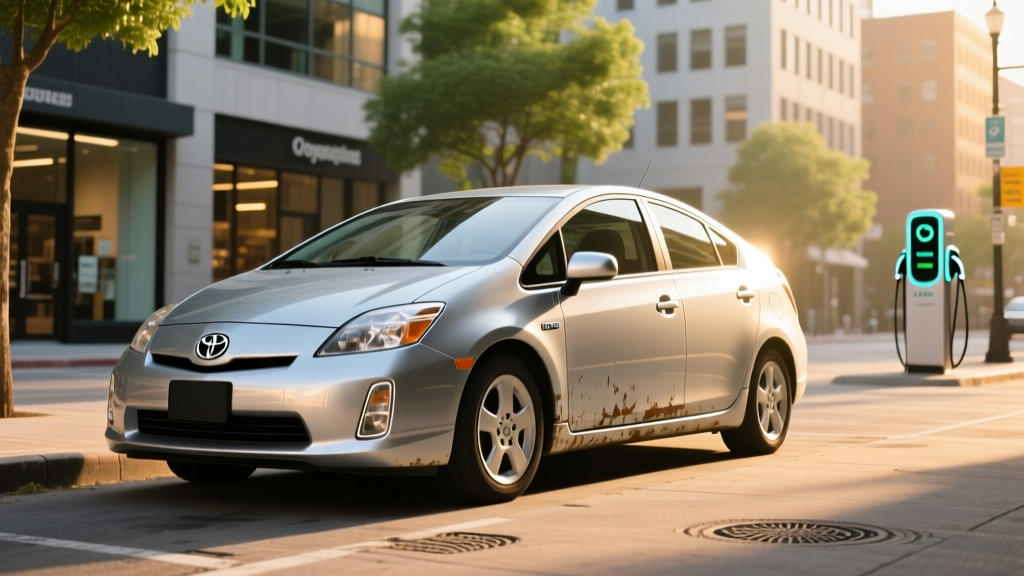
Long before the Tesla Model 3 made EVs mainstream and before plug-in hybrids blurred the line between gas and electric, there was the first-generation Toyota Prius. The 2001 Prius hybrid — technically a 2001 model year (NH10 chassis) — was the car that introduced the word "hybrid" to the American driving public. More than two decades later, some of these originals are still on the road, and a surprising number of buyers search for them as ultra-cheap, ultra-efficient daily drivers or project cars.
But what does owning a 2001 Prius hybrid actually look like in 2026? How do its original EPA fuel economy numbers hold up? What happens when the hybrid battery — now potentially 25 years old — needs attention? This guide covers everything a prospective buyer or current owner needs to know, with real numbers, honest limitations, and context for how this pioneering HEV fits into today's electrified vehicle landscape.
2001 Prius Hybrid at a Glance: Original Specifications
The first-generation Prius sold in the United States (model years 2001–2003) was a compact four-door sedan built on Toyota's dedicated hybrid platform. It used Toyota's Hybrid Synergy Drive — a series-parallel system that combined a small gasoline engine with an electric motor and a nickel-metal hydride (NiMH) battery pack. It was a conventional hybrid (HEV), meaning it never needed to be plugged in. The battery charged solely through regenerative braking and the gasoline engine.
| Specification | Value |
|---|---|
| Powertrain Type | Conventional Hybrid (HEV) — no plug |
| Gasoline Engine | 1.5L 4-cylinder (1NZ-FXE), 70 hp @ 4,500 rpm |
| Electric Motor | Permanent magnet synchronous, 44 hp (33 kW) |
| Combined System Output | ~100 hp (net) |
| Hybrid Battery | NiMH, ~1.78 kWh (nominal), 274V |
| Transmission | Planetary eCVT (power-split device) |
| 0–60 mph | ~12.6 seconds |
| Curb Weight | ~2,765 lbs |
| Original MSRP | $19,995 |
| EPA Fuel Economy (revised) | 48 city / 45 highway / 46 combined MPG |
Note: EPA revised its testing methodology in 2008, retroactively adjusting older vehicle ratings downward. The original window sticker on the 2001 Prius displayed 52 city / 45 highway MPG under the pre-2008 test cycle. The figures above reflect the current revised EPA numbers as listed on fueleconomy.gov.
Fuel Economy Breakdown: EPA vs. Real-World MPG
The 2001 Prius hybrid's headline number was always fuel economy, and even by 2026 standards, its EPA ratings remain competitive with many modern compact hybrids.
| Driving Scenario | EPA Rating | Real-World Expectation |
|---|---|---|
| City | 48 MPG | 44–50 MPG (hybrids often exceed EPA in stop-and-go) |
| Highway | 45 MPG | 40–46 MPG (aerodynamic drag limits efficiency at 70+ mph) |
| Combined | 46 MPG | 42–48 MPG depending on driving mix |
| Cold Weather (below 32°F) | — | 36–42 MPG (engine runs more for cabin heat, battery less efficient) |
Like all conventional hybrids, the 2001 Prius achieves its best efficiency in city driving, where frequent stops maximize regenerative braking and allow the electric motor to handle low-speed propulsion. Highway driving is where the age of the design shows: the NH10's aerodynamics, modest electric-only assist, and small battery mean it doesn't sustain the triple-digit MPG fantasy some owners of later Prius generations report.
Real-world fuel economy also depends heavily on the condition of the hybrid battery. A degraded NiMH pack reduces the system's ability to capture regen energy and assist the gas engine, which can drop observed MPG by 10–15% compared to a car with a healthy battery.
Understanding the HEV Powertrain: How the 2001 Prius Works
If you're coming from a modern EV or plug-in hybrid, the 2001 Prius powertrain may seem almost quaint — but its engineering was genuinely innovative for its time.
HEV vs. PHEV vs. EV — Where the 2001 Prius Fits
| Feature | Conventional Hybrid (HEV) 2001 Prius | Plug-in Hybrid (PHEV) e.g., 2026 Prius Prime | Battery Electric (BEV) e.g., Tesla Model 3 |
|---|---|---|---|
| Plugs in to charge? | No — charges via regen and engine | Yes — Level 1 or Level 2 | Yes — Level 1, 2, or DC fast |
| Electric-only range | Less than 1 mile at very low speed | 25–50 miles typical | 250–400+ miles |
| Gasoline engine? | Yes — primary power source | Yes — kicks in after battery depletes | No |
| Tailpipe emissions | Yes (low) | Yes (when engine runs) | None |
| Federal tax credit (§30D) | Not eligible | Eligible if requirements met | Eligible if requirements met |
The 2001 Prius uses a power-split device — a planetary gearset that seamlessly blends torque from the gasoline engine and the electric motor. At low speeds and gentle acceleration, the car can move on electric power alone for very short distances (a few hundred yards at most). Under harder acceleration or at highway speeds, both the engine and motor work together. During deceleration and braking, the motor acts as a generator, sending energy back into the NiMH battery pack.
This system requires no driver intervention. There is no plug, no charging cable, and no need to change driving habits. You simply fuel it with gasoline and drive.
Hybrid Battery Lifespan: The Big Question for a 25-Year-Old HEV
The single biggest concern for anyone considering a 2001 Prius hybrid in 2026 is the state of its nickel-metal hydride battery. This pack was engineered for longevity, but no battery lasts forever — especially one that may be approaching its 25th birthday.
Original Battery Warranty and Expected Lifespan
- Original warranty: 8 years / 100,000 miles (in most states; 10 years / 150,000 miles in California and states adopting CARB standards) — long expired for all 2001 models
- Typical NiMH battery lifespan: 10–15 years or 150,000–200,000 miles under normal conditions
- Current reality: Any 2001 Prius still running on its original battery is living on borrowed time. Most surviving examples have had at least one battery replacement.
Signs of Hybrid Battery Degradation
Watch for these indicators that the NiMH pack is failing:
- Noticeable drop in fuel economy (5–10+ MPG below expected)
- The gasoline engine runs more frequently, even at low speeds
- Battery state-of-charge gauge fluctuates rapidly
- Dashboard warning light (red triangle or "check hybrid system" message)
- Reduced regenerative braking feel
Battery Replacement Cost in 2026
| Option | Estimated Cost | Notes |
|---|---|---|
| Remanufactured NiMH pack (aftermarket) | $1,000–$1,800 | Most common choice for a car of this age; available from hybrid specialists |
| Used/salvage pack | $400–$900 | Risky — unknown remaining life; may need individual module replacement |
| Individual module replacement (reconditioning) | $200–$600 (DIY or specialist) | Replace only failed cells; requires technical knowledge |
| New OEM Toyota pack | $2,000–$3,000+ | May be difficult to source for NH10 generation; limited availability |
For a vehicle with a current resale value of roughly $1,500–$4,000 depending on condition, a battery replacement can represent a significant percentage of the car's worth. This economic reality is why many 2001 Prius examples on the used market either need a battery or have had a recent aftermarket replacement. Always ask for documentation of any battery work before purchasing.
Reliability and Long-Term Ownership Considerations
The Toyota Prius nameplate has earned a reputation as one of the most reliable vehicles ever sold, and the NH10 generation laid that foundation. However, a 25-year-old car presents challenges that go beyond the hybrid system.
What Holds Up Well
- Power-split eCVT transmission: The planetary gearset has no traditional clutch packs, bands, or torque converter. It is mechanically simple and extremely durable. Failures are rare.
- 1NZ-FXE engine: This 1.5L engine is under-stressed (70 hp) and runs an Atkinson-like cycle, which reduces thermal load. With regular oil changes, 250,000+ miles is common.
- Brakes: Regenerative braking handles most deceleration, so the friction brake pads and rotors last significantly longer than on conventional cars. 80,000–100,000 miles on original brake pads is not unusual.
Age-Related Concerns in 2026
- Rubber components: Hoses, bushings, seals, and weatherstripping degrade with time regardless of mileage. Budget for suspension refresh and cooling system service.
- Inverter coolant pump: The electric water pump that cools the inverter and transaxle is a known wear item. Failure can cause overheating and expensive damage. Replacement runs $200–$400.
- Catalytic converter: Theft remains a concern for older Prius models due to precious metal content. Replacement cost: $800–$1,500.
- Safety technology: The 2001 Prius has no electronic stability control (standard only from 2010+ on most cars), no side-curtain airbags in early builds, and no advanced driver-assistance features. It is a fundamentally early-2000s car in crash protection.
- Parts availability: While mechanical parts for the 1NZ-FXE engine remain available, some hybrid-specific and interior trim components are becoming harder to source new from Toyota.
For a thorough assessment of safety performance, check the NHTSA database for any open recalls on the NH10 Prius.
Pricing, Value, and Tax Credit Reality
Let's be direct about the economics of a 2001 Prius hybrid in 2026:
| Condition | Estimated Price Range |
|---|---|
| Project car / non-running / bad hybrid battery | $500–$1,500 |
| Running, high miles (180K+), needs work | $1,500–$2,500 |
| Good condition, recent battery replacement, under 150K miles | $2,500–$4,000 |
| Excellent/low-mile survivor (rare) | $4,000–$6,000 |
Federal Tax Credit Eligibility
The 2001 Prius hybrid does not qualify for the federal §30D new clean vehicle credit — that credit applies only to new vehicles meeting current battery sourcing, MSRP cap, and buyer income requirements as outlined by the IRS. The original hybrid vehicle tax credit that existed in the mid-2000s (up to $3,150 for the Prius) expired long ago and was claimed by original purchasers.
Similarly, the used clean vehicle credit (§25E, up to $4,000 or 30% of sale price) applies only to used plug-in electric vehicles and fuel cell vehicles — not conventional hybrids. The 2001 Prius, as an HEV with no plug, is ineligible.
Some states may offer minimal incentives for high-efficiency used vehicles, but these are rare and vary by jurisdiction. Check your state's DMV or energy office for any current programs.
Who Should Consider a 2001 Prius Hybrid in 2026?
Reasons to Buy
- Ultra-low purchase price — one of the cheapest ways into a 45+ MPG vehicle
- Proven, simple hybrid system with strong DIY community support
- Exceptional city MPG for stop-and-go commuters
- No charging infrastructure needed — just gas and go
- Strong enthusiast and hybrid-repair knowledge base online
- Low annual fuel cost: ~$900–$1,100/year at 12,000 miles and $3.50/gallon
Reasons to Think Twice
- Hybrid battery replacement likely needed (or recently done — verify quality)
- Minimal safety technology by modern standards
- No EV tax credits of any kind
- Slow acceleration (0–60 in ~12.6 seconds) — a safety concern for highway merging
- Parts sourcing becoming more difficult for hybrid-specific components
- Highway MPG less impressive than modern hybrids (2026 Prius LE: 57 combined)
The Decision Framework
Choose the 2001 Prius hybrid if: You need a sub-$3,000 commuter car with excellent city fuel economy, you're comfortable with an older vehicle's maintenance needs, and you have access to a hybrid-savvy mechanic or are willing to learn basic hybrid battery diagnostics yourself.
Look at a newer hybrid (2010+ Prius, 2020+ Corolla Hybrid) if: You want modern safety features (ESC, side airbags, available ADAS), a factory hybrid battery with remaining life, and highway MPG closer to 50+. Budget: $6,000–$15,000.
Consider a PHEV (2026 Prius Prime) if: You have home charging access, want 40+ miles of electric-only range for short commutes, and want to qualify for the §30D federal tax credit (up to $3,750 for the Prius Prime, subject to income and sourcing rules). Budget: $33,000+ MSRP before incentives.
Go full EV if: You want zero tailpipe emissions, minimal maintenance, home charging convenience, and access to the full $7,500 federal tax credit (on eligible models). Budget: $30,000+ and access to Level 2 home charging.
Frequently Asked Questions
How many MPG does the 2001 Prius hybrid get?
The revised EPA rating is 48 city / 45 highway / 46 combined MPG. In real-world driving, expect 42–50 MPG combined depending on your driving mix, ambient temperature, and hybrid battery condition. City driving typically yields the best numbers because the hybrid system leverages regenerative braking and electric-only assist at low speeds.
Can the 2001 Prius drive on electric power only?
Technically yes, but only for very short distances (a few hundred yards) at very low speeds (under ~25 mph). The NH10's battery is just 1.78 kWh and the system was not designed for meaningful electric-only driving. This is a conventional hybrid — the gasoline engine is the primary power source.
Does the 2001 Prius need to be plugged in?
No. The 2001 Prius is a conventional hybrid (HEV). Its NiMH battery charges entirely through regenerative braking and the gasoline engine. There is no plug, no charging port, and no need for any external electrical infrastructure.
How much does it cost to replace the hybrid battery?
In 2026, a remanufactured NiMH battery pack for the NH10 Prius typically costs $1,000–$1,800 installed. Used packs run $400–$900 but carry unknown remaining life. Individual module reconditioning by a specialist can cost $200–$600. A new OEM pack, if available, may exceed $2,500.
Is a 2001 Prius reliable in 2026?
The core powertrain (engine, eCVT, power-split device) is extremely durable and many examples have exceeded 250,000 miles. However, any 25-year-old vehicle will need age-related maintenance: rubber components, suspension parts, cooling system service, and likely a hybrid battery replacement if not already done. Reliability in 2026 depends entirely on maintenance history and current condition.
Does the 2001 Prius qualify for any tax credits?
No. The 2001 Prius hybrid does not qualify for the federal §30D new vehicle credit (it's not new) or the §25E used clean vehicle credit (that credit requires a plug-in electric or fuel cell vehicle). The original hybrid tax credit from the 2000s is long expired. No current federal incentives apply to this vehicle.
How does the 2001 Prius compare to a modern hybrid?
The 2026 Toyota Prius LE achieves an EPA-estimated 57 MPG combined — about 24% more efficient than the 2001 model — while producing 194 combined horsepower (nearly double). It also includes Toyota Safety Sense 3.0 (automatic emergency braking, lane-keeping, adaptive cruise), Apple CarPlay, and a modern infotainment system. The tradeoff is price: a new Prius starts around $28,000 vs. $2,000–$4,000 for a used 2001 model.
The 2001 Prius hybrid was never meant to be a collector's item — it was meant to prove that a mass-market gasoline-electric car could work. In that mission, it succeeded beyond anyone's expectations, paving the way for every hybrid, plug-in hybrid, and EV that followed. If you find a well-maintained example in 2026 with a healthy battery and a reasonable price, it remains one of the most frugal ways to get from point A to point B. Just go in with eyes open about what a quarter-century-old car demands.