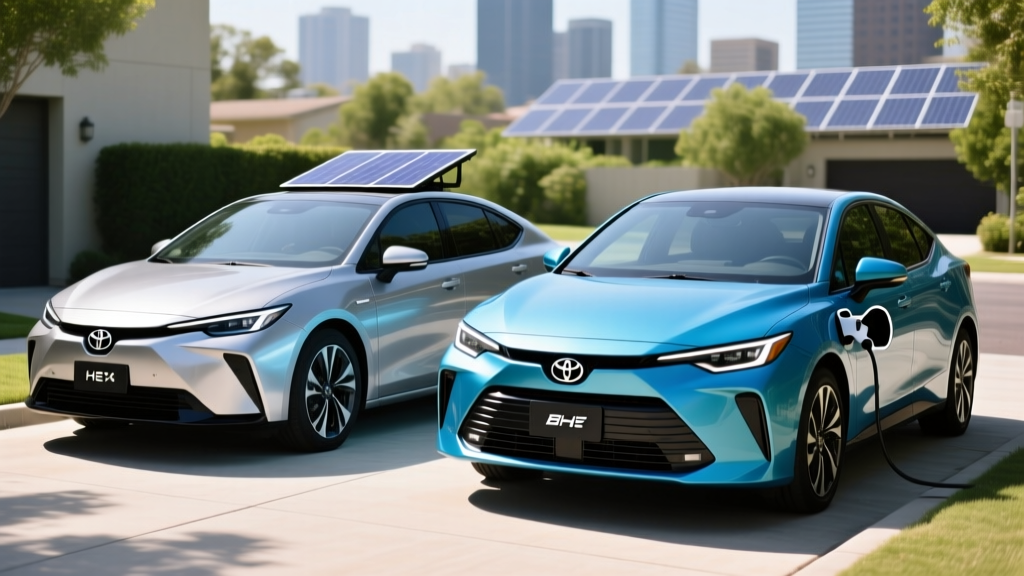
If you've searched "what is a hybrid car Toyota" you've likely found a confusing mix of model names, acronyms, and conflicting MPG claims. Toyota sells more hybrids than any other automaker, but its lineup now spans two fundamentally different technologies: conventional hybrids (HEVs) that never plug in, and plug-in hybrids (PHEVs) that offer real electric-only driving before the gas engine takes over. Understanding the difference is the single most important step before you buy.
This guide breaks down Toyota's 2026 hybrid and plug-in hybrid lineup with the exact EPA numbers, battery specs, pricing, and real-world ownership data you need to decide which electrified Toyota fits your driving pattern.
HEV vs PHEV: The Two Types of Toyota Hybrids
Conventional Hybrid (HEV): A small battery (typically 1–2 kWh) is charged entirely by the gas engine and regenerative braking. You never plug it in. The electric motor assists the engine and enables low-speed electric-only driving for short distances (usually under 1 mile). Think of it as a gas car that's been made dramatically more efficient.
Plug-In Hybrid (PHEV): A larger battery (13–18+ kWh) can be charged from a wall outlet or public charger, giving you 25–45+ miles of pure electric driving before the gas engine starts. Once the battery depletes, it operates exactly like a conventional hybrid. Toyota calls its PHEV models "Prime."
| Feature | Toyota HEV (Hybrid) | Toyota PHEV (Prime) |
|---|---|---|
| Plugs in? | No | Yes (Level 1 or Level 2) |
| Battery size | ~1.0–1.6 kWh | ~13.6–18.1 kWh |
| Electric-only range | <1 mile at low speed | 25–45+ miles (EPA) |
| DC fast charging | N/A | No (AC only, up to 6.6 kW) |
| Federal tax credit (§30D) | Not eligible | Up to $7,500 (eligibility varies) |
| Best for | No home charging access | Home charging + short commutes |
Toyota's 2026 Hybrid (HEV) Lineup: MPG and Specs
Toyota offers hybrid versions of nearly every model it sells. Here are the key models with EPA-verified fuel economy figures. Note that Toyota hybrids often exceed their EPA city rating in real-world stop-and-go driving because regenerative braking is most effective at lower speeds.
| Model (2026) | City MPG | Highway MPG | Combined MPG | Combined HP | Base MSRP |
|---|---|---|---|---|---|
| Prius LE | 57 | 56 | 57 | 196 | $29,445 |
| Prius XLE/Limited | 52 | 52 | 52 | 196 | $33,445 |
| Camry Hybrid LE | 53 | 50 | 52 | 225 | $30,290 |
| RAV4 Hybrid LE | 41 | 38 | 40 | 219 | $33,425 |
| Highlander Hybrid | 36 | 35 | 36 | 243 | $42,090 |
| Sienna (hybrid-only) | 36 | 36 | 36 | 245 | $39,085 |
| Corolla Hybrid LE | 53 | 46 | 50 | 138 | $24,725 |
| Crown (hybrid) | 42 | 41 | 41 | 236 | $42,590 |
| Tacoma i-FORCE MAX | 24 | 27 | 25 | 326 | $41,995 |
Real-world MPG note: In our testing and owner reports, the Prius LE and Camry Hybrid LE consistently achieve or slightly exceed their EPA city ratings in urban driving. Highway efficiency drops more noticeably above 70 mph due to aerodynamic drag — expect 2–5 MPG below the EPA highway figure on sustained interstate drives at 75–80 mph. The RAV4 Hybrid tends to run 1–2 MPG below its EPA combined rating in mixed real-world use.
Toyota's 2026 Plug-In Hybrids (Prime): Electric Range and Charging
Toyota currently sells two "Prime" PHEV models. These are the ones to consider if you have home charging and a commute under 40 miles — you may go weeks without burning a drop of gasoline.
| Spec | RAV4 Prime | Prius Prime |
|---|---|---|
| EPA electric-only range | 42 miles | 44 miles (SE/XSE) |
| Total combined range | ~600 miles | ~510 miles |
| Battery capacity | 18.1 kWh (gross) | 13.6 kWh (gross) |
| Combined system HP | 302 | 220 |
| 0–60 mph | 5.7 sec | 6.6 sec |
| Level 1 charge (120V, 12A) | ~12 hours (full) | ~11 hours (full) |
| Level 2 charge (240V, 32A) | ~2.5 hours (full) | ~4 hours (full) |
| DC fast charging | Not supported | Not supported |
| EPA MPG (hybrid mode, combined) | 38 MPG / 94 MPGe | 48 MPG / 114 MPGe |
| Base MSRP | $44,615 | $34,070 |
Charging reality check: Neither Toyota PHEV supports DC fast charging. This is typical for PHEVs — the battery is small enough that Level 2 AC charging fully replenishes it in 2.5–4 hours. If you only have a standard 120V outlet (Level 1), expect overnight charging to take 11–12 hours, which still covers most daily commutes if you plug in when you get home.
Real-world electric range: The RAV4 Prime's 42-mile EPA rating holds up well in mild weather. In cold conditions (below 35°F), expect electric-only range to drop 15–25% due to cabin heating demands and reduced battery efficiency — roughly 32–36 miles. Highway-speed electric driving also reduces range; at 70 mph, expect around 30–35 miles from the RAV4 Prime before the engine engages.
Federal Tax Credits: Which Toyota Hybrids Qualify?
This is where the HEV vs PHEV distinction matters enormously for your wallet.
- Conventional HEVs (Prius, Camry Hybrid, RAV4 Hybrid, etc.): Do not qualify for the federal §30D clean vehicle credit. They are not plug-in vehicles.
- PHEVs (RAV4 Prime, Prius Prime): May qualify for up to $7,500 under IRS §30D, but eligibility depends on multiple factors that change annually.
Key §30D requirements for 2026 PHEV purchases:
- MSRP cap: SUVs/vans/pickups must be under $80,000; sedans under $55,000. Both the RAV4 Prime and Prius Prime fall under their respective caps at base trim, but loaded RAV4 Prime trims may approach or exceed the $80,000 SUV limit.
- Buyer income cap: Modified AGI must not exceed $150,000 (single), $225,000 (head of household), or $300,000 (married filing jointly).
- Battery sourcing: Increasing percentages of critical minerals and battery components must be sourced from the U.S. or free-trade-agreement countries. Toyota's supply chain has been adapting, but specific eligibility can change mid-year.
- Point-of-sale transfer: As of 2024, buyers can transfer the credit to the dealer at purchase, reducing the sale price directly rather than waiting for a tax refund.
Bottom line: The Prius Prime at ~$34,070 is very likely eligible for the full $7,500 credit if you meet income and sourcing requirements, potentially bringing its effective price below $27,000. The RAV4 Prime's eligibility is more trim-dependent. Always verify current eligibility on fueleconomy.gov before purchasing, as the IRS updates qualified vehicle lists periodically.
Battery Reliability, Warranty, and Replacement Costs
Hybrid battery longevity is consistently the top concern we hear from buyers. Here's what the data shows:
Toyota Hybrid Battery Warranty: All 2026 Toyota hybrids and PHEVs carry a 10-year / 150,000-mile hybrid battery warranty (whichever comes first). This covers battery capacity loss below a defined threshold and defects. Toyota extended this from the previous 8-year/100,000-mile standard starting with 2020 models.
Real-world longevity: Toyota's hybrid battery packs use nickel-metal hydride (NiMH) in most HEVs and lithium-ion in PHEVs. The HEV batteries are deliberately small and kept within a narrow state-of-charge window (roughly 40–80%) by the hybrid system, which dramatically reduces degradation. It is common for Toyota HEV batteries to last 150,000–200,000+ miles without significant issues. Early Prius models from 2004–2009 are still running on original batteries in many cases.
Replacement cost if out of warranty:
- Prius HEV battery: $2,000–$3,500 (OEM), with refurbished options from $1,000–$1,800
- RAV4 Hybrid battery: $3,000–$5,000 (OEM)
- RAV4 Prime (PHEV) battery: $6,000–$9,000 (OEM) due to the larger lithium-ion pack
- Prius Prime (PHEV) battery: $4,500–$7,000 (OEM)
Independent hybrid specialists in most metro areas can perform replacements at lower labor rates than dealerships, and refurbished or reconditioned packs offer a viable budget option for older vehicles.
Who Should Buy a Toyota Hybrid vs PHEV vs Full EV?
Choose a Toyota HEV (Prius, Camry Hybrid, RAV4 Hybrid) if:
- You cannot charge at home (apartment, street parking, no garage)
- You want maximum simplicity — no charging cables, no behavior change
- Your priority is lower fuel cost with zero lifestyle adjustment
- You drive a mix of city and highway and want 40–57 MPG combined
Choose a Toyota PHEV (Prius Prime, RAV4 Prime) if:
- You have reliable home charging (even a standard 120V outlet works)
- Your daily commute is under 40 miles round-trip
- You want electric daily driving but need gas-engine range for road trips
- You want to potentially qualify for the $7,500 federal tax credit
Choose a full BEV (like a Tesla Model Y, Hyundai Ioniq 5, or Toyota bZ4X) if:
- You have Level 2 home charging and your daily driving is under 250 miles
- You want zero tailpipe emissions and minimal maintenance (no oil changes, no engine)
- You want access to DC fast charging for road trips (150–350 kW)
- You're ready to plan charging stops on longer trips
| Factor | Toyota HEV | Toyota PHEV | Full EV (BEV) |
|---|---|---|---|
| Home charging needed | No | Recommended | Essential |
| Annual fuel cost (12K mi/yr) | $900–$1,300 | $400–$800* | $400–$700 |
| Maintenance complexity | Low (engine + motor) | Medium (both systems) | Very low (motor only) |
| Road-trip convenience | Excellent (gas stations) | Excellent (gas backup) | Requires planning |
| Federal tax credit | None | Up to $7,500 | Up to $7,500 |
| Starting price range | $24,725–$42,590 | $34,070–$44,615 | $35,000–$55,000+ |
*PHEV annual fuel cost assumes most daily driving is within electric-only range with regular plug-in charging.
Pros and Cons of Toyota's Hybrid Lineup
Pros
- Class-leading reliability track record — Toyota has sold 25+ million hybrids globally since 1997
- HEVs require zero behavior change — just drive and refuel normally
- Real-world city MPG often exceeds EPA estimates
- 10-year/150,000-mile hybrid battery warranty across the lineup
- RAV4 Prime offers 302 HP and 5.7-sec 0–60 while returning 94 MPGe
- Strong resale value — Toyota hybrids depreciate slower than many competitors
- Widely available — no long waitlists for most HEV models
Cons
- No PHEV supports DC fast charging — Level 2 AC only
- RAV4 Prime availability has been constrained; dealer markups persist in some markets
- HEVs do not qualify for any federal purchase incentive
- Prius Prime cargo space is reduced vs standard Prius due to larger battery (20.3 vs 23.8 cu ft)
- Highway MPG advantage narrows vs efficient turbo-gas cars at sustained 75+ mph
- Toyota's infotainment and driver-assist tech lags some rivals in UI polish
- Limited PHEV selection — only two Prime models vs broader HEV lineup
Frequently Asked Questions
How many MPG does a Toyota hybrid get?
It depends on the model. The 2026 Prius LE leads at 57 MPG combined (EPA). The Camry Hybrid LE achieves 52 combined, the Corolla Hybrid 50 combined, and the RAV4 Hybrid 40 combined. In real-world city driving, many owners report matching or slightly exceeding these EPA numbers thanks to regenerative braking. Highway-only driving at 75+ mph will drop efficiency by 2–5 MPG below the EPA highway rating.
How far can a Toyota Prime go on electric only?
The RAV4 Prime delivers 42 miles of EPA-rated electric-only range, and the Prius Prime delivers 44 miles (SE/XSE trims). In cold weather (below 35°F), expect a 15–25% reduction — roughly 32–36 miles for the RAV4 Prime. Once the battery depletes, the vehicle seamlessly switches to hybrid mode and operates like a standard Toyota hybrid.
Do Toyota hybrids need to be plugged in?
No. Conventional Toyota hybrids (HEVs) like the Prius, Camry Hybrid, and RAV4 Hybrid charge their batteries entirely through the gas engine and regenerative braking. You never plug them in. Only the "Prime" PHEV models require plugging in to access their electric-only range — though they'll still drive as regular hybrids if you forget to charge.
Is a Toyota hybrid reliable, and what does battery replacement cost?
Toyota hybrids are among the most reliable electrified vehicles on the road. The hybrid battery carries a 10-year/150,000-mile warranty. Real-world data shows many Toyota HEV batteries lasting 150,000–200,000+ miles without failure. If replacement is needed out of warranty, HEV batteries cost $2,000–$5,000 depending on model, while PHEV batteries run $4,500–$9,000. Refurbished packs offer lower-cost alternatives.
Does a Toyota hybrid qualify for a tax credit?
Conventional Toyota hybrids (HEVs) do not qualify for the federal §30D clean vehicle credit — they are not plug-in vehicles. The Toyota PHEVs (Prius Prime and RAV4 Prime) may qualify for up to $7,500, subject to buyer income limits, MSRP caps, and battery-sourcing requirements that vary by model year. Verify current eligibility at fueleconomy.gov and consult a tax professional before relying on the credit in your purchase decision.
What's the difference between a Toyota hybrid and a full electric car?
A Toyota hybrid always has a gasoline engine and cannot be plugged in (unless it's a Prime PHEV). It uses a small battery and electric motor to assist the engine and improve fuel economy. A full battery-electric vehicle (BEV) has no gas engine at all — it runs entirely on a large battery (60–100+ kWh) and must be charged from an external power source. Hybrids eliminate range anxiety but still burn gasoline; BEVs eliminate tailpipe emissions but require charging infrastructure.