If you've been shopping for a new electrified vehicle, you've likely hit a wall of acronyms: HEV, PHEV, BEV, MPGe. The confusion is understandable. Automakers market all of them under the broad "hybrid" umbrella, but the difference between a conventional hybrid and a plug-in hybrid fundamentally changes how you fuel, what you pay, and whether you qualify for federal tax credits.
This guide answers the core question — what does plug in hybrid mean — and gives you the exact numbers, real-world expectations, and decision framework to pick the right electrified powertrain for your driving pattern in 2026.
What Does Plug In Hybrid Mean? The Core Definition
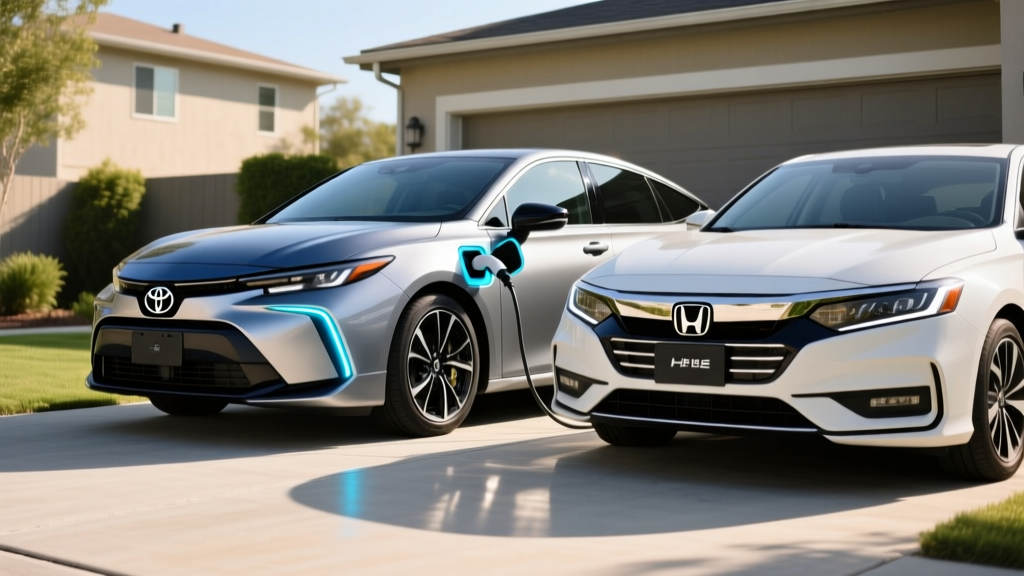
A plug-in hybrid electric vehicle (PHEV) is a car that combines a gasoline engine with a larger battery and electric motor than a conventional hybrid, and that battery can be recharged by plugging into an external power source — a wall outlet, a Level 2 home charger, or (on some models) a public DC fast charger.
The defining characteristic: a PHEV can drive a meaningful distance on electricity alone before the gasoline engine turns on. Once the battery is depleted, it operates as a conventional hybrid, blending engine and motor power to maximize fuel economy.
A conventional hybrid (HEV), by contrast, cannot be plugged in. Its small battery is charged exclusively through regenerative braking and the gasoline engine. You never plug it in; you just fill up at the gas station. The electric motor assists the engine to improve MPG, but an HEV cannot drive on electric power alone for more than a mile or two at very low speeds.
HEV vs PHEV at a Glance
| Feature | Conventional Hybrid (HEV) | Plug-In Hybrid (PHEV) |
|---|---|---|
| Plug in to charge? | No | Yes |
| Battery size | 1–2 kWh | 13–25+ kWh |
| Electric-only range | ~0–1 mile (low speed only) | 20–50+ miles (EPA) |
| Gasoline engine | Yes — primary power source | Yes — kicks in after battery depletes |
| Federal tax credit (§30D) | No | Up to $7,500 (if eligible) |
| Home charging needed | No | Recommended to capture full value |
| Typical combined MPG (gas mode) | 40–58 MPG | 25–48 MPG (after battery depletes) |
Real-World MPG: What the EPA Numbers Actually Look Like
Hybrid fuel economy ratings can mislead if you don't know how to read them. Here's what the EPA numbers look like across popular 2025–2026 models, plus what to expect in the real world.
Conventional Hybrid (HEV) MPG Examples
| Model (2025–2026) | City MPG | Highway MPG | Combined MPG | Real-World Note |
|---|---|---|---|---|
| Toyota Prius LE | 57 | 56 | 57 | City driving often exceeds 58 MPG; highway at 75+ mph drops to ~48–50 MPG |
| Honda Accord Hybrid | 51 | 44 | 48 | Strong city regenerative braking; highway efficiency falls off above 70 mph |
| Toyota RAV4 Hybrid | 41 | 38 | 40 | AWD hybrid SUV; expect ~36–38 MPG in mixed real-world driving |
| Hyundai Tucson Hybrid | 38 | 38 | 38 | Consistent performer; cold weather drops city MPG by ~3–5 MPG |
Key insight: Conventional hybrids often exceed their EPA city rating in stop-and-go traffic because regenerative braking recovers energy that a gas-only car wastes as heat. Highway driving, where regen opportunities are minimal, is where hybrids lose their advantage. Source: fueleconomy.gov.
Plug-In Hybrid (PHEV) Efficiency Examples
| Model (2025–2026) | Electric Range (EPA) | MPGe (Electric Mode) | Combined MPG (Gas Only) | Battery (kWh) |
|---|---|---|---|---|
| Toyota RAV4 Prime | 42 miles | 94 MPGe | 38 MPG | 18.1 kWh |
| Jeep Wrangler 4xe | 22 miles | 49 MPGe | 20 MPG | 17.3 kWh |
| Hyundai Tucson PHEV | 33 miles | 80 MPGe | 35 MPG | 13.8 kWh |
| BMW X5 xDrive50e | 38 miles | 56 MPGe | 27 MPG | 25.7 kWh |
| Chrysler Pacifica PHEV | 32 miles | 82 MPGe | 30 MPG | 16.0 kWh |
MPGe explained: MPGe (miles per gallon equivalent) converts electricity consumption into a gasoline-equivalent number so you can compare. A PHEV rated at 94 MPGe uses about 36 kWh per 100 miles of electric driving. It's useful for comparison, but your actual electricity cost depends on your local rate per kWh.
PHEV Electric Range, Charging Time, and Battery Specs
The entire value proposition of a PHEV hinges on its electric-only range. If your daily commute fits within that range and you charge at home, you may go weeks without buying gasoline.
Charging Speeds: What to Expect
Most PHEVs charge via a J1772 connector (or NACS on newer models like the Ford Escape PHEV). Here's the charging landscape:
| Charging Level | Power (kW) | Typical PHEV Full Charge Time | Where You'll Find It |
|---|---|---|---|
| Level 1 (120V outlet) | 1.0–1.4 kW | 10–18 hours | Any standard household outlet |
| Level 2 (240V) | 3.3–7.2 kW | 2–5 hours | Home wallbox, workplace, public stations |
| DC Fast Charging | 30–50+ kW | 25–45 min (10–80%) | Only on select models (Mitsubishi Outlander PHEV, BMW X5 50e) |
Critical detail: Most PHEVs do not support DC fast charging. The Toyota RAV4 Prime, for example, maxes out at 6.6 kW on Level 2 and has no DC fast-charge capability. If you need quick top-ups on road trips, verify DC fast-charge support before buying. For most PHEV owners, overnight Level 2 charging at home fully replenishes the battery every morning.
2026 Toyota RAV4 Prime — Spec Snapshot
| Combined Horsepower | 302 HP (2.5L 4-cyl + dual electric motors) |
| Electric-Only Range (EPA) | 42 miles |
| Total Combined Range | ~600 miles (electric + 14.5-gal tank) |
| Battery Capacity | 18.1 kWh (lithium-ion, NMC chemistry) |
| Level 2 Charge Time (0–100%) | ~2.5 hours at 6.6 kW |
| DC Fast Charge | Not available |
| 0–60 mph | 5.7 seconds |
| Combined MPG (Gas Mode) | 38 MPG |
| MPGe (Electric Mode) | 94 MPGe |
| Starting MSRP | $44,985 (SE trim) |
| Battery Warranty | 10 years / 150,000 miles |
Hybrid and PHEV Battery Longevity: Warranty, Degradation, and Replacement Cost
Battery lifespan is the number-one concern for hybrid buyers, and it's where the data should ease your mind.
Federal Mandate for Hybrid Battery Warranties
Under US federal law, all hybrid and PHEV battery packs must carry a minimum warranty of 8 years / 100,000 miles (10 years / 150,000 miles in CARB states including California, New York, Massachusetts, and others). This covers defects and excessive capacity loss — typically defined as dropping below 60–70% of original capacity.
Real-World Degradation Data
Toyota's hybrid battery packs have the longest track record. Data from fleet analyses and owner surveys show:
- Toyota Prius HEV batteries routinely last 150,000–200,000+ miles before significant degradation. Many first-generation Prius taxis exceeded 300,000 miles on the original battery.
- PHEV batteries experience more charge cycling (full drain and recharge daily), but the larger capacity buffer means each cycle is less stressful on individual cells. Expect 10–15 years of usable life with 80%+ capacity retention for most models.
- Cold climate impact: Hybrid batteries lose some capacity temporarily in freezing weather, but unlike full EVs, the gasoline engine provides cabin heat and supplemental power, so range loss is less consequential.
Battery Replacement Cost
If your hybrid battery does fail outside warranty:
- HEV battery replacement: $2,000–$4,500 (Toyota Prius: ~$2,500–$3,500; RAV4 Hybrid: ~$3,000–$4,000)
- PHEV battery replacement: $5,000–$9,000 (larger packs cost more; RAV4 Prime: ~$6,000–$8,000)
- Refurbished/reconditioned options: Available for popular models at 40–60% of new battery cost
The reality: battery replacement outside warranty is rare for mainstream hybrids. The cells are passively or mildly actively cooled, and the battery management system prevents deep discharge or overcharge — the two biggest killers of lithium-ion longevity.
PHEV Tax Credit Eligibility: What Qualifies in 2026
Under IRS §30D, qualifying PHEVs can receive up to $7,500 in federal tax credits, which can now be transferred to the dealer at the point of sale as a purchase-price reduction. However, eligibility is far from universal.
- Battery capacity: Must be ≥ 7 kWh (most PHEVs qualify)
- MSRP caps: Vans/SUVs/pickups ≤ $80,000; sedans ≤ $55,000
- Buyer income caps: AGI ≤ $150,000 (single), $225,000 (head of household), $300,000 (joint)
- Battery sourcing: Critical minerals and battery components must meet phased-in domestic/free-trade-partner sourcing requirements that tighten annually through 2029
- Final assembly: Must occur in North America
2026 PHEVs that may qualify (verify current status at IRS.gov):
- Jeep Wrangler 4xe — up to $3,750 (partial credit due to sourcing rules)
- Chrysler Pacifica PHEV — up to $7,500 (if sourcing thresholds met)
- Ford Escape PHEV — up to $3,750–$7,500 (varies by sourcing compliance)
- Toyota RAV4 Prime — $0 (assembled in Japan; does not meet North American assembly requirement)
Always confirm eligibility at the point of sale and consult a tax professional. Sourcing requirements tighten each year, and a model that qualifies in January may lose eligibility by mid-year.
Hybrid vs PHEV vs EV: Which Powertrain Fits Your Life?
This is the decision that matters. Here's a framework based on your actual driving pattern, not marketing.
Choose a Conventional Hybrid (HEV) If:
- You cannot charge at home (apartment, street parking, no garage)
- You want maximum MPG with zero behavior change — just fill up at any gas station
- Your budget is tight and you want the lowest upfront cost (HEVs cost $1,000–$3,000 more than gas equivalents, not $5,000–$10,000 more like PHEVs/EVs)
- You drive mostly highway miles where hybrid advantages are smaller
Choose a Plug-In Hybrid (PHEV) If:
- You can charge at home (Level 1 or Level 2) and your daily commute is under 30–40 miles round trip
- You want electric commuting but need gasoline flexibility for road trips, towing, or rural travel
- You have a two-car household and want one vehicle that covers both roles
- You want to reduce fuel consumption 60–80% without range anxiety
Choose a Full Battery EV (BEV) If:
- You can charge at home and your daily driving is within the EV's range
- You want the lowest per-mile fuel cost ($0.03–$0.05/mile on home electricity vs $0.12–$0.18/mile for gasoline)
- You want minimal maintenance (no oil changes, no spark plugs, fewer moving parts)
- You have access to DC fast charging for road trips (or a second gas car for long trips)
Real-World Cost Comparison: PHEV vs HEV vs Gas (5-Year, 75,000 Miles)
| Factor | Gas (28 MPG) | HEV (50 MPG) | PHEV (33 mi EV + 35 MPG gas) |
|---|---|---|---|
| Fuel/Energy Cost | $9,375 (at $3.50/gal) | $5,250 (at $3.50/gal) | $2,800 (70% electric at $0.14/kWh, 30% gas) |
| Maintenance (est.) | $3,500 | $3,000 | $2,800 |
| Upfront Premium (vs gas) | $0 | +$1,500–$2,500 | +$4,000–$7,000 (before credits) |
| Tax Credit | $0 | $0 | $0–$7,500 |
| Net 5-Year Cost | $12,875 | $9,750–$10,750 | $4,100–$10,100 (credit dependent) |
The PHEV wins decisively if you charge regularly and qualify for the tax credit. If you never plug in, a PHEV becomes an expensive, heavy hybrid — and the HEV is the smarter buy.
PHEV Pros
- 20–50 miles of zero-emission daily driving
- No range anxiety — gas engine covers long trips
- Up to $7,500 federal tax credit (eligible models)
- Strong acceleration from combined electric + gas power
- Regenerative braking reduces brake wear
PHEV Cons
- $4,000–$7,000 price premium over gas equivalent
- Gas-mode MPG often lower than a dedicated HEV
- Requires home charging access to capture full value
- Heavier than HEV (larger battery + engine = more tire wear)
- More complex powertrain (two full systems to maintain)
Frequently Asked Questions
Do I have to plug in a plug-in hybrid?
No, but you should. A PHEV will operate as a conventional hybrid if you never plug it in — the gasoline engine and regenerative braking keep the battery partially charged. However, you'll miss the entire electric-only range benefit, and you'll be carrying around 300–500 lbs of battery you never use. If you can't plug in, buy a conventional hybrid instead.
How far can a PHEV go on electric only?
Current 2025–2026 PHEVs range from 22 miles (Jeep Wrangler 4xe) to 42 miles (Toyota RAV4 Prime) on a full charge per EPA estimates. Real-world electric range drops 10–20% in cold weather (below 35°F) due to battery chemistry limitations and cabin heating demands. Highway-speed electric driving also reduces range compared to city driving.
Is a PHEV reliable compared to a gas car?
PHEVs have two complete powertrains (electric + gasoline), which means more components that could theoretically fail. However, the electric motor reduces strain on the gasoline engine and transmission, and regenerative braking extends brake life. Toyota and Hyundai PHEVs have strong reliability records. The hybrid battery warranty (minimum 8yr/100k mi federally, 10yr/150k mi in CARB states) provides long-term protection. Data from Consumer Reports generally ranks Toyota, Lexus, and Hyundai/Kia hybrids among the most reliable vehicles.
What's the difference between MPGe and MPG?
MPG measures miles per gallon of gasoline. MPGe (miles per gallon equivalent) translates electricity consumption into a gasoline-equivalent figure using the formula: 33.7 kWh of electricity = 1 gallon of gasoline. A PHEV with 94 MPGe uses about 36 kWh per 100 miles of electric driving. For your actual cost, multiply your local electricity rate (e.g., $0.14/kWh) by the kWh/100mi figure.
Can a PHEV tow?
Yes, but towing capacity varies widely. The Jeep Wrangler 4xe tows up to 3,500 lbs; the Toyota RAV4 Prime tows 1,500 lbs. Towing dramatically reduces both electric range and gas-mode MPG — expect a 30–50% reduction in efficiency under load. If you tow frequently, a PHEV's electric-range advantage shrinks considerably.
Does a PHEV qualify for the $7,500 federal tax credit?
Some do, but eligibility depends on MSRP caps, buyer income limits, battery sourcing requirements, and North American final assembly. Many popular PHEVs (Toyota RAV4 Prime, Hyundai Tucson PHEV) are assembled outside North America and do not qualify. Always check the current list at fueleconomy.gov and confirm with your dealer and tax professional before purchasing.