If you've browsed a dealership lot or scrolled car-shopping sites lately, you've likely noticed the word "hybrid" attached to everything from compact sedans to three-row SUVs. But what does it mean when a car is a hybrid — and why do some hybrids plug in while others don't? The answer matters for your fuel budget, your charging routine, and whether you qualify for a federal tax credit.
This guide cuts through the marketing. We'll define the two types of hybrid vehicles sold in the U.S. — conventional hybrids (HEVs) and plug-in hybrids (PHEVs) — and walk through real EPA data, battery longevity, ownership costs, and a practical decision framework so you can choose the right electrified powertrain for your driving life.
The Core Definition: What Makes a Car a Hybrid?
A hybrid vehicle pairs a gasoline internal-combustion engine with at least one electric motor and a battery pack. The electric motor assists the engine during acceleration, recovers energy during braking (regenerative braking), and in some cases can propel the car on electricity alone at low speeds. The result: better fuel economy and lower tailpipe emissions than a gas-only equivalent — without requiring you to change how you fuel up.
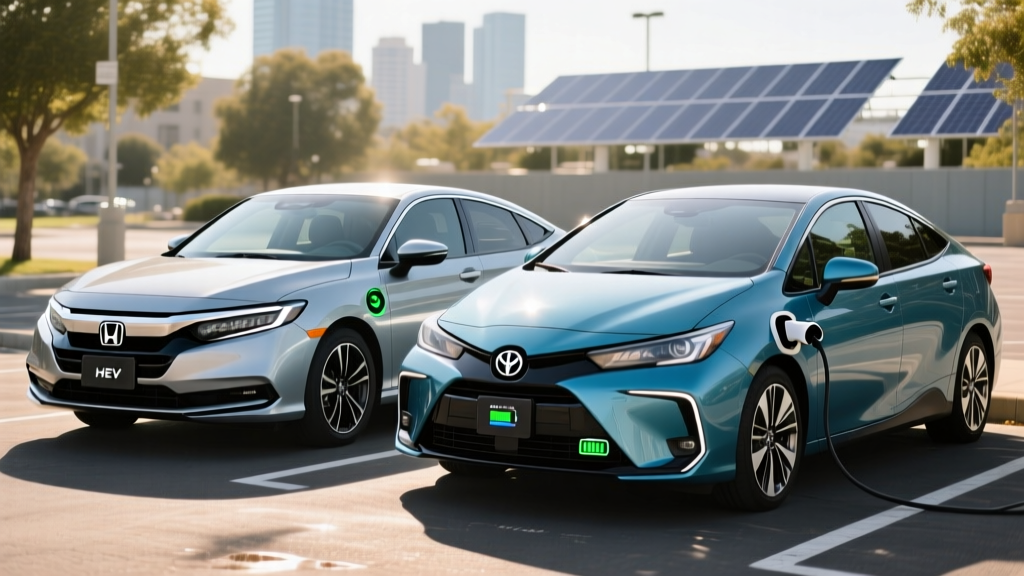
That's the broad definition. The critical split is how the battery gets charged:
Conventional Hybrid (HEV)
- Battery charges only from the engine and regenerative braking
- No plug, no charging cable, no outlet needed
- Small battery (typically 1–2 kWh)
- Electric-only driving limited to brief low-speed moments
- Examples: Toyota Prius, Honda CR-V Hybrid, Hyundai Tucson Hybrid
Plug-In Hybrid (PHEV)
- Battery charges from an external power source (outlet or charger) and from regen/engine
- Has a charging port and comes with a Level 1 cord
- Larger battery (typically 12–25 kWh usable)
- Offers a meaningful electric-only range (25–50+ miles) before the engine starts
- Examples: Toyota RAV4 Prime, Jeep Wrangler 4xe, Chrysler Pacifica Hybrid
If a salesperson tells you a car is "a hybrid," your next question should always be: does it plug in? That single distinction determines whether you'll ever drive on electricity alone and whether you can access federal tax incentives.
How Hybrid Powertrains Actually Work
Modern hybrids use one of three architectures, and the differences affect how the car feels to drive:
Parallel hybrid: The engine and electric motor can both drive the wheels directly. Toyota's Hybrid Synergy Drive (used in the Prius and RAV4 Hybrid) is the most refined example. It seamlessly blends gas and electric power, delivering smooth acceleration and exceptional city efficiency because the motor handles low-speed loads where engines are least efficient.
Series hybrid: The engine never drives the wheels — it acts as a generator to charge the battery or power the electric motor. The Nissan e-Power system (available in some markets) works this way, though it's rare in the U.S.
Series-parallel (power-split): The system can operate in either mode depending on conditions. Most mainstream hybrids from Toyota, Ford, and Hyundai use this architecture. It offers the best of both worlds: electric-only low-speed creep and engine-direct-drive at highway speeds where motors are less efficient.
For PHEVs, the larger battery enables a fourth mode: pure EV driving. The engine stays off entirely until the battery depletes to a threshold (usually around 10–15% state of charge), at which point the vehicle seamlessly transitions to hybrid mode. This is what makes a PHEV function like an EV for daily commuting and like a hybrid for road trips.
Fuel Economy: Real MPG Numbers That Matter
Hybrids shine in city driving, where frequent braking maximizes regenerative energy recovery and the electric motor handles stop-and-go loads. Highway MPG gains are smaller because the engine operates more efficiently at steady speeds anyway.
| Vehicle | Type | City MPG | Highway MPG | Combined MPG | EV Range (mi) |
|---|---|---|---|---|---|
| Toyota Prius (HEV) | HEV | 57 | 56 | 57 | — |
| Toyota Prius Prime | PHEV | 52 (hybrid mode) | 48 | 50 | 44 |
| Honda CR-V Hybrid | HEV | 43 | 36 | 40 | — |
| Toyota RAV4 Prime | PHEV | 40 (hybrid mode) | 36 | 38 | 42 |
| Hyundai Tucson PHEV | PHEV | 38 (hybrid mode) | 38 | 38 | 33 |
| Ford Maverick Hybrid | HEV | 42 | 33 | 38 | — |
| Chrysler Pacifica Hybrid | PHEV | 30 (hybrid mode) | 31 | 30 | 32 |
Source: fueleconomy.gov, U.S. EPA. Figures reflect 2025–2026 model-year data.
Hybrids frequently exceed their EPA city rating in real-world stop-and-go traffic because regen braking is maximized. On the highway, expect 2–5 MPG below the sticker at sustained 75+ mph speeds. PHEV owners who charge daily may use almost no gasoline for commutes under their EV range — the EPA's MPGe and hybrid-mode MPG are separate metrics that don't capture this dual life.
PHEVs in Depth: Electric-Only Range, Charging, and Battery Specs
If you're considering a plug-in hybrid, the electric-only range is the number that determines whether the PHEV actually functions as an EV for your daily needs. Here's what the hardware looks like:
| Vehicle | Battery (kWh usable) | EV Range (mi) | Level 2 Charge Time | DC Fast Charge? | Combined HP |
|---|---|---|---|---|---|
| Toyota RAV4 Prime | 14.9 | 42 | ~2.5 hr (3.3 kW) | No | 302 |
| Toyota Prius Prime | 13.6 | 44 | ~4 hr (3.3 kW) | No | 220 |
| Jeep Wrangler 4xe | 17.3 | 22 | ~2 hr (7.2 kW) | No | 375 |
| Hyundai Tucson PHEV | 13.8 | 33 | ~2 hr (7.2 kW) | No | 261 |
| Chrysler Pacifica Hybrid | 16.0 | 32 | ~2 hr (7.2 kW) | No | 260 |
| BMW X5 xDrive50e | 25.7 | 38 | ~3 hr (7.4 kW) | No | 483 |
A few patterns emerge from this data:
- No current mainstream PHEV offers DC fast charging. The battery packs are small enough that Level 2 (240V) charging replenishes them in 2–4 hours, making DC infrastructure unnecessary for daily use.
- EV range spans 22 to 44 miles. If your round-trip commute is under 40 miles and you charge at home, you may go weeks without the engine starting.
- Combined horsepower is substantial. The electric motor adds meaningful torque, making PHEVs some of the quickest vehicles in their segments (the RAV4 Prime hits 0–60 in 5.7 seconds).
Hybrid vs PHEV vs Full EV: Which Powertrain Fits You?
Choosing between a conventional hybrid, a plug-in hybrid, and a battery-electric vehicle (BEV) comes down to three variables: your daily mileage, your access to charging, and your tolerance for route planning on road trips.
Decision Framework
Choose a conventional hybrid (HEV) if:
- You can't charge at home or work (no garage, no outlet access)
- You want maximum MPG with zero behavior change
- You drive 30+ miles daily and don't want to think about charging
- Your budget is tighter — HEVs carry a smaller price premium over gas models
Choose a plug-in hybrid (PHEV) if:
- You can install a Level 2 charger or have access to a 120V outlet overnight
- Your daily commute is under 40 miles round-trip
- You take regular road trips where EV charging infrastructure is sparse
- You want EV-like daily driving without range anxiety on longer trips
Choose a full EV (BEV) if:
- You have reliable home charging (Level 2 strongly recommended)
- You want zero tailpipe emissions and the lowest per-mile fuel cost
- You're comfortable planning DC fast-charge stops on road trips
- You want to maximize federal tax credit eligibility (§30D applies to BEVs and PHEVs, not HEVs)
Pricing, Tax Credits, and Total Ownership Cost
Hybrids and PHEVs carry a price premium over their gas-only counterparts, but the gap has narrowed considerably. Here's what the market looks like for 2025–2026:
- HEV premium: Typically $1,000–$3,000 over a gas-only equivalent trim. The Toyota Prius starts at approximately $29,000 MSRP; a comparably equipped Corolla (gas) starts around $23,000. Fuel savings of $500–$800/year close the gap in 3–5 years for most drivers.
- PHEV premium: Typically $4,000–$8,000 over the gas equivalent. The RAV4 Prime starts around $44,000 MSRP vs. ~$30,000 for a gas RAV4 LE.
Federal Tax Credit Eligibility (§30D) — 2025–2026 Rules
PHEVs and BEVs can qualify for up to $7,500. Conventional HEVs do NOT qualify.
- Vehicle must be new and assembled in North America (VIN check required)
- MSRP cap: $80,000 for SUVs/pickups/vans; $55,000 for sedans
- Buyer income cap: $300,000 joint / $225,000 head of household / $150,000 single (modified AGI)
- Battery components must meet critical-mineral and sourcing requirements (phasing in through 2026)
- Credit can be transferred to the dealer at point of sale for an immediate price reduction
- Verify current eligibility at IRS.gov — rules are subject to change
For a PHEV like the RAV4 Prime, the full $7,500 credit (if eligible) reduces the effective premium over a gas RAV4 to nearly nothing — a fact that makes PHEVs one of the best value propositions in electrified vehicles today, if you qualify.
State incentives vary widely. States like California, Colorado, and New York offer additional rebates or HOV lane access for PHEVs. Check your state energy office or the AFDC incentive database for current programs.
Battery Longevity, Warranty, and Replacement Costs
Battery reliability is the single most common concern among first-time hybrid buyers. The good news: two decades of real-world data show that hybrid batteries are remarkably durable.
Hybrid Battery Warranty Standards
Federal mandate: All hybrid and PHEV battery packs must carry a minimum warranty of 8 years / 100,000 miles (10 years / 150,000 miles in CARB states including California, New York, Massachusetts, and others).
Manufacturer warranties (2025–2026):
- Toyota: 10 years / 150,000 miles (all hybrids and PHEVs)
- Honda: 8 years / 100,000 miles (10/150k in CARB states)
- Hyundai/Kia: 10 years / 100,000 miles
- Ford: 8 years / 100,000 miles
In practice, hybrid batteries regularly last 150,000–200,000+ miles before significant degradation. The battery packs in HEVs are small (1–2 kWh) and operate in a narrow state-of-charge window (typically 40–80%), which dramatically reduces stress on the cells compared to a full EV that cycles from 10–90%.
Replacement cost if out of warranty:
- HEV battery (Prius, CR-V Hybrid): $2,000–$4,000 for a new OEM pack; refurbished packs available for $1,000–$2,000
- PHEV battery (RAV4 Prime, Wrangler 4xe): $5,000–$9,000 for a new OEM pack
These costs are significant but rarely incurred during the vehicle's typical ownership period. According to Consumer Reports, hybrid powertrains are among the most reliable in the industry, with fewer moving parts than a conventional automatic transmission.
Pros, Cons, and the Bottom Line
Hybrid (HEV) Pros & Cons
Pros:
- 30–50% better city MPG than gas equivalents
- No plug, no charging infrastructure needed
- Proven reliability with 20+ years of data
- Lower purchase price than PHEVs and BEVs
- Regenerative braking reduces brake pad wear
Cons:
- No electric-only driving range
- No federal tax credit eligibility
- Highway MPG gains are modest
- Still 100% gasoline-dependent
Plug-In Hybrid (PHEV) Pros & Cons
Pros:
- 25–44 miles of electric-only range covers most commutes
- Up to $7,500 federal tax credit (if eligible)
- No range anxiety — gas engine for road trips
- Combined HP often exceeds gas-only trims significantly
- Lowest daily fuel cost if you charge regularly
Cons:
- $4,000–$8,000 price premium over gas models
- Requires charging access to realize EV benefits
- Heavier than HEV or gas equivalents (reduces hybrid-mode MPG slightly)
- No DC fast charging — slow top-ups on road trips
- If you don't plug in, you're just carrying dead battery weight
Frequently Asked Questions
How many MPG does a hybrid get compared to a regular gas car?
Conventional hybrids typically achieve 38–57 MPG combined, depending on the model. That's a 30–50% improvement over equivalent gas-only vehicles, which average 25–35 MPG combined. The gains are largest in city driving where regenerative braking and electric-motor assist are most active. The Toyota Prius leads at 57 MPG combined; compact SUV hybrids like the Honda CR-V Hybrid deliver around 40 MPG combined.
How far can a PHEV go on electric only?
Current PHEVs offer 22–44 miles of EPA-rated electric-only range. The Toyota Prius Prime leads the mainstream market at 44 miles; the RAV4 Prime delivers 42 miles; the Jeep Wrangler 4xe manages 22 miles due to its weight and aerodynamics. If your daily round-trip commute falls within this range and you charge at home, the gasoline engine may only run on longer weekend trips.
Do I need to plug in a regular hybrid?
No. Conventional hybrids (HEVs) charge their batteries entirely through the gasoline engine and regenerative braking. There is no charging port and no plug. You fuel them exactly like a gas car. Only plug-in hybrids (PHEVs) have a charging port and benefit from being plugged in — though even PHEVs will operate as regular hybrids if you never plug them in.
Is a hybrid reliable, and what does battery replacement cost?
Hybrids are among the most reliable vehicle types on the road, according to long-term data from Consumer Reports and J.D. Power. The hybrid battery is warranted for at least 8 years/100,000 miles (10/150k in CARB states), and real-world lifespans routinely exceed 150,000 miles. Out-of-warranty replacement costs $2,000–$4,000 for HEVs and $5,000–$9,000 for PHEVs — a meaningful expense, but one that most owners never face during their ownership period.
Does a hybrid qualify for a tax credit?
Conventional hybrids (HEVs) do not qualify for the federal §30D clean vehicle tax credit. Only plug-in hybrids (PHEVs) and full battery-electric vehicles (BEVs) are eligible, for up to $7,500 depending on MSRP caps, buyer income limits, battery sourcing requirements, and North American assembly. The credit can be applied at the point of sale as an immediate price reduction. Always verify current eligibility on IRS.gov and consult a tax professional for your specific situation.
Is a PHEV worth it if I can't charge at home?
Generally, no. Without regular plug-in charging, a PHEV operates as a slightly heavier conventional hybrid, and you lose the electric-only range and fuel-cost advantage that justifies the price premium. If you can't charge at home or work, a conventional hybrid (HEV) delivers excellent efficiency at a lower purchase price — and you won't be paying for battery capacity you never use.