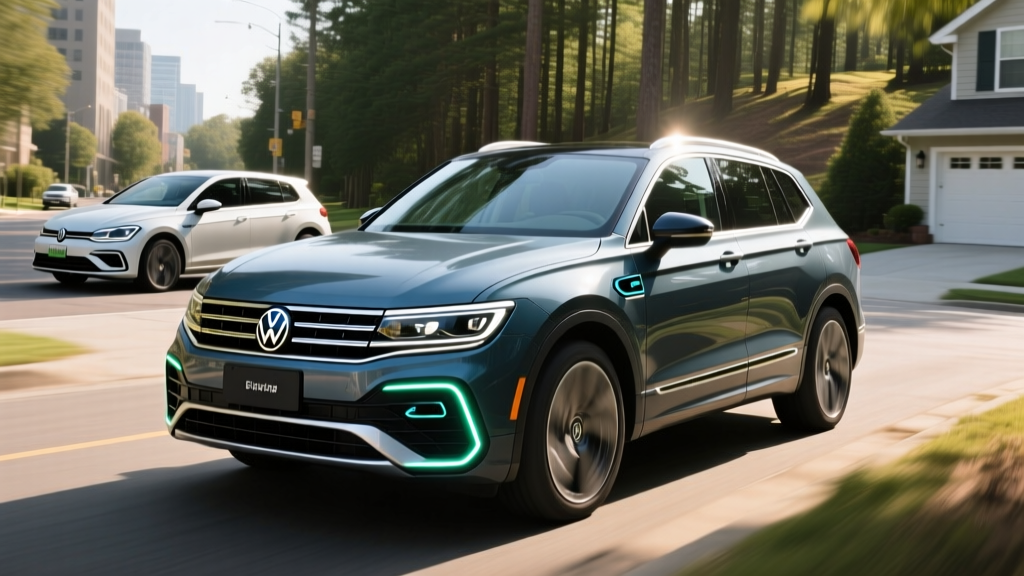
Volkswagen's hybrid strategy in the U.S. has been narrow compared to Toyota or Hyundai, but the 2025 lineup fills two important niches: the redesigned Tiguan eHybrid brings plug-in capability to a compact SUV, and the Golf GTE/eHybrid (available in select markets and anticipated for broader U.S. availability) covers the hatchback segment. This guide breaks down every 2025 VW hybrid and PHEV with the exact numbers buyers need — EPA MPG, electric-only range, battery specs, pricing, and tax-credit eligibility — so you can decide whether a VW hybrid fits your garage or whether a full BEV or conventional gas model makes more sense.
2025 VW Hybrid and PHEV Lineup at a Glance
Volkswagen offers two distinct hybrid architectures for 2025. Understanding the difference is critical before you shop, because the ownership experience — charging needs, fuel savings, and tax-credit eligibility — diverges sharply between them.
HEV vs. PHEV: What VW Buyers Need to Know
Conventional Hybrid (HEV): Uses a small battery (typically 1–2 kWh) charged entirely by the engine and regenerative braking. You never plug it in. It improves MPG modestly, especially in city driving where regen captures braking energy. VW does not currently sell a dedicated HEV in the U.S. for 2025 — the brand has focused on PHEV and full-BEV offerings.
Plug-in Hybrid (PHEV): Pairs a larger battery (13–20 kWh usable) with an electric motor and a gasoline engine. You plug it in to charge (Level 1 or Level 2), and it can drive 30–50 miles on electricity alone before the engine engages. Once the battery depletes, it operates like a conventional hybrid. PHEVs may qualify for federal tax credits under IRS §30D if they meet battery-sourcing and MSRP requirements.
| Specification | 2025 Tiguan eHybrid | 2025 Golf GTE (EU/Announced) | 2025 Golf eHybrid (EU/Announced) |
|---|---|---|---|
| Powertrain Type | PHEV | PHEV | PHEV |
| Engine | 1.5L turbo I4 + electric motor | 1.5L turbo I4 + electric motor | 1.5L turbo I4 + electric motor |
| Combined System HP | ~245 hp (est.) | 245 hp | 204 hp |
| Battery (usable kWh) | ~19.7 kWh (est.) | 19.7 kWh | 19.7 kWh |
| Electric-Only Range (WLTP) | ~62 mi (WLTP est.) | ~62 mi (WLTP) | ~75 mi (WLTP) |
| Electric-Only Range (EPA est.) | ~40–48 mi (est.) | N/A (not EPA-rated) | N/A (not EPA-rated) |
| Level 2 Charge Time (0–100%) | ~2.5–3 hours at 7.2 kW | ~2.75 hours at 7.2 kW | ~2.75 hours at 7.2 kW |
| DC Fast Charging | No | No | No |
| 0–60 mph (est.) | ~7.5 sec | ~6.5 sec | ~7.8 sec |
| Starting MSRP (est.) | ~$40,000–$43,000 | Not U.S.-priced | Not U.S.-priced |
Note: The Golf GTE and Golf eHybrid are confirmed for European markets. U.S. availability for 2025–2026 remains unannounced as of this writing. Specifications for the U.S.-market Tiguan eHybrid are based on VW's global platform data and may differ from final EPA certification. Always confirm with your local dealer.
2025 VW Tiguan eHybrid: Range, MPG, and Real-World Efficiency
The redesigned 2025 Tiguan is the most significant VW hybrid product for American buyers. Built on the MQB Evo platform, the Tiguan eHybrid pairs a 1.5-liter turbocharged four-cylinder engine with an electric motor integrated into the six-speed DSG automatic transmission. Combined output is estimated at approximately 245 horsepower — a meaningful step up from the gas-only Tiguan's 184 hp.
Electric-Only Range and Total Range
EPA-Estimated Electric Range: ~40–48 miles (pending final EPA certification)
Real-World Expectation: Expect 35–42 miles of electric-only driving in mixed city/highway conditions at moderate temperatures. Highway-heavy commutes at 70+ mph will reduce electric range to approximately 28–35 miles due to aerodynamic drag and the absence of regenerative braking opportunities. Cold weather (below 32°F) can reduce electric range by 20–30%, bringing winter electric-only distance to roughly 25–33 miles.
Total Combined Range (electric + gas): Approximately 430–480 miles with a full tank and full battery.
Fuel Economy: EPA MPG and Real-World Results
Once the battery is depleted, the Tiguan eHybrid operates as a conventional hybrid. VW's European WLTP figures suggest combined fuel consumption around 166 MPGe (electric + gas combined) and approximately 36–40 MPG on gasoline alone after battery depletion. U.S. EPA figures are pending final certification.
| Mode | City | Highway | Combined |
|---|---|---|---|
| Charge-Depleted (Gas Hybrid) | ~38 MPG | ~35 MPG | ~37 MPG |
| MPGe (with full battery) | ~166 MPGe (est., WLTP-based) | ||
| Gas-Only Tiguan (baseline) | 24 MPG | 32 MPG | 27 MPG |
Real-world MPG note: Hybrids and PHEVs typically exceed their EPA city estimates in stop-and-go traffic, where regenerative braking recaptures the most energy. Highway driving, where the engine runs continuously, tends to come in at or slightly below the EPA highway figure. If your commute is mostly city miles and you charge nightly, you may use gasoline only on longer weekend trips.
Charging the Tiguan eHybrid: What You Need at Home
The Tiguan eHybrid uses a 19.7 kWh (usable) lithium-ion battery pack. Unlike full EVs, VW's current PHEV platform does not support DC fast charging — all charging is AC-only via the J1772 connector.
| Charging Level | Power (kW) | Time (0–100%) | Notes |
|---|---|---|---|
| Level 1 (120V outlet) | ~1.4 kW | ~14 hours | Trickle charge; suitable for overnight if daily electric use is modest |
| Level 2 (240V, 32A) | 7.2 kW | ~2.5–3 hours | Recommended for daily home charging; requires a 40A circuit |
| DC Fast Charge | N/A | N/A | Not supported on VW PHEVs |
Home charging setup: A Level 2 home charger (such as a ChargePoint Home Flex or Emporia Level 2) on a NEMA 14-50 outlet or hardwired 240V circuit is the practical standard for PHEV owners. Installation typically costs $500–$1,500 depending on panel capacity and wiring distance. Since the PHEV battery is under 20 kWh, even a Level 1 standard outlet can replenish the battery overnight if your daily electric-only driving is under 30 miles — but Level 2 is strongly recommended for convenience and battery preconditioning.
Pricing, Trims, and Tax-Credit Eligibility
The 2025 Tiguan eHybrid is expected to start in the $40,000–$43,000 range for the base SE trim, with higher trims (SEL, SEL Premium) pushing toward $47,000–$50,000. These are estimates pending official U.S. pricing.
Federal Tax Credit (§30D) for PHEVs — Current Rules
- Credit amount: Up to $7,500 for qualifying new PHEVs, or up to $3,750 if only one of the two sourcing requirements (critical minerals OR battery components) is met
- Battery capacity: Must be at least 7 kWh (Tiguan eHybrid qualifies at ~19.7 kWh)
- MSRP cap: SUVs/vans/pickups must be under $80,000; sedans under $55,000 (Tiguan qualifies as an SUV)
- Buyer income cap: AGI must not exceed $150,000 (single), $225,000 (head of household), or $300,000 (joint)
- Battery sourcing: Critical minerals and battery components must meet phased-in percentage thresholds from qualifying sources — this is the requirement most likely to disqualify a vehicle. Check the latest IRS eligibility list at IRS.gov
- Point-of-sale transfer: As of 2024+, you can transfer the credit to the dealer at purchase, reducing your out-of-pocket cost immediately rather than waiting for tax filing
Important: VW's battery supply chain sourcing will determine whether the Tiguan eHybrid earns the full $7,500, a partial $3,750, or no credit. Always verify current eligibility on the IRS qualified vehicles list before purchasing. State incentives may also apply — check your state energy office or AFDC incentive database.
Battery Longevity, Warranty, and Replacement Costs
Hybrid and PHEV battery longevity is consistently the top concern for buyers transitioning from conventional vehicles. Here's what the data shows for VW's PHEV platform.
VW PHEV Battery Warranty
Coverage: 8 years / 100,000 miles (whichever comes first), consistent with federal emissions-component warranty requirements. In CARB states (California and states adopting CARB standards), coverage may extend to 10 years / 150,000 miles.
Capacity threshold: VW warrants the high-voltage battery to retain at least 70% of its original capacity during the warranty period. If capacity falls below this threshold, VW will repair or replace the battery at no cost.
Real-world degradation: VW's PHEV batteries use a conservative buffer strategy — the vehicle never charges to true 100% or discharges to true 0%, which significantly reduces calendar and cycle degradation. Based on data from earlier VW GTE models in Europe, expect approximately 5–8% capacity loss over 5 years and 60,000 miles of typical use. Most PHEV batteries outlast their warranty periods with capacity remaining above 80%.
Battery Replacement Cost
If a battery replacement is needed out of warranty, expect a cost in the range of $6,000–$9,000 for the pack itself, plus $1,000–$2,000 in labor, based on current VW PHEV parts pricing. However, individual module replacement (rather than the full pack) may be possible at lower cost, depending on the failure mode. For context, out-of-warranty PHEV battery replacements remain rare — most failures occur within the warranty window, and long-term data from the MQB PHEV platform in Europe shows strong durability.
Driving Experience: Performance and Refinement
The Tiguan eHybrid's combined 245 hp gives it noticeably stronger acceleration than the gas-only Tiguan, with an estimated 0–60 mph time of approximately 7.5 seconds. The electric motor provides instant torque at low speeds, making the PHEV feel responsive in city driving and highway merging.
In electric-only mode, the Tiguan eHybrid is quiet and smooth — ideal for residential neighborhoods and short commutes. The transition from electric to hybrid mode is generally seamless, though you may notice a slight vibration when the 1.5L turbo engine starts under load. The six-speed DSG transmission shifts crisply in most conditions, though it can hesitate slightly during low-speed maneuvers — a characteristic common to dual-clutch designs.
Regenerative braking: The Tiguan eHybrid offers adjustable regen levels via steering-wheel paddles or the infotainment menu. It does not offer true one-pedal driving (full stop via regen alone), which is more common in full BEVs. Expect moderate regen that slows the vehicle noticeably but still requires the brake pedal for a complete stop.
Tiguan eHybrid vs. Gas Tiguan vs. Full EV: Which Should You Choose?
Decision Framework
Choose the Tiguan eHybrid (PHEV) if:
- You can charge at home (Level 1 or Level 2) and your daily commute is under 40 miles round-trip
- You want electric daily driving but need gasoline flexibility for road trips without route-planning around chargers
- You're not ready for a full EV but want meaningful fuel savings and lower tailpipe emissions on most trips
- You want more power than the gas Tiguan offers (245 hp vs. 184 hp)
Choose the gas Tiguan if:
- You cannot charge at home (apartment, street parking, no garage outlet access)
- Your daily commute regularly exceeds 50 miles, negating much of the PHEV's electric advantage
- The $8,000–$12,000 price premium of the eHybrid over the gas Tiguan doesn't pencil out against your annual mileage and fuel costs
Choose a full EV (e.g., VW ID.4, Hyundai Ioniq 5, Tesla Model Y) if:
- You can install a Level 2 home charger and want to eliminate gasoline entirely
- You want access to DC fast charging for road trips (20–30 minute stops at 150–250 kW)
- You want the lowest per-mile "fuel" cost — home electricity at $0.14/kWh costs roughly $0.04–$0.05/mile vs. $0.12–$0.16/mile for gasoline in a hybrid
- You want zero tailpipe emissions and a simpler powertrain with fewer maintenance items (no oil changes, no transmission fluid)
Tiguan eHybrid Pros
- 30–48 miles of electric-only range covers most daily commutes
- No range anxiety — gasoline engine for longer trips
- 245 hp combined output; significantly quicker than gas Tiguan
- Potential federal tax credit up to $7,500 (verify IRS eligibility)
- Conservative battery management promotes long-term durability
- Familiar SUV packaging with no compromise on cargo space
Tiguan eHybrid Cons
- No DC fast charging — road-trip charging limited to Level 2
- Estimated $40K+ starting price; significant premium over gas Tiguan
- Tax-credit eligibility uncertain pending battery-sourcing confirmation
- Electric range drops meaningfully in cold weather and at highway speeds
- DSG transmission can hesitate at low speeds
- U.S. availability and final EPA figures still pending for some trims
What About the Golf GTE and Golf eHybrid?
Volkswagen sells two PHEV variants of the Golf in Europe: the sport-oriented Golf GTE (245 hp, performance-tuned) and the efficiency-focused Golf eHybrid (204 hp, optimized for maximum electric range). Both use the same 19.7 kWh battery pack and 1.5L turbo engine, but the GTE's tuning prioritizes combined power output while the eHybrid prioritizes electric efficiency.
As of early 2025, VW has not confirmed U.S. availability for either Golf PHEV variant. The U.S. Golf lineup has been limited to the gas-powered GTI and Golf R in recent years. If VW reintroduces a PHEV Golf to the U.S. market, expect pricing in the $35,000–$40,000 range with electric-only range of approximately 40–50 miles (EPA estimate) and the same 7.2 kW Level 2 charging capability as the Tiguan eHybrid.
For buyers specifically seeking a PHEV hatchback in the U.S. today, alternatives like the Toyota Prius Prime (44 miles electric, 52 MPG hybrid mode, ~$33,000) and the Hyundai Ioniq PHEV (discontinued after 2022, but available used) remain the primary options.
5-Year Ownership Cost Estimate
| Cost Category | Tiguan eHybrid (PHEV) | Gas Tiguan (2.0T) |
|---|---|---|
| Purchase Price (base MSRP) | ~$41,500 | ~$30,500 |
| Federal Tax Credit | –$3,750 to –$7,500 (if eligible) | $0 |
| Net Purchase Cost | ~$34,000–$37,750 | ~$30,500 |
| Fuel (5 yr, 75K mi) | ~$3,800–$5,200 (mix of electricity + gas) | ~$8,500–$10,000 |
| Maintenance (5 yr) | ~$2,800 | ~$3,500 |
| Insurance (5 yr avg.) | ~$7,500 | ~$6,800 |
| Estimated Depreciation | ~$16,000–$19,000 | ~$14,000–$16,000 |
| Total 5-Year Cost (est.) | ~$64,000–$72,000 | ~$63,000–$70,000 |
Key takeaway: The PHEV's fuel savings ($3,000–$5,000 over 5 years) largely offset its higher purchase price, especially if the federal tax credit applies. The break-even point typically arrives around year 3–4 for owners who charge daily and drive primarily on electricity. If you cannot charge at home, the PHEV premium is harder to justify economically.
Frequently Asked Questions
How many MPG does the 2025 VW Tiguan eHybrid get?
Once the battery is depleted, the Tiguan eHybrid is estimated to achieve approximately 37 MPG combined (38 city / 35 highway) as a conventional hybrid. This is a significant improvement over the gas-only Tiguan's 27 MPG combined. When operating with a charged battery, the combined MPGe rating is estimated at approximately 166 MPGe, though this figure depends heavily on how much of your driving is done on electricity versus gasoline.
How far can the Tiguan eHybrid go on electric only?
The estimated EPA electric-only range is approximately 40–48 miles, though final EPA certification is pending. In real-world conditions, expect 35–42 miles in mixed driving, dropping to 25–33 miles in cold weather or sustained highway driving above 70 mph. This range is sufficient to cover the average American's daily commute (approximately 35 miles round-trip, per U.S. Census data) entirely on electricity.
Does the 2025 VW Tiguan eHybrid qualify for a tax credit?
Potentially. Under current IRS §30D rules, the Tiguan eHybrid meets the battery-capacity threshold (19.7 kWh, well above the 7 kWh minimum) and the MSRP cap for SUVs ($80,000). However, eligibility depends on battery-component and critical-mineral sourcing requirements that are verified on a per-model basis. Check the IRS qualified vehicles list before purchasing. Buyer income limits also apply ($150K single / $300K joint). The credit can be transferred to the dealer at point of sale, reducing your purchase price directly.
Is the VW PHEV battery reliable, and what does replacement cost?
VW's MQB-based PHEV battery packs have demonstrated strong reliability in European-market GTE and eHybrid models since 2020. The battery is warranted for 8 years / 100,000 miles with a 70% capacity-retention threshold. Conservative buffer management (the car never charges or discharges to true limits) reduces stress on cells. Out-of-warranty replacement, if ever needed, is estimated at $7,000–$11,000 including labor. However, PHEV battery replacement remains uncommon — most packs outlast their warranty periods with minimal degradation.
Can I charge the Tiguan eHybrid at a public fast charger?
No. The Tiguan eHybrid does not support DC fast charging (CCS, NACS, or CHAdeMO). All charging is AC-only via the J1772 connector at Level 1 (120V) or Level 2 (240V) speeds. This is standard for virtually all current PHEVs — the battery is small enough that Level 2 charging replenishes it in 2.5–3 hours, and the cost of adding DC fast-charge hardware isn't justified for a ~20 kWh pack. Plan to charge at home or at Level 2 destination chargers.
Hybrid vs. PHEV vs. full EV — which VW should I buy?
VW does not currently sell a conventional (non-plug-in) hybrid in the U.S. Your choice is between the Tiguan eHybrid (PHEV), the gas Tiguan, or a full EV like the VW ID.4. If you can charge at home and want electric daily driving with gas-engine backup for road trips, the PHEV is the ideal bridge. If you want to eliminate gasoline entirely and have home charging, the ID.4 (EPA range ~275 miles, DC fast charging at up to 175 kW) is the stronger long-term play. If you cannot charge at home, stick with the gas Tiguan — a PHEV you never plug in is just a heavier, more expensive hybrid with marginal MPG gains.
Sources: fueleconomy.gov (EPA ratings), IRS §30D qualified vehicle list, Volkswagen AG global press specifications. All estimates marked as such are based on pre-certification data and may change upon final EPA testing. Verify all pricing and credit eligibility with your dealer and tax professional before purchasing.