If you've been searching for a hybrid van VW in the United States, you've likely hit a wall of conflicting information. Volkswagen's van lineup has expanded dramatically, but the powertrain options available to American buyers look very different from what's sold overseas. This guide cuts through the confusion with exact specs, real-world efficiency data, and a clear framework for deciding whether a VW electrified van — or a competitor — is right for your family.
The VW Van Lineup in 2026: What's Actually Available
Volkswagen currently sells two electrified vans globally, but only one is available in the U.S. market:
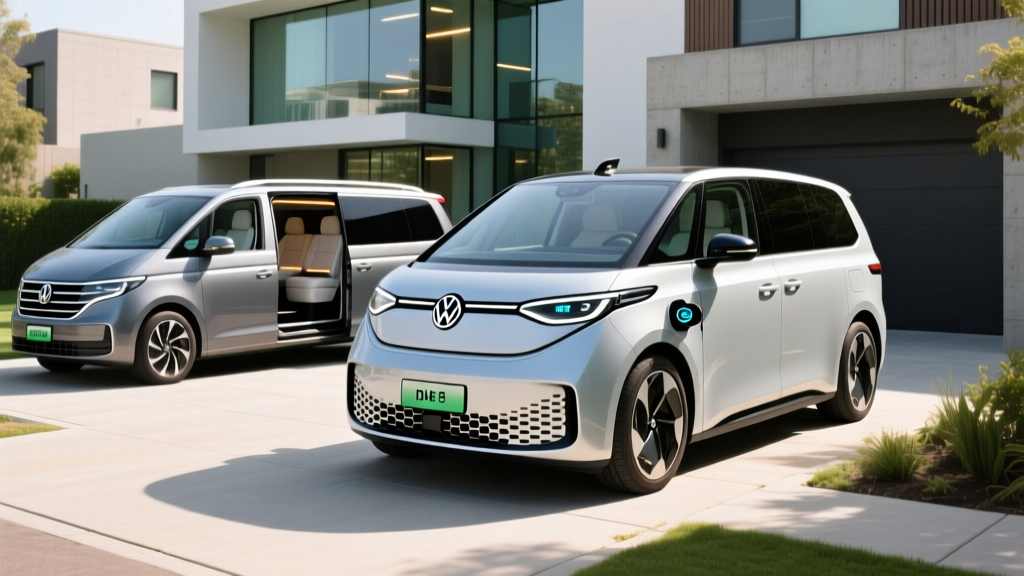
- VW ID. Buzz (BEV) — The all-electric retro-styled minivan, available in the U.S. since late 2024 as a 2025 model and continuing into 2026. This is a battery-electric vehicle, not a hybrid.
- VW Multivan eHybrid (PHEV) — A plug-in hybrid version of VW's modular van, sold in Europe. Not available in the United States.
VW does not currently offer a conventional hybrid (HEV) van in any market. There is no self-charging hybrid VW minivan you can buy new in America. If you need a VW-branded electrified people-mover, the ID. Buzz is your only option.
VW ID. Buzz: The Electric Van Americans Can Actually Buy
The 2026 VW ID. Buzz is a three-row, rear-wheel-drive or all-wheel-drive electric minivan built on VW's MEB platform. It channels the spirit of the classic Microbus with modern EV architecture. Here are the numbers that matter:
| Spec | RWD (Standard) | AWD (4MOTION) |
|---|---|---|
| EPA Range | 234 miles | 231 miles |
| Battery (usable) | 86 kWh (NMC) | 86 kWh (NMC) |
| Horsepower | 282 hp | 335 hp |
| 0–60 mph | ~7.9 sec | ~6.5 sec |
| Max DC Fast Charge | 175 kW | 175 kW |
| 10–80% DC Charge | ~26 min | ~26 min |
| Level 2 Charge Rate | 11 kW | 11 kW |
| Cargo (behind 3rd row) | 18.2 cu ft | 18.2 cu ft |
| Starting MSRP | $59,995 | $63,495 |
The VW Multivan eHybrid: Europe's PHEV Van (Not Sold in the U.S.)
The VW Multivan eHybrid is a plug-in hybrid minivan sold across European markets. It pairs a 1.4-liter turbocharged four-cylinder engine with an electric motor for a combined output of approximately 215 horsepower. Key specs from the European market:
- Battery: 13.0 kWh (usable), NMC chemistry
- Electric-only range: ~31 miles (WLTP; expect ~25–27 miles in real-world driving)
- Combined fuel economy: ~157 MPGe (WLTP, heavily weighted toward electric operation)
- Gas-only operation: ~33 MPG combined once battery is depleted
- DC fast charging: Not available — AC-only at up to 3.6 kW (~3.5 hours for full charge)
- Starting price (Germany): ~€55,000 (~$59,000 USD equivalent)
The Multivan eHybrid is a legitimate PHEV with enough electric range for school runs and grocery trips, but its relatively small battery and lack of DC fast charging limit its electric utility. VW has no announced plans to bring this vehicle to North America.
HEV vs PHEV vs BEV: Which VW Van Powertrain Makes Sense?
Since VW doesn't sell a conventional hybrid van, here's how the powertrain types compare and where the ID. Buzz fits:
| Factor | HEV (Conventional Hybrid) | PHEV (Plug-In Hybrid) | BEV (Battery Electric) |
|---|---|---|---|
| Plug in required? | No | Yes, for EV range | Yes, always |
| Electric-only range | None (motor assists engine) | 20–40 mi typical | 200–300+ mi |
| Home charging needed | No | Recommended | Essential |
| Fuel cost per mile | ~$0.10–0.12 | ~$0.04 electric / $0.10 gas | ~$0.03–0.05 |
| Maintenance complexity | Moderate (engine + motor) | High (two full systems) | Low (no engine) |
| Example in U.S. | Toyota Sienna Hybrid | Chrysler Pacifica PHEV | VW ID. Buzz |
Real-World Efficiency: ID. Buzz vs the Hybrid Competition
If you're cross-shopping a hybrid van against the ID. Buzz, efficiency comparisons are essential. The EPA's fueleconomy.gov data provides the baseline:
| Vehicle | Powertrain | EPA Combined | City | Highway | Est. Annual Fuel Cost |
|---|---|---|---|---|---|
| VW ID. Buzz (RWD) | BEV | 86 MPGe | 89 MPGe | 82 MPGe | ~$650 (electricity) |
| Toyota Sienna Hybrid | HEV | 36 MPG | 36 MPG | 36 MPG | ~$1,550 (gas) |
| Chrysler Pacifica PHEV | PHEV | 82 MPGe / 30 MPG | — | — | ~$900 (mixed) |
The ID. Buzz wins on operating cost by a wide margin if you charge at home. The Toyota Sienna Hybrid wins on total range (520+ miles) and requires zero charging infrastructure. The Chrysler Pacifica PHEV splits the difference with 32 miles of electric range and a gas engine backup — but it's aging and no longer receiving significant updates.
Battery Warranty, Reliability & Replacement Costs
Hybrid and EV battery longevity is the top concern for buyers spending $50,000+ on a family vehicle. Here's what you need to know:
• VW ID. Buzz (BEV): 8 years / 100,000 miles — guaranteed to retain at least 70% of original capacity
• Toyota Sienna Hybrid: 10 years / 150,000 miles on hybrid battery
• Chrysler Pacifica PHEV: 10 years / 150,000 miles on high-voltage battery (where required by state); 8 yr / 100,000 mi federally
Battery replacement costs if you're out of warranty:
- ID. Buzz (86 kWh NMC pack): Estimated $12,000–$18,000 for the pack alone, plus labor. Prices are expected to decline as battery costs fall industry-wide.
- Toyota Sienna hybrid battery: $3,000–$5,000 — smaller pack, well-established supply chain.
- Pacifica PHEV battery: $7,000–$10,000 for the 16 kWh pack.
On reliability, VW's MEB platform has shown improvement since the early ID.4 launch, but the brand still trails Toyota in long-term dependability rankings. The Sienna's hybrid system has been in production since 2021 with very few reported battery failures. The ID. Buzz is newer and has less long-term data, though its 86 kWh pack is oversized relative to daily use, which reduces cycle-depth stress and should slow degradation.
Pricing, Tax Credits & Total Cost of Ownership
The ID. Buzz starts at $59,995 (RWD Pro S) and climbs to approximately $69,995 for a fully loaded AWD 1st Edition. That's a premium over the Sienna Hybrid ($39,000–$54,000) and Pacifica PHEV ($51,000–$58,000).
Federal tax credit eligibility (§30D): As of 2026, the VW ID. Buzz does not qualify for the full $7,500 federal EV tax credit due to battery component and critical mineral sourcing requirements under the Inflation Reduction Act. VW has been working to localize battery sourcing, but buyers should verify current eligibility on the IRS clean vehicle credit list before purchasing. The credit can be transferred to the dealer at point of sale if eligible, acting as an instant discount.
- MSRP cap (vans/SUVs): $80,000 — ID. Buzz clears this
- Buyer income cap: $300,000 joint / $150,000 single — applies to buyer
- Battery sourcing: Must meet escalating critical mineral and component requirements — verify on IRS list
- Assembly: Must be assembled in North America — ID. Buzz is built in Hannover, Germany, which disqualifies it from §30D as of 2026
The foreign-assembly requirement is the dealbreaker: since the ID. Buzz is manufactured in Germany, it does not qualify for the new-vehicle §30D credit regardless of battery sourcing. A used ID. Buzz may qualify for the up-to-$4,000 used clean vehicle credit (§25E) once models enter the secondary market.
| Category | VW ID. Buzz (RWD) | Toyota Sienna Hybrid | Chrysler Pacifica PHEV |
|---|---|---|---|
| Purchase price (base) | $59,995 | $39,485 | $51,095 |
| Federal tax credit | $0 | $0 | $0* |
| Fuel/energy (5 yr, 15K mi/yr) | ~$3,250 | ~$7,750 | ~$4,500 |
| Maintenance (5 yr) | ~$2,000 | ~$3,500 | ~$4,000 |
| Insurance (5 yr est.) | ~$12,500 | ~$9,500 | ~$10,500 |
| Depreciation (est.) | ~$22,000 | ~$14,000 | ~$19,000 |
| 5-Year Total | ~$99,745 | ~$74,235 | ~$89,095 |
*Pacifica PHEV credit eligibility varies by model year and sourcing; verify with IRS. Totals are estimates based on national averages.
Who Should Buy the ID. Buzz — And Who Should Look Elsewhere
- You have home Level 2 charging and drive under 200 miles daily
- You want the lowest per-mile energy cost (~$0.04/mi)
- Style and interior ambiance matter — the ID. Buzz cabin is genuinely unique
- You value quiet, vibration-free driving and one-pedal regen
- Budget is $55,000+ after incentives
- You can't install a home charger (apartment, no garage)
- You take frequent 400+ mile road trips and don't want to plan around chargers
- Budget is under $45,000 (Toyota Sienna territory)
- You want proven long-term reliability data (Toyota's hybrid system)
- You need the maximum possible total range on one fill-up
Frequently Asked Questions
Does VW make a hybrid van?
VW makes the Multivan eHybrid (PHEV) in Europe, but it is not sold in the United States. In America, VW's only electrified van is the ID. Buzz, which is fully electric (BEV), not a hybrid. There is no conventional hybrid VW van available in any market.
How many MPG does the VW ID. Buzz get?
The ID. Buzz doesn't use MPG — it's electric. Its EPA efficiency rating is 86 MPGe combined (89 city / 82 highway). In real-world terms, that translates to roughly 2.0–2.2 kWh per mile, or about $0.04 per mile when charging at home on a national average electricity rate of $0.16/kWh.
How far can the VW Multivan PHEV go on electric only?
The European-market Multivan eHybrid achieves approximately 31 miles of electric-only range on the WLTP cycle (roughly 25–27 miles in real-world conditions). This vehicle is not available in the U.S.
Is the VW ID. Buzz reliable?
Early ID. Buzz models have shown improvement over VW's first-generation MEB vehicles (ID.4, ID.3), with fewer reported software glitches. However, VW as a brand still ranks below Toyota and Honda in long-term dependability studies from J.D. Power and Consumer Reports. The 8-year/100,000-mile battery warranty provides a solid backstop.
What is the battery replacement cost for the ID. Buzz?
Out-of-warranty replacement for the 86 kWh NMC battery pack is estimated at $12,000–$18,000 including labor. Industry-wide battery cost declines should reduce this figure over time. Under warranty, VW replaces or repairs the pack if capacity drops below 70% within 8 years or 100,000 miles.
Does the VW ID. Buzz qualify for any tax credit?
As of 2026, the ID. Buzz does not qualify for the $7,500 federal §30D new clean vehicle credit because it is assembled in Hannover, Germany — and the credit requires North American final assembly. It may qualify for the up-to-$4,000 used EV credit (§25E) once pre-owned examples become available. Some states offer their own rebates that don't require domestic assembly; check your state's energy office for details.
Hybrid vs PHEV vs EV — which van fits me?
If you have reliable home charging and mostly drive under 200 miles a day, the ID. Buzz (BEV) offers the lowest running costs and smoothest driving experience. If you lack home charging or regularly drive 400+ miles, the Toyota Sienna Hybrid (HEV) gives you 520+ miles of range with no plug required. The Chrysler Pacifica PHEV splits the difference with 32 miles of electric range and a gas backup, but it's the oldest design in this group.