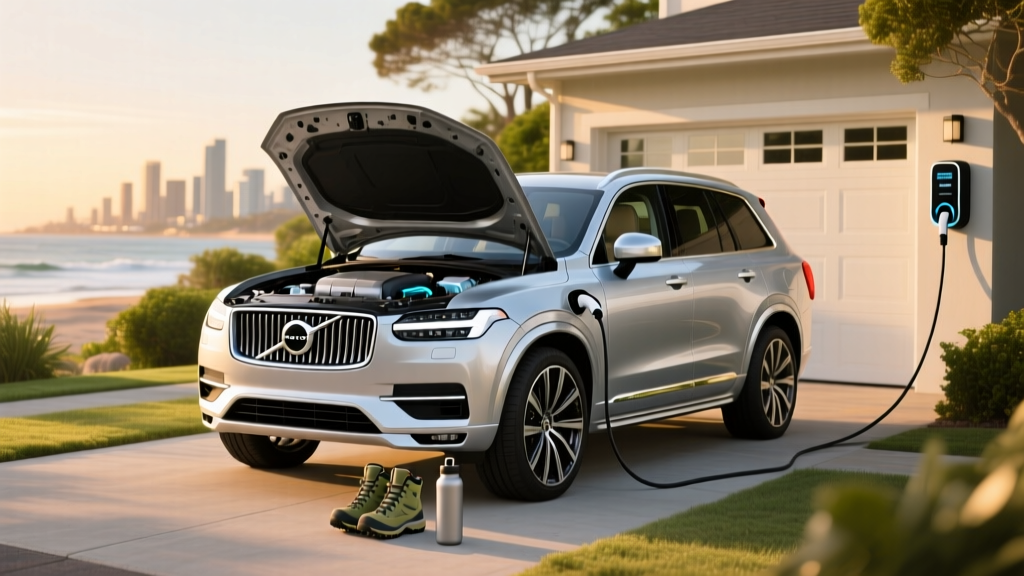
The Volvo XC90 T8 Recharge is a three-row luxury plug-in hybrid (PHEV) that tries to give you the best of both worlds: short electric-only commutes and gas-engine flexibility for long road trips. For the 2026 model year, Volvo has refined the powertrain and battery to make the XC90 T8 one of the more capable PHEVs in the luxury SUV segment. But does the real-world efficiency match the EPA sticker, and does it make financial sense over a full battery-electric vehicle (BEV) or a conventional hybrid? This guide breaks down every number you need.
HEV vs. PHEV: Where the XC90 T8 Fits
Before diving into specs, it's critical to understand the distinction between a conventional hybrid (HEV) and a plug-in hybrid (PHEV) like the XC90 T8.
Conventional Hybrid (HEV)
- Small battery (~1-2 kWh), charged only by regenerative braking and the engine
- Never plugs in — you fuel it like a normal gas car
- Electric motor assists the engine; no meaningful electric-only driving
- Example: Toyota Highlander Hybrid
Plug-In Hybrid (PHEV) — XC90 T8 Recharge
- Larger battery (18.8 kWh usable), charges via plug or regen
- Plug into a Level 1 (120V) or Level 2 (240V) charger to unlock EV range
- Can drive 36 miles on electricity alone before the gas engine engages
- Functions as a hybrid once the battery is depleted
The XC90 T8 is strictly a PHEV. If you never plug it in, you're carrying around a heavy battery for no benefit — you'd get better fuel economy from a lighter, conventional hybrid. The T8 rewards owners who charge regularly.
Powertrain and Performance Specs
| Specification | 2026 Volvo XC90 T8 Recharge |
|---|---|
| Engine | 2.0L turbocharged & supercharged 4-cylinder |
| Electric Motor | 143 hp rear-axle motor (eAWD) |
| Combined System Output | 455 hp / 523 lb-ft torque |
| Transmission | 8-speed automatic |
| Battery (Usable) | 18.8 kWh lithium-ion (NMC chemistry) |
| Drivetrain | eAWD (front wheels engine-driven, rear wheels electric) |
| 0–60 mph | 5.5 seconds (EPA-rated) |
| Towing Capacity | 5,000 lbs |
| Cargo Volume (behind 3rd row) | 15.8 cu ft |
| Seating | 6 or 7 passengers |
The T8's eAWD system is unconventional: the gas engine drives only the front wheels, while the electric motor powers the rears. There's no mechanical connection between the axles. In EV-only mode, the XC90 is effectively rear-wheel drive. Under hard acceleration or when traction is needed, both power sources engage simultaneously for all-wheel drive.
Electric-Only Range and Total Driving Range
EPA Electric-Only Range: 36 miles
Real-world expectation: Expect 28–33 miles in mixed driving (city/highway blend). Highway-only driving at 70+ mph may drop this to 25–28 miles. In cold weather (below 32°F), plan on 20–25 miles of electric range due to cabin heating demand and reduced battery efficiency. The heat pump on the 2026 model mitigates some of this loss compared to earlier model years.
Once the battery depletes, the 2.0L engine takes over and the XC90 operates as a conventional hybrid. With an 18.8-gallon fuel tank and approximately 27 MPG in hybrid-only mode, total combined range (EV + gas) reaches roughly 540–560 miles.
Fuel Economy: MPGe and MPG Breakdown
| Metric | City | Highway | Combined |
|---|---|---|---|
| MPGe (charge-depleting + sustaining) | — | — | 55 MPGe |
| MPG (gas-only, battery depleted) | 26 | 28 | 27 |
| Energy consumption (EV mode) | 63 kWh/100 mi | ||
Source: EPA Fueleconomy.gov
Real-World MPG vs. EPA Sticker
The 27 MPG combined gas-only figure is measured after the battery is depleted. In real-world ownership:
- City driving (short trips with regular charging): Many owners burn little to no gas, effectively achieving 100+ MPGe over a week of commuting.
- Highway road trips (no charging): Expect 25–27 MPG at 70 mph. The boxy SUV aerodynamics and 5,000+ lb curb weight work against it.
- Cold-weather gas-only: 23–25 MPG is realistic in sub-freezing temperatures.
PHEVs like the XC90 T8 reward daily charging. If your commute is under 30 miles round-trip and you charge every night, you may visit a gas station only on road trips.
Charging: Speeds, Times, and Equipment
| Charging Level | Power | 0–100% Time | Miles of EV Range per Hour |
|---|---|---|---|
| Level 1 (120V household) | ~1.4 kW | ~13–14 hours | ~5–6 miles/hr |
| Level 2 (240V, home or public) | ~3.6 kW (onboard charger limit) | ~5 hours | ~14–16 miles/hr |
| DC Fast Charging | Not supported — no DC fast charge port | ||
The XC90 T8's onboard charger maxes out at 3.6 kW, which is typical for PHEVs but slow compared to full EVs. This means even if you plug into a 48-amp Level 2 charger capable of 11.5 kW, the car will only accept 3.6 kW. A full charge from empty still takes about 5 hours on Level 2.
The lack of DC fast charging is a notable limitation. On road trips, you cannot top up the battery at a highway Electrify America or Tesla Supercharger station. This is standard for nearly all PHEVs in this class — DC fast charging on PHEVs remains rare and is typically reserved for larger-battery vehicles.
Home Charging Setup
Most XC90 T8 owners will want a Level 2 home charger. A 16-amp, 240V circuit (like a NEMA 14-50 outlet) is sufficient. Expect to spend $500–$1,500 on a Level 2 EVSE (charger) and $300–$1,200 on electrician installation, depending on panel proximity and local permit costs. A full panel upgrade (to 200A) can add $1,500–$3,000 if your home's electrical service is older.
Pricing, Trims, and Tax Credit Eligibility
The 2026 Volvo XC90 T8 Recharge starts at approximately $81,800 (Core trim, including destination). Higher trims push the price significantly:
- Core: ~$81,800
- Plus: ~$85,000
- Ultra: ~$89,000
- Ultimate (with Bowers & Wilkins, air suspension): ~$94,000+
Federal Tax Credit (§30D) Status
The Volvo XC90 T8 Recharge does not currently qualify for the full $7,500 federal §30D Clean Vehicle Credit for new EVs/PHEVs. Here's why:
- Battery sourcing requirement: The §30D credit requires critical minerals and battery components to meet escalating domestic-content thresholds. The XC90 T8's battery supply chain does not currently satisfy these requirements for the 2026 tax year.
- MSRP cap: SUVs must be under $80,000 MSRP to qualify. The XC90 T8 base price exceeds this cap.
- Income cap: Even if it qualified, buyers must earn ≤ $300,000 (joint) / $150,000 (single) modified AGI.
Source: IRS.gov §30D Clean Vehicle Credits. Tax rules change — consult a tax professional before purchasing.
Some states offer additional rebates or HOV lane access for PHEVs (California's CVRP, for example, though funding and eligibility vary). Check your state energy office or Alternative Fuels Data Center for local incentives.
Battery Warranty, Reliability, and Replacement Cost
Volvo Hybrid Battery Warranty
- Coverage: 8 years / 100,000 miles (whichever comes first)
- Capacity threshold: Volvo warrants the high-voltage battery against defects and excessive capacity loss, typically defined as falling below ~70% of original capacity during the warranty period.
- Powertrain warranty: 4 years / 50,000 miles (standard Volvo new-vehicle coverage)
Reliability Outlook
The XC90 T8 powertrain has been in production since 2016 (with the 18.8 kWh battery arriving for 2022). This longevity is a reliability positive — Volvo has had years to refine the system. However, the XC90 platform is aging, and Volvo's overall reliability ratings from sources like Consumer Reports have historically been mid-pack, not class-leading. The complexity of a turbocharged and supercharged engine paired with an electric motor and high-voltage system means more potential failure points than a simpler BEV or conventional hybrid.
Battery Replacement Cost
Out-of-warranty high-voltage battery replacement for the XC90 T8 is estimated at $12,000–$18,000 including parts and labor at a Volvo dealership. Individual module replacement (if only one cell group degrades) may cost less. In practice, PHEV batteries tend to outlast their warranty periods — degradation is gradual, and the 18.8 kWh pack has a relatively conservative buffer. Most owners will not face a full battery replacement during typical ownership.
XC90 T8 vs. Full EV vs. Gas SUV: Which Is Right for You?
Choose the Volvo XC90 T8 PHEV if:
- Your daily commute is under 35 miles and you can charge at home every night
- You need three rows and take regular road trips where charging infrastructure is uncertain
- You want to reduce (but not eliminate) gasoline consumption
- You value luxury, Scandinavian design, and strong safety credentials (IIHS Top Safety Pick+)
Choose a Full EV (e.g., Rivian R1S, Tesla Model X, BMW iX) if:
- You have reliable home Level 2 charging and your daily driving is under 250 miles
- You want zero tailpipe emissions and lower per-mile fueling costs
- You want DC fast charging for road trips
- You're eligible for the $7,500 federal tax credit on qualifying BEVs
Choose a Conventional Hybrid (e.g., Toyota Grand Highlander Hybrid) if:
- You cannot charge at home (apartment, no garage, no outlet access)
- You want maximum simplicity with no plug-in routine
- Budget is a priority — conventional hybrids start $30,000+ less
Pros and Cons at a Glance
Pros
- 36 miles of EV range covers most daily commutes
- 455 hp provides genuinely quick acceleration (5.5s 0–60)
- Premium three-row interior with top-tier safety features
- 540+ total range eliminates road-trip range anxiety
- Smooth, silent EV-mode driving around town
Cons
- $81,800+ starting price; does not qualify for $7,500 federal credit
- 3.6 kW onboard charger is slow for a PHEV in this price range
- No DC fast charging capability
- Real-world gas-only MPG (25–27) is unremarkable for a hybrid
- Aging platform — competing luxury PHEVs offer newer tech
- Third row is tight for adults on longer trips
Frequently Asked Questions
How many MPG does the Volvo XC90 T8 plug-in hybrid get?
The EPA rates the XC90 T8 at 55 MPGe combined when factoring in electric-only driving. Once the battery is depleted, it achieves 27 MPG combined on gasoline alone (26 city / 28 highway). Real-world gas-only driving, especially on highways or in cold weather, typically yields 25–27 MPG.
How far can the XC90 T8 go on electric only?
The EPA rates the XC90 T8 at 36 miles of electric-only range. In real-world conditions, expect 28–33 miles in mixed driving, and as low as 20–25 miles in freezing weather. This covers most daily commutes if you charge nightly.
Does the Volvo XC90 T8 qualify for a federal tax credit?
As of 2026, the XC90 T8 Recharge does not qualify for the $7,500 federal §30D Clean Vehicle Credit. It exceeds the $80,000 MSRP cap for SUVs, and its battery components do not meet current domestic sourcing thresholds. State-level incentives may still apply — check the Alternative Fuels Data Center for your state.
How long does the XC90 T8 hybrid battery last?
Volvo warranties the high-voltage battery for 8 years or 100,000 miles. PHEV batteries generally outlast their warranty periods with gradual degradation. Based on data from earlier T8 models (2016+), most owners see 10–15% capacity loss over the first 5–6 years, which reduces EV range by roughly 4–5 miles. Full replacement, if ever needed, costs $12,000–$18,000 out of warranty.
Can the XC90 T8 charge at a public fast-charging station?
No. The XC90 T8 supports only Level 1 (120V) and Level 2 (240V) AC charging. It has no DC fast-charging capability, which is typical for PHEVs. On road trips, you rely on the gasoline engine once the battery depletes.
Is the XC90 T8 reliable compared to a full EV?
The T8 powertrain is more complex than a battery-electric vehicle — it combines a turbocharged/supercharged engine, an electric motor, a high-voltage battery, and an 8-speed transmission. More components mean more potential service points. That said, Volvo has been building this specific T8 system since 2016, and major failures are uncommon. A BEV like the BMW iX or Rivian R1S has fewer moving parts and typically lower long-term maintenance costs, but the PHEV offers flexibility that a BEV cannot match for road-trip-heavy households.
Should I buy the XC90 T8 or a fully electric SUV?
If you can charge at home, drive under 250 miles daily, and have access to DC fast chargers for road trips, a full EV will save you more on fuel and maintenance over time. If you regularly drive beyond EV range, tow, or travel through areas with sparse charging infrastructure, the XC90 T8's gas-engine backup is a practical advantage. The decision hinges on your charging access and driving patterns — not on which technology is "better" in the abstract.