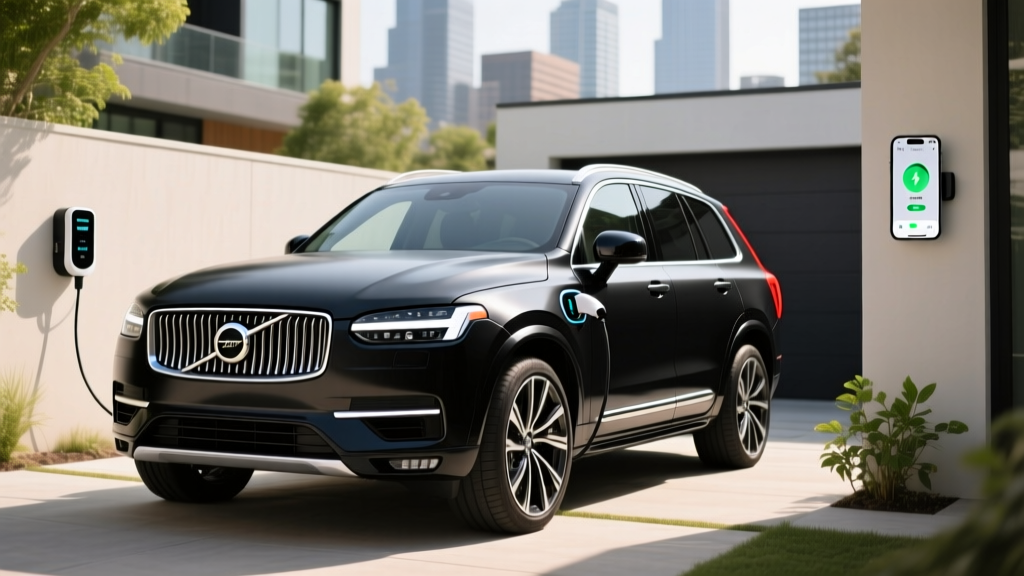
The 2024 Volvo XC90 Recharge plug-in hybrid occupies a specific niche: a three-row luxury SUV that can handle most daily commutes on electricity alone while retaining a turbocharged gas engine for road trips. For buyers not ready to commit to a full battery-electric vehicle but who want meaningful fuel savings and electric driving, the XC90 Recharge is one of the few PHEVs offering seven-passenger seating and genuine premium credentials. This guide covers the exact numbers—range, efficiency, charging, powertrain output, pricing, and long-term ownership costs—that matter when evaluating this vehicle against full EVs and conventional hybrids.
HEV vs PHEV: What the XC90 Recharge Actually Is
Before examining specs, it's essential to distinguish the two hybrid categories, because Volvo sells the XC90 in both forms depending on market and model year.
Conventional Hybrid (HEV) vs Plug-In Hybrid (PHEV)
| Feature | Conventional Hybrid (HEV) | Plug-In Hybrid (PHEV) — XC90 Recharge |
|---|---|---|
| Plug-in charging | No — charges via regenerative braking and engine | Yes — plug in to charge the larger battery |
| Battery size | Small (typically 1–2 kWh) | 18.6 kWh usable (2024 model year) |
| Electric-only driving | Brief assists only, no sustained EV mode | Up to 32 miles EPA at full highway speeds |
| Fuel economy | Measured in MPG only | MPGe (electric) + MPG (gas-only after battery depletes) |
| Best for | Drivers without home charging access | Drivers who can charge at home and commute under 30 miles |
The 2024 XC90 Recharge is firmly a PHEV. It has a substantially larger battery than any conventional hybrid, a dedicated electric motor on the rear axle, and a charge port. If you never plug it in, it operates as a heavy, less-efficient hybrid—defeating the purpose of the premium you pay for the Recharge powertrain.
Electric-Only Range and Total Range
The EPA rates the 2024 Volvo XC90 Recharge at 32 miles of electric-only range. That figure is derived from combined city/highway driving on a full charge. In practice, your results depend heavily on driving style, temperature, and terrain.
Real-World Electric Range Expectations
| Condition | Expected Electric Range |
|---|---|
| Mild weather, city/suburban (under 45 mph) | 30–35 miles |
| Highway cruising (70+ mph) | 24–28 miles |
| Cold weather (below 35°F), cabin heat on | 20–25 miles |
| Hot weather with aggressive A/C | 27–30 miles |
The XC90 Recharge uses a heat pump for cabin heating, which mitigates some cold-weather range loss compared to resistive heaters, but battery chemistry still suffers in freezing temperatures.
Once the battery depletes below its usable threshold, the 2.0-liter turbocharged four-cylinder engine takes over. The 18.5-gallon fuel tank provides roughly 430–460 miles of gas-only range after battery depletion, giving a total combined range of approximately 460–490 miles from a full charge and full tank.
Fuel Economy: MPGe and Gas-Only MPG
PHEV fuel economy is measured in two ways: MPGe (miles per gallon equivalent, combining electric and gas operation on a full charge) and MPG (gasoline-only operation after the battery is depleted).
| Measurement | City | Highway | Combined |
|---|---|---|---|
| MPGe (electric + gas, full charge) | — | — | 55 MPGe |
| MPG (gas only, battery depleted) | 26 MPG | 27 MPG | 27 MPG |
Source: EPA Fuel Economy
Real-World MPG vs EPA Estimates
The gas-only 27 MPG combined rating is respectable for a 5,100-pound luxury SUV. In real-world testing, owners who regularly deplete the battery and drive longer highway stretches report 25–28 MPG on gas alone. City driving after battery depletion can yield slightly better numbers—closer to 28–30 MPG—because the regenerative braking system recovers energy during stop-and-go traffic, and the engine can shut off at low loads.
The critical insight for PHEV ownership: if your daily commute is under 32 miles and you charge every night, your gas consumption drops to near zero. Owners with short commutes and regular charging report visiting gas stations once every six to eight weeks, using fuel primarily for longer weekend trips.
Powertrain and Performance
The 2024 XC90 Recharge pairs a 2.0-liter turbocharged and supercharged four-cylinder engine with an electric motor integrated into the rear axle. Volvo's "Twin Engine" layout provides all-wheel drive without a mechanical driveshaft—the engine powers the front wheels, the electric motor powers the rear.
| Specification | 2024 Volvo XC90 Recharge |
|---|---|
| Engine | 2.0L turbocharged + supercharged I4 |
| Electric motor | Rear-axle permanent magnet synchronous (143 hp / 228 lb-ft) |
| Combined system output | 455 hp / 523 lb-ft torque |
| Transmission | 8-speed automatic |
| Drivetrain | AWD (electric rear axle) |
| 0–60 mph | 5.0 seconds |
| Battery capacity (usable) | 18.6 kWh (lithium-ion NMC) |
| Curb weight | ~5,135 lbs |
| Towing capacity | 5,000 lbs |
The 455-horsepower combined output makes the XC90 Recharge genuinely quick—5.0 seconds to 60 mph is sports-sedan territory in a three-row SUV. In Pure mode (electric-only), the rear motor delivers 143 hp, adequate for city merging but noticeably less urgent than the combined powertrain. In Power mode, both systems deliver maximum output simultaneously.
Charging: Speed, Time, and Connector
One of the XC90 Recharge's notable limitations is charging speed. The onboard charger maxes out at 3.7 kW on Level 2 (240V), and the vehicle does not support DC fast charging. This is common among PHEVs but worth highlighting for buyers coming from full EVs.
| Charging Level | Power (kW) | Time to Full (0–100%) | Miles of EV Range Added per Hour |
|---|---|---|---|
| Level 1 (120V household) | ~1.4 kW | ~13–14 hours | ~4 miles |
| Level 2 (240V home/public) | 3.7 kW (max onboard) | ~5 hours | ~8 miles |
| DC Fast Charging | Not supported | N/A | N/A |
Because the battery is only 18.6 kWh, the 5-hour Level 2 charge time is manageable for overnight charging. A standard NEMA 14-50 outlet with a Level 2 charger (like a ChargePoint Home Flex or Wallbox Pulsar Plus) will fully replenish the battery while you sleep. Level 1 charging from a standard 120V outlet is technically possible but impractical as a daily routine—you'd need 13+ hours for a full charge.
The charge port uses a standard J1772 connector (the universal North American standard for Level 1 and Level 2 AC charging). No adapter is needed for any public Level 2 station.
Pricing, Trims, and Tax Credit Eligibility
The 2024 Volvo XC90 Recharge starts at approximately $76,850 (including destination) for the Plus trim and climbs to roughly $84,550 for the Ultimate trim. Adding the available air suspension, Bowers & Wilkins audio, or metallic paint pushes the sticker above $90,000.
Federal Tax Credit (§30D) Eligibility
Under the current IRS §30D rules for new clean vehicles, the XC90 Recharge faces a significant hurdle: the MSRP cap for SUVs is $80,000. The Plus trim at $76,850 qualifies on price, but the Ultimate trim and heavily optioned Plus models exceed the cap and become ineligible.
§30D Federal Tax Credit Checklist for XC90 Recharge
- MSRP cap: SUVs must be $80,000 or below — only base Plus trim reliably qualifies
- Buyer income cap: AGI must not exceed $150,000 (single), $225,000 (head of household), or $300,000 (joint)
- Battery sourcing: Critical minerals and battery components must meet phased percentage thresholds that increase annually — verify current-year compliance on the IRS clean vehicle credits page
- Point-of-sale transfer: Eligible buyers can transfer the credit to the dealer for an immediate price reduction at purchase
- Final assembly: Must be assembled in North America — the XC90 is assembled in Gothenburg, Sweden, which disqualifies it from the §30D new vehicle credit
This is the critical detail many buyers miss: the XC90 is built in Sweden. Under the North American final assembly requirement enacted by the Inflation Reduction Act, the 2024 XC90 Recharge does not qualify for the $7,500 federal new-vehicle tax credit. Always verify assembly location via the VIN lookup tool on fueleconomy.gov before purchasing.
Some states offer their own PHEV rebates (California's CVRP, for example, has offered rebates for qualifying PHEVs, though funding and eligibility change frequently). Check your state's energy or environmental agency for current programs.
Battery Longevity, Warranty, and Replacement Cost
The high-voltage battery in the XC90 Recharge is an 18.6 kWh lithium-ion pack using NMC (nickel-manganese-cobalt) chemistry. Unlike the smaller batteries in conventional hybrids, PHEV batteries experience deeper charge-discharge cycles, making warranty coverage and degradation a legitimate concern.
Volvo Hybrid Battery Warranty
| High-voltage battery warranty | 8 years / 100,000 miles (whichever comes first) |
| Capacity retention threshold | Typically 70% of original capacity (check your specific warranty document) |
| Powertrain warranty | 4 years / 50,000 miles |
| Basic vehicle warranty | 4 years / 50,000 miles |
Is the XC90 Recharge Reliable?
Volvo's powertrain reliability in the Recharge lineup has been mixed. The turbocharged-supercharged four-cylinder engine is complex, and early production years (2019–2021) of the T8 powertrain saw some reports of electrical gremlins and software issues. The 2024 model year benefits from several iterations of refinement, but the XC90 platform itself dates to 2016, and some interior electronics feel dated compared to newer competitors.
The hybrid battery itself is not a common failure point in Volvo PHEVs. NMC chemistry in a thermally managed pack with moderate daily cycling (shallow depth of discharge if charged nightly) tends to age well. Most owners will not need a battery replacement during the warranty period.
Battery Replacement Cost
If the high-voltage battery does need replacement out of warranty, expect a cost in the range of $8,000 to $12,000 including parts and labor at a Volvo dealership. This figure is lower than full EV battery replacements because the pack is significantly smaller. Volvo's 8-year/100,000-mile hybrid battery warranty provides substantial protection, and most vehicles will be out of their ownership cycle before a replacement becomes necessary.
Who Should Buy the XC90 Recharge vs a Full EV or Gas SUV?
The PHEV decision comes down to your daily driving pattern, charging access, and trip profile. Here's a practical framework:
Choose the XC90 Recharge (PHEV) If:
- Your daily commute is under 30 miles round-trip and you can charge at home every night
- You regularly take road trips exceeding 200 miles and don't want to plan around charging infrastructure
- You need three rows of seating and want to reduce fuel costs without going fully electric
- You live in an area with limited DC fast-charging stations
Choose a Full EV (e.g., Tesla Model X, Rivian R1S) If:
- You have reliable home Level 2 charging and your daily driving is under 250 miles
- You want to eliminate gasoline entirely and minimize maintenance
- You qualify for the federal tax credit on a qualifying EV (many are assembled in North America)
Choose a Conventional Hybrid or Gas SUV If:
- You cannot install a Level 2 charger at home (apartment, street parking, no garage)
- You rarely drive less than 50 miles per day — the PHEV premium won't pay for itself
- Your budget is tighter and you want lower upfront cost
Pros
- 32 miles of electric-only range covers most daily commutes
- 455 hp provides effortless acceleration for a three-row SUV
- Quiet, refined electric driving in city traffic
- No range anxiety — gas engine provides 430+ additional miles
- Heat pump improves cold-weather EV efficiency
- 5,000-lb towing capacity with hybrid efficiency benefits
Cons
- No DC fast charging — limited to 3.7 kW Level 2
- Built in Sweden — does not qualify for §30D federal tax credit
- Gas-only MPG (27 combined) is unremarkable once battery depletes
- Aging platform (introduced 2016) — infotainment and interior tech lag newer rivals
- Third row is tight for adults on longer trips
- Premium fuel recommended for optimal performance
Frequently Asked Questions
How many MPG does the 2024 Volvo XC90 Recharge get?
On a full charge, the EPA rates it at 55 MPGe combined (electric + gas). Once the battery is depleted, it returns 27 MPG combined on gasoline alone (26 city / 27 highway). Real-world gas-only MPG ranges from 25–30 depending on driving conditions.
How far can the XC90 Recharge go on electric only?
The EPA rates it at 32 miles electric-only. In mild weather with city driving, expect 30–35 miles. Highway driving at 70+ mph reduces that to roughly 24–28 miles, and cold weather (below 35°F) drops it further to 20–25 miles.
Hybrid vs PHEV vs EV — which is right for me?
A conventional hybrid (HEV) is best if you cannot charge at home. A PHEV like the XC90 Recharge is ideal if you have home charging and a short commute but also take long road trips. A full EV (BEV) is best if you can charge at home, drive under 250 miles daily, and want to eliminate gas entirely with lower maintenance costs.
Is the XC90 Recharge reliable, and what does a battery replacement cost?
The 2024 model benefits from years of powertrain refinement, though the platform is aging. The hybrid battery is covered by an 8-year/100,000-mile warranty. Out-of-warranty replacement costs approximately $8,000–$12,000. Most owners will not need a replacement during typical ownership.
Does the 2024 XC90 Recharge qualify for a federal tax credit?
No. Under current §30D rules, the vehicle must be assembled in North America to qualify for the new clean vehicle credit. The XC90 is assembled in Gothenburg, Sweden, making it ineligible. The MSRP cap ($80,000 for SUVs) would also disqualify higher trims. Some state-level incentives may still apply—check your state's energy agency.
Can I charge the XC90 Recharge on a regular household outlet?
Yes, using a Level 1 (120V) cord, but it takes 13–14 hours for a full charge and adds only about 4 miles of range per hour. For practical daily use, a 240V Level 2 home charger is strongly recommended, cutting charge time to about 5 hours.
Does the XC90 Recharge support DC fast charging?
No. Like most PHEVs, the XC90 Recharge is limited to AC charging (Level 1 and Level 2 only) at a maximum of 3.7 kW. This is a deliberate engineering choice—the 18.6 kWh battery is small enough that overnight Level 2 charging is sufficient for daily needs.