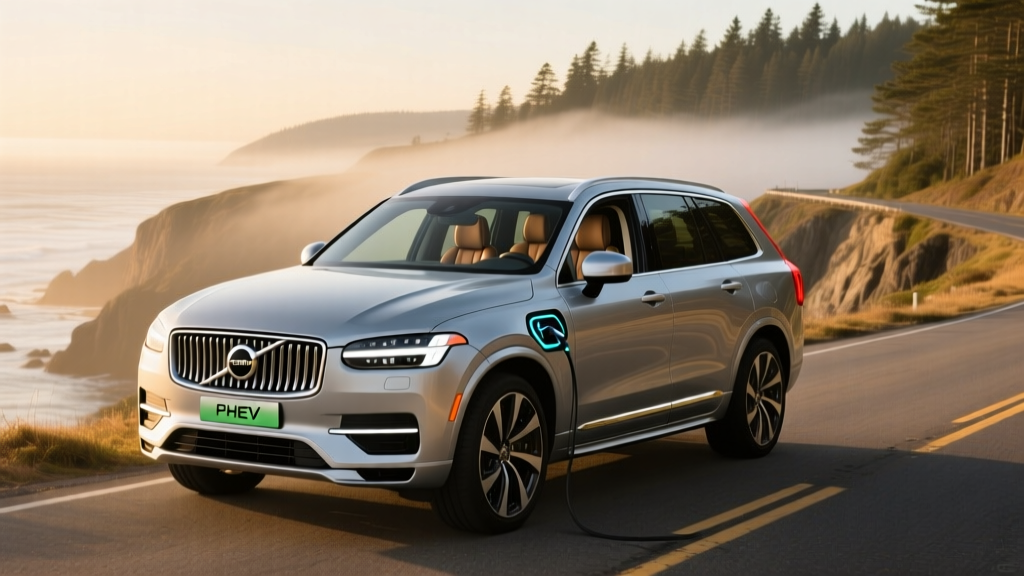
Leasing a plug-in hybrid SUV lets you test electrified driving without committing to a full EV or worrying about long-term battery depreciation. The 2026 Volvo XC90 Recharge — Volvo's plug-in hybrid electric (PHEV) flagship — pairs a turbocharged and supercharged engine with a rear-axle electric motor and an 18.8 kWh battery for an EPA-estimated 35 miles of electric-only range. If you're researching a Volvo XC90 hybrid lease, this guide covers every number that matters: real-world MPG, charging logistics, tax-credit eligibility, and how the Recharge compares to the mild-hybrid XC90 and full EV alternatives.
Volvo XC90 Recharge vs. XC90 Mild Hybrid: HEV or PHEV?
Volvo sells two electrified versions of the XC90 for 2026, and confusing them is the most common mistake shoppers make. Here's the critical distinction:
XC90 B5/B6 (Mild Hybrid — HEV)
- 48-volt mild-hybrid system; cannot plug in
- No electric-only driving — the electric motor only assists the gas engine
- EPA combined: ~24–26 MPG depending on drivetrain
- No federal tax credit eligibility
- Lower MSRP starting point
XC90 Recharge T8 (Plug-In Hybrid — PHEV)
- 18.8 kWh lithium-ion battery; plugs into Level 1 or Level 2 chargers
- 35 miles EPA electric-only range before the gas engine engages
- Combined output: 455 horsepower
- Potential federal tax credit (up to $7,500) depending on sourcing rules
- Higher MSRP, but lease incentives can offset
This guide focuses on the XC90 Recharge T8 PHEV — the model most shoppers mean when searching for a "Volvo XC90 hybrid lease." If you don't have access to home or workplace charging, the mild-hybrid B5/B6 may be the more practical choice, since its 48-volt system requires no plug-in infrastructure.
How Many MPG Does the XC90 Recharge Get?
The EPA rates the 2026 Volvo XC90 Recharge with the following efficiency figures. Because it's a PHEV, you get two sets of numbers: one for electric-only operation (measured in MPGe) and one for hybrid gasoline operation once the battery is depleted.
| Mode | City | Highway | Combined |
|---|---|---|---|
| Charge-Sustaining (Gas Hybrid) | 26 MPG | 27 MPG | 27 MPG |
| Electric + Gas (MPGe) | 58 MPGe | 55 MPGe | 55 MPGe |
Real-world expectation: PHEVs reward city and suburban driving. If your daily commute is under 35 miles and you charge nightly, you may burn almost no gasoline during the work week. On long highway road trips — where the battery depletes within the first 30 miles and the 2.0-liter turbocharged/supercharged four-cylinder does the heavy lifting — expect roughly 24–26 MPG at 70–75 mph. That's competitive for a 5,000-pound three-row luxury SUV, but it won't match a dedicated hybrid like the Toyota Grand Highlander Hybrid (35 MPG combined) in gas-only driving. According to fueleconomy.gov, the XC90 Recharge's combined 55 MPGe rating assumes regular plug-in charging; skip the plug and you're driving a 27 MPG hybrid.
Electric-Only Range, Battery, and Charging Specs
| Specification | 2026 Volvo XC90 Recharge T8 |
|---|---|
| Battery Capacity | 18.8 kWh (usable) |
| Battery Chemistry | Lithium-ion (NMC) |
| EPA Electric-Only Range | 35 miles |
| Total Range (Electric + Gas) | ~410 miles |
| Onboard Charger (AC) | 3.7 kW (Level 1/Level 2) |
| DC Fast Charging | Not supported |
| Level 1 Charge Time (120V) | ~8–10 hours (0–100%) |
| Level 2 Charge Time (240V) | ~5 hours (0–100%) |
| Combined Horsepower | 455 hp / 523 lb-ft torque |
| Engine | 2.0L turbo + supercharged I4 + rear electric motor (143 hp) |
| 0–60 mph | 4.5 seconds |
| Drivetrain | eAWD (electric rear axle) |
Real-World Electric Range
The EPA's 35-mile electric range assumes moderate temperatures and mixed driving. In practice, expect 28–32 miles of electric driving in cold weather (below 40°F) due to cabin heating demands and reduced battery efficiency. In mild conditions with light-footed city driving, some owners report reaching 37–38 miles. Highway speeds above 65 mph will deplete the battery closer to 25–28 miles.
A key limitation: the XC90 Recharge's 3.7 kW onboard charger caps Level 2 charging speed. Even on a 48-amp home charger, you're pulling roughly 3.7 kW into the battery, meaning a full charge takes about five hours. For a PHEV with a small battery, this is rarely a problem — plug in overnight and you'll wake up fully charged. But it also means a midday top-up at a public Level 2 station won't add range quickly. The XC90 Recharge does not support DC fast charging, which is standard across nearly all PHEVs in this class.
Volvo XC90 Hybrid Lease Pricing and Tax Credits
Lease pricing for the XC90 Recharge varies by region, dealer, and current Volvo incentive programs. Here's the MSRP landscape for the 2026 model year:
| Trim | MSRP (approx.) |
|---|---|
| Core | $81,550 |
| Plus | $85,150 |
| Ultra | $89,750 |
Federal tax credit (§30D): The Volvo XC90 Recharge has historically qualified for up to $7,500 under the IRS Clean Vehicle Credit. However, eligibility depends on battery component and critical mineral sourcing requirements that have tightened significantly since the Inflation Reduction Act. As of 2026, many PHEVs with European or Chinese battery supply chains have lost partial or full credit eligibility. Check the current qualified vehicle list at fueleconomy.gov before signing a lease.
Lease loophole (§25W commercial credit): When you lease rather than buy, the leasing company (the legal owner) may claim the commercial clean vehicle credit and pass savings to you via reduced monthly payments. This "lease loophole" has been a workaround for vehicles that don't qualify for the §30D consumer credit. Ask the dealer whether Volvo Financial Services is passing through any credit benefit on current XC90 Recharge leases.
- MSRP cap for SUVs: $80,000 (the XC90 Recharge Core starts above this — verify current pricing)
- Buyer income cap: $300,000 MFJ / $150,000 single (for purchase credit; lease credit has no income cap)
- Battery sourcing: must meet critical mineral and component thresholds per IRS guidance
- Point-of-sale transfer available for purchase credit; lease credit handled by lessor
Typical lease structure (illustrative): A 36-month / 30,000-mile lease on an XC90 Recharge Plus might run $1,050–$1,250/month with $5,000–$7,000 due at signing, depending on money factor, residual, and incentives. Compare this to a cash purchase at ~$85,000 plus tax. Leasing makes sense if you want lower monthly outlay, plan to upgrade in three years, and want to avoid long-term battery-degradation risk.
Reliability, Battery Warranty, and Replacement Cost
Volvo PHEV Battery Warranty
8 years / 100,000 miles (whichever comes first) on the high-voltage hybrid battery and electric drive components. Volvo covers defects and capacity loss below a specified threshold (typically 70% of original capacity). This warranty is federally mandated for PHEVs and transfers to subsequent owners.
Volvo's hybrid battery warranty matches the industry standard set by the EPA and CARB-influenced regulations. In practice, PHEV battery degradation is modest because the 18.8 kWh pack is relatively small and the battery management system maintains conservative charge buffers — you never use 100% of the cells, which extends cycle life.
Reliability: Volvo's overall brand reliability has been middling in recent Consumer Reports and J.D. Power surveys, with the XC90 specifically drawing complaints about infotainment glitches and minor electrical issues rather than powertrain failures. The T8 powertrain itself — the combination of the 2.0L engine and rear electric motor — has proven durable across Volvo's 60 and 90 series since its introduction. The most expensive failure point outside warranty would be the high-voltage battery pack, which dealers estimate at $8,000–$12,000 for parts and labor if replacement is needed post-warranty. However, PHEV batteries in this size class rarely require full replacement; individual module repair is sometimes possible.
For a leased vehicle, this risk is minimal — you'll return the XC90 before the 8-year warranty expires. Battery degradation is the lessor's problem, not yours.
XC90 Recharge vs. Full EV vs. Gas: Which Fits You?
The XC90 Recharge occupies a specific niche. Here's how to decide if it's the right electrified three-row SUV for your situation, or if a full EV or conventional vehicle serves you better.
Choose the XC90 Recharge PHEV if:
- You have home Level 2 (240V) charging and a commute under 35 miles
- You regularly take road trips exceeding 250 miles and don't want to plan around DC fast chargers
- You need three rows and ~5,000-lb towing isn't required
- You want EV-like daily driving with a gasoline safety net
Choose a full EV (e.g., Rivian R1S, Tesla Model X, Volvo EX90) if:
- You have reliable home charging and access to DC fast-charging corridors
- You want to eliminate gasoline entirely and minimize per-mile fuel cost
- Your daily driving is predictable and within 250–300 miles
Choose the XC90 B5/B6 mild hybrid or a gas SUV if:
- You cannot charge at home or work (apartment, street parking)
- You want the lowest upfront cost and don't care about electric-only driving
- Your annual mileage is low and fuel savings won't offset the PHEV premium
The XC90 Recharge's biggest competitive advantage is its seamless transition between electric and gas modes. Unlike some PHEVs that feel sluggish once the battery depletes, the T8's combined 455 hp means acceleration remains strong regardless of state of charge. The eAWD system — with the gasoline engine driving the front wheels and the 143-hp electric motor driving the rears — provides confident all-weather traction without a mechanical driveshaft connecting the axles.
Pros and Cons of Leasing the XC90 Recharge
Pros
- 35 miles electric covers most daily commutes gasoline-free
- 455 hp makes it one of the quickest three-row SUVs in its class
- Lease avoids long-term battery-degradation risk
- 8-year/100,000-mile battery warranty covers the full lease term
- Premium Scandinavian interior with Google built-in infotainment
- Potential lease credit pass-through reduces effective monthly cost
Cons
- 3.7 kW onboard charger is slow for midday public Level 2 top-ups
- No DC fast charging capability
- Real-world highway MPG (24–26) is unremarkable once battery depletes
- MSRP exceeds $80,000, potentially limiting §30D consumer credit eligibility
- Third row is tight for adults on longer trips
- Middling brand reliability scores vs. Lexus or BMW competitors
Frequently Asked Questions
How far can the Volvo XC90 Recharge go on electric only?
The EPA rates the 2026 XC90 Recharge at 35 miles of electric-only range. In cold weather or at highway speeds, expect 25–32 miles. For most commutes under 30 miles round-trip, you can drive all week without the gasoline engine engaging — provided you plug in nightly.
Does the XC90 hybrid need to be plugged in?
The XC90 Recharge (T8 PHEV) benefits enormously from plugging in — that's how you access the 35-mile electric range and achieve the 55 MPGe combined rating. If you never plug it in, it operates as a conventional hybrid at roughly 27 MPG combined. The mild-hybrid XC90 B5/B6 does not plug in at all.
Does the Volvo XC90 Recharge qualify for a tax credit in 2026?
Eligibility depends on current IRS battery-sourcing rules, which have disqualified several European-built PHEVs. Check fueleconomy.gov for the latest qualified vehicle list. If purchasing doesn't qualify, leasing may still provide credit benefits through the lessor's commercial clean vehicle credit (§25W).
What is the Volvo hybrid battery replacement cost?
Out-of-warranty high-voltage battery replacement for the XC90 Recharge is estimated at $8,000–$12,000 including labor. However, the 8-year/100,000-mile warranty covers this during the lease period, and PHEV batteries rarely require full replacement — partial module repair is often possible.
Is it better to lease or buy the XC90 Recharge?
Leasing is advantageous if you want lower monthly payments, plan to upgrade within 36–48 months, and want to avoid battery-degradation risk. Buying makes sense if you qualify for the full §30D tax credit, plan to keep the vehicle 6+ years, and drive enough to recoup the PHEV premium through fuel savings. A 36-month lease shields you from the biggest unknown: long-term resale value of a luxury PHEV as the market shifts toward full EVs.
Can the XC90 Recharge charge at a public fast charger?
No. The XC90 Recharge does not support DC fast charging. It can use public Level 2 (240V) stations, but at only 3.7 kW, a full charge takes roughly five hours. Most PHEV owners charge exclusively at home using a standard 120V outlet (overnight) or a Level 2 wallbox.