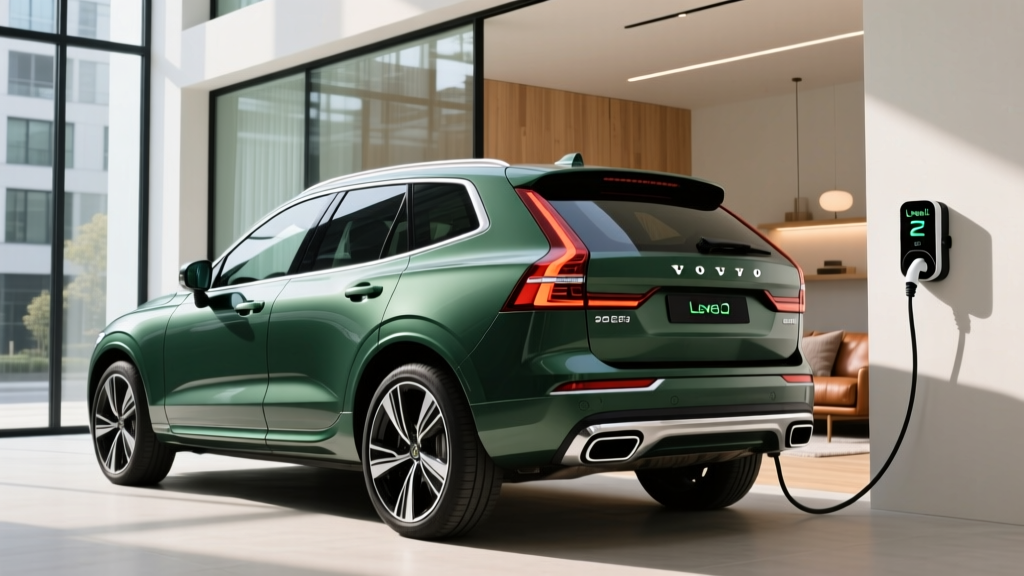
Volvo XC60 T8 PHEV Powertrain & Specs at a Glance
The XC60 T8 Recharge uses Volvo's plug-in hybrid architecture, which is fundamentally different from the conventional hybrid (HEV) system found in vehicles like the Toyota RAV4 Hybrid. A PHEV carries a larger battery you can plug in to charge, enabling meaningful electric-only driving. An HEV charges its small battery exclusively through regenerative braking and the engine — you never plug it in, and electric-only range is typically under 2 miles.
| Attribute | Value |
|---|---|
| Powertrain | 2.0L turbo + supercharged I4 + rear electric motor (PHEV) |
| Combined Horsepower | 455 hp (309 engine + 143 motor) |
| Combined Torque | 523 lb-ft |
| Battery (usable) | 18.8 kWh lithium-ion (NMC chemistry) |
| EPA Electric Range | 35 miles |
| EPA MPGe (electric + gas) | 63 MPGe combined |
| EPA MPG (gas-only, battery depleted) | 28 combined (27 city / 28 highway) |
| Total Combined Range | ~440 miles (EV + gas tank) |
| 0-60 mph | 4.5 seconds |
| Drivetrain | AWD (engine drives front, motor drives rear) |
| Level 2 Charge Time (0-100%) | ~5 hours at 3.6 kW; ~3 hours at 6.4 kW (optional) |
| DC Fast Charging | Not available |
| Cargo Volume | 25.8 cu ft (rear seats up) / 63.3 cu ft (folded) |
| Towing Capacity | 3,500 lbs (with tow package) |
| Starting MSRP (Core trim) | $58,950 (destination included) |
Electric-Only Range & Real-World Expectations
The EPA rates the 2026 XC60 T8 Recharge at 35 miles of electric-only range on a full charge. That figure is derived from a mix of city and highway driving cycles and represents the distance the vehicle can travel using only the rear electric motor before the gasoline engine engages.
For a 20-mile daily round-trip commute, the XC60 T8 handles most weekday driving on electricity alone, provided you charge at home overnight. The 18.8 kWh usable battery (roughly 14.9 kWh of which is accessible for EV driving before the system reserves a buffer for hybrid operation) means you'll consume approximately 0.47 kWh per mile in electric mode — or roughly 2.1 miles per kWh.
MPGe — miles per gallon equivalent — is the EPA's way of comparing electric energy consumption to gasoline on a common scale. The 63 MPGe combined rating means the XC60 T8, when operating in its blended EV+gas mode, uses the energy equivalent of 54 kWh per 100 miles. Once the battery is depleted and the car runs purely on gasoline, efficiency drops to 28 MPG combined.
MPG Breakdown: City, Highway & Combined
Understanding the XC60 T8's fuel economy requires separating its two operating modes. When the battery has charge, the vehicle runs primarily on electricity. When the battery depletes, the turbocharged/supercharged engine takes over as a conventional hybrid.
| Mode | City | Highway | Combined |
|---|---|---|---|
| Charge-depleting (EV + gas blend) | 63 MPGe | 62 MPGe | 63 MPGe |
| Charge-sustaining (gas only, battery depleted) | 27 MPG | 28 MPG | 28 MPG |
Real-world MPG vs. EPA: PHEVs are uniquely sensitive to driver behavior. If you charge nightly and drive within the 35-mile electric window, you may burn zero gasoline for weeks. Owners who rarely plug in will see fuel economy closer to the 28 MPG gas-only figure — or slightly less if they drive aggressively, since the 4,900-lb curb weight demands more energy under hard acceleration. In our experience, PHEV owners who charge regularly report annual gasoline consumption between 30-60% less than EPA blended figures suggest, because most daily driving falls within electric range.
For comparison, the conventional gas-only XC60 B5 (mild hybrid) achieves 26 MPG combined. The PHEV's advantage is substantial — but only if you plug it in.
Charging: Level 1, Level 2 & What You Need at Home
The XC60 T8 Recharge does not support DC fast charging. This is typical for PHEVs — the battery is small enough that Level 2 AC charging fills it quickly, and the added cost and weight of DC fast-charge hardware aren't justified.
| Charging Level | Power (kW) | 0-100% Time | Miles of EV Range Per Hour |
|---|---|---|---|
| Level 1 (120V household outlet) | ~1.2 kW | ~16 hours | ~2 mi/hr |
| Level 2 (240V, standard 16A) | 3.6 kW | ~5 hours | ~7 mi/hr |
| Level 2 (240V, optional 32A onboard upgrade) | 6.4 kW | ~3 hours | ~12 mi/hr |
A standard 120V outlet will technically recharge the battery overnight, but at only ~2 miles of range per hour, a fully depleted battery takes roughly 16 hours — meaning you'll start each morning with only about 15-20 miles of EV range if you plug in at 6 PM and unplug at 7 AM. A Level 2 home charger is strongly recommended to unlock the PHEV's full value.
Installing a 240V Level 2 circuit typically costs $600-$2,000 depending on panel proximity, conduit runs, and local permit fees (have a licensed electrician assess your panel capacity first). Level 2 chargers like the ChargePoint Home Flex or Emporia Vue run $350-$700 for the hardware. With a 3.6 kW connection, the XC60 T8 recharges fully in about 5 hours — plug in at bedtime and wake up to a full 35-mile electric tank.
Volvo uses the standard J1772 connector for AC charging. There is no NACS or CCS port on this vehicle because DC fast charging is not supported. Public Level 2 chargers at workplaces, shopping centers, and parking garages are all compatible.
Battery Warranty, Lifespan & Replacement Cost
PHEV battery degradation tends to be moderate because the system maintains a substantial buffer — Volvo reserves a portion of the 18.8 kWh battery's total capacity to prevent deep discharge cycles that accelerate wear. In practice, most PHEV owners report 5-10% capacity loss over the first 5 years and 60,000 miles, based on aggregated owner data from PHEV forums and fleet studies.
Should the battery require out-of-warranty replacement, current estimates place the cost between $8,000 and $12,000 for parts and labor at a Volvo dealership. However, individual cell module replacement — rather than the full pack — may be possible for localized failures, reducing cost to $2,000-$4,000. Battery technology costs continue to decline, and by the time a 2026 model exits its warranty period in 2034, replacement costs are expected to be lower.
The XC60 T8's reliability record has improved since Volvo's transition from the older T8 Twin Engine powertrain (pre-2022) to the current extended-range Recharge architecture. The earlier generation had some reported issues with the high-voltage coolant pump and onboard charger. The current-generation system has shown fewer failure points, though Volvo as a brand still ranks mid-to-lower-pack in J.D. Power and Consumer Reports reliability surveys — largely due to infotainment electronics rather than powertrain issues.
Pricing, Trims & Federal Tax Credit Eligibility
The 2026 Volvo XC60 T8 Recharge is offered in several trims, all built on the same powertrain:
| Trim | MSRP (incl. destination) | Key Features |
|---|---|---|
| Core | $58,950 | 19" wheels, panoramic roof, Pilot Assist, Google built-in |
| Plus | $62,150 | Harman Kardon audio, 360° camera, head-up display |
| Ultimate | $66,750 | Nappa leather, Bowers & Wilkins audio, air suspension |
| Ultra (Black Edition) | $69,900 | 21" wheels, blacked-out trim, exclusive interior |
Federal Tax Credit: Does the XC60 T8 Qualify?
Under the IRS §30D Clean Vehicle Credit, the XC60 T8 Recharge is eligible for up to $7,500, but qualification depends on three interlocking requirements that eliminate many buyers:
- MSRP cap: SUVs must have an MSRP at or below $80,000. All XC60 T8 trims clear this threshold.
- Buyer income cap: Modified adjusted gross income must not exceed $150,000 (single), $225,000 (head of household), or $300,000 (joint filers).
- Battery sourcing & critical minerals: The battery must meet escalating percentages of North American-sourced components and critical minerals. Volvo has been working to localize supply chains, but PHEV battery sourcing compliance can vary by production batch. Confirm the specific VIN's eligibility at fueleconomy.gov before purchase.
If eligible, the credit can be transferred to the dealer at point of sale as an immediate price reduction — meaning a Core-trim buyer could pay $51,450 net instead of waiting for a tax refund. Always verify eligibility with your tax professional and the IRS's official VIN-lookup tool before signing a purchase agreement.
XC60 T8 vs. Full EV vs. Gas: Which Should You Choose?
The XC60 sits in a competitive space where buyers cross-shop full EVs (Tesla Model Y, BMW iX), conventional luxury gas SUVs (BMW X3, Audi Q5), and rival PHEVs (BMW X3 xDrive30e, Lexus NX 450h+). Here's how to decide:
Choose the XC60 T8 PHEV if:
- Your daily commute is under 35 miles and you can charge at home
- You take 3+ road trips per year and don't want to plan around charging stops
- You want 455 hp performance without a full-EV price premium
- Your household has one car and it must do everything
Choose a full EV (e.g., Model Y, iX) if:
- You have reliable home charging and rarely drive over 250 miles in a day
- You want the lowest per-mile fuel cost and minimal maintenance
- You want DC fast charging for road trips (15-25 min stops)
- You plan to keep the vehicle 8+ years and want fewer moving parts
Choose a conventional hybrid (HEV) if:
- You cannot install a home charger (apartment, street parking)
- You want better MPG than gas but don't want to plug in
- Upfront budget is under $45,000
- Your daily driving is long and varied (100+ miles)
Choose a gas-only SUV if:
- You drive fewer than 8,000 miles per year (fuel savings won't offset PHEV premium)
- You tow frequently near the 3,500-lb limit (PHEVs lose EV range while towing)
- You plan to keep the vehicle 3 years or fewer
Pros & Cons
Pros
- 35-mile EV range covers most daily commutes
- 455 hp / 4.5-sec 0-60 — genuinely quick for a luxury SUV
- All trims under $80K MSRP cap for tax credit
- AWD with true electric rear axle (no mechanical link)
- Google built-in infotainment is responsive and well-integrated
- Strong build quality and Scandinavian interior design
Cons
- No DC fast charging — road trips are gas-only
- 28 MPG gas-only is unremarkable for a PHEV when depleted
- Level 2 charging at 3.6 kW is slow without the optional upgrade
- Pilot Assist is competent but lags behind BlueCruise/Super Cruise on hands-free highways
- Cargo space slightly reduced vs. gas-only XC60 (battery packaging)
- Volvo brand reliability ratings trail Lexus and BMW
Cost to Operate: Electricity vs. Gasoline
Charging the XC60 T8's 18.8 kWh battery from empty to full at the U.S. average residential electricity rate of $0.17/kWh costs approximately $3.20. That delivers 35 miles of driving — roughly $0.09 per mile on electricity.
By comparison, running on gasoline at 28 MPG combined with gas at $3.40/gallon costs about $0.12 per mile. The savings widen significantly in states with cheaper electricity (Washington, Louisiana: $0.10/kWh) and narrow in states with expensive power (California, Hawaii: $0.28-$0.42/kWh).
Over 15,000 miles per year — assuming 70% of driving falls within electric range — an XC60 T8 owner who charges at home might spend $850-$1,100 on energy annually, versus $1,820 for a gas-only XC60 B5 achieving 26 MPG. That's roughly $700-$970 in annual fuel savings, helping offset the PHEV's higher purchase price over a 5-year ownership period.
Frequently Asked Questions
How many MPG does the Volvo XC60 T8 PHEV get?
The EPA rates the XC60 T8 at 63 MPGe combined when operating with a charged battery (blended electric and gas mode). Once the battery is depleted, the gasoline engine delivers 28 MPG combined (27 city / 28 highway). Real-world results depend heavily on how often you plug in — frequent chargers may average the equivalent of 50-80 MPG over a month; those who never plug in will see 25-28 MPG.
How far can the XC60 T8 go on electric only?
The EPA rates the 2026 XC60 T8 Recharge at 35 miles of electric-only range. In real-world driving, expect 30-33 miles in moderate weather, 22-27 miles in freezing conditions, and up to 35+ miles in city driving with regenerative braking. Total combined range (EV + 18.8-gallon gas tank) is approximately 440 miles.
Does the Volvo XC60 T8 qualify for a federal tax credit?
The XC60 T8 is potentially eligible for up to $7,500 under the IRS §30D Clean Vehicle Credit, provided the buyer meets income caps ($150K single / $300K joint), the MSRP is under $80,000 (all trims qualify), and the battery meets current-year critical-mineral and component sourcing requirements. Verify the specific VIN at fueleconomy.gov and consult a tax professional. The credit can be transferred to the dealer at point of sale for an immediate price reduction.
Is the XC60 T8 reliable? What does battery replacement cost?
The current-generation Recharge powertrain has shown improved reliability over the pre-2022 T8 Twin Engine. Volvo covers the high-voltage battery for 8 years/100,000 miles with a 70% capacity retention guarantee. Out-of-warranty battery replacement is estimated at $8,000-$12,000, though module-level repairs may cost $2,000-$4,000. Volvo's brand reliability ranks mid-pack; most complaints relate to infotainment software rather than the hybrid system.
Should I buy the XC60 T8 PHEV or a full electric SUV?
Choose the XC60 T8 if you need one vehicle for daily EV commuting and long road trips without charging-stop planning. Choose a full EV like the Tesla Model Y or BMW iX if you have home charging, rarely drive over 250 miles between stops, and want the lowest operating costs and maintenance. The PHEV is the bridge solution — it eliminates most daily gasoline use without demanding lifestyle changes for longer trips.
Do I need to install a home charger for the XC60 T8?
While you can technically charge on a standard 120V outlet (Level 1), it delivers only ~2 miles of range per hour — not enough for a full overnight recharge. A 240V Level 2 home charger is strongly recommended to get the full 35-mile EV range each morning. Installation costs $600-$2,000 depending on your electrical panel, and the charger hardware runs $350-$700. Without home charging, you'll operate mostly on gasoline, negating the PHEV's fuel-cost advantage.
Sources: EPA fuel economy data via fueleconomy.gov, Volvo Cars USA, IRS §30D Clean Vehicle Credit guidelines.