Volvo's Electrified Strategy: Recharge PHEVs and Mild Hybrids Explained
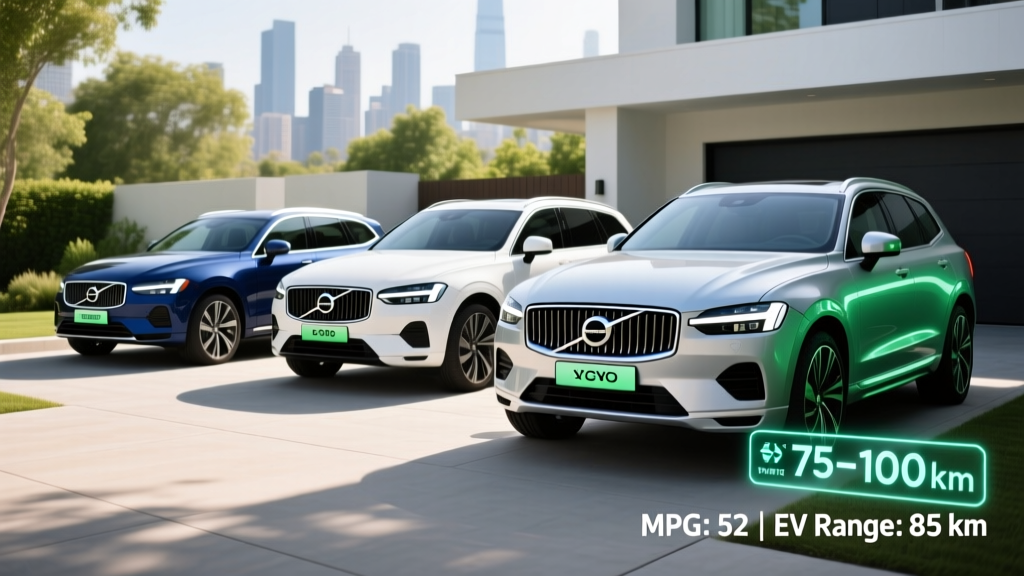
If you're researching a Volvo hybrid, you'll quickly discover that Volvo has fully committed to plug-in hybrid (PHEV) and mild-hybrid powertrains across its lineup. The Swedish automaker no longer sells conventional self-charging hybrids (HEVs) in the US market — instead, every gasoline-powered Volvo now pairs a turbocharged engine with either a 48-volt mild-hybrid system (badged "B5" or "B6") or a full plug-in hybrid system (badged "Recharge" or "T8").
This distinction matters enormously for your wallet and daily driving. A mild-hybrid Volvo cannot drive on electric power alone and offers no plug-in capability. A Recharge PHEV, by contrast, delivers 35–41 miles of pure electric range before the gasoline engine engages — enough for most commutes without burning a drop of fuel.
Volvo Mild Hybrid (B5/B6) vs. Recharge PHEV (T8) at a Glance
| Feature | Mild Hybrid (B5/B6) | Recharge PHEV (T8) |
|---|---|---|
| Plug-in charging | No — never plugs in | Yes — Level 1 or Level 2 |
| Electric-only driving | No (motor assists engine only) | Yes — 35 to 41 miles EPA |
| Battery size | 0.4 kWh (48V system) | 18.8 kWh usable (high-voltage) |
| Combined horsepower | 247–295 hp | 455 hp |
| Starting MSRP range | $47,000–$58,000 | $58,000–$78,000 |
| Federal tax credit (§30D) | Not eligible | Not eligible (see details below) |
This guide focuses on Volvo's Recharge PHEV lineup — the models buyers actually mean when they search for a "Volvo hybrid" — while clarifying what the mild-hybrid B5/B6 badges actually deliver.
2026 Volvo Recharge PHEV Lineup: Specs, Range, and Pricing
Volvo offers the Recharge T8 plug-in hybrid powertrain in three core models for 2026: the XC60 midsize SUV, the XC90 three-row SUV, and the S60 sedan. All three share the same 2.0-liter turbocharged and supercharged four-cylinder engine paired with a rear-axle electric motor and an 18.8 kWh (usable) lithium-ion battery pack.
| Spec | S60 Recharge | XC60 Recharge | XC90 Recharge |
|---|---|---|---|
| Combined HP / lb-ft | 455 hp / 523 lb-ft | 455 hp / 523 lb-ft | 455 hp / 523 lb-ft |
| Engine | 2.0L turbo+super I4 + rear e-motor | 2.0L turbo+super I4 + rear e-motor | 2.0L turbo+super I4 + rear e-motor |
| Battery (usable) | 18.8 kWh | 18.8 kWh | 18.8 kWh |
| EPA electric-only range | 41 miles | 35 miles | 35 miles |
| EPA MPGe (electric+gas) | 69 MPGe | 63 MPGe | 58 MPGe |
| MPG (gas-only, combined) | 31 MPG | 28 MPG | 27 MPG |
| Total combined range | ~520 miles | ~480 miles | ~470 miles |
| 0–60 mph | 4.4 sec | 4.5 sec | 4.6 sec |
| Level 2 charge time (0–100%) | ~5 hours (3.7 kW) | ~5 hours (3.7 kW) | ~5 hours (3.7 kW) |
| DC fast charging | No | No | No |
| Drivetrain | eAWD | eAWD | eAWD |
| Base MSRP | $54,495 | $58,395 | $73,395 |
Sources: EPA Fueleconomy.gov, Volvo Cars USA
Electric-Only Range and Real-World Efficiency
The EPA rates the XC60 Recharge and XC90 Recharge at 35 miles of electric-only range, while the lighter S60 Recharge sedan achieves 41 miles. In real-world driving, expect those numbers to hold fairly steady in mild weather around town — the rear electric motor provides genuine propulsion, not just assist, and Volvo's Pure mode locks the powertrain into electric-only operation up to about 78 mph.
Real-World Electric Range Expectations
EPA sticker: 35–41 miles electric-only (depending on model)
Mild weather, city/suburban: 33–40 miles — closely matches EPA
Highway (70+ mph): 25–30 miles — aerodynamic drag and higher speeds deplete the battery faster
Cold weather (below 32°F): 22–28 miles — battery chemistry loses efficiency and cabin heating draws significant energy. Volvo's heat pump on Recharge models helps, but expect a 25–35% range reduction in deep cold.
Once the battery depletes, the gasoline engine engages seamlessly. Here's where the PHEV advantage shows itself over a full EV: you still have a full tank of gas for a combined range of 470–520 miles depending on the model. No range anxiety on road trips — you simply refuel at any gas station.
| Model | City MPG | Highway MPG | Combined MPG |
|---|---|---|---|
| S60 Recharge | 30 | 33 | 31 |
| XC60 Recharge | 27 | 29 | 28 |
| XC90 Recharge | 26 | 28 | 27 |
These gas-only MPG figures are respectable for vehicles producing 455 horsepower, but they won't beat a Toyota RAV4 Hybrid (39 MPG combined). The PHEV value proposition hinges on charging regularly — if you never plug in, you're carrying 400+ pounds of battery and electric motor hardware for no efficiency gain.
Charging: What You Need to Know
Volvo Recharge PHEVs accept Level 1 (120V household outlet) and Level 2 (240V) charging. They do not support DC fast charging — this is common for PHEVs, as the battery is small enough that Level 2 charging is adequate overnight.
| Charging Level | Power | 0–100% Time | Notes |
|---|---|---|---|
| Level 1 (120V outlet) | ~1.4 kW | ~13–14 hours | Adequate for overnight top-up if battery isn't fully depleted |
| Level 2 (240V, 16A) | 3.7 kW | ~5 hours | Full charge overnight; recommended for daily use |
| DC Fast Charging | N/A | N/A | Not supported on any Volvo Recharge PHEV |
A dedicated Level 2 home charger (240V, such as a ChargePoint Home Flex or Wallbox Pulsar Plus) is strongly recommended. Installation typically runs $500–$1,500 depending on your electrical panel's capacity and the distance from panel to charger location. With a Level 2 charger, you'll wake up to a full battery every morning — turning your PHEV into a daily electric commuter with the gas engine as backup.
Key insight: The onboard charger in Volvo Recharge PHEVs is limited to 3.7 kW. Even if you install a 48-amp Level 2 charger capable of 11.5 kW, the car will only draw 3.7 kW. There's no benefit to overspecifying the charger for the PHEV specifically — but if you plan to add a full EV later, installing a higher-capacity circuit now is smart future-proofing.
Battery Warranty, Reliability, and Replacement Cost
Volvo PHEV Battery Warranty
High-voltage battery: 8 years or 100,000 miles (whichever comes first)
Capacity retention threshold: Volvo warrants the battery will retain at least 70% of original capacity during the warranty period
Powertrain warranty: 4 years / 50,000 miles
Hybrid-specific components: 8 years / 100,000 miles (electric motor, inverter, charging system)
Volvo's PHEV powertrain has been in production since 2015 (originally branded T8 Twin Engine), and the current 18.8 kWh battery generation debuted for the 2023 model year. Long-term degradation data on this larger pack is still accumulating, but the earlier 11.6 kWh packs have shown moderate degradation of roughly 8–12% over 5–6 years of typical use based on owner reports.
Out-of-warranty high-voltage battery replacement for a Volvo Recharge PHEV currently runs approximately $8,000–$12,000 including parts and labor at a Volvo dealership. This is a significant cost, but the 8-year/100,000-mile warranty provides substantial coverage, and PHEV batteries experience less stress than full EV batteries because they operate in a narrower state-of-charge window and are smaller overall.
The 48-volt mild-hybrid system (B5/B6 models) uses a much smaller, less expensive battery. Replacement costs for that system are typically under $2,000, and failures have been uncommon.
Volvo as a brand scores average to slightly below average in major reliability surveys. The PHEV powertrain adds complexity — two power sources, additional cooling circuits, and high-voltage electronics — but the core components are proven. The most commonly reported issues involve software glitches in the infotainment system (Google-built Android Automotive OS) rather than the hybrid drivetrain itself.
Tax Credits and Incentives: The Bad News
Here's where Volvo Recharge PHEV buyers face a frustrating reality: no current Volvo PHEV qualifies for the federal §30D clean vehicle tax credit.
Why Volvo Recharge PHEVs Don't Qualify for §30D
- Battery sourcing requirement: The §30D credit requires a minimum percentage of critical minerals and battery components sourced from the US or free-trade-agreement countries. Volvo's PHEV battery supply chain does not currently meet these thresholds.
- MSRP cap: The XC90 Recharge ($73,395+) exceeds the §30D SUV MSRP cap of $80,000 in higher trims, and the credit phases out based on manufacturer sales caps (though Volvo has not hit this cap — sourcing is the disqualifier).
- Income limits still apply: Even if a Volvo PHEV qualified, buyers must meet adjusted gross income caps ($150K single / $300K joint filers) to claim the credit.
Some state-level incentives may still apply. States like California, Colorado, and Massachusetts offer rebates or tax credits for PHEVs that meet certain electric-range thresholds, and the XC60 and S60 Recharge (with 35–41 miles of range) often qualify. Check your state's energy office or AFDC state incentive database for current programs.
The mild-hybrid B5/B6 models are not eligible for any federal or state EV/PHEV incentives — they are classified as conventional gasoline vehicles with efficiency assist.
Volvo Hybrid vs. Full EV vs. Gas: Which Is Right for You?
Choose a Volvo Recharge PHEV if:
- You have home charging access (Level 1 or Level 2) and a commute under 35 miles round-trip
- You want electric daily driving but take road trips where charging infrastructure is unreliable
- You want 455 hp and eAWD without the price of a full-electric luxury SUV
- You're not ready to commit to a full EV but want to reduce gas consumption significantly
Choose a full EV (like the Volvo EX90 or EX40) if:
- You have reliable home and/or workplace charging
- Your daily driving is under 250 miles and you road-trip infrequently
- You want to eliminate oil changes, spark plugs, and gas-engine maintenance entirely
- You want access to the federal §30D credit (the EX40 and some EX90 configurations may qualify — verify current IRS sourcing rules)
Choose a Volvo mild hybrid (B5/B6) if:
- You cannot charge at home or work — no garage, no outlet access, apartment living without charging
- You want the lowest purchase price in the Volvo lineup
- You drive mostly highway miles where PHEV electric-range advantage is minimized
- You prefer simplicity — no charging cables, no battery management, no plug-in routine
The PHEV's sweet spot is the driver who can charge nightly at home and commute on electricity Monday through Friday, then use the gas engine for weekend trips. In that scenario, a Volvo Recharge owner might use 5–8 gallons of gas per week instead of 12–15, saving $1,500–$2,500 annually depending on local electricity and gas prices.
Pros and Cons of Volvo's Hybrid Lineup
Pros
- 455 hp and 4.4–4.6 second 0–60 across the lineup — genuinely quick
- 35–41 miles electric-only covers most commutes without gas
- No range anxiety — gas engine provides 470+ miles total range
- Standard eAWD with torque-vectoring rear electric motor
- Premium Scandinavian interior, Google Built-in infotainment, strong safety ratings
- One-pedal driving available in Pure (electric) mode
- 8-year / 100,000-mile hybrid battery and component warranty
Cons
- No DC fast charging — Level 2 only, limiting public charging utility
- 3.7 kW onboard charger is slow compared to some competitors (e.g., Toyota RAV4 Prime at 6.6 kW)
- No federal §30D tax credit eligibility due to battery sourcing
- Gas-only MPG (27–31 combined) is unremarkable when battery is depleted
- Higher MSRP than non-electrified competitors — $58K–$78K range
- Android Automotive OS has drawn mixed reviews for responsiveness and app availability
- Out-of-warranty battery replacement cost ($8K–$12K) is significant
Frequently Asked Questions
How many MPG does a Volvo hybrid get?
It depends on whether you charge. In electric mode, the Volvo Recharge PHEVs achieve 58–69 MPGe (miles per gallon equivalent). Once the battery is depleted and the car runs on gasoline alone, expect 27 MPG combined in the XC90, 28 in the XC60, and 31 in the S60. If you charge daily and commute under 35 miles, you may use almost no gasoline during the workweek.
How far can a Volvo PHEV go on electric only?
The EPA rates the XC60 Recharge and XC90 Recharge at 35 miles of electric-only range, and the S60 Recharge at 41 miles. Real-world range in mild city driving comes close to these figures. Highway driving at 70+ mph reduces electric range to roughly 25–30 miles, and cold winter weather (below freezing) can drop it to 22–28 miles.
Do Volvo mild hybrids (B5/B6) need to be plugged in?
No. The B5 and B6 mild-hybrid Volvos cannot be plugged in. They use a small 48-volt battery and integrated starter-generator that recaptures energy during braking and assists the gas engine during acceleration. You fuel them like any conventional gasoline car — there is no electric-only driving mode and no plug.
Does a Volvo hybrid qualify for any tax credit?
As of 2026, no Volvo Recharge PHEV qualifies for the federal §30D clean vehicle tax credit (up to $7,500) due to battery component and critical mineral sourcing requirements. Some state-level incentives may apply — check your state's EV incentive programs. Mild-hybrid B5/B6 models are not eligible for any EV-related tax credits.
Is the Volvo hybrid powertrain reliable?
Volvo's T8/Recharge PHEV system has been in production since 2015 and the major drivetrain components are well-proven. Volvo scores average in reliability surveys from Consumer Reports and J.D. Power. The most common complaints involve infotainment software rather than the hybrid system itself. The high-voltage battery carries an 8-year / 100,000-mile warranty with a 70% capacity retention guarantee.
What does it cost to replace a Volvo PHEV battery?
Out-of-warranty replacement of the 18.8 kWh high-voltage battery in a Volvo Recharge PHEV costs approximately $8,000–$12,000 at a Volvo dealership, including parts and labor. This is covered under the 8-year / 100,000-mile hybrid warranty if capacity drops below 70% during that period. Most PHEV batteries are lasting well beyond their warranty periods based on industry data.
Can I DC fast charge a Volvo Recharge PHEV?
No. Volvo Recharge PHEVs do not have DC fast charging capability. The maximum charge rate is 3.7 kW on a Level 2 (240V) connection, which fully charges the 18.8 kWh battery in about 5 hours. This is typical for PHEVs — the battery is small enough that overnight Level 2 charging is sufficient for daily use.