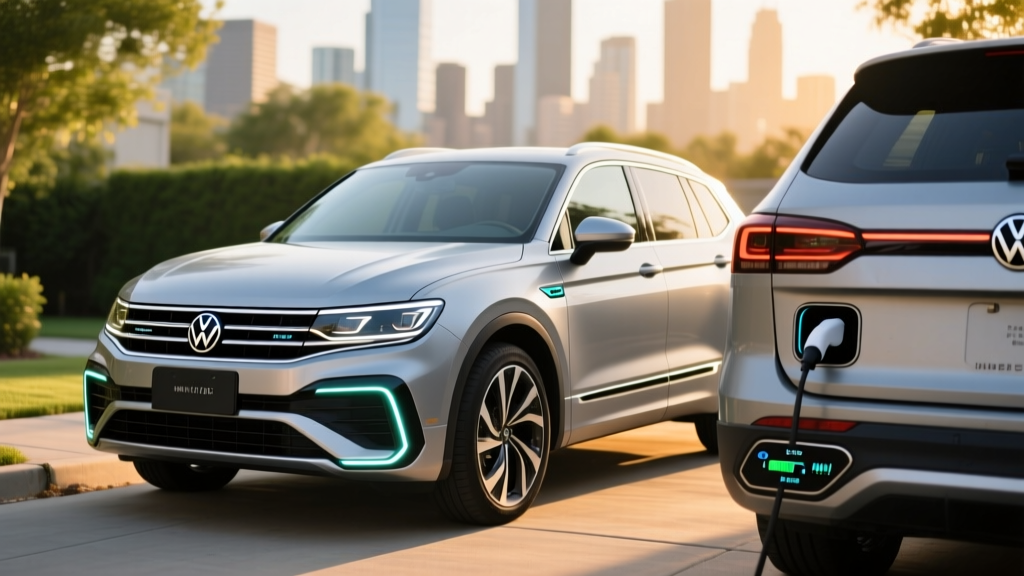
The compact crossover segment has no shortage of electrified options, but the Volkswagen Tiguan hybrid — officially the Tiguan eHybrid plug-in hybrid (PHEV) — carves out a specific niche: European driving dynamics paired with enough electric-only range to cover most daily commutes without burning a drop of gasoline. For 2026, Volkswagen continues to offer the Tiguan eHybrid alongside a conventional mild-hybrid variant, giving buyers two distinct paths to electrification in the same familiar package.
This guide breaks down exactly what the 2026 Tiguan hybrid lineup delivers in real-world driving — EPA fuel economy, electric-only range, charging logistics, powertrain output, battery longevity, and whether the federal tax credit applies. If you're weighing this PHEV against a full battery-electric vehicle (BEV) or a traditional hybrid, you'll find a clear decision framework below.
HEV vs PHEV: Which Tiguan Hybrid Are You Looking At?
Volkswagen's 2026 Tiguan lineup includes two electrified flavors, and confusing them is the most common mistake shoppers make. Here's the critical difference:
Conventional Hybrid (HEV) — Tiguan eHybrid (MHEV mild-hybrid)
- No plug required. The battery recharges through regenerative braking and the gasoline engine.
- Small battery (~1 kWh) — assists the engine for smoother stop/start and marginal efficiency gains.
- No electric-only driving beyond very low-speed coasting.
- No federal tax credit eligibility under IRS §30D.
Plug-in Hybrid (PHEV) — Tiguan eHybrid
- Plug-in charging required to access full electric range. Uses a standard J1772 connector for Level 1 and Level 2 AC charging.
- Larger battery (19.7 kWh usable) enabling 35–37 miles of electric-only driving.
- Full EV mode at highway speeds up to ~87 mph before the engine engages.
- Federal tax credit eligible — up to $3,750 under current §30D rules (see details below).
The rest of this guide focuses primarily on the Tiguan eHybrid PHEV, as it's the model most buyers mean when searching for the "Volkswagen Tiguan hybrid." We'll note the mild-hybrid variant where relevant.
How Many MPG Does the Volkswagen Tiguan Hybrid Get?
Fuel economy for a PHEV requires two numbers: the MPGe rating when operating on electricity, and the gasoline-only MPG once the battery is depleted. The EPA publishes both, and the 2026 Tiguan eHybrid posts competitive figures in each mode.
| Mode | City | Highway | Combined |
|---|---|---|---|
| Electric (MPGe) | 83 MPGe | 74 MPGe | 78 MPGe |
| Gasoline Only (MPG) | 33 MPG | 30 MPG | 31 MPG |
| Electric-Only Range | 36 miles (EPA) | ||
| Total Combined Range | ~430 miles (36 mi EV + ~394 mi gas) | ||
Source: EPA Fuel Economy (fueleconomy.gov). Actual results vary with driving style, terrain, and temperature.
Real-World MPG vs EPA Sticker
PHEVs introduce a variable that pure gas cars don't: your actual fuel consumption depends entirely on how often you charge. If your commute is 20 miles round-trip and you plug in every night, you may burn zero gasoline for weeks. Owners who rarely charge will see the gasoline-mode 31 MPG combined figure — and in real-world mixed driving with frequent charging, many Tiguan eHybrid owners report effective consumption equivalent to 50–70 MPG when factoring in electric miles.
In city driving, the gasoline engine operates in its least efficient range (stop-and-go, idling). The electric motor handles low-speed launches, which is where PHEVs shine. Expect the real-world gasoline-mode city figure to land close to or slightly above the EPA's 33 MPG rating, since the electric assist reduces engine load in traffic. Highway driving at sustained 75+ mph will trend toward 28–30 MPG gasoline-only, consistent with the aerodynamic drag of a compact crossover.
Electric-Only Range and Battery: What Powers the Tiguan eHybrid
The 2026 Tiguan eHybrid carries a 19.7 kWh usable lithium-ion battery pack (gross capacity ~22 kWh, with a software buffer protecting the cells from deep discharge and overcharge). This is a meaningful upgrade from earlier-generation VW PHEVs, which offered as little as 12–16 kWh and roughly 20 miles of range.
| Battery Capacity (usable) | 19.7 kWh |
| Battery Chemistry | NMC (Nickel Manganese Cobalt) |
| EPA Electric-Only Range | 36 miles |
| Real-World Electric Range | ~30–34 mi (highway/cold); ~36–40 mi (city/mild weather) |
| Max EV-Mode Speed | ~87 mph |
| Level 1 Charging (120V) | ~1.4 kW — full charge in ~14 hours |
| Level 2 Charging (240V) | ~3.6 kW — full charge in ~5 hours |
| DC Fast Charging | Not available |
| Combined Horsepower | 245 hp |
| Combined Torque | 295 lb-ft |
| Gasoline Engine | 1.4L turbocharged 4-cylinder (150 hp) |
| Electric Motor | 115 hp (integrated into transmission) |
| Transmission | 6-speed DSG automatic |
| 0–60 mph | ~7.5 seconds |
| Drivetrain | Front-wheel drive (FWD) |
| Fuel Tank | 11.9 gallons |
⚡ Real-World Electric Range Expectations
EPA sticker: 36 miles electric-only.
Real-world mild weather, city/mixed driving: 34–40 miles — regenerative braking in stop-and-go traffic extends range.
Highway (70+ mph sustained): 26–30 miles — higher speeds drain the battery faster.
Cold weather (below 32°F): 22–28 miles — battery chemistry is less efficient in the cold, and cabin heating draws from the pack unless preconditioned.
Tip: Use the Tiguan's built-in preconditioning feature while plugged in to warm or cool the cabin on grid power, preserving battery for driving.
Charging the Tiguan eHybrid: What You Need to Know
The Tiguan eHybrid charges exclusively via AC — Level 1 (standard 120V household outlet) or Level 2 (240V, the same outlet your dryer uses). DC fast charging is not supported. This is typical for PHEVs in this class; the relatively small battery doesn't justify the cost and weight of DC fast-charge hardware.
| Charging Level | Voltage | Power (kW) | Time to Full | Miles Added per Hour |
|---|---|---|---|---|
| Level 1 (Trickle) | 120V AC | ~1.4 kW | ~14 hours | ~2.5 mi/hr |
| Level 2 (Home/Public) | 240V AC | ~3.6 kW | ~5 hours | ~7 mi/hr |
For most owners, a Level 2 home charger is the practical choice. Overnight charging easily replenishes the full 36-mile range. A Level 2 home charger installation typically costs $500–$1,800 (equipment plus electrician labor), depending on panel capacity and run distance. If your electrical panel is near the garage, expect the lower end; a panel upgrade or long conduit run pushes costs higher.
Public Level 2 chargers (ChargePoint, EVgo, Blink) work with the Tiguan's J1772 connector, but given the 3.6 kW onboard charger limit, public charging is slow relative to a BEV. Plan accordingly — a 30-minute stop at a public Level 2 adds roughly 3–4 miles of electric range.
Powertrain and Driving Dynamics
The Tiguan eHybrid pairs a 1.4-liter turbocharged inline-four (producing 150 hp on its own) with a 115-hp electric motor integrated into the 6-speed DSG dual-clutch automatic transmission. Combined system output is 245 hp and 295 lb-ft of torque, sent to the front wheels.
In EV mode, the Tiguan accelerates with the quiet, instant torque characteristic of electric motors — adequate for merging and city driving, though not sporty. Engage "Hybrid" or "GTE" mode and both power sources work together, delivering a 0–60 mph time of roughly 7.5 seconds. That's brisk for the segment and noticeably quicker than the non-hybrid Tiguan's ~9-second run.
The DSG transmission is generally smooth, though some drivers notice the occasional low-speed hesitation common to dual-clutch designs. Regenerative braking offers multiple levels, selectable via paddle shifters or drive-mode settings, but it does not achieve true one-pedal driving — you'll still use the friction brake for complete stops.
Pricing, Trims, and Federal Tax Credit Eligibility
The 2026 Volkswagen Tiguan eHybrid is offered in two trims, with pricing that positions it against competitors like the Toyota RAV4 Prime and Hyundai Tucson PHEV.
| Trim | MSRP | Est. After Federal Credit |
|---|---|---|
| SE eHybrid | $39,490 | ~$35,740* |
| SEL R-Line eHybrid | $43,790 | ~$40,040* |
*Estimated effective price assuming full $3,750 federal tax credit eligibility. Destination charge (~$1,350) additional.
Does the Tiguan Hybrid Qualify for a Federal Tax Credit?
The Tiguan eHybrid PHEV may qualify for a partial federal tax credit under IRS §30D, but eligibility depends on several factors that change frequently. As of 2026, the key requirements include:
- Credit amount: Up to $3,750 for the Tiguan eHybrid (based on battery capacity and critical-mineral sourcing compliance). The full $7,500 is generally not available for this model due to battery component and critical mineral sourcing rules.
- MSRP cap: SUVs must have an MSRP below $80,000 — both Tiguan eHybrid trims qualify.
- Buyer income cap: Modified adjusted gross income (MAGI) must not exceed $150,000 (single), $225,000 (head of household), or $300,000 (married filing jointly).
- Battery sourcing: A percentage of critical minerals and battery components must be sourced from the U.S. or free-trade-agreement countries. Volkswagen's supply chain compliance determines whether the full or partial credit applies.
- Point-of-sale transfer: As of 2024, eligible buyers can transfer the credit to the dealer at purchase, reducing the out-of-pocket price immediately rather than waiting for a tax refund.
Source: IRS Clean Vehicle Credits. Tax rules are subject to change. Consult a tax professional to confirm your personal eligibility before purchasing.
Neither the conventional mild-hybrid Tiguan nor any non-plug-in variant qualifies for the §30D credit — only vehicles with a battery of at least 7 kWh and plug-in capability are eligible.
Battery Warranty, Reliability, and Replacement Cost
Battery longevity is consistently the top concern among hybrid and PHEV buyers. Volkswagen backs the Tiguan eHybrid's high-voltage battery with a warranty that meets the industry standard:
🔋 Volkswagen PHEV Battery Warranty
- Duration: 8 years or 100,000 miles (whichever comes first)
- Capacity retention threshold: Warranty covers the battery if it degrades below 70% of original capacity
- Powertrain warranty: 4 years / 50,000 miles
- Bumper-to-bumper: 4 years / 50,000 miles
Is the Volkswagen Tiguan Hybrid Reliable?
Volkswagen's recent reliability record has been mixed, with some model years drawing criticism for electrical gremlins and infotainment bugs rather than powertrain failures. The eHybrid system itself — the 1.4T engine, electric motor, and DSG — is a carryover from the European-market Tiguan and Golf GTE, where it has accumulated years of real-world service data. The high-voltage battery uses proven NMC chemistry with liquid thermal management, which helps mitigate the accelerated degradation seen in passively cooled packs.
Based on data from similar VW PHEV powertrains (Golf GTE, Passat GTE), expect battery degradation of approximately 8–12% over the first 5 years / 75,000 miles under normal use. This means a 36-mile new-battery range might settle to roughly 32–33 miles after several years — still well within the 70% warranty threshold.
Battery Replacement Cost
Out-of-warranty high-voltage battery replacement for the Tiguan eHybrid is estimated at $6,000–$9,000 (parts and labor) at a Volkswagen dealer. However, full battery replacement is rare — individual module replacement is sometimes possible at lower cost. Given the 8-year/100,000-mile warranty and typical degradation curves, most owners will never face this expense during their ownership.
Tiguan Hybrid vs Full EV vs Gas: Which Should You Choose?
Decision Framework: Is the Tiguan eHybrid Right for You?
Choose the Tiguan eHybrid PHEV if:
- Your daily commute is under 35 miles and you can charge at home overnight.
- You want electric driving for errands but need gasoline flexibility for road trips without charging-infrastructure planning.
- You live in a region with cold winters where BEV range loss is a concern.
- You're not ready to commit to a full EV but want to reduce fuel consumption and emissions.
Choose a full EV (like the VW ID.4) if:
- You have reliable home Level 2 charging and your daily driving is under 200 miles.
- You want to eliminate gasoline costs and engine maintenance entirely.
- You're eligible for the full $7,500 federal tax credit on a qualifying BEV.
Choose the gas-only or mild-hybrid Tiguan if:
- You cannot charge at home (apartment, street parking, no garage).
- Your budget is tighter and the PHEV premium (~$4,000–$5,000 over gas trims) doesn't pencil out.
- You drive primarily long highway routes where PHEV electric-range benefits are minimal.
✅ Pros
- 36-mile EPA electric range covers most commutes
- 245 hp combined — quickest Tiguan variant
- No range anxiety — 430+ mile total range
- Eligible for partial federal tax credit (up to $3,750)
- Quiet, smooth EV-mode city driving
- Practical cargo space retained (battery under rear seats)
❌ Cons
- No DC fast charging — public charging is slow
- FWD only — no AWD option on eHybrid (unlike RAV4 Prime)
- 3.6 kW onboard charger limits Level 2 speed
- PHEV premium over gas-only Tiguan trims
- Cargo space slightly reduced vs gas model (battery packaging)
- VW infotainment system has drawn usability criticism
Ownership Costs: 5-Year Outlook
To put the Tiguan eHybrid's economics in context, here's an estimated 5-year/75,000-mile total cost of ownership compared to the gas-only Tiguan and a comparable BEV (VW ID.4). Assumptions: 15,000 miles/year, $3.50/gallon gas, $0.14/kWh electricity, PHEV charged 80% of days.
| Category | Tiguan eHybrid PHEV | Tiguan Gas (AWD) | VW ID.4 (BEV) |
|---|---|---|---|
| Purchase Price (after credits) | ~$36,840 | ~$33,500 | ~$34,990 |
| Fuel / Electricity (5 yr) | ~$2,800 | ~$8,750 | ~$3,940 |
| Maintenance (5 yr) | ~$2,500 | ~$3,500 | ~$1,500 |
| Insurance (5 yr est.) | ~$7,500 | ~$6,800 | ~$7,800 |
| Est. Depreciation | ~$14,000 | ~$13,500 | ~$15,000 |
| 5-Year Total (approx.) | ~$63,640 | ~$66,050 | ~$63,230 |
The PHEV and BEV land in a similar cost neighborhood over five years, with the gas Tiguan costing modestly more due to fuel. Your specific numbers will vary with local electricity rates, gas prices, driving patterns, and insurance premiums — but the PHEV's fuel savings are substantial if you charge regularly.
Frequently Asked Questions
How many MPG does the Volkswagen Tiguan hybrid get?
The 2026 Tiguan eHybrid PHEV achieves 78 MPGe combined when operating on electricity and 31 MPG combined (33 city / 30 highway) in gasoline-only mode. Real-world gasoline MPG may be slightly higher in city driving thanks to electric motor assist at low speeds.
How far can the Tiguan eHybrid go on electric only?
The EPA rates the Tiguan eHybrid at 36 miles of electric-only range. In real-world driving, expect 30–34 miles on the highway or in cold weather, and up to 40 miles in mild-weather city driving with regenerative braking. The vehicle can operate in EV mode at speeds up to ~87 mph.
Does the Volkswagen Tiguan hybrid qualify for a tax credit?
The Tiguan eHybrid PHEV may qualify for a partial federal tax credit of up to $3,750 under IRS §30D, subject to buyer income limits, MSRP caps, and battery sourcing requirements. The conventional mild-hybrid Tiguan does not qualify. Always verify current eligibility on fueleconomy.gov and consult a tax professional.
Can the Tiguan eHybrid charge at a DC fast charger?
No. The Tiguan eHybrid supports only AC charging — Level 1 (120V) and Level 2 (240V) via a J1772 connector. DC fast charging (CCS, NACS, CHAdeMO) is not available on this model. A full charge on Level 2 takes approximately 5 hours.
Is the Tiguan hybrid battery expensive to replace?
Out-of-warranty battery replacement is estimated at $6,000–$9,000. However, Volkswagen covers the battery for 8 years or 100,000 miles (70% capacity retention threshold), and real-world degradation data from similar VW PHEVs suggests 8–12% loss over 5 years — well within warranty coverage. Most owners will not need a replacement.
Hybrid vs PHEV vs EV — which is right for me?
A conventional hybrid (HEV) is best if you can't charge at home and want better MPG with zero behavior change. A PHEV like the Tiguan eHybrid is ideal if you can charge at home, commute under 35 miles, but still want gasoline range for road trips. A full EV makes the most sense if you have home charging, drive under 200 miles daily, and want to eliminate gas and engine maintenance entirely. The Tiguan eHybrid is the bridge option — electric for daily life, gas for everything else.
Does the Tiguan eHybrid have all-wheel drive?
No. The 2026 Tiguan eHybrid is front-wheel drive only. If AWD is a priority, the gas-only Tiguan offers VW's 4Motion AWD system, and competitors like the Toyota RAV4 Prime PHEV offer AWD via a rear electric motor.
Specifications and pricing based on Volkswagen's announced 2026 model-year data and EPA estimates. Tax credit rules reflect IRS §30D as of 2026 and are subject to legislative change. Verify all figures with your local Volkswagen dealer and IRS.gov before purchasing.