Volkswagen's approach to electrification in 2026 is bifurcated: the ID. family handles full battery-electric duty, while Volkswagen hybrid technology bridges the gap for buyers who want electric commuting without range anxiety. The centerpiece of this strategy is the redesigned Tiguan, available as both a conventional hybrid (HEV) and a plug-in hybrid (PHEV), alongside the Golf-based eHybrid models sold in select markets. This guide breaks down the real numbers — MPG, electric range, battery capacity, charging times, and tax credit eligibility — so you can decide whether VW's hybrid lineup fits your driveway.
HEV vs PHEV: What Volkswagen Actually Offers in 2026
Before examining specific models, it is critical to distinguish the two hybrid architectures Volkswagen deploys. They serve fundamentally different use cases and have different infrastructure requirements.
Conventional Hybrid (HEV)
- No plug — regenerates energy through braking and engine operation
- Small battery (~1–2 kWh) that buffers energy, not for sustained electric driving
- Electric motor assists the gas engine; cannot drive on electricity alone for meaningful distances
- Primary benefit: improved MPG, especially in stop-and-go city traffic
- Fuels exclusively with gasoline
Plug-in Hybrid (PHEV)
- Plugs into a wall outlet or Level 2 charger to fill a larger battery (~14–20 kWh)
- Can drive 30–45 miles on electricity alone before the gas engine engages
- Once battery depletes, operates as a conventional hybrid
- Primary benefit: daily electric commuting with gas-engine range for road trips
- Requires access to charging (home or workplace) to realize full value
For 2026, Volkswagen's US hybrid lineup centers on the Tiguan (both eHybrid PHEV and a mild-hybrid variant of the standard model). The Golf GTE and Passat GTE remain European-market offerings and are not sold new in the United States. The Touareg R PHEV was discontinued after the 2023 model year. This means US buyers evaluating Volkswagen hybrid technology are primarily looking at the Tiguan family.
2026 Volkswagen Tiguan eHybrid: PHEV Specs and Performance
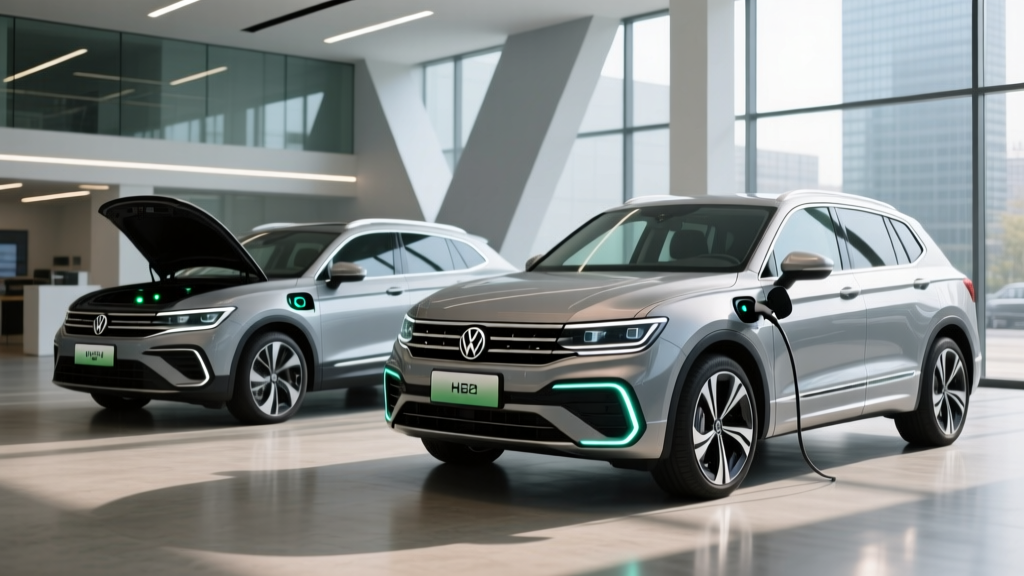
The 2026 Tiguan eHybrid is the volume play for VW's plug-in strategy. It pairs a 1.5-liter turbocharged four-cylinder engine with an integrated electric motor, drawing energy from a lithium-ion battery pack mounted beneath the rear seats and cargo floor.
| Specification | Value |
|---|---|
| Powertrain | 1.5L turbo I4 + electric motor |
| Combined System Output | 242 hp / 295 lb-ft torque |
| Battery (gross / usable) | 19.7 kWh / ~17.0 kWh |
| Battery Chemistry | NMC (nickel manganese cobalt) |
| EPA Electric-Only Range | 35 miles |
| EPA Combined Range (electric + gas) | ~430 miles |
| EPA MPGe (electric mode) | 88 MPGe |
| EPA MPG (hybrid mode, combined) | 35 MPG combined (37 city / 33 highway) |
| Level 1 Charging (120V, 1.4 kW) | ~12 hours (0–100%) |
| Level 2 Charging (240V, 3.6 kW) | ~4.5 hours (0–100%) |
| DC Fast Charging | Not available |
| 0–60 mph | 7.2 seconds |
| Drivetrain | Front-wheel drive (FWD) |
| Cargo Volume (behind 2nd row) | 33.0 cu ft |
| Base MSRP (SE eHybrid) | $39,490 |
Electric-Only Range: What 35 Miles Actually Means
The EPA rates the Tiguan eHybrid at 35 miles of electric-only range. In real-world use, expect that figure to hold fairly well in mild weather (50–80°F) during mixed suburban driving. Highway driving at 70+ mph will reduce electric range to roughly 25–28 miles due to aerodynamic drag, and cold weather (below 30°F) can drop it to 22–25 miles because the battery's usable capacity shrinks and cabin heating draws additional power.
Charging the Tiguan eHybrid: Level 1 and Level 2 Only
The Tiguan eHybrid does not support DC fast charging — this is typical for most PHEVs, which prioritize overnight home charging over rapid public top-ups. The onboard charger is rated at 3.6 kW, meaning:
| Charging Level | Power (kW) | 0–100% Time | Miles of Range Added per Hour |
|---|---|---|---|
| Level 1 (standard 120V outlet) | ~1.4 kW | ~12 hours | ~3 miles/hr |
| Level 2 (240V home charger) | 3.6 kW | ~4.5 hours | ~8 miles/hr |
A standard household outlet will replenish the battery overnight if you plug in when you get home. A Level 2 home charger (such as a ChargePoint Home Flex or Emporia Vue) cuts that to roughly 4.5 hours — easily enough to recharge during the workday if you have a workplace charger, or fully overnight at home. Installation of a Level 2 home charger typically runs $500–$1,500 including equipment and electrician labor, depending on whether your electrical panel needs an upgrade.
2026 Tiguan Mild Hybrid (HEV): The No-Plug Alternative
For buyers who cannot charge at home or simply want better fuel economy without behavioral change, the standard 2026 Tiguan features a 48-volt mild-hybrid system. This is not a full hybrid like a Toyota RAV4 Hybrid — it cannot drive on electric power alone. Instead, the small electric motor-generator smooths stop-start operation, provides a brief torque fill during acceleration, and enables slightly more aggressive regenerative braking.
| Drivetrain | City MPG | Highway MPG | Combined MPG |
|---|---|---|---|
| FWD | 26 | 33 | 29 |
| AWD (4Motion) | 24 | 31 | 27 |
Real-world MPG for the mild-hybrid Tiguan tends to align closely with EPA estimates, or slightly underperform on the highway. Unlike full hybrids (which can dramatically exceed their EPA city rating in stop-and-go traffic thanks to extended electric motor operation), mild hybrids provide a modest 1–2 MPG improvement over a non-hybrid equivalent. Expect 27–30 MPG combined in mixed driving for the FWD model.
The mild-hybrid system adds no complexity for the owner — there is no plug, no charging behavior to manage, and no electric range to monitor. The 48V battery is covered under the same powertrain warranty as the rest of the drivetrain.
Federal Tax Credits: Does the Tiguan eHybrid Qualify?
Under the current IRS §30D Clean Vehicle Credit rules for 2026, plug-in hybrids with at least 7 kWh of battery capacity can qualify for up to $7,500 in federal tax credits, but several restrictions apply:
- MSRP cap: SUVs must have an MSRP at or below $80,000 (the Tiguan eHybrid at ~$39,490–$44,000 clears this easily).
- Buyer income cap: Adjusted gross income must not exceed $150,000 (single), $225,000 (head of household), or $300,000 (married filing jointly).
- Battery sourcing requirements: A percentage of critical minerals and battery components must be sourced from the US or free-trade-agreement countries. Volkswagen has been working to localize battery supply chains, but eligibility for the full $7,500 vs. a partial $3,750 credit depends on the specific model year's sourcing compliance. Check the DOE/EPA fueleconomy.gov tax credit page for the latest per-model eligibility.
- Point-of-sale transfer: As of 2024, buyers can transfer the credit to the dealer at purchase, reducing the purchase price directly rather than waiting for a tax refund. This applies to the Tiguan eHybrid if it qualifies.
The mild-hybrid Tiguan (HEV) does not qualify for the §30D credit — its 48V battery is far below the 7 kWh minimum. No federal incentive applies to conventional hybrids or mild hybrids.
Reliability and Battery Replacement Costs
Volkswagen's hybrid systems have been in use across European-market models (Golf GTE, Passat GTE) since 2015, giving the architecture roughly a decade of real-world service history. The 1.5L turbo engine (EA211 evo2 family) is widely used across the VW Group and has proven durable in high-volume applications. The dual-clutch automatic transmission (DSG) paired with the hybrid system has a more mixed reputation — earlier generations had mechatronic reliability issues, though the latest DQ400e variant used in PHEVs has been substantially improved.
For the high-voltage PHEV battery, out-of-warranty replacement costs are estimated at $6,000–$9,000 including parts and labor, based on current VW Group PHEV battery pricing. However, PHEV batteries are smaller and less stressed than full EV batteries, and degradation data from earlier Golf GTE models suggests most packs retain well above 80% capacity at 100,000 miles under normal use. The 8-year / 100,000-mile warranty provides substantial protection.
The mild-hybrid's 48V battery is a much smaller, less expensive component — replacement cost is typically $800–$1,500 if needed outside warranty, and failure rates are low.
Pricing, Trims, and Ownership Economics
The 2026 Tiguan lineup positions the hybrid models as follows:
| Model / Trim | MSRP | Est. Tax Credit | Effective Price |
|---|---|---|---|
| Tiguan S (mild hybrid, FWD) | $31,490 | $0 | $31,490 |
| Tiguan SE (mild hybrid, AWD) | $35,290 | $0 | $35,290 |
| Tiguan SE eHybrid (PHEV, FWD) | $39,490 | Up to $3,750–$7,500* | ~$31,990–$35,740 |
| Tiguan SEL eHybrid (PHEV, FWD) | $43,990 | Up to $3,750–$7,500* | ~$36,490–$40,240 |
*Tax credit amount depends on battery sourcing compliance for the 2026 model year and buyer income eligibility. Verify current status at fueleconomy.gov before purchasing.
When the full $7,500 point-of-sale credit applies, the Tiguan SE eHybrid's effective price drops to roughly $31,990 — competitive with the gas-only SE AWD model while offering 35 miles of daily electric driving and lower per-mile fuel costs for commuters who charge regularly.
Operating cost comparison: At $3.50/gallon gasoline and $0.14/kWh electricity (national averages), the Tiguan eHybrid costs roughly $0.05/mile in electric mode versus $0.10/mile in hybrid gas mode. A commuter driving 30 miles round-trip and charging nightly would spend approximately $1.50/day on electricity versus $3.00/day on gasoline — saving roughly $450/year on a 15,000-mile annual commute if most miles are covered in electric mode.
Hybrid vs PHEV vs EV: Which Volkswagen Fits You?
Volkswagen's 2026 lineup gives buyers three distinct electrification paths. Here is a decision framework based on your situation:
Choose the Tiguan Mild Hybrid (HEV) if:
- You have no access to home or workplace charging
- You want a simple ownership experience with no plug-in behavior
- You drive a mix of city and highway and want a modest MPG improvement
- Your budget is under $36,000
Choose the Tiguan eHybrid (PHEV) if:
- You can charge at home (even a standard 120V outlet works overnight)
- Your daily commute is under 35 miles round-trip
- You take road trips where pure EV range would cause anxiety
- You want to reduce fuel costs without committing to full electric
- You qualify for the §30D tax credit, making the effective price competitive
Choose a Volkswagen ID.4 (full EV) if:
- You have reliable Level 2 home charging
- Your daily driving is under 200 miles and you're comfortable with DC fast charging on road trips
- You want the lowest per-mile operating cost and minimal maintenance
- You want to eliminate gasoline entirely
Pros and Cons of Volkswagen's Hybrid Lineup
Pros
- Tiguan eHybrid offers a practical 35-mile electric range for most commutes
- PHEV eliminates range anxiety — gas engine covers long trips seamlessly
- Level 2 charging fills the battery in ~4.5 hours — easy overnight routine
- 242 combined hp provides confident acceleration for a compact SUV
- Point-of-sale tax credit can reduce effective price by up to $7,500
- 8-year / 100,000-mile battery warranty matches industry standard
- Mild-hybrid option available for buyers without charging access
Cons
- No DC fast charging on the PHEV — public charging is slow (3.6 kW max)
- FWD only for the eHybrid — no all-wheel-drive PHEV option in the US
- Cargo space reduced slightly vs. gas Tiguan due to battery placement
- Mild hybrid offers only incremental MPG gains — not a full hybrid system
- Tax credit eligibility uncertain due to battery sourcing rules — verify before purchase
- VW's PHEV reliability track record in the US is limited (Tiguan eHybrid is relatively new)
Frequently Asked Questions
How many MPG does the Volkswagen Tiguan hybrid get?
The 2026 Tiguan eHybrid (PHEV) achieves 35 MPG combined (37 city / 33 highway) when operating in hybrid mode after the battery is depleted. The mild-hybrid Tiguan (non-plug-in) achieves 29 MPG combined with FWD (26 city / 33 highway) or 27 MPG combined with AWD. In practice, PHEV owners who charge daily may use very little gasoline during the work week, effectively achieving much higher "MPG" when measured as miles per gallon of gasoline consumed.
How far can the Tiguan eHybrid drive on electric only?
The EPA rates the Tiguan eHybrid at 35 miles of electric-only range. Real-world range varies: expect 28–32 miles in moderate-temperature suburban driving, 25–28 miles on the highway, and 22–25 miles in cold winter conditions. This is sufficient for most daily commutes under 30 miles round-trip.
Does the Volkswagen Tiguan hybrid qualify for a tax credit?
The Tiguan eHybrid (PHEV) may qualify for up to $7,500 under the IRS §30D Clean Vehicle Credit, subject to battery sourcing requirements, buyer income caps ($150K single / $300K joint), and the $80,000 SUV MSRP cap. The mild-hybrid Tiguan does not qualify for any federal tax credit. Always verify current eligibility at fueleconomy.gov and consult a tax professional before relying on credit amounts for purchase decisions.
Is the Volkswagen hybrid system reliable? What does battery replacement cost?
VW's PHEV powertrain has been in service in Europe since 2015 (Golf GTE), providing a reasonable track record. The high-voltage battery is warrantied for 8 years / 100,000 miles at 70% capacity retention. Out-of-warranty replacement is estimated at $6,000–$9,000, though most PHEV batteries show modest degradation given their smaller size and lower cycle stress compared to full EVs. The mild-hybrid's 48V system is simpler and cheaper to service ($800–$1,500 for battery replacement).
Can I charge the Tiguan eHybrid at a DC fast charger?
No. The Tiguan eHybrid does not have a DC fast charging port. It charges exclusively via Level 1 (120V, ~1.4 kW) or Level 2 (240V, up to 3.6 kW). A full charge on Level 2 takes approximately 4.5 hours. This is standard for most PHEVs — the smaller battery makes overnight home charging practical without needing high-speed public infrastructure.
Should I buy the Tiguan eHybrid or the ID.4?
If you can charge at home and your daily driving stays under 200 miles, the ID.4 (full EV, ~275-mile EPA range) offers lower operating costs, less maintenance, and a smoother driving experience. Choose the Tiguan eHybrid if you regularly drive longer distances where DC fast charging infrastructure is sparse, if you lack reliable home charging, or if you want to ease into electrification without fully committing. The PHEV is the pragmatic middle ground; the EV is the lower-cost long-term play.