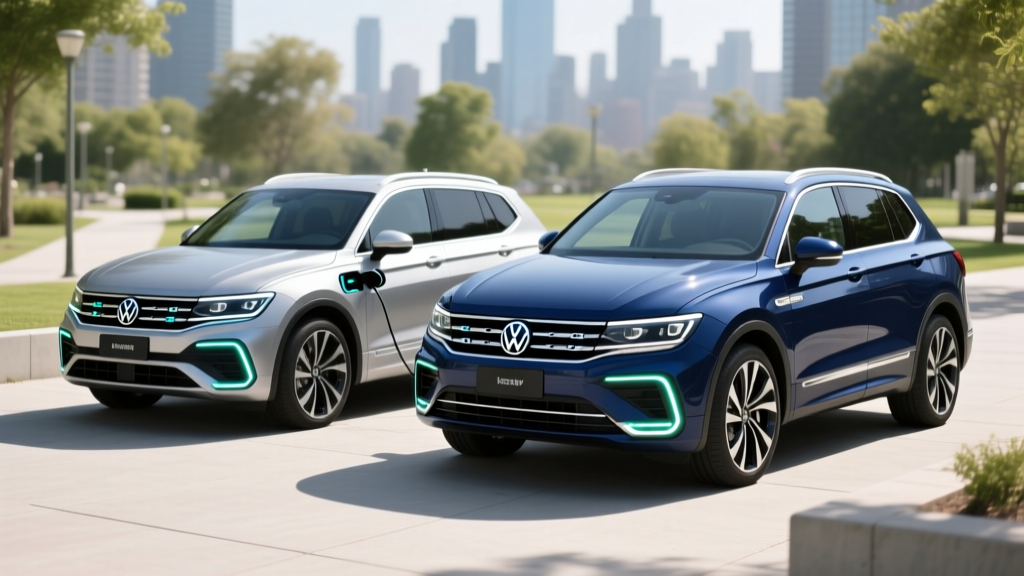
For buyers searching for a Volkswagen hybrid SUV, the 2026 lineup centers on the Tiguan eHybrid—a plug-in hybrid (PHEV) compact crossover that bridges the gap between a conventional gas car and a full battery-electric vehicle. Volkswagen also offers the larger Atlas and Atlas Cross Sport with mild-hybrid turbocharged powertrains, though these are not full hybrids or plug-ins. This guide breaks down exactly what VW's electrified SUVs deliver in range, efficiency, charging, and value so you can decide whether a VW hybrid fits your garage.
2026 Volkswagen Hybrid SUV Lineup at a Glance
Volkswagen's U.S. SUV strategy in 2026 leans heavily on the all-new third-generation Tiguan, which introduced a PHEV variant to the American market for the first time. The Atlas and Atlas Cross Sport received mild-hybrid 2.0L turbo engines that improve efficiency modestly but cannot drive on electric power alone. Here is how the lineup stacks up:
| Model | Powertrain Type | Combined HP | Battery (kWh) | EV Range (mi) | EPA Combined | Starting MSRP |
|---|---|---|---|---|---|---|
| Tiguan eHybrid | PHEV | 245 hp | 19.7 kWh (usable ~15.6) | ~32 | 80 MPGe / 35 MPG gas | $40,990 |
| Tiguan (MHEV) | Mild Hybrid | 201 hp | N/A (48V system) | 0 | 28 MPG | $32,990 |
| Atlas (MHEV) | Mild Hybrid | 269 hp | N/A (48V system) | 0 | 23 MPG | $40,490 |
| Atlas Cross Sport (MHEV) | Mild Hybrid | 269 hp | N/A (48V system) | 0 | 23 MPG | $42,990 |
The Tiguan eHybrid is the only true plug-in hybrid in VW's U.S. SUV stable and the model most buyers mean when they search for a "Volkswagen hybrid SUV." The mild-hybrid variants use a 48-volt system that smooths stop-start and recovers small amounts of energy under braking, but they do not offer electric-only driving or plug-in charging.
HEV vs PHEV vs Mild Hybrid: What VW Actually Offers
Understanding the Differences
It is critical to distinguish between three types of electrified powertrains before evaluating VW's SUVs:
- Conventional Hybrid (HEV): A gasoline engine paired with an electric motor and small battery (typically 1–2 kWh). The battery charges via regenerative braking and the engine—you never plug it in. Examples: Toyota RAV4 Hybrid, Honda CR-V Hybrid.
- Plug-in Hybrid (PHEV): A larger battery (typically 13–25 kWh) that you plug in to charge. Offers 20–50 miles of electric-only driving before the gas engine takes over. Example: Tiguan eHybrid.
- Mild Hybrid (MHEV): A 48-volt system that assists the gas engine during acceleration and enables smoother stop-start. Cannot drive on electric power alone. Examples: 2026 Tiguan base, Atlas, Atlas Cross Sport.
Volkswagen does not currently sell a conventional (non-plug) full hybrid SUV in the United States. If you want a self-charging hybrid with no plug from VW, the mild-hybrid Tiguan is the closest option, though its efficiency gains are modest compared to a Toyota or Honda HEV. If you want meaningful electric driving and the ability to plug in, the Tiguan eHybrid PHEV is the answer.
Tiguan eHybrid: Fuel Economy, Electric Range, and Real-World Efficiency
The 2026 Tiguan eHybrid pairs a 1.5-liter turbocharged four-cylinder engine with an electric motor integrated into the six-speed DSG automatic transmission. Combined output is 245 horsepower and approximately 295 lb-ft of torque. The 19.7 kWh lithium-ion battery pack (roughly 15.6 kWh usable) sits beneath the rear seats and cargo floor.
| Mode | City | Highway | Combined |
|---|---|---|---|
| Charge-depleting (EV + gas) | 80 MPGe | ||
| Charge-sustaining (gas only) | 37 MPG | 33 MPG | 35 MPG |
EPA Electric Range vs. Real World
EPA-rated electric-only range: ~32 miles. In real-world mixed driving at moderate temperatures (60–75°F), expect 28–32 miles before the engine engages. In cold weather (below 35°F), cabin heating and reduced battery efficiency can drop electric range to 22–26 miles. Highway-speed electric driving (70+ mph) also reduces range to roughly 24–27 miles due to higher energy consumption.
Total combined range (electric + gas): approximately 420–440 miles with a full charge and full 13.2-gallon tank.
In practice, PHEV owners who charge nightly at home and commute under 30 miles round-trip may go weeks without visiting a gas station. The Tiguan eHybrid's charge-sustaining MPG of 35 combined is competitive with dedicated HEVs in the compact SUV segment, meaning you are not sacrificing efficiency once the battery depletes.
Charging the Tiguan eHybrid: Times, Levels, and Connector Details
The Tiguan eHybrid uses a CCS1 (J1772 for AC) charge port located on the driver-side front fender. Here is what charging looks like at each level:
| Charging Level | Power (kW) | Time (0–100%) | Notes |
|---|---|---|---|
| Level 1 (120V household) | ~1.4 kW | ~11 hours | Trickle charge; overnight top-up only |
| Level 2 (240V home/public) | ~3.6 kW (onboard limit) | ~4.5 hours | Standard home wallbox or public Level 2 |
| DC Fast Charge | N/A | N/A | No DC fast charging capability |
A key limitation: the Tiguan eHybrid's onboard charger is capped at approximately 3.6 kW, meaning even a 7.2 kW or 11.5 kW Level 2 home charger will only deliver 3.6 kW to the battery. This is typical for PHEVs with smaller batteries—Volkswagen prioritized cost and weight over faster AC charging. For most owners, a standard Level 2 wallbox will fully replenish the battery in about 4.5 hours, easily covering an overnight or workday charge cycle.
The Tiguan eHybrid does not support DC fast charging. This is standard for most compact PHEVs; DC fast-charge hardware adds weight, cost, and packaging complexity that is hard to justify on a 19.7 kWh battery.
Pricing, Trims, and Federal Tax Credit Eligibility
The 2026 Tiguan eHybrid is offered in two trims in the U.S. market:
- SE eHybrid: $40,990 MSRP (includes destination)
- SEL Premium eHybrid: $46,490 MSRP (includes destination)
Does the Tiguan eHybrid Qualify for the Federal Tax Credit?
Under current IRS §30D Clean Vehicle Credit rules, the Tiguan eHybrid's eligibility for the full $7,500 credit depends on battery component and critical mineral sourcing requirements, which have tightened significantly since 2024. As of the 2026 tax year, many PHEVs with globally sourced battery cells have seen their credit reduced or eliminated.
§30D Credit Requirements (2026 Tax Year)
- Battery capacity: At least 7 kWh (Tiguan eHybrid meets this at 19.7 kWh)
- MSRP cap: SUVs/vans/pickups must be under $80,000 (Tiguan eHybrid qualifies)
- Buyer income cap: Modified AGI ≤ $150,000 (single), $225,000 (head of household), $300,000 (joint)
- Critical minerals requirement: Percentage of minerals sourced from U.S. or FTA partners (phases up annually—check IRS guidance)
- Battery components requirement: Percentage manufactured in North America (phases up annually)
- FEOC restriction: No battery components from a "foreign entity of concern" (China, Russia, etc.)
- Point-of-sale transfer: Eligible buyers can transfer the credit to the dealer for an upfront price reduction
Buyers should verify current eligibility on the fueleconomy.gov tax credit database before purchasing, as credit amounts can change mid-year based on sourcing updates. Consult a tax professional for your specific situation.
Battery Warranty, Reliability, and Long-Term Ownership Costs
VW PHEV Battery Warranty
Volkswagen covers the Tiguan eHybrid's high-voltage battery with an 8-year / 100,000-mile warranty (whichever comes first), consistent with the federal mandate for emissions-related components. The warranty guarantees the battery will retain at least 70% of its original capacity over that period. The conventional 12V battery, powertrain, and vehicle structure carry separate warranties (4-year/50,000-mile bumper-to-bumper; 6-year/72,000-mile powertrain).
PHEV battery degradation in real-world use is typically modest. Based on data from similar VW Group PHEV platforms (including the European-market Golf GTE and Passat GTE), owners report 5–10% capacity loss over the first 5 years under normal charging habits. The Tiguan eHybrid's battery management system includes a buffer (roughly 4 kWh of the 19.7 kWh total is reserved), which helps protect long-term health by preventing deep discharge and overcharge.
If the battery does require replacement out of warranty, VW Group PHEV battery packs currently cost between $6,000 and $9,000 for parts and labor at a dealership. However, individual module replacement (rather than the full pack) may be possible at lower cost as the vehicle ages and the aftermarket develops.
Overall reliability of the third-generation Tiguan is still establishing itself (the platform debuted for the 2025 model year), but VW's MQB Evo underpinnings are proven across the group. The PHEV powertrain adds complexity—two power sources, a DSG transmission, and high-voltage electronics—so adherence to maintenance schedules matters more than on a simple gas-only vehicle.
Who Should Choose the Tiguan eHybrid vs. a Full EV or Gas SUV?
Choose the Tiguan eHybrid PHEV If:
- Your daily commute is under 30 miles round-trip and you can charge at home (Level 1 or 2)
- You want electric daily driving but need gas-engine flexibility for road trips, towing, or rural travel
- You live in a region with limited DC fast-charging infrastructure
- You want a compact SUV with European driving dynamics and VW's interior quality
Choose a Full BEV (e.g., VW ID.4, Hyundai Ioniq 5) If:
- You have reliable home Level 2 charging and your daily driving is under 200 miles
- You want to eliminate gasoline purchases entirely and minimize maintenance (no oil changes, fewer moving parts)
- You want DC fast-charging capability for road trips (200+ kW charging in 18–25 minutes)
- You want to maximize federal tax credit eligibility (many BEVs still qualify for the full $7,500)
Choose a Gas or Mild-Hybrid SUV If:
- You cannot charge at home or at work (apartment/condo without charging access)
- Your budget is under $35,000 (the mild-hybrid Tiguan starts at $32,990)
- You drive very few miles annually and the fuel-cost savings of a PHEV would not offset the higher purchase price
Tiguan eHybrid Pros
- 32 miles of electric range covers most commutes gas-free
- 35 MPG combined on gas alone—competitive with dedicated hybrids
- Premium interior with VW Digital Cockpit and 12.9-inch infotainment
- 245 hp provides confident highway merging and passing
- Eligible for HOV lane access in several states (check local rules)
Tiguan eHybrid Cons
- 3.6 kW onboard charger means slow Level 2 charging (~4.5 hrs)
- No DC fast charging—limits utility of public fast-charge stations
- Cargo volume reduced vs. gas Tiguan due to battery placement (~27 cu ft vs. ~33 cu ft)
- Full §30D tax credit eligibility uncertain—verify before purchase
- Starting at ~$41K, it is $8,000+ more than the base mild-hybrid Tiguan
Frequently Asked Questions
How many MPG does the Volkswagen Tiguan eHybrid get?
The 2026 Tiguan eHybrid is rated at 80 MPGe combined when operating in electric-assisted mode and 35 MPG combined (37 city / 33 highway) when running on gasoline alone after the battery depletes. Real-world city driving in hybrid mode can slightly exceed the EPA city figure thanks to aggressive regenerative braking in stop-and-go traffic.
How far can the Tiguan eHybrid go on electric power only?
The EPA rates the Tiguan eHybrid at approximately 32 miles of electric-only range. Real-world results vary: expect 28–32 miles in mild weather with mixed driving, and 22–26 miles in cold conditions or at sustained highway speeds.
Does the Volkswagen Tiguan hybrid need to be plugged in?
The Tiguan eHybrid is a plug-in hybrid (PHEV) and should be plugged in to take advantage of its electric range. However, it will still operate as a conventional hybrid if you never plug it in—you simply lose the 32 miles of electric driving and run on the gas engine, achieving about 35 MPG combined. The standard mild-hybrid Tiguan does not plug in at all.
Is the Tiguan eHybrid reliable, and what does battery replacement cost?
The PHEV powertrain adds complexity compared to a gas-only SUV, but VW's MQB Evo platform and hybrid components are well-tested in European markets. The high-voltage battery is warrantied for 8 years / 100,000 miles with a 70% capacity retention guarantee. Out-of-warranty replacement is estimated at $6,000–$9,000, though module-level repair may reduce this cost.
Does the Tiguan eHybrid qualify for the $7,500 federal tax credit?
Eligibility for the IRS §30D Clean Vehicle Credit depends on battery sourcing, your income, and the vehicle's MSRP. The Tiguan eHybrid meets the MSRP and battery-capacity thresholds, but critical mineral and battery component sourcing requirements may reduce the credit amount. Always verify on fueleconomy.gov and consult a tax professional before relying on the credit.
Can the Tiguan eHybrid tow?
Volkswagen rates the Tiguan eHybrid at approximately 1,500 pounds of towing capacity (braked trailer). This is lower than the gas/mild-hybrid Tiguan's 2,600-pound rating due to the added weight of the hybrid system and reduced cooling margin. For light utility trailers or small boat trailers, it is adequate; for heavier loads, consider the gas Tiguan or Atlas.
What is the total driving range of the Tiguan eHybrid?
With a fully charged battery and a full 13.2-gallon fuel tank, the Tiguan eHybrid can travel approximately 420–440 total miles before needing fuel or a charge. This makes it suitable for long road trips without range anxiety—you simply refuel at any gas station as you would with a conventional vehicle.