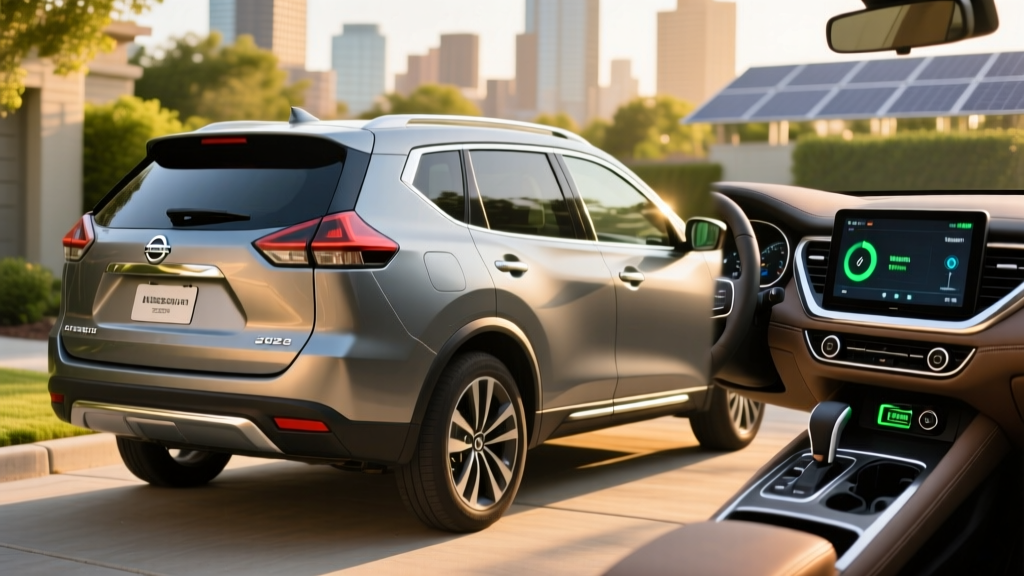
The Nissan Rogue Hybrid was a brief but notable experiment in Nissan's compact-SUV lineup. Sold primarily between the 2014 and 2019 model years (with a discontinuation in the U.S. after 2019), this conventional hybrid paired a 2.0-liter four-cylinder engine with an electric motor to deliver meaningful fuel savings over the standard gas Rogue — without requiring a plug. For budget-conscious shoppers in 2026, a used Nissan Rogue Hybrid represents an affordable entry into hybrid ownership, typically priced between $11,000 and $19,000 depending on year, mileage, and condition.
But before you sign the paperwork, you need the full picture: real-world MPG versus EPA estimates, hybrid battery longevity and replacement costs, and how this HEV stacks up against modern PHEVs and full EVs. This guide covers every number that matters.
HEV vs. PHEV: What the Used Nissan Rogue Hybrid Actually Is
It's critical to understand what you're buying. The Nissan Rogue Hybrid is a conventional hybrid electric vehicle (HEV) — not a plug-in hybrid (PHEV). That distinction changes everything about how you own it.
| Feature | HEV (Rogue Hybrid) | PHEV (e.g., Toyota RAV4 Prime) | BEV (e.g., Tesla Model Y) |
|---|---|---|---|
| Plug-in charging required? | No — self-charging via regen & engine | Yes — plug in for electric-only range | Yes — plug in for all driving |
| Electric-only range | None (motor assists engine only) | 35–42 miles typical | 260–330+ miles (full battery) |
| Battery size | ~0.9 kWh (small buffer) | 14–18 kWh usable | 60–82 kWh usable |
| Fuel source | Gasoline (improved MPG) | Gasoline + electricity | Electricity only |
| Federal tax credit (§30D) | Not eligible | Up to $7,500 (if eligible, new only) | Up to $7,500 (if eligible, new only) |
The Rogue Hybrid's small lithium-ion battery (roughly 0.9 kWh) charges itself through regenerative braking and the gasoline engine. You never plug it in. You simply fill up at the gas station and drive — the hybrid system handles the rest, seamlessly switching between electric-motor assist and engine power to optimize fuel consumption.
EPA Fuel Economy: How Many MPG Does the Nissan Rogue Hybrid Get?
The headline number for any hybrid buyer. Here's the official EPA data for the most common model years (FWD configuration), sourced from fueleconomy.gov:
| Model Year | Drivetrain | City MPG | Highway MPG | Combined MPG |
|---|---|---|---|---|
| 2015–2017 | FWD | 33 | 35 | 34 |
| 2015–2017 | AWD | 31 | 34 | 33 |
| 2018–2019 | FWD | 33 | 35 | 34 |
| 2018–2019 | AWD | 31 | 33 | 32 |
For comparison, the equivalent gas-only Nissan Rogue of the same era achieves roughly 26 city / 33 highway / 29 combined (FWD). The hybrid delivers a 5-MPG combined improvement, which translates to roughly 60–80 fewer gallons of fuel per year for a driver covering 15,000 miles annually — a savings of approximately $180–$250 per year at 2026 fuel prices.
Real-World MPG vs. EPA Sticker
Hybrids often exceed their EPA city estimates in stop-and-go traffic because regenerative braking recaptures energy that a gas car wastes as heat. Many Rogue Hybrid owners report 35–37 MPG in city driving during warm weather. However, highway MPG tends to run slightly below the sticker — expect 31–33 MPG at sustained 70–75 mph — because the electric motor provides less benefit at constant high speeds where aerodynamic drag dominates.
In cold weather (below 35°F), expect a 5–10% MPG reduction as the engine runs more frequently to provide cabin heat and the battery operates less efficiently. Real-world combined MPG across seasons: 30–35 MPG for most drivers.
Powertrain Specs: Engine, Motor, and Combined Output
| Specification | Detail |
|---|---|
| Engine | 2.0L inline-4 (QR20DE) |
| Engine horsepower | 135 hp @ 6,000 rpm |
| Electric motor output | 30 kW (~40 hp) |
| Net combined horsepower | 176 hp |
| Transmission | Xtronic CVT (continuously variable) |
| Drivetrain options | FWD or AWD (Intelligent AWD) |
| Battery type | Lithium-ion, ~0.9 kWh |
| 0–60 mph (est.) | ~8.5 seconds |
| Towing capacity | 1,000 lbs (not rated for heavy towing) |
The combined 176 hp gives the Rogue Hybrid adequate acceleration for merging and passing, though it won't feel quick. The CVT prioritizes smoothness and efficiency over sportiness. If you're coming from a V6 SUV, the power delivery will feel deliberate rather than urgent — but for daily commuting and school runs, it's perfectly sufficient.
Hybrid Battery Lifespan, Warranty, and Replacement Cost
This is the top concern for any used hybrid buyer — and it should be. The Rogue Hybrid's lithium-ion traction battery is located beneath the rear cargo floor and is designed to last the life of the vehicle under normal use.
Nissan Hybrid Battery Warranty (Original)
- Hybrid system coverage: 8 years / 100,000 miles (whichever comes first)
- Capacity retention threshold: Nissan warranted the battery against failure and significant capacity loss
- Transferability: The warranty transfers to subsequent owners — a 2017 model's coverage expires in 2025 or at 100k miles; a 2019 model's coverage extends to 2027 or 100k miles
What Happens When the Battery Degrades?
Nissan's hybrid system is relatively conservative — it doesn't cycle the small 0.9 kWh battery through deep charge/discharge ranges the way a PHEV or BEV does. This shallow cycling significantly extends cell life. Most Rogue Hybrids reaching 150,000+ miles show minimal hybrid-system degradation.
If the battery does fail outside warranty, replacement options include:
- New OEM battery from Nissan: $2,500–$4,000 (parts + labor at a dealer)
- Refurbished/remanufactured battery: $1,500–$2,500 from independent hybrid specialists
- Used salvage battery: $800–$1,500 (risky — unknown remaining life)
For context, hybrid battery failure rates on the Rogue Hybrid are low compared to early-generation Toyota and Honda systems. The lithium-ion chemistry Nissan chose has proven durable. Most owners will never need a replacement.
Does the Used Nissan Rogue Hybrid Qualify for a Tax Credit?
No. The Nissan Rogue Hybrid does not qualify for the federal §30D Clean Vehicle Credit. Per IRS guidelines, the §30D credit applies only to new plug-in electric vehicles (PHEVs and BEVs) with a battery capacity of at least 7 kWh. The Rogue Hybrid's ~0.9 kWh battery and conventional HEV architecture place it outside eligibility entirely.
This applies to both new (when it was sold) and used purchases. The separate used clean vehicle credit (up to $4,000 or 30% of sale price) also requires the vehicle to be a PHEV or BEV — conventional hybrids are excluded.
Some states offer their own incentives for hybrid purchases, but these vary widely by jurisdiction and many have expired. Check your state's energy office or DMV for current programs.
Used Pricing in 2026: What You'll Actually Pay
Based on current market data for the used Nissan Rogue Hybrid:
| Model Year | Mileage Range | Typical Price (Private Party) | Typical Price (Dealer) |
|---|---|---|---|
| 2014–2015 | 90k–130k miles | $10,000–$13,500 | $12,000–$15,500 |
| 2016–2017 | 65k–100k miles | $13,000–$16,500 | $14,500–$18,000 |
| 2018–2019 | 40k–75k miles | $15,500–$19,000 | $17,000–$21,000 |
The Rogue Hybrid typically commands a $1,000–$2,000 premium over an equivalent gas-only Rogue of the same year and mileage. Given the annual fuel savings of $180–$250, the premium pays for itself in roughly 5–8 years of average driving — or sooner if you drive more than 15,000 miles per year or live in a high-fuel-cost state.
Rogue Hybrid vs. PHEV vs. Full EV: Which Should You Choose?
The right choice depends on your charging access, budget, and driving patterns. Here's a practical decision framework:
Choose the Used Rogue Hybrid (HEV) If:
- You cannot install a home charger or lack reliable plug-in access
- Your budget is under $20,000 and you want a crossover
- You drive 10,000–18,000 miles/year and want lower fuel costs without lifestyle changes
- You want zero range anxiety — it refuels at any gas station in 3 minutes
- You plan to keep the vehicle 3–6 years
Choose a PHEV (e.g., RAV4 Prime, Tucson PHEV) If:
- You can charge at home (Level 1 or 2) and have a commute under 40 miles
- You want to drive mostly electric daily but need gas flexibility for road trips
- Your budget allows $25,000–$40,000 (used/new PHEV)
- You want to qualify for a tax credit on a new purchase
Pros: Used Nissan Rogue Hybrid
- 34 MPG combined EPA — 5 MPG better than gas Rogue
- No plug-in required; zero infrastructure cost
- Low hybrid-battery failure rate; warranty may still apply on 2018–2019 models
- Affordable entry price ($11k–$19k)
- Practical cargo space (only slight reduction vs. gas model due to battery placement)
Cons: Used Nissan Rogue Hybrid
- No electric-only driving — still 100% gasoline dependent
- No federal or most state tax credits
- Discontinued after 2019 — limited remaining inventory
- CVT can feel sluggish under hard acceleration
- 1,000-lb towing limit (below class average)
Reliability Ratings and Known Issues
The Nissan Rogue Hybrid shares most of its mechanicals with the conventional Rogue, which carries mixed reliability ratings from major evaluators. The hybrid-specific components (battery, inverter, electric motor) have proven robust, but the broader vehicle has some documented concerns:
- CVT transmission: Nissan's Xtronic CVTs from this era have a history of shudder and premature wear. Check for smooth acceleration without hesitation or juddering during a test drive. Some 2014–2016 models were subject to extended CVT warranties.
- Brakes: Regenerative braking reduces wear on the friction brakes — many owners report original brake pads lasting 80,000+ miles, a genuine cost benefit.
- Electronics: Infotainment and sensor issues are comparable to the gas Rogue — nothing specific to the hybrid system.
Check NHTSA recall data for the specific VIN you're considering, and always get a pre-purchase inspection from a mechanic familiar with hybrid systems.
Frequently Asked Questions
How many MPG does the used Nissan Rogue Hybrid get in real driving?
The EPA rates the FWD Rogue Hybrid at 33 city / 35 highway / 34 combined. In real-world use, expect 30–35 MPG combined depending on driving style, terrain, and climate. City driving often yields 35+ MPG thanks to regenerative braking, while sustained highway driving at 75 mph may return 31–33 MPG.
Does the Nissan Rogue Hybrid need to be plugged in?
No. The Rogue Hybrid is a conventional HEV. Its small lithium-ion battery charges through regenerative braking and the gasoline engine. You never plug it in — just refuel at any gas station.
Is the Nissan Rogue Hybrid reliable?
The hybrid-specific components (battery, motor, inverter) have a strong reliability record. The main concern is Nissan's CVT transmission from this era, which has documented issues on some units. A pre-purchase inspection focused on CVT behavior is essential. The hybrid battery itself rarely fails before 150,000 miles.
What does it cost to replace the hybrid battery?
A new OEM replacement runs $2,500–$4,000 at a dealer. Refurbished units from hybrid specialists cost $1,500–$2,500. However, failure rates are low, and if you buy a 2018–2019 model, the original 8-year/100,000-mile hybrid warranty may still be in effect through 2026–2027.
How does the Rogue Hybrid compare to a Toyota RAV4 Hybrid?
The Toyota RAV4 Hybrid of the same era achieves a slightly higher 32–34 MPG combined (AWD standard) and benefits from Toyota's reputation for hybrid longevity. However, used RAV4 Hybrids typically cost $3,000–$6,000 more than equivalent Rogue Hybrids. If budget is the priority, the Rogue Hybrid offers better value; if long-term resale and brand reliability perception matter more, the RAV4 Hybrid wins.
Can I get a tax credit for buying a used Nissan Rogue Hybrid?
No. The federal §30D Clean Vehicle Credit and the used-vehicle credit (up to $4,000) apply only to plug-in vehicles (PHEVs and BEVs). Conventional hybrids like the Rogue Hybrid are not eligible. Check your state for any local hybrid incentives, though most have expired.
Bottom Line: Is a Used Nissan Rogue Hybrid Worth It in 2026?
For buyers who need a compact crossover, can't plug in at home, and want to reduce fuel costs without stretching their budget past $20,000, the used Nissan Rogue Hybrid fills a narrow but real niche. Its 34 MPG combined is a genuine improvement over the gas model, the hybrid battery is durable, and the purchase price is compelling.
It's not the most advanced hybrid on the used market — the RAV4 Hybrid is more refined, and any modern PHEV offers electric-only commuting that an HEV can't match. But at $11,000–$19,000, the Rogue Hybrid asks very little and delivers exactly what it promises: better fuel economy with zero lifestyle changes. If that's your brief, it's a smart, practical buy.