The Used Hybrid Tax Credit: What Buyers Need to Know in 2026
The federal used clean vehicle credit under IRS §25E can put up to $4,000 back in your pocket when you buy a qualifying pre-owned plug-in hybrid or battery-electric vehicle. But the rules are specific, the eligible model list is narrower than most shoppers assume, and conventional hybrids (HEVs) that don't plug in are excluded entirely. This guide breaks down exactly which used PHEVs and EVs qualify, how the income and price caps work, and what real-world ownership looks like for the top contenders.
§25E Used Clean Vehicle Credit — 2026 Eligibility Checklist
- Credit amount: 30% of sale price, up to $4,000 maximum
- Vehicle price cap: Sale price must be $25,000 or less
- Vehicle age: Model year must be at least 2 years older than the calendar year of purchase (so for 2026, model year 2024 or earlier)
- Buyer income caps (AGI): $150,000 joint / $112,500 head of household / $75,000 single
- Vehicle type: Must be a plug-in hybrid (PHEV) or battery-electric vehicle (BEV) with ≥4 kWh battery capacity — conventional HEVs do NOT qualify
- Dealer requirement: Must be purchased from a licensed dealer (private-party sales excluded)
- Transfer option: Credit can be transferred to the dealer at point of sale as a down-payment reduction
- Frequency limit: One used-vehicle credit per taxpayer every 3 years
HEV vs. PHEV: Why the Plug Matters for the Tax Credit
This is the single most common point of confusion among used hybrid shoppers. Not every vehicle with "hybrid" on the badge qualifies for the used hybrid tax credit. The distinction comes down to one thing: can you plug it in?
| Feature | Conventional Hybrid (HEV) | Plug-in Hybrid (PHEV) |
|---|---|---|
| Plugs into a charger? | No — charges via engine & regen | Yes — J1772 / NACS port |
| Battery size | 0.5–2 kWh (small) | 8–20+ kWh (large) |
| Electric-only range | None (motor assists engine) | 20–45 miles typical |
| Qualifies for §25E used credit? | No | Yes (if other criteria met) |
| Qualifies for §30D new credit? | No | Yes (if eligible) |
| Example | Toyota Camry Hybrid | Toyota RAV4 Prime |
If you're shopping for a used hybrid specifically to capture the tax credit, you must be looking at PHEVs or full BEVs. Popular HEVs like the Honda Accord Hybrid, Toyota Highlander Hybrid, and Ford Maverick Hybrid are excellent vehicles with strong fuel economy, but they carry zero federal tax credit eligibility — new or used.
Top Used PHEVs That Qualify for the Tax Credit
Below are the most common used PHEVs you'll find on dealer lots in the sub-$25,000 range — the price ceiling for §25E eligibility. Specs reflect original model-year EPA data sourced from fueleconomy.gov.
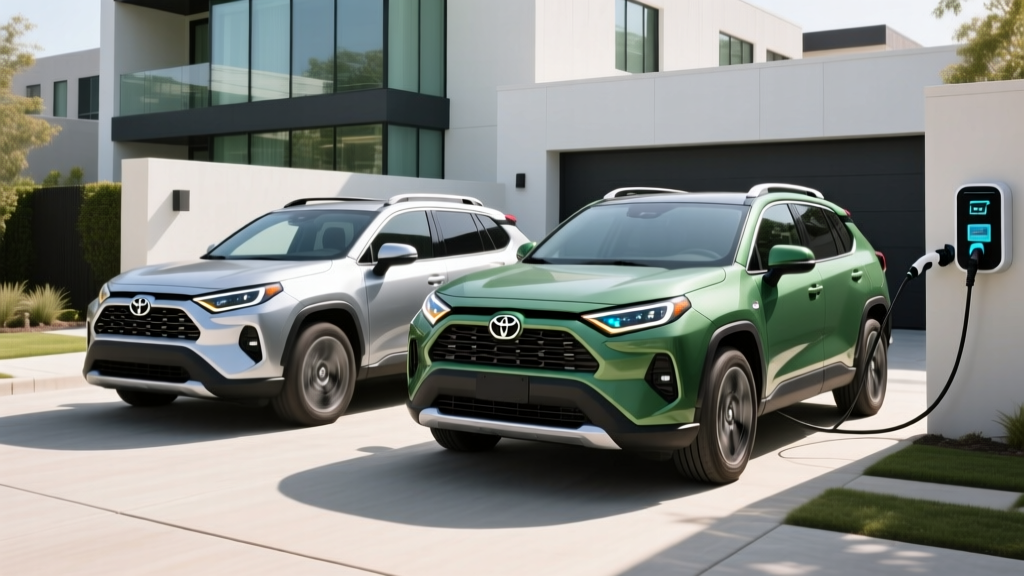
Toyota RAV4 Prime (2021–2023)
| Powertrain | 2.5L 4-cyl + 2 electric motors, 302 combined HP |
| Battery | 18.1 kWh lithium-ion (usable ~14.9 kWh) |
| EV-only range | 42 miles (EPA) |
| Combined range (EV + gas) | ~600 miles |
| EPA MPG (hybrid mode) | 38 city / 35 highway / 38 combined |
| MPGe (EV mode) | 94 MPGe combined |
| DC fast charge? | No — Level 2 only, ~2.5 hours to full |
| 0–60 mph | 5.7 seconds |
| Battery warranty | 10 years / 150,000 miles (hybrid battery) |
| Original MSRP | $39,220–$43,545 (2021–2023) |
| Used price range (2026) | $22,000–$25,000 (high-mileage examples) |
Hybrid Battery Longevity: What the Data Shows
Toyota's hybrid battery warranty covers 10 years/150,000 miles across all 50 states. Real-world data from fleet operators and owner surveys indicates most Toyota hybrid batteries last 150,000–200,000+ miles before significant degradation. Replacement cost for a RAV4 Prime traction battery runs approximately $4,000–$6,500 at a dealership, though refurbished units are increasingly available for $2,500–$3,500. For a 2021 model with 60,000 miles, you likely have 4+ years of factory battery warranty remaining.
Ford Escape PHEV (2020–2023)
| Powertrain | 2.5L Atkinson-cycle 4-cyl + electric motor, 210 combined HP |
| Battery | 14.4 kWh lithium-ion (usable ~11.2 kWh) |
| EV-only range | 37 miles (EPA) |
| EPA MPG (hybrid mode) | 40 city / 36 highway / 39 combined |
| MPGe (EV mode) | 105 MPGe combined |
| DC fast charge? | No — Level 2 only, ~3.5 hours to full |
| 0–60 mph | ~8.5 seconds |
| Battery warranty | 8 years / 100,000 miles |
| Used price range (2026) | $17,000–$24,000 |
The Escape PHEV is one of the easiest models to find under the $25,000 cap. Depreciation has been steeper than the RAV4 Prime, making it a strong value play. The trade-off is less power, no AWD option, and a smaller EV range — but 37 miles covers most daily commutes.
Hyundai Tucson PHEV (2022–2023)
| Powertrain | 1.6L turbo 4-cyl + electric motor, 261 combined HP |
| Battery | 13.8 kWh lithium-ion (usable ~11.5 kWh) |
| EV-only range | 33 miles (EPA) |
| EPA MPG (hybrid mode) | 35 city / 35 highway / 35 combined |
| MPGe (EV mode) | 80 MPGe combined |
| DC fast charge? | No — Level 2 only, ~2 hours to full |
| 0–60 mph | 7.1 seconds |
| Battery warranty | 10 years / 100,000 miles |
| Used price range (2026) | $19,500–$24,500 |
Hyundai's 10-year powertrain and battery warranty is a standout. A 2022 Tucson PHEV with 40,000 miles still has 8 years of battery coverage remaining — a significant risk-reducer for used buyers. The turbo powertrain delivers strong passing power, and standard AWD adds all-weather capability.
Chrysler Pacifica Hybrid (2019–2023)
| Powertrain | 3.6L V6 + 2 electric motors, 260 combined HP |
| Battery | 16.0 kWh lithium-ion (usable ~13.0 kWh) |
| EV-only range | 32 miles (EPA) |
| EPA MPG (hybrid mode) | 30 city / 27 highway / 29 combined |
| MPGe (EV mode) | 82 MPGe combined |
| DC fast charge? | No — Level 2 only, ~2 hours to full |
| Battery warranty | 10 years / 100,000 miles (CA/PZEV states: 10/150k) |
| Used price range (2026) | $16,000–$24,000 |
The only plug-in hybrid minivan available. If you need three rows and a plug, this is your option. Reliability has improved significantly since the 2017–2018 launch years, but buyers should still prioritize a pre-purchase inspection focused on the high-voltage system.
Real-World MPG: What the EPA Sticker Doesn't Tell You
PHEVs introduce a unique efficiency dynamic: your actual fuel consumption depends almost entirely on how often you charge. Here's what the data shows for real-world PHEV ownership:
| Model | EPA Combined MPG (Gas) | Real-World City (Gas) | Real-World Highway (Gas) | Daily Commute on Electric |
|---|---|---|---|---|
| RAV4 Prime | 38 MPG | 40–44 MPG | 33–36 MPG | Up to 42 mi |
| Escape PHEV | 39 MPG | 41–46 MPG | 34–37 MPG | Up to 37 mi |
| Tucson PHEV | 35 MPG | 36–39 MPG | 31–34 MPG | Up to 33 mi |
| Pacifica Hybrid | 29 MPG | 30–33 MPG | 26–28 MPG | Up to 32 mi |
Key takeaway: In city driving, PHEVs in hybrid mode often exceed their EPA combined rating because regenerative braking recaptures energy at low speeds. Highway driving at 70–80 mph drops efficiency 10–15% below the combined figure. If your daily round-trip commute is under 35 miles and you charge nightly at home, you may use gasoline only on road trips — effectively making a PHEV a daily EV with a built-in range extender.
Cold-Weather EV Range Loss in PHEVs
Expect 20–35% reduction in electric-only range at 20°F compared to EPA-rated range. A RAV4 Prime rated for 42 EV miles may deliver 28–34 miles in freezing weather. The gasoline engine will start more frequently in cold conditions to provide cabin heat and protect the battery. Models with a heat pump (some Hyundai/Kia PHEVs) retain EV range better in cold climates.
Hybrid vs. PHEV vs. EV: Which Fits Your Situation?
The used hybrid tax credit only applies to PHEVs and BEVs, but the right choice depends on your driving pattern, charging access, and risk tolerance.
Choose a Used PHEV If:
- You have home Level 1 or Level 2 charging access
- Your daily commute is under 40 miles round-trip
- You take road trips 4+ times per year and don't want to plan around chargers
- You want the $4,000 used credit but aren't ready to go full electric
- You live in a rural area with sparse DC fast-charging infrastructure
Choose a Used BEV If:
- You have reliable home or workplace charging
- Your daily driving is under 200 miles
- You want near-zero fuel maintenance (no oil, no spark plugs, no transmission fluid)
- You want maximum §25E credit benefit (BEVs often qualify at higher used prices)
- You prioritize lowest per-mile energy cost (electricity vs. gasoline)
What About a Conventional Hybrid (HEV)?
A used HEV like the Toyota Prius or Honda CR-V Hybrid makes sense if you cannot charge at home and want maximum simplicity. You won't get any federal tax credit, but a used Prius at $14,000 with 52 MPG combined may cost less over 5 years than a PHEV at $22,000 after the $4,000 credit. Run the math based on your local gas prices and electricity rates. At $3.50/gal and 12,000 miles/year, the Prius saves ~$1,100/year in fuel vs. a 28 MPG gas car — the PHEV saves ~$1,400/year if charged nightly, but cost $8,000 more upfront before the credit.
How to Claim the Used Hybrid Tax Credit: Step by Step
- Confirm vehicle eligibility. The dealer should provide the vehicle's VIN and confirm it qualifies as a clean vehicle under §25E. You can cross-check the battery capacity (must be ≥4 kWh) and model year requirements.
- Verify your income. Your modified adjusted gross income (MAGI) for the year of purchase or the prior year (whichever is lower) must fall under the caps: $150k joint, $112.5k HOH, $75k single.
- Confirm the sale price. The total sale price — including dealer fees but before taxes and registration — must be $25,000 or less. A car listed at $26,500 that you negotiate to $24,800 qualifies.
- Choose your credit method. You can either claim the credit on your federal tax return using IRS Form 8936, or transfer the credit to the dealer at point of sale for an immediate price reduction. The point-of-sale transfer has been available since January 2024.
- File properly. If claiming on your return, file Form 8936 with your tax return. If transferring, the dealer handles the registration through the IRS Energy Credits Online portal and reduces your purchase price by the credit amount (30% of sale price or $4,000, whichever is less).
Battery Reliability and Replacement Costs
Battery longevity is the top concern for used hybrid buyers — and the data is largely reassuring. Here's what you should know:
| Model | Battery Warranty | Estimated Replacement Cost | Typical Lifespan (Reported) |
|---|---|---|---|
| Toyota RAV4 Prime | 10 yr / 150,000 mi | $4,000–$6,500 | 180,000–250,000+ mi |
| Ford Escape PHEV | 8 yr / 100,000 mi | $5,000–$7,500 | 130,000–180,000 mi |
| Hyundai Tucson PHEV | 10 yr / 100,000 mi | $4,500–$6,000 | 150,000–200,000 mi |
| Chrysler Pacifica Hybrid | 10 yr / 100,000 mi | $5,500–$8,000 | 120,000–170,000 mi |
PHEV batteries experience less stress than full EV batteries because they operate in a narrower state-of-charge window (typically 15–85% SoC) and the gasoline engine supplements during hard acceleration. This "buffer" design reduces cycle degradation. Toyota's hybrid battery track record is particularly strong — Prius batteries from the 2004–2009 era are still running at 200,000+ miles in significant numbers.
Pre-purchase tip: Ask the dealer to pull the hybrid battery State of Health (SoH) reading via the OBD-II diagnostic port. A healthy used PHEV battery should show 85–95% SoH at 50,000–80,000 miles. Below 80% SoH is a negotiation point or walk-away signal.
Frequently Asked Questions
Does a regular Toyota Prius hybrid qualify for the used hybrid tax credit?
No. The standard Prius is a conventional hybrid (HEV) — it cannot plug in. The §25E credit only applies to plug-in vehicles (PHEVs and BEVs). The Prius Prime (the plug-in version) does qualify, though finding one under the $25,000 price cap is difficult due to strong resale values.
How many MPG does a used PHEV get on gasoline alone?
When the battery is depleted and the PHEV operates as a conventional hybrid, expect 29–44 MPG combined depending on the model. The Ford Escape PHEV leads at 39 MPG combined, followed by the RAV4 Prime at 38 MPG combined. Real-world city driving often exceeds these figures by 2–5 MPG due to regenerative braking efficiency.
How far can a used PHEV drive on electric power only?
Most used PHEVs in the $17,000–$25,000 range offer 30–42 miles of EPA-rated electric-only range. The RAV4 Prime leads at 42 miles. In real-world conditions at moderate temperatures with mixed city/highway driving, expect 80–90% of the EPA figure. In freezing weather, expect 65–80%.
Is the used hybrid tax credit refundable?
No. The §25E credit is nonrefundable, meaning it can reduce your federal tax liability to zero but cannot generate a refund beyond what you owe. However, the point-of-sale transfer option effectively makes it usable regardless of tax liability, since the dealer takes the credit and reduces your purchase price directly.
Can I claim the used credit if I buy from a private seller?
No. The §25E credit requires purchase from a licensed dealer. Private-party sales, auctions, and family transfers do not qualify. The dealer must also register the sale through the IRS Energy Credits Online portal.
Do PHEVs need to be plugged in to work?
No. A PHEV functions perfectly well as a conventional hybrid if you never plug it in — the gasoline engine and regenerative braking keep the battery charged. However, you'll miss the fuel savings from electric-only driving, which is the primary economic advantage of owning a PHEV. If you cannot charge at home or work, a conventional HEV may be a simpler and cheaper choice.
What happens if my PHEV battery fails outside warranty?
Replacement costs range from $4,000 to $8,000 depending on the model. However, complete battery failure is rare — more common is gradual capacity loss (degradation) that reduces EV range over time. A PHEV with 70% battery SoH still drives fine as a hybrid; it just has shorter electric-only range. Independent hybrid battery repair shops can often replace individual modules for $1,500–$3,000 rather than the full pack.
For current IRS rules and eligible vehicle lists, always verify at irs.gov before purchasing. Tax rules are subject to change, and individual eligibility depends on your specific financial situation — consult a tax professional for personalized guidance.