The Used Honda CR-V Hybrid: A Data-Driven Buyer's Overview
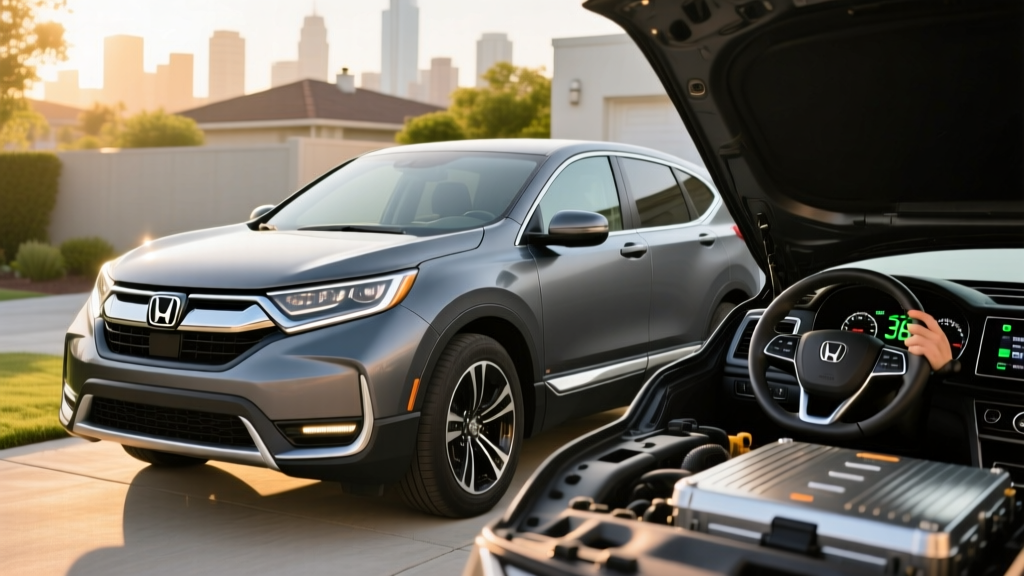
If you are shopping for a used Honda CR-V Hybrid, you are looking at one of the most pragmatic electrified SUVs on the secondary market. Honda's compact SUV has consistently ranked near the top for reliability and efficiency, but buying one used—especially an electrified model—requires understanding exactly what you are getting under the hood, what the battery will cost if it fails, and how real-world fuel economy compares to the EPA sticker.
This guide covers both the conventional hybrid (HEV) and the plug-in hybrid (PHEV) variants of the CR-V, with exact specs, pricing context for 2026 used-market values, and a clear decision framework to help you choose the right powertrain.
HEV vs. PHEV: What's the Difference?
The Honda CR-V Hybrid (HEV) uses a small battery charged entirely by the gasoline engine and regenerative braking. You never plug it in. It operates as a seamless blend of electric motor and gas engine, optimizing efficiency automatically.
The Honda CR-V e:PHEV (sold in select markets, primarily Europe and China, and introduced for the US market in the 2026 model year) carries a larger battery you can plug in to charge. It offers a meaningful electric-only driving range before the gas engine engages. If you are buying used in the US, you will almost certainly encounter the HEV version, as the PHEV was not widely available stateside until very recently.
Fuel Economy: EPA Ratings and Real-World MPG
The headline number for any hybrid buyer is fuel economy. Here is how the used Honda CR-V Hybrid stacks up across recent model years, per fueleconomy.gov:
| Model Year | Drivetrain | City MPG | Highway MPG | Combined MPG |
|---|---|---|---|---|
| 2024–2025 CR-V Hybrid (FWD) | 2.0L 4-cyl + 2 motors | 43 | 36 | 40 |
| 2024–2025 CR-V Hybrid (AWD) | 2.0L 4-cyl + 2 motors | 40 | 34 | 37 |
| 2020–2022 CR-V Hybrid (AWD) | 2.0L 4-cyl + 2 motors | 40 | 35 | 38 |
| 2026 CR-V e:PHEV (AWD) | 2.0L 4-cyl + e-motor | — | — | ~65 MPGe (combined) |
Real-World MPG: What Owners Actually See
Honda's two-motor hybrid system excels in stop-and-go city driving, where the electric motors do the heavy lifting. In real-world testing, many owners report exceeding the EPA city estimate—seeing 42–45 MPG in urban traffic is common. Highway driving tells a different story: at sustained 70–80 mph speeds, expect 32–35 MPG for AWD models, slightly below the sticker.
Cold weather reduces efficiency by roughly 10–15% due to increased engine use for cabin heating and reduced battery performance. A northern-climate owner in January might see combined figures closer to 32–34 MPG in an AWD model.
Powertrain Specs: What's Under the Hood
| Specification | CR-V Hybrid (HEV, 2023–2025) | CR-V e:PHEV (2026, US) |
|---|---|---|
| Engine | 2.0L Atkinson-cycle 4-cylinder | 2.0L Atkinson-cycle 4-cylinder |
| Electric Motors | Two (one drive, one generator) | Two (one drive, one generator) |
| Combined Horsepower | 204 hp | ~207 hp |
| Combined Torque | 247 lb-ft | ~247 lb-ft |
| Battery Capacity | ~1.06 kWh (lithium-ion) | ~17.7 kWh (lithium-ion) |
| Electric-Only Range | N/A (not a plug-in) | ~37 miles (EPA est.) |
| Total Range | ~470–510 miles | ~420+ miles combined |
| Transmission | e-CVT (direct-drive) | e-CVT (direct-drive) |
| DC Fast Charge Capable | No | No (Level 2 AC only) |
| Level 2 Charge Time (0–100%) | N/A | ~2.5 hours at 7.2 kW |
| 0–60 mph | ~7.6 seconds | ~7.5 seconds |
Key takeaway: the CR-V Hybrid's two-motor system is fundamentally different from a traditional CVT. One motor primarily drives the wheels at low speeds (feeling like a pure EV), while the engine acts mostly as a generator. At highway speeds, a lock-up clutch connects the engine directly to the wheels. This is why the system is so efficient in the city but less impressive on the highway.
Battery Health, Warranty, and Replacement Costs
This is the number-one concern for used hybrid buyers—and rightly so. Here is what you need to know about the CR-V Hybrid's battery.
Honda Hybrid Battery Warranty
Honda covers the hybrid battery with a 10-year / 150,000-mile warranty in CARB states (California, Colorado, Connecticut, Maine, Maryland, Massachusetts, New Jersey, New York, Oregon, Rhode Island, Vermont, Washington, and others adopting California emissions standards). In non-CARB states, coverage is 8 years / 100,000 miles. This warranty transfers to subsequent owners.
How Long Does the Battery Actually Last?
Honda's lithium-ion hybrid battery is relatively small (~1.06 kWh in the HEV), which means it operates within a narrow state-of-charge window—typically between 20% and 80%. This shallow cycling dramatically reduces degradation compared to a full EV battery. Based on long-term data from Honda's hybrid lineup (Insight, Accord Hybrid, CR-V Hybrid), most batteries show minimal capacity loss over 150,000+ miles.
Failures before 100,000 miles are rare but not unheard of. The most common failure mode is individual cell imbalance rather than total pack death, which can sometimes be repaired at the module level.
Battery Replacement Cost
If you are outside the warranty window and face a full battery replacement:
- OEM replacement (dealer): $3,000–$5,000 including labor
- Aftermarket / refurbished: $1,500–$3,000
- Module-level repair (specialist shops): $800–$1,500
For the PHEV variant (17.7 kWh battery), expect replacement costs to be significantly higher—likely $6,000–$10,000+ at dealer rates, given the larger pack size. However, PHEV models are so new that out-of-warranty replacements are essentially nonexistent as of 2026.
Pre-Purchase Battery Check
Before buying a used CR-V Hybrid, ask the seller or dealer to pull the battery state-of-health (SoH) data via Honda's diagnostic system. Alternatively, an OBD-II scanner with hybrid-specific software (such as Dr. Prius or Torque Pro with the right PID set) can read battery voltage spread across modules. A healthy pack should show less than 0.3V variance between modules.
Used Market Pricing and Tax Credit Eligibility
Current Used Pricing (2026 Market)
Based on current market data for the used Honda CR-V Hybrid:
- 2020–2021 models: $20,000–$25,000 depending on mileage and condition
- 2022–2023 models: $26,000–$32,000
- 2024–2025 models: $32,000–$38,000 (low-mileage, well-equipped trims)
Does a Used CR-V Hybrid Qualify for a Tax Credit?
This is where many buyers get confused. Under current IRS §25E (Used Clean Vehicle Credit) rules:
- You may qualify for a credit of up to $4,000 (or 30% of the sale price, whichever is less) on a used hybrid or PHEV.
- The vehicle must be purchased from a licensed dealer (private-party sales do not qualify).
- The sale price must be $25,000 or less.
- Your modified adjusted gross income must not exceed $75,000 (single), $112,500 (head of household), or $150,000 (joint).
- The vehicle must be at least two model years old.
- This is a non-refundable credit—it reduces your tax liability but does not generate a refund beyond what you owe.
Practically, this means a 2022–2023 CR-V Hybrid purchased from a dealer for under $25,000 could qualify you for the full $4,000 credit, bringing your effective cost down significantly. Higher-trim or newer models priced above $25,000 will not qualify. Always verify current rules with a tax professional and the IRS website before relying on credit eligibility.
Note: The new-vehicle §30D credit (up to $7,500) does not apply to conventional HEVs. It applies to PHEVs and BEVs only, subject to MSRP caps ($80,000 for SUVs), income limits, and critical-mineral/battery-sourcing requirements. The CR-V e:PHEV, if priced under the cap, may qualify when purchased new.
CR-V Hybrid vs. PHEV vs. Full EV: Which Fits You?
Choose the CR-V Hybrid (HEV) If:
- You lack access to home or workplace charging
- You want zero behavior change from a gas car
- You drive 12,000–15,000 miles/year and want to cut fuel costs ~35–40%
- You want the lowest upfront cost in an electrified SUV
- You frequently take long road trips where charging infrastructure is sparse
Choose the CR-V e:PHEV If:
- You can charge at home (Level 1 or Level 2)
- Your daily commute is under 35 miles round-trip
- You want EV-like daily driving with gas backup for road trips
- You qualify for the §30D new-vehicle credit
- You want to reduce gasoline consumption by 60–80%
A full EV (like the Hyundai Ioniq 5, Tesla Model Y, or Honda Prologue) makes sense if you have reliable home charging, your daily driving is under 250 miles, and you want to eliminate gasoline entirely. The CR-V Hybrid is the bridge solution for buyers who want electrified efficiency without charging logistics.
Reliability Ratings and Common Issues
The CR-V Hybrid's powertrain has proven durable. Honda's two-motor hybrid system, shared with the Accord Hybrid, has been in production since 2014 with iterative improvements. Key reliability notes:
- Hybrid system: Very few widespread failures reported. The inverter and electric motors have excellent track records.
- 12V battery: Like many modern hybrids, the CR-V Hybrid uses a conventional 12V battery for accessories. Premature 12V battery drain is a known complaint, especially in models that sit unused for extended periods.
- Brakes: Regenerative braking reduces wear on the friction brakes significantly. Many owners report original brake pads lasting 80,000–100,000+ miles.
- Oil consumption: The 2.0L Atkinson-cycle engine in earlier (2020–2021) models had scattered reports of oil consumption. Honda issued TSBs for some cases. Check oil level regularly on higher-mileage examples.
For safety ratings, consult NHTSA and IIHS directly—the 2024–2025 CR-V earned top marks from both organizations.
Frequently Asked Questions
How many MPG does the used Honda CR-V Hybrid actually get?
The EPA rates the 2024–2025 CR-V Hybrid AWD at 40 city / 34 highway / 37 combined. In real-world city driving, many owners see 42–45 MPG. Highway driving at 75+ mph typically yields 32–35 MPG. Cold weather reduces combined figures by roughly 10–15%.
Does the Honda CR-V Hybrid need to be plugged in?
No. The conventional CR-V Hybrid (HEV) charges its battery entirely through regenerative braking and the gasoline engine. You never plug it in. The CR-V e:PHEV variant does require plugging in to access its ~37-mile electric-only range, but this model was not widely available in the US until 2026.
How far can the CR-V e:PHEV go on electric only?
The 2026 CR-V e:PHEV has an EPA-estimated electric-only range of approximately 37 miles. This is sufficient for most daily commutes. Once the battery is depleted, the vehicle operates as a conventional hybrid with a combined range exceeding 420 miles.
Is the Honda CR-V Hybrid reliable, and what does battery replacement cost?
Yes. The CR-V Hybrid's powertrain has a strong reliability record. The hybrid battery is covered for 8 years/100,000 miles (non-CARB states) or 10 years/150,000 miles (CARB states), and this warranty transfers to used-car buyers. Full battery replacement costs $3,000–$5,000 at a dealer, but failures are uncommon before 150,000 miles.
Does a used Honda CR-V Hybrid qualify for any tax credit?
Under the IRS §25E Used Clean Vehicle Credit, you may qualify for up to $4,000 if you buy from a licensed dealer, the sale price is $25,000 or less, and your income falls below IRS thresholds ($75K single / $150K joint). The new-vehicle §30D credit does not apply to conventional HEVs but may apply to the PHEV variant when purchased new.
Should I get the hybrid or the gas-only CR-V?
The hybrid costs approximately $1,500–$2,500 more than the equivalent gas-only trim on the used market. At current fuel prices (~$3.40/gallon) and 15,000 miles/year, the hybrid saves roughly $500–$700/year in fuel. The premium pays for itself in 3–5 years. The hybrid also offers noticeably smoother, quieter acceleration from a stop.
What should I check before buying a used CR-V Hybrid?
Request the hybrid battery state-of-health report from a Honda dealer. Check for any outstanding recalls or TSBs. Verify the 12V battery condition (a common weak point). Confirm the remaining hybrid warranty coverage based on the vehicle's in-service date and your state's CARB status. A pre-purchase inspection by a technician familiar with Honda hybrid systems is strongly recommended.