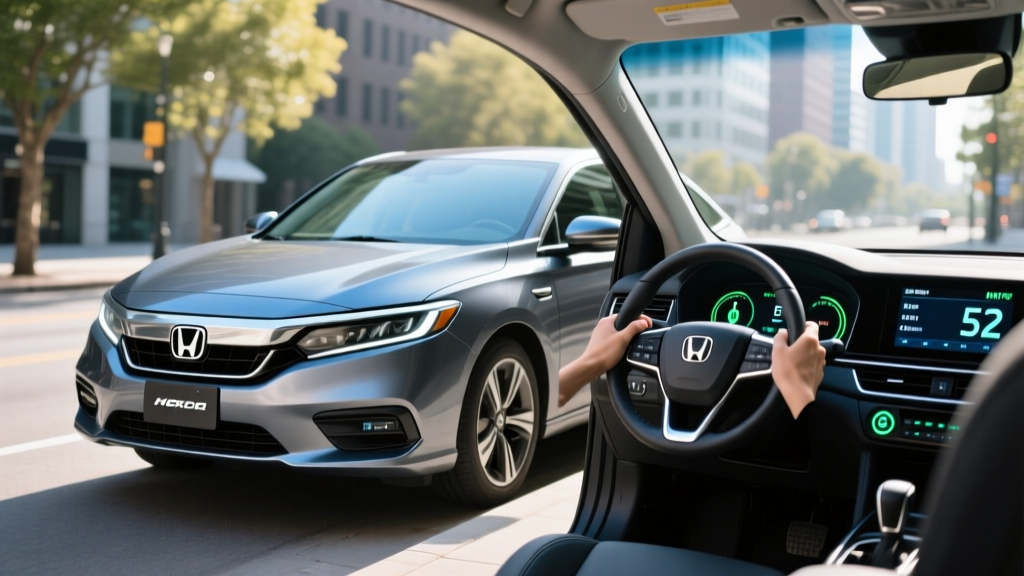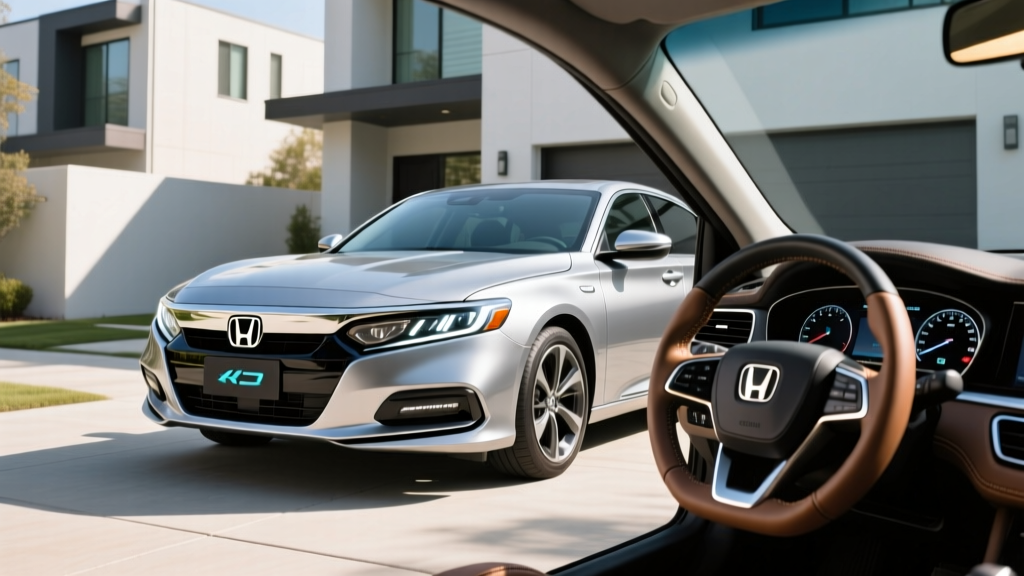
If you've been searching for a de segunda mano 2023 Honda Accord Hybrid, you're targeting one of the most fuel-efficient midsize sedans on the used market. The 2023 model year introduced the eleventh-generation Accord with a refined two-motor hybrid system, updated styling, and a tech-heavy cabin. Now that these cars are hitting the pre-owned market in volume, buyers can often find them at meaningful discounts off the original MSRP — but there are specifics about the powertrain, battery longevity, and real-world MPG that you need to know before signing.
This guide covers every number that matters: EPA fuel economy, real-world efficiency, the hybrid battery warranty, what you'll actually pay in 2026, and how the Accord Hybrid stacks up against plug-in hybrids and full EVs for your daily driving.
2023 Honda Accord Hybrid: Powertrain and Performance Specs
The 2023 Accord Hybrid uses Honda's fourth-generation two-motor hybrid system. It pairs a 2.0-liter Atkinson-cycle four-cylinder engine with two electric motors and a lithium-ion battery pack. Unlike a plug-in hybrid (PHEV), this is a conventional hybrid (HEV) — it charges its own battery through regenerative braking and the gasoline engine. You never plug it in.
| Specification | Value |
|---|---|
| Powertrain Type | Conventional Hybrid (HEV), no plug-in required |
| Engine | 2.0L Atkinson-cycle inline-4 |
| Combined System Horsepower | 204 hp |
| Combined System Torque | 247 lb-ft (electric motor) |
| Transmission | e-CVT (direct-drive, no traditional gears) |
| Drivetrain | Front-wheel drive |
| 0–60 mph (est.) | ~7.2 seconds |
| Battery Type | Lithium-ion (small capacity, self-charging) |
| Cargo Volume | 16.7 cu ft |
| Seating | 5 passengers |
The two-motor system operates primarily in electric-drive mode at low and moderate speeds, with the gas engine acting as a generator. At highway speeds, a lock-up clutch connects the engine directly to the wheels for efficiency. This is fundamentally different from older hybrid systems that relied on the gas engine more heavily — and it's why the Accord Hybrid achieves such strong city MPG.
Fuel Economy: EPA Ratings and Real-World MPG
The headline number for any hybrid buyer is fuel economy. Here's what the EPA rates the 2023 Accord Hybrid at, broken down by trim, per fueleconomy.gov:
| Trim Level | City MPG | Highway MPG | Combined MPG |
|---|---|---|---|
| Sport / Sport-L | 46 | 41 | 44 |
| EX-L / Touring | 51 | 44 | 48 |
The EX-L and Touring trims achieve higher EPA numbers because they come with 18-inch wheels and tires optimized for lower rolling resistance, while the Sport trims use 19-inch wheels. The difference is meaningful: 48 combined vs. 44 combined adds up over 15,000 miles of annual driving.
Real-World MPG: What to Actually Expect
Conventional hybrids like the Accord often exceed their EPA city rating in stop-and-go traffic because regenerative braking recaptures energy that a gas car wastes as heat. In real-world mixed driving:
- City-heavy commuting: Expect 47–53 MPG on EX-L/Touring trims. Hybrids thrive here.
- Highway cruising (70–80 mph): Expect 38–43 MPG. Aerodynamic drag reduces the hybrid advantage at sustained speed.
- Cold weather (below 30°F): Expect a 5–10% reduction as the engine runs more frequently to provide cabin heat.
- Combined real-world average: Most owners report 42–48 MPG on EX-L/Touring, 39–44 on Sport trims.
Hybrid vs. Plug-In Hybrid vs. Full EV: Which Fits You?
Used-car shoppers cross-shopping a de segunda mano 2023 Honda Accord Hybrid may also encounter plug-in hybrids (PHEVs) like the Toyota Prius Prime or full battery-electric vehicles (BEVs) like the Tesla Model 3 or Hyundai Ioniq 6. Here's how to decide:
| Factor | HEV (Accord Hybrid) | PHEV (e.g., Prius Prime) | BEV (e.g., Model 3) |
|---|---|---|---|
| Plug-in Charging Required? | No — self-charging | Yes — for electric-only range | Yes — exclusively electric |
| Electric-Only Range | ~1 mile (low-speed only) | 25–44 miles (model dependent) | 250–360+ miles |
| Total Range | ~560 miles | ~400–600 miles (electric + gas) | 250–360+ miles |
| Home Charging Setup Needed? | No | Recommended (Level 2) | Essential (Level 2) |
| Federal Tax Credit (New) | None | Up to $3,750–$7,500* | Up to $7,500* |
| Best For | No home charging, long trips, simplicity | Short commutes + occasional road trips | Home charging available, daily commuting |
*Federal tax credits under IRS §30D apply only to new vehicle purchases and are subject to MSRP caps, buyer income limits, and battery-sourcing requirements. See IRS.gov for current rules. Used vehicles may qualify for a separate used clean vehicle credit of up to $4,000 under §25E — but conventional HEVs like the Accord Hybrid do not qualify for either credit.
Used Pricing: What a 2023 Accord Hybrid Costs in 2026
When new, the 2023 Accord Hybrid started at $33,990 for the Sport Hybrid trim and topped out around $39,000 for the Touring Hybrid. As these vehicles enter the used market in 2026 with typical 30,000–50,000 miles, here's what you can expect to pay:
- Sport Hybrid (30K–45K miles): $24,000–$28,000
- Sport-L Hybrid (30K–45K miles): $26,000–$30,000
- EX-L Hybrid (25K–40K miles): $28,000–$32,000
- Touring Hybrid (20K–40K miles): $30,000–$35,000
Prices vary by region, vehicle condition, accident history, and dealership vs. private-party sales. Certified pre-owned (CPO) examples from Honda dealerships carry an extended warranty and typically command a $1,500–$2,500 premium over non-CPO listings.
Does a Used Accord Hybrid Qualify for Any Tax Credit?
The federal used clean vehicle credit (§25E) offers up to $4,000 (30% of the sale price, capped at $4,000) for qualifying used EVs and PHEVs purchased from a dealer for $25,000 or less. However, conventional hybrids like the Accord Hybrid do not qualify — the credit applies only to plug-in vehicles with a battery capacity of at least 7 kWh. The Accord Hybrid's battery is far smaller (approximately 1.1 kWh) and the vehicle cannot be plugged in.
No state currently offers a standalone incentive for purchasing a used conventional hybrid either. Your cost savings come entirely from reduced fuel consumption.
Battery Longevity, Warranty, and Replacement Cost
Battery lifespan is the number-one concern for used hybrid buyers. Here's what you need to know about the 2023 Accord Hybrid's lithium-ion pack:
Realistic Battery Degradation Expectations
Conventional hybrid batteries are much smaller than EV batteries and experience less stress because they operate in a narrow state-of-charge window (typically 40%–80%). Honda's hybrid battery management system avoids full charges and deep discharges, which significantly extends cell life.
Based on long-term data from previous-generation Accord and Civic Hybrids:
- Most Honda hybrid batteries retain sufficient capacity well past 150,000 miles.
- Noticeable degradation (reduced fuel economy, more frequent engine cycling) is uncommon before 120,000–150,000 miles.
- Complete failure before the 8-year/100K-mile warranty expires is rare but does occur — and it's covered.
Battery Replacement Cost
If you do need a replacement outside of warranty:
- New OEM battery from Honda: $2,000–$3,500 (parts and labor)
- Refurbished/remanufactured battery: $1,200–$2,000
- Individual cell replacement (specialist shops): $500–$1,200
For context, this is dramatically less than a full EV battery replacement, which can run $8,000–$20,000+. The Accord Hybrid's small battery pack is one of the most affordable hybrid batteries to replace on the market.
Reliability, Safety, and Ownership Costs
Honda's hybrid powertrain has a strong reliability track record. The two-motor system eliminates the traditional transmission — there are no gears, belts, or torque converters to fail. The e-CVT is essentially a direct-drive system with very few moving parts.
The 2023 Accord earned top safety ratings:
- IIHS: Top Safety Pick+ (highest rating) — per IIHS.org
- NHTSA: 5-Star Overall Safety Rating — per NHTSA.gov
Maintenance Costs Compared to Gas-Only Sedans
Hybrid ownership actually reduces some routine maintenance:
- Brake pads last longer: Regenerative braking reduces wear on friction brakes. Many hybrid owners report 80,000–100,000+ miles on original brake pads.
- No transmission fluid changes: The e-CVT uses a simple fluid that rarely needs service.
- Engine runs less: Reduced engine hours mean less oil degradation, though Honda still recommends changes every 7,500–10,000 miles.
- Insurance: Typically 5–10% higher than the gas-only Accord due to higher repair costs for hybrid-specific components.
Pros and Cons of a Used 2023 Accord Hybrid
✓ Pros
- 48 MPG combined (EX-L/Touring) — among the best in the midsize segment
- No plug-in charging required; zero change to refueling habits
- Strong reliability record and 8-year/100K hybrid warranty
- Spacious cabin with 16.7 cu ft trunk (no battery intrusion)
- Top Safety Pick+ from IIHS
- Smooth, quiet electric-driven acceleration in city driving
- Competitive used pricing in 2026 ($24K–$35K range)
✗ Cons
- No electric-only driving range (unlike PHEVs)
- No federal or state tax credit eligibility (new or used)
- Sport trim drops to 44 combined MPG (19-inch wheels)
- Highway MPG drops to 38–43 in real-world driving at 75+ mph
- Road noise noticeable on coarse pavement (common Honda critique)
- Apple CarPlay/Android Auto wireless only on EX-L and above
- FWD only — no all-wheel-drive option
What to Check When Buying a Used 2023 Accord Hybrid
Before you finalize a purchase, run through this checklist specific to the hybrid powertrain:
- Verify the hybrid battery warranty status. Ask for the VIN and call a Honda dealer to confirm the remaining hybrid system warranty. A 2023 model should still have significant coverage in 2026.
- Check the battery state-of-health indicator. The Accord's driver information display shows hybrid system status. Look for any warning lights or reduced-power messages.
- Review maintenance records. While hybrids need less maintenance, regular oil changes and cabin air filter replacements should be documented.
- Test-drive in EV mode. At low speeds in city traffic, the Accord Hybrid should operate almost silently on electric power. If the engine kicks in constantly at low speed, the battery may be degraded.
- Inspect brake pad thickness. Regenerative braking extends pad life, but a high-mileage example may be due for replacement ($200–$400 per axle).
- Confirm trim level and wheel size. The 19-inch wheels on Sport trims reduce MPG by 4 combined. If efficiency is your priority, target EX-L or Touring.
Frequently Asked Questions
How many MPG does the 2023 Honda Accord Hybrid get?
The EPA rates the Accord Hybrid EX-L and Touring at 51 city / 44 highway / 48 combined MPG. The Sport and Sport-L trims are rated at 46 city / 41 highway / 44 combined. In real-world city driving, many owners exceed the EPA city rating thanks to regenerative braking. Highway driving at 75+ mph typically yields 38–43 MPG.
Is the 2023 Accord Hybrid a plug-in hybrid?
No. The 2023 Accord Hybrid is a conventional hybrid (HEV). It charges its own small lithium-ion battery through regenerative braking and the gasoline engine. You never plug it in. Honda does not currently offer a plug-in hybrid (PHEV) version of the Accord in the US market.
Is the 2023 Accord Hybrid reliable, and what does a battery replacement cost?
Honda's hybrid system has a strong reliability track record. The hybrid battery is covered by an 8-year/100,000-mile warranty (10 years/150,000 miles in CARB states). Most batteries last well past 150,000 miles. If replacement is needed outside warranty, expect $2,000–$3,500 for a new OEM battery, or $1,200–$2,000 for a refurbished unit.
Does a used 2023 Accord Hybrid qualify for any tax credit?
No. The federal used clean vehicle credit (§25E) and new vehicle credit (§30D) both require a plug-in vehicle with a minimum battery capacity. The Accord Hybrid is a conventional hybrid that cannot be plugged in, so it does not qualify for any federal tax credit. No state currently offers incentives for used conventional hybrids either.
How does the Accord Hybrid compare to a full EV like the Tesla Model 3?
The Model 3 offers zero tailpipe emissions, lower per-mile fuel cost (electricity vs. gasoline), and available federal tax credits when purchased new. However, it requires home charging infrastructure, has a lower total range (~330 miles vs. ~560 for the Accord Hybrid), and costs more upfront even on the used market. The Accord Hybrid is the better choice if you lack reliable home charging, take frequent road trips over 400 miles, or want to minimize upfront cost while still cutting fuel bills significantly.
What is the difference between the Sport and EX-L Accord Hybrid trims?
The Sport and Sport-L use 19-inch wheels, which reduce EPA fuel economy to 44 combined MPG (vs. 48 for EX-L/Touring with 18-inch wheels). The Sport trims add sport-tuned suspension, darker exterior accents, and paddle shifters. The EX-L adds leather seats, a power moonroof, and wireless Apple CarPlay/Android Auto. If maximum MPG is your goal, choose EX-L or Touring.