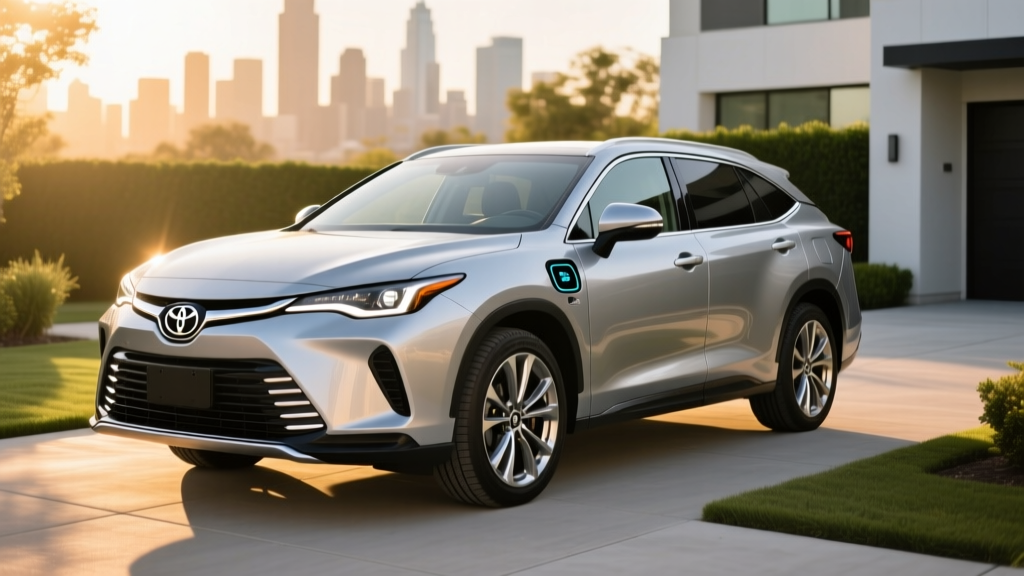
The Toyota Venza occupies a specific niche in the midsize crossover segment: a conventional hybrid (HEV) that prioritizes fuel efficiency and standard all-wheel drive over plug-in capability or third-row seating. For 2026, Toyota continues to offer the Venza exclusively as a self-charging hybrid—meaning no plug, no range anxiety, and no dependency on charging infrastructure. If you've been searching for a Venza hybrid and wondering whether it still makes sense against the growing wave of PHEVs and full EVs, this guide breaks down every number that matters.
What the Toyota Venza Hybrid Actually Is (HEV vs PHEV)
The Venza is a conventional hybrid electric vehicle (HEV), not a plug-in hybrid (PHEV). This distinction matters because it shapes everything from daily use to tax-credit eligibility.
HEV (Toyota Venza) vs PHEV (e.g., Toyota RAV4 Prime)
| Feature | Venza (HEV) | Typical PHEV |
|---|---|---|
| Plug-in charging | No — charges via engine & regen | Yes — plug in for EV-only miles |
| Electric-only range | ~1 mile at low speed | 25–42 miles typical |
| Battery size | 1.6 kWh (NiMH) | 13–18 kWh (Li-ion) |
| Federal tax credit (§30D) | Not eligible | Up to $7,500 (if eligible) |
| Refueling | Gas station only | Gas + optional plug-in |
| Best for | No home charging access | Home charging + short commutes |
If you have a garage or driveway where you can install a Level 2 charger and your daily commute falls under 30 miles, a PHEV like the RAV4 Prime delivers dramatic fuel savings. If you park on the street, live in an apartment, or simply don't want to think about plugging in, the Venza's HEV powertrain removes that friction entirely.
Fuel Economy: EPA Ratings and Real-World MPG
The 2026 Venza hybrid carries over Toyota's proven 2.5-liter four-cylinder hybrid system with electronic on-demand AWD. The EPA fuel economy figures remain competitive in the midsize hybrid SUV class.
| Driving Cycle | EPA Rating | Real-World Expectation |
|---|---|---|
| City | 40 MPG | 38–43 MPG (hybrids often beat EPA in city) |
| Highway | 37 MPG | 33–36 MPG (sustained 70+ mph reduces regen benefit) |
| Combined | 39 MPG | 36–40 MPG depending on driving mix |
Like most Toyota hybrids, the Venza tends to exceed its EPA city rating in stop-and-go traffic where regenerative braking and electric-motor assist do the heavy lifting. Highway driving is where the Venza—like all hybrids—is least efficient, because the gasoline engine runs continuously at steady speed with minimal regen recovery.
For context, the EPA's fueleconomy.gov listing shows the Venza's combined 39 MPG slots between the Hyundai Tucson Hybrid (38 MPG combined) and the Honda CR-V Hybrid (40 MPG combined AWD). On a 14.5-gallon tank, expect a real-world total range of roughly 520–560 miles before refueling.
Powertrain Specs: Horsepower, Engine, and Motors
| Specification | 2026 Toyota Venza |
|---|---|
| Engine | 2.5L inline-4 Atkinson-cycle |
| Engine output | 176 hp / 163 lb-ft torque |
| Front electric motor | 118 hp / 149 lb-ft |
| Rear electric motor (AWD) | 54 hp / 89 lb-ft |
| Net combined horsepower | 219 hp |
| Transmission | eCVT (planetary gearset, no belt) |
| Drivetrain | Electronic on-demand AWD (standard) |
| 0–60 mph | ~7.6 seconds (est.) |
| Towing capacity | Not rated for towing |
The Venza uses Toyota's fourth-generation hybrid synergy drive. The rear axle is powered exclusively by an electric motor—there is no mechanical driveshaft connecting the engine to the rear wheels. This "e-AWD" system engages automatically when slip is detected or during hard acceleration, then disengages to save fuel during cruising. It's adequate for rain and light snow, but this is not an off-road vehicle.
At 219 net horsepower, the Venza has enough power for confident highway merging. The eCVT is smooth and avoids the rubber-band feeling of older belt-driven CVTs because it uses a planetary gearset to blend engine and motor power.
Pricing, Trims, and Tax Credit Eligibility
The 2026 Venza hybrid is offered in three trims. Pricing includes destination charge.
| Trim | MSRP (incl. destination) | Key Features |
|---|---|---|
| LE | $36,465 | 8" touchscreen, TSS 3.0, heated front seats, power liftgate |
| XLE | $39,665 | SofTex seats, 12.3" display, wireless CarPlay/Android Auto, ambient lighting |
| Limited | $43,365 | Fixed panoramic roof, 10-speaker JBL audio, HUD, digital rearview mirror |
Does the Venza Hybrid Qualify for a Federal Tax Credit?
No. The Venza is a conventional HEV, not a plug-in vehicle. The federal §30D Clean Vehicle Credit (up to $7,500) applies only to battery electric vehicles (BEVs) and plug-in hybrids (PHEVs) that meet battery-sourcing, critical-mineral, MSRP cap, and buyer income requirements. The Venza does not qualify.
Some states offer rebates or reduced registration fees for hybrids, but these vary widely. Check your state's energy office or the DOE's Alternative Fuels Data Center for current local incentives.
Battery Warranty, Reliability, and Replacement Cost
Toyota Hybrid Battery Warranty
Coverage: 10 years / 150,000 miles (whichever comes first), applicable to all 50 states.
Capacity threshold: Toyota warrants the hybrid battery against defects and abnormal loss of capacity. There is no fixed percentage degradation threshold published—claims are evaluated by Toyota dealerships.
Transferable: Yes, the hybrid battery warranty transfers to subsequent owners at no cost.
How Long Does the Venza Hybrid Battery Last?
Toyota's hybrid battery packs—nickel-metal hydride (NiMH) in the Venza—are among the most proven in the industry. The Prius, which uses a similar chemistry, routinely exceeds 200,000 miles on its original battery. The Venza's pack is relatively small (1.6 kWh usable) and operates in a narrow state-of-charge window (roughly 40–80%), which dramatically reduces stress on the cells.
In the event of failure outside warranty, a replacement hybrid battery for the Venza typically costs $2,000–$3,500 for the part, plus $300–$600 in labor, depending on your dealership or independent hybrid specialist. Refurbished and reconditioned packs are available from third-party suppliers for $1,200–$2,000.
Overall Reliability
Toyota's hybrid powertrain is one of the most reliable systems on the market. The eCVT has no clutch packs, belts, or friction bands to wear out. The engine runs on the Atkinson cycle with lower thermal stress. The Venza shares its platform and powertrain with the RAV4 Hybrid and Camry Hybrid, both of which have extensive long-term reliability data.
Driving Impressions and Practical Ownership
The Venza rides on the same TNGA-K platform as the RAV4 and Camry, but it's tuned more for comfort than sportiness. Ride quality is composed over broken pavement, and cabin noise is well-controlled at cruising speed. The fixed panoramic glass roof on the Limited trim (with an electrochromic dimming function) adds an airy feel, though it does reduce headroom slightly compared to competitors with conventional steel roofs.
Cargo space is the Venza's most notable compromise. With 28.8 cubic feet behind the rear seats and 55.2 cubic feet with the rear seats folded, it trails the RAV4 Hybrid (37.6 / 69.8 cu ft) and CR-V Hybrid (36.3 / 76.5 cu ft). If cargo capacity is a priority, the RAV4 Hybrid is the more practical Toyota.
The Toyota Safety Sense 3.0 suite is standard across all trims and includes adaptive cruise control, lane-tracing assist, automatic emergency braking with pedestrian detection, and road-sign assist. This is a Level 2 driver-assist system—you must keep your hands on the wheel and eyes on the road at all times.
Pros
- 39 MPG combined EPA; often exceeds 40 MPG in city driving
- Standard AWD at no extra cost across all trims
- Strong 10yr/150k-mile hybrid battery warranty
- Smooth, quiet powertrain with no plug-in dependency
- Competitive pricing vs. turbocharged non-hybrid rivals
Cons
- Cargo volume significantly smaller than RAV4 Hybrid and CR-V Hybrid
- No federal tax credit eligibility (HEV, not PHEV)
- Not rated for towing
- Fixed panoramic roof (Limited) reduces headroom and cannot open
- Rear-seat legroom is adequate but not class-leading
Venza Hybrid vs PHEV vs Full EV: Which Fits You?
Choose the Venza Hybrid (HEV) if:
- You lack access to home or workplace charging (apartment, street parking)
- You want maximum simplicity—gas and go, no plug, no apps
- Your budget is $36K–$43K and you want standard AWD
- You drive a mix of city and highway and value 500+ miles of total range
Choose a PHEV (e.g., RAV4 Prime, Tucson PHEV) if:
- You can charge at home (Level 2, ~$500–$1,500 install)
- Your daily commute is under 35 miles round-trip (you'd rarely use gas)
- You want to qualify for the §30D federal tax credit (up to $7,500, income and sourcing rules apply)
- You want EV-like daily driving with gas-engine backup for road trips
Choose a Full EV (e.g., Tesla Model Y, Ioniq 5) if:
- You have reliable home charging and your trips mostly fall within 250 miles
- You want zero tailpipe emissions and minimal maintenance (no oil changes, no spark plugs)
- You want the lowest per-mile fuel cost (electricity at $0.13/kWh ≈ $0.04/mile vs. gas at $3.50/gal ≈ $0.12/mile at 30 MPG)
- You're ready to plan around DC fast-charging on longer road trips
Frequently Asked Questions
How many MPG does the Toyota Venza hybrid get?
The 2026 Toyota Venza hybrid is EPA-rated at 40 MPG city, 37 MPG highway, and 39 MPG combined. In real-world city driving, many owners report 41–43 MPG thanks to aggressive regenerative braking. Highway driving at 75+ MPH typically yields 33–36 MPG.
Does the Venza hybrid need to be plugged in?
No. The Venza is a conventional hybrid (HEV). Its small battery recharges through regenerative braking and the gasoline engine. You never plug it in—you simply fill up at a gas station like any other car.
Is the Venza hybrid reliable, and what does battery replacement cost?
Toyota's hybrid system is among the most reliable powertrains in the industry, with many examples exceeding 200,000 miles on the original battery. The hybrid battery is warranted for 10 years / 150,000 miles. Out-of-warranty replacement costs $2,000–$3,500 for the battery plus $300–$600 labor.
Does the Toyota Venza qualify for any federal tax credit?
No. The federal §30D Clean Vehicle Credit applies only to plug-in vehicles (BEVs and PHEVs). The Venza, as a conventional hybrid, does not qualify. Some states may offer minor hybrid incentives—check your state's energy office.
How does the Venza hybrid compare to the RAV4 Hybrid?
The RAV4 Hybrid offers more cargo room (37.6 vs 28.8 cu ft), a tow rating (1,500 lbs), and slightly better EPA fuel economy (41 MPG combined for the RAV4 Hybrid LE AWD). The Venza offers a more premium interior feel, a fixed panoramic roof option, and a slightly quieter ride. Both use the same 219 hp hybrid powertrain and TNGA-K platform.
Can the Venza hybrid drive on electric power alone?
Only at very low speeds (under ~25 mph) for roughly one mile under light load. The battery is too small (1.6 kWh) for meaningful electric-only driving. This is normal for conventional hybrids—the electric motor assists the engine for efficiency rather than replacing it.