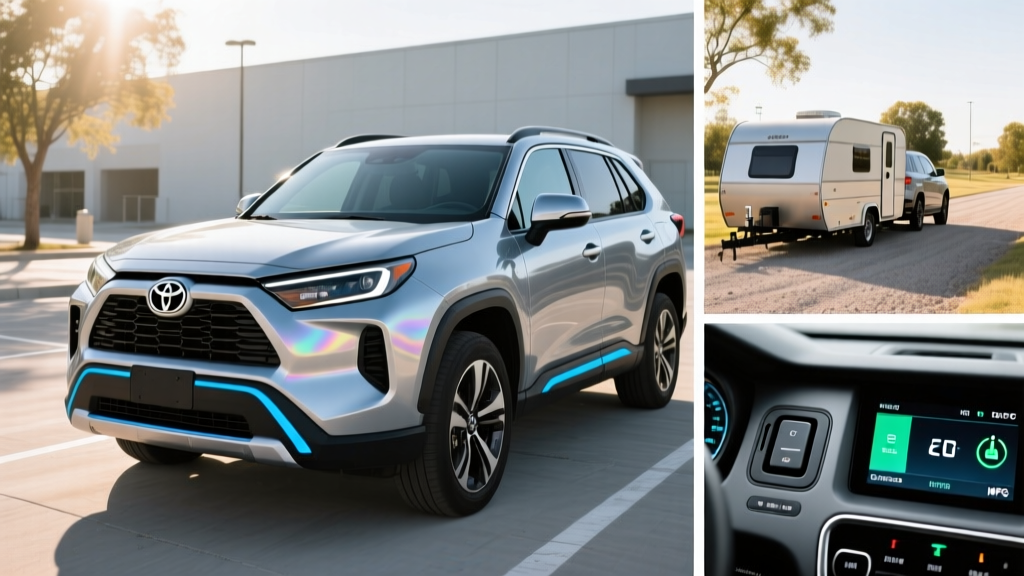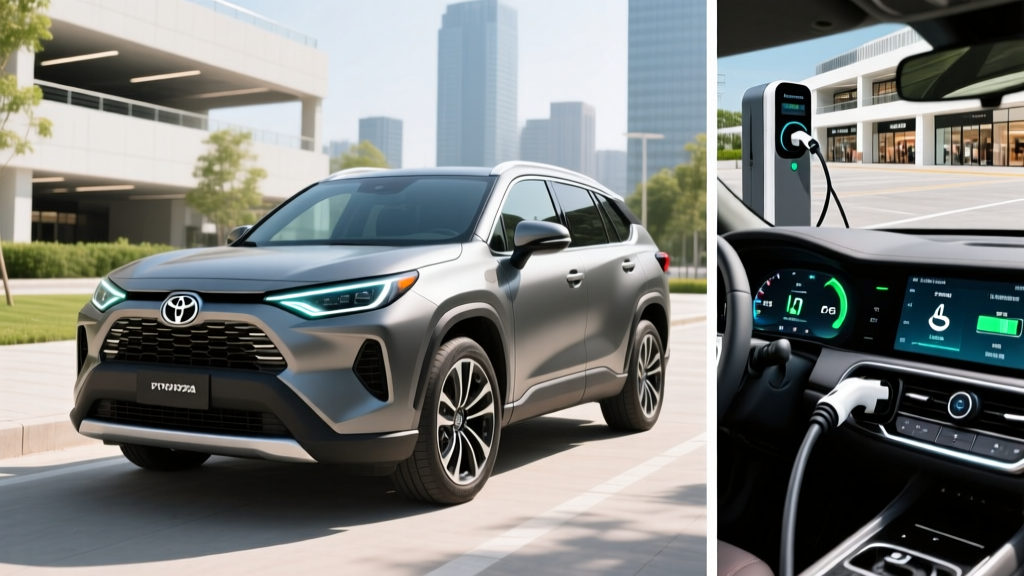
If you're researching Toyota SUV hybrid models for 2026, you're looking at one of the most comprehensive electrified SUV lineups on the market. Toyota offers conventional hybrids (HEVs) that never need plugging in alongside plug-in hybrids (PHEVs) that deliver meaningful electric-only range. This guide breaks down every current Toyota SUV hybrid with exact EPA numbers, pricing, and real-world ownership insights so you can pick the right one.
HEV vs PHEV: Understanding Toyota's Two Hybrid Approaches
Before diving into specific models, it's critical to understand the difference between Toyota's hybrid types — confusing them is the single most common mistake buyers make.
Conventional Hybrid (HEV)
How it works: A small battery (typically 1-2 kWh) paired with a gasoline engine and electric motor(s). The battery recharges through regenerative braking and the engine — you never plug it in.
Benefit: Better fuel economy than a gas car with zero behavior change. Just fill up and drive.
Toyota HEV SUVs for 2026: RAV4 Hybrid, Highlander Hybrid, Grand Highlander Hybrid, Crown Signia.
Plug-In Hybrid (PHEV)
How it works: A larger battery (18-22 kWh) that you can charge from a wall outlet or charger, giving 30-42 miles of electric-only driving before the gas engine kicks in.
Benefit: Daily commutes on electricity with gas-engine range for road trips. Eligible for up to $7,500 federal tax credit if you and the vehicle qualify.
Toyota PHEV SUVs for 2026: RAV4 Prime.
2026 Toyota RAV4 Hybrid and RAV4 Prime: The Volume Leader
The RAV4 Hybrid remains Toyota's best-selling electrified vehicle and the benchmark compact SUV hybrid. The RAV4 Prime (PHEV) is the performance and efficiency flagship of the lineup.
| Spec | RAV4 Hybrid (HEV) | RAV4 Prime (PHEV) |
|---|---|---|
| Powertrain | 2.5L 4-cyl + 2 electric motors | 2.5L 4-cyl + 2 electric motors |
| Combined Horsepower | 219 hp | 302 hp |
| 0-60 mph | 7.4 sec | 5.7 sec |
| Battery Capacity | ~1.6 kWh (NiMH) | 18.1 kWh (Li-ion) |
| Electric-Only Range | N/A (not a PHEV) | 42 miles (EPA) |
| EPA Combined MPG / MPGe | 39 MPG combined | 94 MPGe (EV mode) / 38 MPG (gas) |
| EPA City / Highway | 41 city / 38 hwy | 40 city / 36 hwy (gas mode) |
| Total Range | ~580 miles | ~600 miles (gas + electric) |
| Charging (Level 2) | N/A | ~2.5 hours (6.6 kW onboard) |
| DC Fast Charging | N/A | Not available |
| Drivetrain | AWD (electronic rear motor) | AWD (electronic rear motor) |
| Starting MSRP | $33,575 (LE) | $45,450 (SE) |
Real-World MPG: RAV4 Hybrid
The EPA rates the RAV4 Hybrid at 41 city / 38 highway / 39 combined. In real-world driving, Toyota's hybrid system tends to exceed EPA city estimates because regenerative braking recovers more energy in stop-and-go traffic. Owners regularly report 42-45 MPG in urban driving. Highway fuel economy at 75+ mph tends to drop to 34-36 MPG due to aerodynamic drag, which is typical for all hybrids and gas vehicles.
Real-World Electric Range: RAV4 Prime
The RAV4 Prime's EPA-rated 42 miles of electric-only range is among the best of any PHEV on the market. In warm weather at city speeds, expect 44-48 miles. In cold weather (below 32°F) or at sustained highway speeds, expect 32-36 miles as the battery's usable capacity shrinks and climate draw increases. The gasoline engine will start automatically if you demand hard acceleration or when the battery depletes to its buffer threshold.
Toyota Hybrid Battery Warranty
All 2026 Toyota hybrid and PHEV models come with a 10-year / 150,000-mile hybrid battery warranty (whichever comes first). This covers the traction battery against defects and excessive capacity loss. For context, most Toyota hybrid batteries in the field are lasting well beyond 200,000 miles based on fleet data. A RAV4 hybrid battery replacement outside warranty currently runs approximately $3,500-$5,000 including labor, while the RAV4 Prime's larger lithium-ion pack costs approximately $8,000-$11,000.
2026 Toyota Highlander Hybrid and Grand Highlander Hybrid
For families needing three rows, Toyota offers the midsize Highlander Hybrid and the larger Grand Highlander Hybrid. Both are conventional HEVs — no plug required.
| Model | City MPG | Highway MPG | Combined MPG | Combined HP | Starting MSRP |
|---|---|---|---|---|---|
| Highlander Hybrid (AWD) | 35 | 35 | 35 | 243 hp | $42,220 (LE) |
| Grand Highlander Hybrid (AWD) | 36 | 32 | 34 | 245 hp | $46,770 (XLE) |
| Grand Highlander Hybrid MAX | 27 | 28 | 27 | 362 hp | $55,070 (Limited) |
Highlander Hybrid: Real-World Notes
The Highlander Hybrid's 35 MPG combined is exceptional for a three-row SUV. Real-world city driving yields 36-38 MPG thanks to Toyota's series-parallel hybrid system favoring electric motor operation at low speeds. Highway cruising at 70-80 MPH typically returns 31-33 MPG. The trade-off is a CVT-like driving feel under hard acceleration — the engine drones at a fixed RPM while the electric motors handle torque delivery. If towing matters, the Highlander Hybrid is rated for 3,500 lbs.
Grand Highlander Hybrid: Space vs. Efficiency
The Grand Highlander Hybrid trades a single MPG combined for substantially more third-row legroom and cargo space (97.5 cu ft with both rows folded vs. 84.3 in the standard Highlander). The Hybrid MAX variant swaps efficiency for 362 hp and a turbocharged powertrain, but its 27 MPG combined makes it more of a performance cruiser than an efficiency play. For maximum fuel savings, the standard Grand Highlander Hybrid is the clear pick.
2026 Toyota Crown Signia: The Wagon-Style Hybrid Crossover
The Crown Signia slots into Toyota's lineup as a lifted wagon/crossover hybrid, replacing the Venza. It comes exclusively as a conventional hybrid.
| Spec | Crown Signia |
|---|---|
| Powertrain | 2.5L 4-cyl hybrid |
| Combined HP | 240 hp |
| EPA City / Hwy / Combined | 39 / 37 / 38 MPG |
| Drivetrain | AWD standard |
| Cargo Volume | 68.8 cu ft (rear seats folded) |
| Starting MSRP | $44,990 (XLE) |
The Crown Signia targets buyers who want hybrid efficiency without SUV proportions. Its 38 MPG combined is competitive with the RAV4 Hybrid, and the standard AWD adds all-weather confidence. Real-world owners report 37-40 MPG in mixed driving. The trade-off is a higher starting price and less ground clearance than a traditional SUV.
Pricing, Tax Credits, and Total Cost of Ownership
Understanding what you'll actually pay — and what you might get back — is essential when comparing Toyota's hybrid SUVs.
Federal Tax Credit Eligibility (§30D)
Under current IRS §30D rules, only plug-in hybrids with sufficient battery capacity qualify for the federal clean vehicle credit. For Toyota's 2026 SUV lineup:
- RAV4 Prime (PHEV): Potentially eligible for up to $7,500, subject to battery critical-mineral and component sourcing requirements, buyer income caps ($150K single / $300K joint), MSRP cap of $80,000 for SUVs, and final assembly in North America. The point-of-sale transfer option allows you to apply the credit directly at the dealer. Always verify current eligibility on the IRS website or with a tax professional before purchasing — sourcing rules tighten periodically.
- RAV4 Hybrid, Highlander Hybrid, Grand Highlander Hybrid, Crown Signia (all HEVs): Do NOT qualify for the §30D federal tax credit. Conventional hybrids lack the plug and battery capacity required by the statute.
Some states offer additional rebates for hybrids and PHEVs. Check your state's energy or environmental agency for current programs.
Five-Year Ownership Cost Snapshot
At 15,000 miles/year and $3.50/gallon gas, the RAV4 Hybrid uses approximately $1,346/year in fuel versus $2,188/year for the comparably equipped gas-only RAV4 (29 MPG combined). That's roughly $4,200 in fuel savings over five years, which nearly offsets the hybrid's typical $1,500-$2,000 price premium over a gas equivalent. The RAV4 Prime's savings are even greater if you charge regularly: at $0.15/kWh, a full charge costs about $2.70 and covers 42 miles — equivalent to roughly $0.06/mile versus $0.12/mile on gas.
Who Should Buy a Toyota Hybrid vs. a Full EV or Gas SUV?
Choose a Toyota HEV (RAV4 Hybrid, Highlander Hybrid) if:
- You cannot charge at home (apartment, street parking, no garage)
- You want better fuel economy with zero lifestyle change
- You drive 10,000-20,000 miles/year in mixed city/highway conditions
- You want proven long-term reliability with a 10-year battery warranty
- Your budget is $33,000-$50,000
Choose a Toyota PHEV (RAV4 Prime) if:
- You can charge at home (Level 1 standard outlet works overnight for 42 miles)
- Your daily commute is under 40 miles round-trip
- You want electric daily driving without range anxiety on road trips
- You may qualify for the $7,500 federal tax credit
- You want the quickest Toyota SUV (5.7 sec 0-60)
Choose a Full BEV (e.g., Tesla Model Y, Hyundai Ioniq 5) if:
- You have reliable home Level 2 charging
- Your daily driving is under 250 miles and you road-trip infrequently
- You want zero tailpipe emissions and minimal maintenance (no oil changes)
- You want maximum federal tax credit eligibility
Reliability and Long-Term Battery Outlook
Toyota's hybrid system is among the most proven in the industry, with over 25 years of production history dating to the 1997 Prius. According to Consumer Reports and J.D. Power data, Toyota hybrids consistently rank at or near the top for powertrain reliability.
The hybrid battery is the most common concern among prospective buyers. Here's what the data shows:
- HEV batteries (RAV4 Hybrid, Highlander Hybrid): Nickel-metal hydride packs are remarkably durable. Fleet data shows most lasting 150,000-250,000+ miles with minimal capacity loss. The smaller battery undergoes shallow charge/discharge cycles, reducing stress.
- PHEV batteries (RAV4 Prime): The larger lithium-ion pack has more capacity to lose but also a larger buffer. Toyota's 10-year/150,000-mile warranty provides substantial coverage. Expect 10-15% capacity degradation over 10 years under normal use.
- Replacement cost: HEV battery replacement runs $3,500-$5,000; PHEV replacement runs $8,000-$11,000. However, these are worst-case scenarios — most hybrid batteries outlast the vehicle's economic life.
Toyota's hybrid warranty documentation covers the battery, hybrid control module, and inverter assembly for 10 years or 150,000 miles, whichever comes first, across all 50 states.
Frequently Asked Questions
How many MPG does the RAV4 Hybrid get in real driving?
The EPA rates it at 41 city / 38 highway / 39 combined. In real-world use, expect 42-45 MPG in city driving (regenerative braking helps significantly) and 34-36 MPG at sustained highway speeds above 70 MPH. Overall mixed-driving averages of 38-41 MPG are typical, as reported on fueleconomy.gov owner submissions.
How far can the RAV4 Prime go on electric only?
The EPA rates the RAV4 Prime at 42 miles of electric-only range. Real-world range varies: 44-48 miles in warm city driving, 32-36 miles in cold weather or at highway speeds. Once the battery depletes, it operates as a conventional hybrid at 38 MPG combined.
Do Toyota hybrid SUVs need to be plugged in?
No — with one exception. The RAV4 Hybrid, Highlander Hybrid, Grand Highlander Hybrid, and Crown Signia are conventional hybrids (HEVs) that recharge their own batteries through regenerative braking and the gas engine. You never plug them in. The RAV4 Prime is a plug-in hybrid (PHEV) that benefits from plugging in to access its 42-mile electric range, but can also operate as a regular hybrid if you don't charge it.
Does any Toyota hybrid SUV qualify for a tax credit?
Only the RAV4 Prime (PHEV) may qualify for the federal §30D clean vehicle credit of up to $7,500, subject to buyer income limits, MSRP caps, battery sourcing requirements, and North American final assembly. Conventional Toyota hybrids do not qualify for this federal credit. Always check current IRS rules before purchasing.
How long will a Toyota hybrid battery last?
Toyota's hybrid batteries are designed to last the life of the vehicle. Real-world data shows most HEV batteries lasting 150,000-250,000+ miles. All 2026 Toyota hybrids carry a 10-year/150,000-mile hybrid battery warranty. Replacement cost, if needed outside warranty, is $3,500-$5,000 for HEV models and $8,000-$11,000 for the RAV4 Prime.
Which Toyota hybrid SUV is the best value?
The RAV4 Hybrid LE at $33,575 offers the best combination of efficiency (39 MPG combined), practicality (AWD, 37.6 cu ft cargo), and affordability in the lineup. Over five years, fuel savings versus the gas RAV4 largely offset the hybrid premium. If you can charge at home and qualify for the tax credit, the RAV4 Prime offers dramatically lower operating costs and 302 hp, making it the performance and efficiency champion despite its higher $45,450 starting price.
Toyota Hybrid SUV Pros
- Class-leading fuel economy across the lineup (27-39 MPG combined)
- No charging infrastructure needed for HEV models
- 10-year/150,000-mile hybrid battery warranty
- Proven long-term reliability with decades of hybrid data
- RAV4 Prime offers 42 miles EV range + gas flexibility
- Strong resale value across Toyota hybrid SUVs
Toyota Hybrid SUV Cons
- CVT-like drone under hard acceleration (non-MAX models)
- RAV4 Prime is frequently sold above MSRP due to high demand
- No DC fast charging on the RAV4 Prime
- Conventional hybrids (HEVs) don't qualify for federal tax credit
- Grand Highlander Hybrid MAX sacrifices MPG for power (27 combined)
- Infotainment and interior materials lag some competitors at similar price points