If you've been shopping for a family minivan and keep asking "are all Toyota Siennas hybrid?" the short answer is yes. Since the 2021 model year, Toyota has built every Sienna exclusively as a conventional hybrid electric vehicle (HEV). There is no gas-only Sienna in the lineup, and for the 2026 model year, that strategy continues unchanged. The Sienna pairs a 2.5-liter four-cylinder engine with Toyota's fourth-generation hybrid system to deliver up to 36 MPG combined — a figure that would have seemed impossible for a 4,600-pound minivan just a decade ago.
This guide breaks down exactly what powers every 2026 Toyota Sienna, how the hybrid system works in real-world driving, what the battery warranty covers, and whether a conventional hybrid minivan is the right call versus a plug-in hybrid (PHEV) or full battery-electric vehicle (BEV).
Every 2026 Toyota Sienna Is a Hybrid — Here's the Powertrain
Toyota made a bold move when it redesigned the Sienna for 2021: it eliminated the V6 entirely and made the hybrid powertrain standard across every trim. For 2026, the formula remains the same, refined with incremental software and efficiency improvements.
| Specification | Detail |
|---|---|
| Powertrain type | Conventional hybrid (HEV) — no plug-in required |
| Engine | 2.5L inline-4 Atkinson-cycle |
| Electric motors | 2 motor-generators (FWD) / 3 motor-generators (AWD) |
| Combined net horsepower | 245 hp |
| Transmission | Electronically controlled CVT (eCVT) |
| Drivetrain options | FWD or electronic AWD (AWD adds rear electric motor) |
| Hybrid battery | 1.9 kWh nickel-metal hydride (NiMH) |
| Towing capacity | 3,500 lbs (properly equipped) |
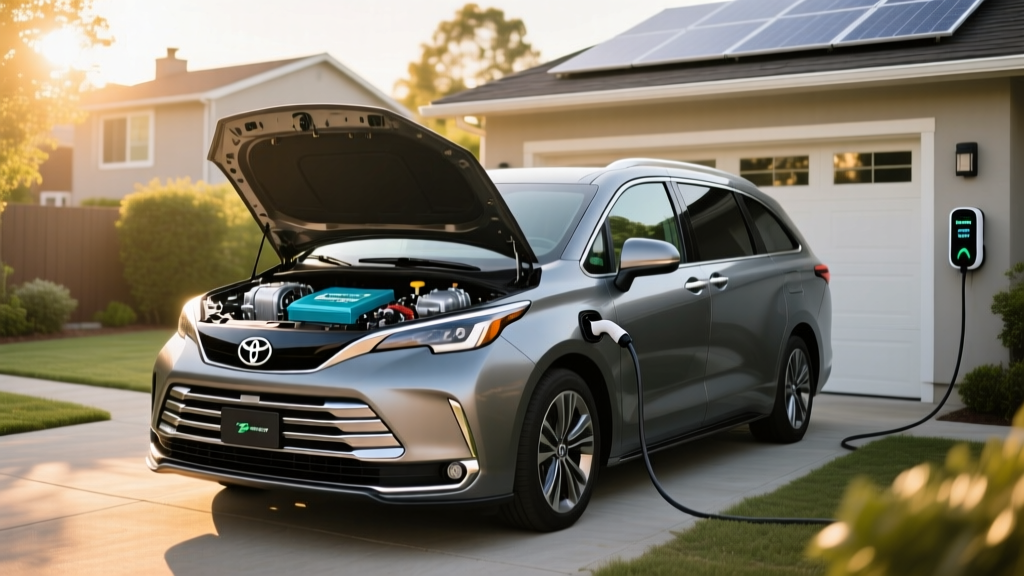
The key distinction here: this is a conventional hybrid, not a plug-in hybrid. The Sienna's small 1.9 kWh battery recharges itself through regenerative braking and the gasoline engine. You never plug it in. The electric motors assist the engine during acceleration, enable brief low-speed electric-only driving (typically under 1 mile at very low speeds), and recapture energy during braking — but the gasoline engine remains the primary energy source.
How Many MPG Does the Toyota Sienna Hybrid Get?
The EPA publishes separate fuel economy ratings for front-wheel-drive and all-wheel-drive Sienna configurations. Here's the official breakdown from fueleconomy.gov:
| Configuration | City MPG | Highway MPG | Combined MPG |
|---|---|---|---|
| FWD (LE, XLE, Limited, Platinum) | 36 | 36 | 36 |
| AWD (all trims available) | 35 | 36 | 35 |
| Woodland Edition (AWD standard) | 35 | 36 | 35 |
Real-World MPG: What Owners Actually See
Toyota hybrids tend to perform at or above their EPA ratings in city driving, where regenerative braking and electric-motor assist do the most work. In our experience and aggregated owner reports, FWD Sienna drivers regularly see 37–40 MPG in mixed suburban driving with frequent stops. Highway-only driving at 75+ mph tends to drop to around 32–34 MPG, as the aerodynamic drag of a minivan body works against the hybrid system's advantages.
Cold weather impacts any hybrid's fuel economy. Expect a 3–5 MPG drop in winter months (below 35°F) due to the engine running more frequently to maintain cabin heat and battery temperature. This is normal for all hybrids and is less severe than the 20–30% range loss a full EV experiences in the same conditions.
Real-World MPG Callout: EPA combined: 36 MPG (FWD) / 35 MPG (AWD). Expect 37–40 MPG in city-heavy suburban driving, 32–34 MPG on sustained highway trips at 75+ mph, and a 3–5 MPG reduction in freezing temperatures.
Hybrid (HEV) vs. Plug-In Hybrid (PHEV) vs. Full EV: Which Fits Your Family?
The Sienna is a conventional hybrid — but it's not the only electrified minivan option, and some buyers wonder if a PHEV or full EV would serve them better. Here's how the three categories break down for a family-hauler use case:
| Factor | Conventional Hybrid (Sienna HEV) | Plug-In Hybrid (e.g., Chrysler Pacifica PHEV) | Full EV (BEV) |
|---|---|---|---|
| Plug-in charging needed? | No | Yes (for electric range) | Yes (always) |
| Electric-only range | ~0.5 mi at low speed | ~32 mi (Pacifica PHEV) | 250–350+ mi |
| Combined fuel economy | 35–36 MPG | 30 MPG (gas) / 82 MPGe (electric) | N/A — electricity only |
| Home charging setup | Not required | Level 2 recommended (240V) | Level 2 essential (240V) |
| Road-trip convenience | Gas station, no planning | Gas station after battery depletes | DC fast charging stops required |
| Federal tax credit (§30D) | Not eligible | Eligible (up to $7,500, rules apply) | Eligible (up to $7,500, rules apply) |
| Starting MSRP (minivan segment) | ~$39,000 | ~$51,000 | Limited BEV minivan options as of 2026 |
The Sienna HEV is ideal if: you want maximum fuel savings with zero lifestyle change. No plug, no charging apps, no range planning. You fill up at any gas station and get 35–36 MPG in a vehicle that seats seven or eight.
A PHEV minivan makes sense if: you have home charging access (a garage or driveway with a 240V outlet), your daily driving is under 30 miles, and you want to do most weekday driving on electricity while keeping gas for longer trips. The trade-off is a significantly higher purchase price.
A full EV minivan works if: you have reliable home charging, rarely take trips beyond 200 miles without planning, and want to eliminate gasoline entirely. As of 2026, BEV minivan options remain extremely limited in the U.S. market.
2026 Toyota Sienna Pricing by Trim
The Sienna is offered across a wide trim range, from the value-oriented LE to the premium Platinum and the adventure-oriented Woodland Edition. Because every trim uses the same hybrid powertrain, your choice comes down to features, not powertrain differences.
| Trim | Drivetrain | Starting MSRP |
|---|---|---|
| LE (8-passenger) | FWD | ~$39,285 |
| LE (8-passenger) | AWD | ~$40,085 |
| XLE (7- or 8-passenger) | FWD | ~$43,500 |
| XLE | AWD | ~$44,300 |
| XSE (7-passenger, sport-tuned) | FWD | ~$45,000 |
| Limited (7-passenger) | FWD | ~$49,500 |
| Platinum (7-passenger) | AWD | ~$54,000 |
| Woodland Edition (7-passenger) | AWD | ~$48,500 |
Note: Pricing is based on manufacturer-announced MSRP figures and may vary by dealer. Destination charges add approximately $1,395.
Does the Toyota Sienna Hybrid Qualify for a Federal Tax Credit?
No. The conventional Toyota Sienna HEV does not qualify for the federal §30D Clean Vehicle Credit. Under current IRS rules, the §30D credit applies only to plug-in electric vehicles (BEVs and PHEVs) that meet battery capacity, critical-mineral sourcing, MSRP caps, and buyer income requirements. Because the Sienna is a conventional hybrid with no plug-in capability and a battery under 4 kWh, it is ineligible.
Some states offer their own incentives for conventional hybrids, but these are increasingly rare as state programs shift focus to plug-in vehicles. Check your state's energy or environmental agency website for current programs.
Toyota Sienna Hybrid Battery: Warranty, Lifespan, and Replacement Cost
For many hybrid buyers, battery longevity is the single biggest concern. Toyota addresses this with one of the strongest hybrid battery warranties in the industry.
Hybrid Battery Warranty: Toyota covers the Sienna's hybrid battery for 10 years or 150,000 miles (whichever comes first) in all 50 states. This applies to the 2026 model year and has been Toyota's standard since 2020. The warranty covers battery capacity loss below a defined threshold and any manufacturing defects.
How Long Does the Sienna Hybrid Battery Actually Last?
Toyota's hybrid batteries have a well-documented track record of longevity. The Sienna uses a nickel-metal hydride (NiMH) battery pack — a chemistry Toyota has refined over two decades of hybrid production (dating back to the original Prius). NiMH packs are less energy-dense than the lithium-ion batteries in EVs, but they are extremely durable and tolerant of the shallow charge/discharge cycles that characterize conventional hybrid operation.
Based on fleet data and owner reports from Toyota hybrids using similar NiMH packs, most Sienna hybrid batteries last well beyond 150,000 miles without requiring replacement. The hybrid system's battery management software keeps the pack in a narrow state-of-charge window (typically 40–80%), which dramatically reduces degradation compared to a full EV that cycles from 0–100%.
What Does a Sienna Hybrid Battery Replacement Cost?
If the battery does eventually need replacement outside of warranty, expect to pay between $2,000 and $4,000 for a new OEM hybrid battery pack, including labor. Refurbished or reconditioned packs are available from third-party suppliers for $1,000 to $2,000. This is significantly less than EV traction battery replacements, which can exceed $10,000–$20,000, because the Sienna's 1.9 kWh pack is physically small and uses mature, affordable chemistry.
For context, the hybrid system also includes the inverter, motor-generators, and associated control electronics. These components are covered under the same 10-year/150,000-mile hybrid system warranty and rarely require service.
Reliability and Long-Term Ownership Costs
The Toyota Sienna has historically earned strong reliability scores. The current-generation Sienna (2021–present) benefits from Toyota's extensive hybrid experience — the company has sold over 25 million hybrid vehicles globally. The eCVT transmission has no traditional gears, torque converter, or clutch packs to wear out, which eliminates one of the most common failure points in conventional automatic transmissions.
From a maintenance perspective, the Sienna hybrid requires the same routine service as any gasoline vehicle — oil changes (typically every 10,000 miles with synthetic), tire rotations, brake fluid, and cabin air filters. One advantage: regenerative braking significantly reduces wear on the friction brake pads and rotors. Many Sienna owners report original brake pads lasting 80,000–100,000+ miles under normal driving conditions.
Five-Year Fuel Cost Estimate
At 36 MPG combined and an assumed $3.50/gallon national average (2026 estimate), a Sienna driven 15,000 miles per year would consume approximately 417 gallons annually, costing roughly $1,459 per year in fuel. Over five years, that's about $7,295 — compared to approximately $11,667 for a comparable non-hybrid minivan averaging 22 MPG combined at the same fuel price and mileage. The hybrid saves an estimated $4,300+ in fuel over five years versus a conventional gas minivan.
Pros and Cons of the 2026 Toyota Sienna Hybrid
Pros
- Class-leading 36 MPG combined — no plug-in minivan or gas minivan comes close
- No charging infrastructure needed — works with your existing routine
- Standard AWD availability with electronic rear motor (no mechanical driveshaft)
- 10-year / 150,000-mile hybrid battery warranty
- 3,500-lb towing capacity adequate for small trailers and boats
- Proven Toyota hybrid reliability with minimal additional maintenance
- Spacious 7- or 8-passenger seating with generous cargo volume
Cons
- 245 hp is adequate but not quick — 0–60 mph in approximately 7.5 seconds
- No federal tax credit eligibility (conventional hybrid)
- eCVT engine drone under hard acceleration (common to Toyota hybrids)
- No plug-in variant available — cannot do daily driving on electricity alone
- Third-row seat doesn't fold flat into the floor (unlike some competitors)
- Premium trims (Platinum) push MSRP above $54,000
Frequently Asked Questions
Are all Toyota Siennas hybrid?
Yes. Every Toyota Sienna built from the 2021 model year onward — including the current 2026 model — uses Toyota's hybrid powertrain as standard equipment. There is no non-hybrid, gas-only Sienna available in any trim. This applies to all configurations: FWD, AWD, 7-passenger, and 8-passenger.
Can you plug in the Toyota Sienna to charge it?
No. The Sienna is a conventional hybrid (HEV), not a plug-in hybrid (PHEV). Its 1.9 kWh battery is charged entirely by the gasoline engine and regenerative braking. There is no charge port on the vehicle. If you want a Toyota minivan-style vehicle with plug-in capability, you would need to look at a different vehicle category, as Toyota does not currently offer a Sienna PHEV.
How does the Sienna's hybrid AWD system work?
The Sienna's available AWD uses a separate electric motor mounted on the rear axle — there is no mechanical driveshaft connecting the engine to the rear wheels. The system automatically sends up to 50% of torque to the rear wheels when it detects front-wheel slip, during hard acceleration, or in low-traction conditions. Under normal cruising, the Sienna operates in front-wheel drive for maximum efficiency. This electronic AWD system is lighter and more compact than a traditional mechanical AWD setup.
Is the Toyota Sienna hybrid good for road trips?
Yes. With a 17.9-gallon fuel tank and 36 MPG combined, the FWD Sienna delivers an estimated 640+ miles of total range on a single tank. You refuel at any gas station in under five minutes — no charging stops, no range planning, no app dependency. For families who regularly drive 400+ miles in a day, the Sienna's conventional hybrid setup is more practical than any current PHEV or BEV minivan.
What is the Toyota Sienna's hybrid battery warranty?
Toyota covers the hybrid battery and hybrid system components for 10 years or 150,000 miles, whichever comes first, in all 50 states. This warranty has been in effect since the 2020 model year and covers defects and abnormal capacity loss. The powertrain (engine and eCVT) is covered for 5 years / 60,000 miles.
How does the Sienna compare to the Chrysler Pacifica Hybrid?
The Chrysler Pacifica offers a plug-in hybrid (PHEV) variant with approximately 32 miles of electric-only range and 82 MPGe when running on its battery. However, once the battery depletes, the Pacifica PHEV drops to around 30 MPG combined on gasoline — notably less than the Sienna's 35–36 MPG. The Pacifica PHEV also starts around $51,000, roughly $12,000 more than the Sienna LE. The Pacifica PHEV may qualify for the federal §30D tax credit (up to $7,500, subject to IRS eligibility rules including income caps, MSRP limits, and battery sourcing requirements), which narrows the price gap — but the Sienna still wins on total range, long-term efficiency after battery depletion, and lower starting price.
Should I buy the Sienna hybrid or wait for an electric minivan?
As of 2026, there are no mainstream battery-electric minivans available in the U.S. market. If you need a minivan today, the Sienna hybrid offers the best fuel economy in the segment with zero infrastructure requirements. If you can wait several years and want a BEV minivan, upcoming platforms from various manufacturers have been announced, but none have confirmed pricing, range, or availability. The Sienna's strong resale value and proven powertrain make it a low-risk purchase even if you plan to transition to a BEV in the future.