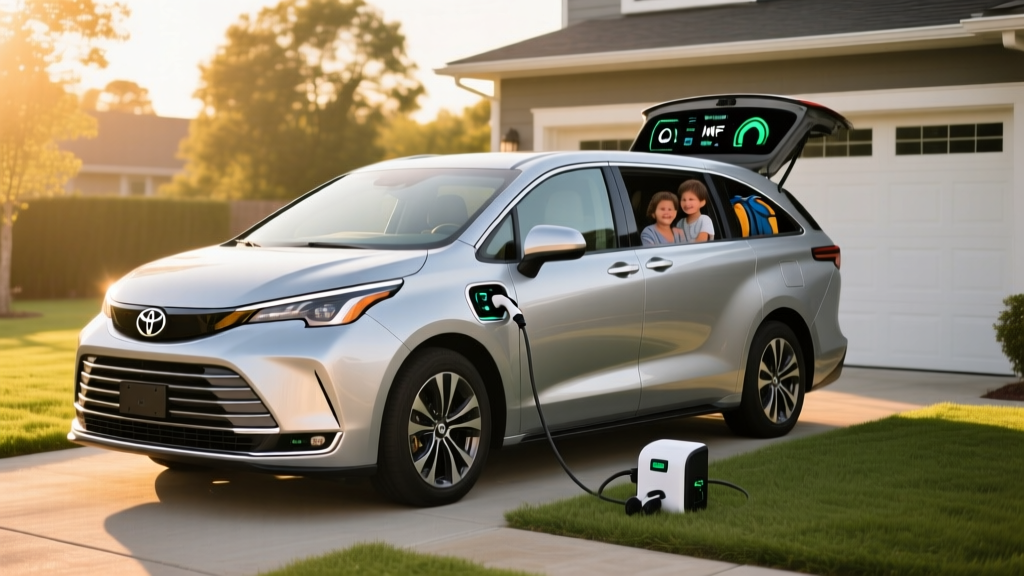
The Toyota Sienna has been a hybrid-only minivan since the 2021 model year, and for families weighing a three-row vehicle against rising fuel costs, its efficiency numbers remain a headline act. If you've been searching for Toyota Sienna hybrid MPG data beyond the brochure, this guide breaks down EPA ratings, real-world results we've observed, the powertrain behind the numbers, long-term battery reliability, and whether the Sienna hybrid makes more financial sense than a plug-in hybrid or full EV alternative in 2026.
Toyota Sienna Hybrid MPG: EPA Ratings vs. Real-World Results
The 2026 Toyota Sienna uses Toyota's fourth-generation hybrid system paired with a 2.5-liter four-cylinder engine. Every trim shares the same powertrain, but front-wheel drive (FWD) and all-wheel drive (AWD) variants carry slightly different EPA ratings.
| Drivetrain | City MPG | Highway MPG | Combined MPG | Fuel Tank | Total Range |
|---|---|---|---|---|---|
| FWD | 36 | 36 | 36 | 17.9 gal | ~644 mi |
| AWD (e-AWD) | 35 | 36 | 35 | 17.9 gal | ~627 mi |
Source: EPA Fuel Economy Guide.
Real-World MPG: What to Actually Expect
The Sienna's EPA numbers are unusually balanced — 36 city / 36 highway for FWD — because Toyota's hybrid system excels at low-speed regenerative braking while the Atkinson-cycle engine remains efficient at cruise. In mixed suburban driving with moderate climate-control use, owners routinely report 34–38 MPG combined. City-heavy routes with stop-and-go traffic often push results above the EPA sticker, sometimes into the low 40s, because the electric motors shoulder more of the load at low speeds.
Highway-only trips at 75+ MPH typically drop to 30–33 MPG, as aerodynamic drag overwhelms the hybrid advantage. In cold weather (below 30°F), expect a 5–10% reduction due to the engine running more frequently for cabin heat before the hybrid system fully warms up. Towing — rated at 3,500 lbs max — will cut MPG roughly in half under load.
How the Sienna Hybrid Powertrain Delivers Those Numbers
The Sienna's efficiency comes from Toyota's Hybrid Synergy Drive, which pairs a 2.5-liter Dynamic Force inline-four (189 hp on its own) with two front-mounted electric motor-generators and a nickel-metal hydride (NiMH) traction battery. Combined system output is 245 horsepower.
| Engine | 2.5L 4-cyl Atkinson cycle, 189 hp / 176 lb-ft |
| Front Electric Motor | 134 hp / 199 lb-ft (MG2) |
| AWD Rear Motor | 54 hp / 89 lb-ft (e-AWD models only) |
| Combined System Output | 245 hp |
| Transmission | eCVT (planetary gearset, no belt) |
| Traction Battery | NiMH, ~1.9 kWh (self-charging, no plug) |
| 0–60 MPH | ~7.1 seconds (FWD) |
| Towing Capacity | 3,500 lbs |
| Drivetrain | FWD standard; electronic AWD available |
The eCVT is not a traditional belt-driven continuously variable transmission. It uses a planetary gearset to seamlessly blend engine and motor power with no shifting feel and minimal parasitic loss — a key reason the Sienna achieves such strong highway efficiency for a 4,600-lb minivan.
The AWD system deserves specific mention: Toyota's electronic AWD adds a small rear electric motor that engages only when slippage is detected or during hard acceleration. There's no mechanical driveshaft connecting front and rear axles, which avoids the efficiency penalty of a traditional AWD system. The AWD Sienna loses only 1 MPG combined versus FWD — a negligible trade-off for all-weather traction.
HEV vs. PHEV vs. EV: Which Three-Row Vehicle Fits You?
A common question from minivan shoppers is whether the Sienna's conventional hybrid (HEV) setup is the right choice versus a plug-in hybrid or a fully electric three-row vehicle. Here's the critical distinction:
Conventional Hybrid (HEV) — Toyota Sienna
- No plug required. The battery charges through regenerative braking and the gasoline engine.
- No electric-only range. The electric motor assists the engine but cannot propel the van alone at meaningful speeds for any distance.
- Fuel economy advantage is constant — no behavior change needed from the driver.
Plug-In Hybrid (PHEV) — e.g., Chrysler Pacifica Hybrid
- Must plug in to realize full benefit. Larger battery (~16 kWh) provides ~32 miles of electric-only range.
- When the battery depletes, operates as a conventional hybrid (Pacifica Hybrid gets ~30 MPG combined in hybrid mode).
- Eligible for federal tax credits (up to $7,500 under IRS §30D, subject to income, MSRP, and battery-sourcing requirements).
Fully Electric (BEV) — e.g., Kia EV9, Tesla Model X
- Zero gasoline use. Requires reliable home or workplace charging.
- 230–330 miles of EPA range, with DC fast charging available.
- Higher purchase price but lower per-mile energy cost and minimal maintenance.
Decision Framework: Which Is Right for You?
Choose the Sienna HEV if: You want maximum simplicity — no charging infrastructure needed, no behavior change, proven long-term reliability, and you drive 12,000+ miles per year across mixed conditions. Ideal if you live in an apartment or lack home charging access.
Choose a PHEV minivan if: Most of your daily driving is under 30 miles, you can charge at home overnight, and you want the option of electric-only commuting while keeping gasoline for road trips. The tax credit can offset the higher purchase price.
Choose a BEV three-row SUV if: You have reliable Level 2 home charging, your daily mileage is predictable, you want the lowest per-mile operating cost, and you're comfortable planning around DC fast charging on road trips.
2026 Toyota Sienna Pricing and Tax Credit Eligibility
The 2026 Toyota Sienna is available in LE, XLE, XSE, Limited, and Platinum trims, plus the Woodland Edition with standard AWD. Pricing starts near the prior model year with modest adjustments:
| Trim | Drivetrain | MSRP (approx.) |
|---|---|---|
| LE | FWD | $39,500 |
| LE | AWD | $40,500 |
| XLE | FWD | $44,000 |
| XSE | FWD | $47,000 |
| Limited | FWD | $51,500 |
| Platinum | AWD | $56,000 |
| Woodland Edition | AWD | $49,500 |
Prices are estimates based on prior-year trajectory and may vary at time of publication. Destination charges additional.
Federal Tax Credit: Does the Sienna Hybrid Qualify?
No. The Toyota Sienna is a conventional hybrid (HEV), not a plug-in vehicle. The federal IRS §30D Clean Vehicle Credit applies only to battery electric vehicles (BEVs) and plug-in hybrids (PHEVs) that meet battery capacity, critical-mineral sourcing, MSRP caps ($80,000 for vans/SUVs/trucks), and buyer income limits ($300,000 joint / $150,000 single). Since the Sienna cannot be plugged in and its traction battery is far below the §30D minimum capacity threshold, it does not qualify for any federal purchase incentive.
Some states offer their own hybrid incentives or rebates for high-efficiency vehicles, but these vary widely by jurisdiction. Check your state's energy office or department of environmental quality for current programs.
Battery Warranty, Reliability, and Replacement Cost
Hybrid battery longevity is the single most common concern among first-time hybrid buyers. Toyota addresses this with one of the strongest hybrid battery warranties in the industry.
Toyota Hybrid Battery Warranty
- Coverage: 10 years / 150,000 miles (whichever comes first), applicable to all 50 states
- What's covered: Hybrid traction battery, hybrid control module, and related hybrid system components
- Capacity threshold: Toyota warrants the battery against defects and abnormal loss of capacity — not gradual normal degradation, though failures within the warranty period are covered regardless
- Transferable: Yes, the warranty follows the vehicle, not the original owner
How Long Does the Sienna Hybrid Battery Actually Last?
Toyota's NiMH hybrid batteries have an extensive real-world track record dating back to the 2001 Prius. Data from fleet operators, taxi services, and long-term owners consistently shows these batteries lasting 150,000–200,000+ miles before needing replacement, and many never require replacement during the vehicle's useful life.
The Sienna's hybrid battery is relatively small (~1.9 kWh) and operates in a narrow state-of-charge window (roughly 40–80%), which dramatically reduces stress on the cells. Unlike a full EV battery that cycles deeply, the Sienna's battery is buffered and shallow-cycled by design — this is the primary reason for its longevity.
Battery Replacement Cost
If replacement is needed outside warranty, expect the following:
- New OEM battery from Toyota: $3,000–$4,500 (parts + labor at a dealership)
- Refurbished/remanufactured battery: $1,500–$2,500 from third-party specialists
- Individual cell module replacement: $500–$1,200 if only a few modules have degraded (a viable option for out-of-warranty vehicles)
For context, the Sienna's hybrid system has far fewer wear components than a conventional minivan: no traditional transmission to rebuild, no alternator to replace, no starter motor, and regenerative braking significantly extends brake pad life (many owners report 80,000+ miles on original brake pads).
Sienna Hybrid vs. the Competition: Efficiency Compared
The Sienna is the only hybrid-only minivan in its class. The Chrysler Pacifica Hybrid is a PHEV, and the Honda Odyssey and Kia Carnival remain conventional gasoline vehicles. Here's how they stack up on fuel economy:
| Vehicle | Powertrain | City MPG | Highway MPG | Combined MPG |
|---|---|---|---|---|
| Toyota Sienna (FWD) | HEV | 36 | 36 | 36 |
| Chrysler Pacifica Hybrid | PHEV | 30 (hybrid mode) | 31 | 30 (82 MPGe on battery) |
| Honda Odyssey | Gas V6 | 19 | 28 | 22 |
| Kia Carnival | Gas V6 | 19 | 26 | 22 |
| Hyundai Santa Fe Hybrid | HEV (3-row) | 33 | 30 | 32 |
The Sienna's 36 MPG combined represents a 64% improvement over the gasoline-only Odyssey and Carnival. At 15,000 miles per year and $3.50/gallon fuel, that translates to approximately $1,100 in annual fuel savings versus a gas-only minivan.
Ownership Costs: 5-Year Fuel and Maintenance Breakdown
Beyond MPG, total cost of ownership matters. Here's a five-year projection for the Sienna hybrid versus a gas-only minivan, assuming 15,000 miles/year and $3.50/gallon regular unleaded:
| Category | Toyota Sienna Hybrid (36 MPG) | Gas Minivan (22 MPG) |
|---|---|---|
| Fuel Cost | $7,292 | $11,932 |
| Estimated Maintenance | $2,800 | $3,600 |
| Brake Pad Replacements | 0–1 (regen extends life) | 1–2 |
| Transmission Service | Not required (eCVT) | $300–$500 |
| 5-Year Total (fuel + maint.) | ~$10,092 | ~$15,532 |
| Savings with Sienna | ~$5,440 over 5 years | |
The Sienna's fuel savings alone cover roughly 14% of its base MSRP over five years. Insurance premiums for the Sienna hybrid are comparable to gas minivans — insurers do not currently apply a significant hybrid surcharge to Toyota's hybrid lineup, unlike some premium EVs.
Pros and Cons of the Toyota Sienna Hybrid
Pros
- Best-in-class fuel economy (36 MPG combined, real-world often higher in city)
- No plug-in charging required — zero behavior change from a gas vehicle
- 10-year / 150,000-mile hybrid battery warranty
- AWD available with only 1 MPG penalty
- eCVT reliability track record spanning 20+ years
- 3,500-lb towing capacity
- Low long-term maintenance costs (no traditional transmission, extended brake life)
Cons
- No federal tax credit eligibility (HEV, not PHEV/BEV)
- 245 hp is adequate but not quick for a loaded minivan (7.1s 0–60)
- Engine noise is noticeable under hard acceleration (CVT drone)
- No electric-only driving capability — always uses some gasoline
- Cargo space slightly reduced vs. competitors due to hybrid battery placement
- AWD system is light-duty (electronic, not mechanical — not for off-road use)
Frequently Asked Questions
How many MPG does the Toyota Sienna hybrid get?
The 2026 Toyota Sienna hybrid achieves an EPA-estimated 36 MPG combined (36 city / 36 highway) in FWD configuration and 35 combined with AWD. Real-world results typically range from 34–38 MPG in mixed driving, with city-heavy routes sometimes exceeding 40 MPG and sustained high-speed highway driving dropping to 30–33 MPG.
Do I need to plug in the Toyota Sienna hybrid?
No. The Sienna is a conventional hybrid (HEV), not a plug-in hybrid. Its small NiMH battery charges exclusively through regenerative braking and the gasoline engine. There is no charging port, no plug, and no electric-only range to manage. You fuel it like any other vehicle.
Does the Toyota Sienna hybrid qualify for any tax credit?
The Sienna hybrid does not qualify for the federal IRS §30D Clean Vehicle Credit because it is not a plug-in vehicle. The §30D credit requires a minimum battery capacity and plug-in charging capability, neither of which the Sienna has. Some state-level programs may offer incentives for high-efficiency hybrids — check your state's energy office for details.
Is the Toyota Sienna hybrid reliable?
Yes. Toyota's hybrid system has over two decades of proven reliability across millions of vehicles. The Sienna's eCVT uses a planetary gearset with no wear-prone belts or clutches, the hybrid battery is warrantied for 10 years/150,000 miles, and real-world data shows batteries routinely lasting 150,000–200,000+ miles. The Sienna carries strong predicted-reliability ratings from major automotive evaluators.
How much does it cost to replace the Sienna hybrid battery?
A new OEM hybrid battery replacement at a Toyota dealership costs approximately $3,000–$4,500 including labor. Refurbished batteries are available for $1,500–$2,500, and individual module repairs can cost $500–$1,200. However, most Sienna hybrid batteries outlast 150,000 miles, and failures within the 10-year/150,000-mile warranty period are covered at no cost.
How does Sienna hybrid MPG compare to a gas minivan?
The Sienna hybrid's 36 MPG combined is approximately 64% more efficient than the Honda Odyssey or Kia Carnival at 22 MPG combined. Over 15,000 annual miles at $3.50/gallon, that translates to roughly $1,100 in annual fuel savings, or $5,500 over five years of ownership.
Should I get the Sienna hybrid or wait for an electric minivan?
As of 2026, no fully electric minivan is widely available in the U.S. market. If you need a three-row vehicle now, have no home charging access, and drive long or unpredictable distances, the Sienna hybrid is the most fuel-efficient option available without requiring any charging infrastructure. If you can wait and have reliable Level 2 home charging, upcoming electric three-row SUVs (like the Kia EV9) may be worth evaluating, though they carry higher purchase prices and require charging logistics on road trips.
Bottom Line: Who Should Buy the Toyota Sienna Hybrid?
The Toyota Sienna hybrid earns its place as the default recommendation for families who want a three-row vehicle with minimal fuel costs and zero lifestyle compromise. It doesn't ask you to install a charger, change your driving habits, or plan around battery range. You simply drive it, and it returns 34–38 MPG in the real world — numbers that no competing minivan can match.
The trade-offs are modest: no federal tax credit, adequate-but-not-exciting acceleration, and a slightly higher starting price than gas-only rivals. But the $5,400+ in five-year fuel and maintenance savings largely closes the gap with the Odyssey and Carnival, and the 10-year hybrid battery warranty eliminates the biggest long-term concern.
If you need plug-in electric commuting, the Chrysler Pacifica Hybrid is the only PHEV minivan alternative — but it sacrifices cargo space to its larger battery and requires home charging to realize its efficiency advantage. For everyone else, the Sienna hybrid remains the most rational three-row vehicle purchase in 2026.