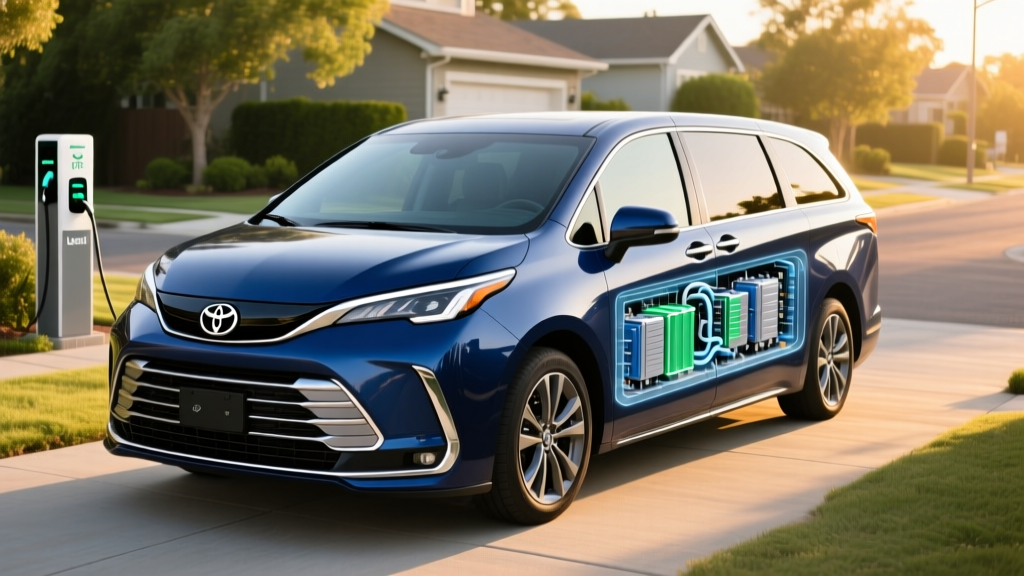
The Toyota Sienna has been a hybrid-only minivan since the 2021 model year, and the 2026 Sienna hybrid continues that strategy with a fourth-generation 2.5-liter four-cylinder hybrid powertrain across every trim. There is no gas-only Sienna, and there is no plug-in hybrid (PHEV) variant — Toyota has committed fully to the conventional hybrid (HEV) architecture for its minivan. That decision has paid off: the Sienna remains one of the most fuel-efficient three-row vehicles sold in the United States, and it faces limited direct competition from the Chrysler Pacifica Hybrid (a PHEV) and the Honda Odyssey (a conventional gas V6).
This guide covers everything a buyer needs to evaluate the 2026 Sienna hybrid: EPA fuel economy, real-world MPG expectations, powertrain details, pricing by trim, battery warranty and replacement costs, tax credit eligibility, and whether a hybrid minivan is the right choice versus a PHEV or full battery-electric vehicle (BEV).
2026 Toyota Sienna Hybrid Fuel Economy: EPA and Real-World MPG
The Sienna's hybrid system pairs a 2.5-liter inline-four engine with two front-mounted electric motors (three motors on AWD trims, with a dedicated rear motor). The result is fuel economy that significantly outperforms any non-hybrid minivan on the market.
| Drivetrain | City MPG | Highway MPG | Combined MPG |
|---|---|---|---|
| FWD (LE, XLE, Limited) | 36 | 36 | 36 |
| AWD (LE, XLE, Limited, Platinum, Woodland) | 35 | 36 | 35 |
Source: EPA / fueleconomy.gov
Real-World MPG vs. EPA Sticker
Toyota's hybrid system excels in stop-and-go city driving, where regenerative braking and electric-motor assist reduce engine load. Many Sienna owners report matching or slightly exceeding the 36 MPG EPA combined figure in suburban and city driving. On sustained highway trips at 70-80 mph, expect a modest dip to roughly 32-34 MPG — hybrids lose some efficiency advantage at steady high speeds where the gasoline engine carries the full load. In cold weather (below 30°F), the engine runs more frequently to maintain cabin heat and battery temperature, which can drop observed MPG to the low 30s for short trips.
Powertrain Specs: Engine, Motors, and Horsepower
The 2026 Sienna uses Toyota's fourth-generation hybrid system. Here is the full powertrain breakdown:
| Specification | Detail |
|---|---|
| Engine | 2.5L inline-4 (Atkinson cycle) |
| Engine Output | 189 hp / 176 lb-ft torque |
| Front Electric Motors | Two motor-generators (MG1, MG2) |
| Rear Electric Motor (AWD only) | 40 hp independent rear motor |
| Combined Net Horsepower | 245 hp |
| Transmission | eCVT (planetary gearset, no belt) |
| Hybrid Battery | 1.6 kWh NiMH (sealed, self-charging) |
| 0-60 mph | ~7.1 seconds (FWD) |
| Towing Capacity | 3,500 lbs (when properly equipped) |
The eCVT in the Sienna is not a traditional belt-and-pulley CVT. It uses a planetary gearset to blend power from the engine and electric motors, which eliminates the rubber-band feel associated with older CVTs and contributes to the system's long-term reliability. The 1.6 kWh nickel-metal hydride (NiMH) battery is small by EV standards — it cannot propel the van on electric power alone for meaningful distances. Instead, it serves as a buffer for regenerative energy capture and electric-motor assist during acceleration.
HEV vs. PHEV vs. EV: Which Minivan Fits Your Life?
The Sienna is a conventional hybrid (HEV). It does not plug in. If you're cross-shopping minivans, you'll encounter three electrification approaches:
| Factor | HEV (Toyota Sienna) | PHEV (Chrysler Pacifica Hybrid) | BEV (No current minivan option) |
|---|---|---|---|
| Plugs in? | No | Yes (Level 1/2) | Yes (Level 1/2/DC) |
| Electric-Only Range | None (motor-assist only) | ~32 miles | 250-350+ miles |
| Combined MPG / MPGe | 35-36 MPG | 30 MPG (gas) / 82 MPGe (electric) | N/A (MPGe only) |
| Home Charging Needed? | No | Recommended for EV range | Essential |
| Best For | No-charging-access families, road trips | Short school runs + home charging | Not available in minivan segment (2026) |
| Base MSRP (approx.) | ~$39,000 | ~$51,000 | N/A |
Who Should Choose the Sienna Hybrid?
- Choose the Sienna HEV if: You want maximum fuel efficiency without changing your fueling habits. You don't have access to home or workplace charging. You take regular road trips and don't want to plan around charging stops. You want a proven, low-maintenance hybrid system with strong resale value.
- Choose a PHEV minivan if: You have Level 2 home charging, your daily driving is under 30 miles, and you want to drive mostly on electricity during the week while keeping gas-engine range for weekend trips.
- Wait for a BEV minivan if: You want zero tailpipe emissions, have reliable home charging, and are willing to plan charging stops on road trips. As of 2026, no fully electric minivan is on sale in the U.S., though several have been announced for future model years.
2026 Sienna Hybrid Pricing by Trim
The Sienna is available in six trims for 2026. All use the same hybrid powertrain; trim differences are in features, upholstery, wheels, and available AWD.
| Trim | FWD MSRP | AWD MSRP | Key Features |
|---|---|---|---|
| LE | $39,185 | $40,785 | Toyota Safety Sense 3.0, 9" touchscreen, sliding 2nd-row seats |
| XLE | $43,685 | $45,285 | SofTex seats, power liftgate, wireless CarPlay/Android Auto |
| XSE | $44,685 | $46,285 | Sport-tuned suspension, 20" wheels, black exterior accents |
| Limited | $49,485 | $51,085 | Leather, 12-speaker JBL audio, dual sunroofs, HUD |
| Platinum | $53,385 | $54,985 | 360° camera, rear entertainment, heated/ventilated 2nd row |
| Woodland Edition | N/A | $47,585 | AWD standard, roof rails, all-terrain tires, tow package |
Note: MSRP figures include destination charge. Prices are approximate and may vary by dealer. Always confirm with your local Toyota dealer.
Does the Sienna Hybrid Qualify for a Federal Tax Credit?
No. The 2026 Toyota Sienna hybrid does not qualify for the federal §30D clean vehicle tax credit. Under current IRS rules, the §30D credit applies only to plug-in electric vehicles (BEVs and PHEVs) with a battery capacity of at least 7 kWh. The Sienna's 1.6 kWh NiMH battery and conventional hybrid architecture do not meet these requirements.
- Federal §30D credit: Not eligible (HEV, not a plug-in vehicle)
- State hybrid incentives: A handful of states offer small rebates for conventional hybrids, but most state EV incentives also target plug-in vehicles. Check your state's energy office or DMV for current programs.
- Fuel savings as incentive: At 36 MPG combined vs. ~22 MPG for a gas-only minivan, the Sienna saves roughly $700-$900 per year in fuel costs for a driver covering 15,000 miles annually (at $3.50/gallon).
Hybrid Battery Warranty, Lifespan, and Replacement Cost
Hybrid battery longevity is consistently the top concern for first-time hybrid buyers. Toyota addresses this with one of the strongest hybrid battery warranties in the industry.
- Coverage: 10 years / 150,000 miles (whichever comes first)
- Applies to: Hybrid battery pack, hybrid control module, inverter, and related hybrid system components
- Transferable: Yes — warranty transfers to subsequent owners automatically
- Capacity threshold: Toyota covers the battery if it fails or drops below a defined performance threshold during the warranty period
How Long Does a Sienna Hybrid Battery Last?
Toyota's NiMH hybrid batteries have an extensive track record dating back to the original Prius in the late 1990s. Real-world data from millions of Toyota hybrids shows that most NiMH packs last well beyond the warranty period — commonly reaching 180,000 to 250,000 miles before significant degradation. The Sienna's hybrid battery is relatively small (1.6 kWh) and is never deeply discharged or charged to full capacity, which reduces stress on the cells. The battery management system keeps the state of charge (SoC) within a narrow operating window (roughly 40-80%), which is ideal for NiMH longevity.
Hybrid Battery Replacement Cost
If the hybrid battery does eventually need replacement out of warranty:
- New OEM battery: $3,000 - $4,000 (parts and labor at a Toyota dealer)
- Refurbished/reconditioned battery: $1,500 - $2,500 (from third-party hybrid specialists)
- Individual cell replacement: $500 - $1,200 (some shops can replace only the failed cells within the pack)
For context, a conventional minivan's transmission replacement can cost $4,000-$6,000, and the Sienna's eCVT has no belt or friction components that wear in the same way. The hybrid system's simplicity is a reliability advantage, not a liability.
Reliability, Safety, and Long-Term Ownership Costs
The Sienna's hybrid powertrain has been in production since 2021 (with the current generation), and the underlying Toyota hybrid architecture has been refined over more than 25 years. Toyota consistently ranks at or near the top of dependability studies, and the Sienna specifically benefits from a powertrain shared with the RAV4 Hybrid and Highlander Hybrid — both high-volume, well-proven platforms.
Safety Ratings
The 2026 Sienna comes standard with Toyota Safety Sense 3.0, which includes adaptive cruise control, lane-keeping assist, automatic emergency braking with pedestrian detection, and road-sign assist. For detailed crash-test ratings, consult the IIHS and NHTSA databases once testing for the 2026 model year is published.
Five-Year Ownership Cost Snapshot
| Category | Estimated Cost |
|---|---|
| Purchase Price (MSRP) | $43,685 |
| Fuel (15,000 mi/yr, $3.50/gal, 36 MPG) | $10,940 |
| Insurance (avg. national) | $9,000 - $11,000 |
| Maintenance (oil, tires, brakes) | $3,000 - $4,000 |
| Estimated Depreciation | $14,000 - $17,000 |
| Total (approx.) | $80,625 - $86,625 |
Compared to a gas-only minivan averaging 22 MPG combined, the Sienna saves roughly $3,500-$4,500 in fuel costs over five years. That offset partially compensates for the Sienna's higher starting price relative to some non-hybrid competitors.
Pros and Cons of the 2026 Sienna Hybrid
Pros
- Class-leading 36 MPG combined — best fuel economy of any minivan
- No plug-in required — zero change to fueling habits
- Standard AWD availability across most trims
- 10-year / 150,000-mile hybrid battery warranty
- Strong resale value and Toyota reliability reputation
- 3,500-lb towing capacity adequate for small trailers and boats
- Spacious interior with versatile second-row seating
Cons
- No federal tax credit (HEV not eligible under §30D)
- 245 hp is adequate, not quick — passing power at highway speed is modest
- No PHEV or EV-only driving mode for zero-emission school runs
- Infotainment system lags behind competitors in responsiveness
- Third-row seat does not fold flat into the floor (unlike some rivals)
- AWD adds ~$1,600 and reduces MPG by 1
Frequently Asked Questions
How many MPG does the Toyota Sienna hybrid get?
The 2026 Sienna hybrid achieves an EPA-estimated 36 MPG city / 36 MPG highway / 36 MPG combined in FWD trims, and 35/36/35 in AWD trims. Real-world owners commonly report 34-37 MPG in mixed driving, with highway-only trips yielding 32-34 MPG.
Does the Sienna hybrid need to be plugged in?
No. The Sienna is a conventional hybrid (HEV), not a plug-in hybrid (PHEV). It charges its own small battery through the gasoline engine and regenerative braking. You fuel it exactly like a regular gas vehicle — at a gas station.
Can the Sienna drive on electric power alone?
Only for very short distances at low speeds (typically under 1 mile at under 25 mph, such as creeping through a parking lot). The 1.6 kWh battery is too small for meaningful EV-only range. If electric-only commuting is a priority, consider a PHEV like the Chrysler Pacifica Hybrid, which offers ~32 miles of EV range.
Is the Toyota Sienna hybrid reliable?
Yes. Toyota's hybrid system is among the most proven in the automotive industry, with over 25 years of continuous refinement. The Sienna's eCVT has no wear-prone belts or clutches, and the NiMH battery is managed conservatively to maximize lifespan. The hybrid battery is covered for 10 years / 150,000 miles.
What does a Sienna hybrid battery replacement cost?
A new OEM hybrid battery costs approximately $3,000-$4,000 installed at a Toyota dealer. Refurbished options range from $1,500-$2,500. Most Sienna hybrid batteries last 180,000+ miles, and many outlast the vehicle itself.
Does the Sienna hybrid qualify for any tax credits?
The Sienna does not qualify for the federal §30D clean vehicle credit, which is limited to plug-in vehicles (BEVs and PHEVs). Some states may offer minor hybrid incentives — check your state energy office. The primary financial benefit is fuel savings: roughly $700-$900 per year versus a 22 MPG gas minivan.
How does the Sienna hybrid compare to the Chrysler Pacifica Hybrid?
The Pacifica Hybrid is a PHEV with ~32 miles of electric-only range and an EPA rating of 82 MPGe when running on its charged battery. Once the battery is depleted, it drops to about 30 MPG combined — 5-6 MPG less than the Sienna. The Pacifica Hybrid starts around $51,000 and may qualify for the full $7,500 federal tax credit (subject to IRS §30D eligibility requirements including income caps, MSRP caps, and battery sourcing rules). If you can charge at home and drive under 30 miles daily, the Pacifica PHEV can operate as an EV most days. For everything else, the Sienna is more efficient and less expensive.
Is the Sienna hybrid good for towing?
The Sienna is rated to tow up to 3,500 pounds when properly equipped, which covers small camping trailers, jet skis, and utility trailers. Towing will reduce fuel economy — expect 22-26 MPG while towing depending on trailer weight and terrain. The AWD Woodland Edition comes with a factory tow package.