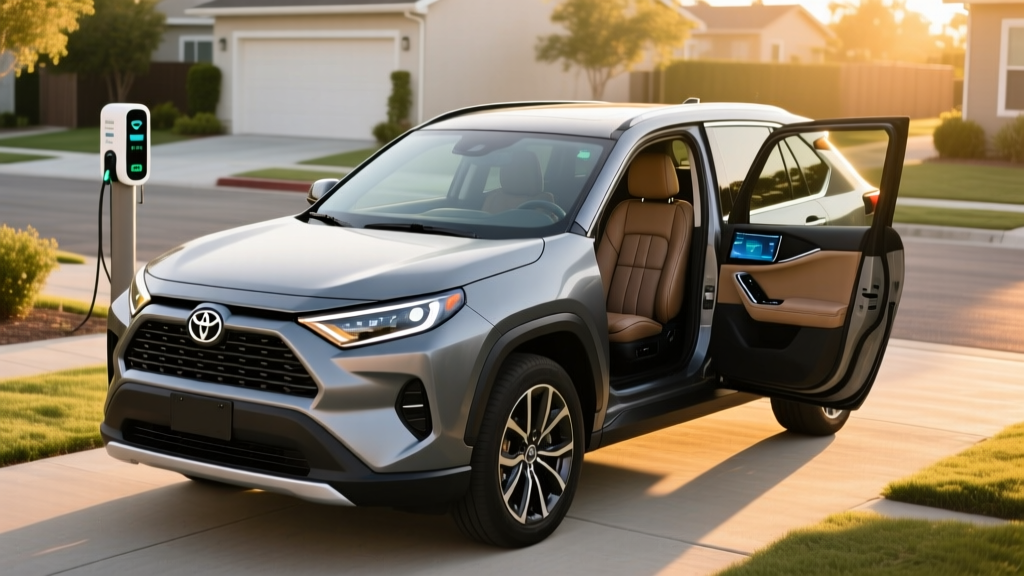
The Toyota RAV4 Hybrid has been America's best-selling hybrid SUV for years, but the XSE trim occupies a specific niche: it's the sport-tuned variant that pairs a 219-horsepower hybrid powertrain with a stiffer suspension, paddle shifters, and a two-tone roof. For 2026, the RAV4 XSE Hybrid continues as a conventional hybrid electric vehicle (HEV) — meaning no plug, no range anxiety, and an EPA-estimated 39 MPG combined that frequently gets beaten in real-world city driving.
This guide breaks down every number that matters: real-world fuel economy versus the EPA sticker, the hybrid battery's expected lifespan and warranty coverage, how the XSE compares to the RAV4 Prime PHEV, and whether this HEV or a full battery-electric vehicle (BEV) is the right call for your garage.
2026 RAV4 XSE Hybrid Powertrain and Performance Specs
The XSE Hybrid uses Toyota's fourth-generation hybrid system, pairing a 2.5-liter Dynamic Force four-cylinder engine with front and rear electric motors for standard electronic all-wheel drive (AWD-i). The result is a combined 219 horsepower — split between 176 hp from the gasoline engine and 118 hp from the front electric motor (54 hp rear motor), with system net output governed to 219 hp.
| Specification | Value |
|---|---|
| Powertrain | 2.5L 4-cyl HEV + 3 electric motors (AWD-i) |
| Combined System Horsepower | 219 hp |
| Engine Output | 176 hp @ 5,700 rpm / 163 lb-ft torque |
| Front Motor Output | 118 hp / 149 lb-ft |
| Rear Motor Output | 54 hp / 89 lb-ft |
| Transmission | eCVT (electronically controlled) |
| Hybrid Battery | ~1.6 kWh lithium-ion (sealed NiMH on some builds) |
| Drivetrain | Electronic AWD (AWD-i) |
| 0-60 mph | 7.4 seconds |
| Towing Capacity | 1,750 lbs |
| Cargo Volume | 37.5 cu ft (rear seats up) / 69.8 cu ft (folded) |
| Base MSRP (XSE AWD) | ~$38,525 |
The XSE's eCVT doesn't use fixed gear ratios or a traditional belt — it's a planetary gearset that blends engine and motor power seamlessly. On the road, that means smooth, linear acceleration off the line (electric motors deliver peak torque at 0 rpm) with the engine kicking in audibly only under hard acceleration or sustained highway climbs. The XSE adds paddle shifters that simulate six stepped "gears" for drivers who want more engagement, though the mechanical reality remains a power-split device.
EPA Fuel Economy vs. Real-World MPG
The EPA rates the 2026 RAV4 XSE Hybrid at 41 MPG city / 38 MPG highway / 39 MPG combined per fueleconomy.gov. Those numbers are competitive within the compact hybrid SUV segment, but the real story is how hybrid efficiency behaves in different conditions — because HEVs often beat their EPA city estimate while falling short on the highway.
| Condition | EPA Estimate | Real-World Expectation |
|---|---|---|
| City Driving | 41 MPG | 42-46 MPG (regenerative braking maximizes EV-mode usage) |
| Highway (70-75 mph) | 38 MPG | 34-37 MPG (aerodynamic drag, engine runs continuously) |
| Combined (mixed) | 39 MPG | 37-41 MPG (depends on city/highway ratio) |
| Cold Weather (below 32°F) | Not rated | 32-36 MPG (engine runs more for cabin heat, battery less efficient) |
| Short Trips (<5 mi, cold start) | Not rated | 28-33 MPG (engine warms up before hybrid system optimizes) |
Why city MPG exceeds highway: In stop-and-go traffic, the RAV4 XSE Hybrid spends significant time in EV mode, the engine shuts off at stops, and regenerative braking recaptures energy that a gas car would waste as brake heat. On the highway, the engine must run continuously to maintain speed, and the SUV's boxy shape creates aerodynamic drag that scales with the square of velocity. Driving 75 mph instead of 65 mph can cost you 3-5 MPG.
Cold-weather reality: Below freezing, expect a 10-15% fuel economy penalty. The gasoline engine runs more frequently to generate cabin heat (hybrids have no waste heat from a continuously running engine), and the battery's charge/discharge efficiency drops in cold temperatures. Pre-conditioning the cabin while plugged into a garage outlet isn't an option on the HEV — that's a PHEV/BEV advantage.
HEV vs. PHEV: Should You Consider the RAV4 Prime Instead?
This is the most common cross-shopping question, and the answer depends entirely on your charging access and daily mileage. The RAV4 XSE Hybrid (HEV) and the RAV4 Prime (PHEV) share the same basic platform but differ fundamentally in how they use electricity.
HEV vs. PHEV — The Core Distinction
HEV (Hybrid Electric Vehicle): The RAV4 XSE Hybrid has a small ~1.6 kWh battery charged only by the engine and regenerative braking. You never plug it in. It can travel roughly 0.5-1 mile on electric power alone at low speeds. The engine is always available.
PHEV (Plug-In Hybrid Electric Vehicle): The RAV4 Prime has a much larger 18.1 kWh battery that you plug in to charge. It delivers 42 miles of EPA-rated electric-only range before the engine engages, then operates as a conventional hybrid afterward.
| Attribute | RAV4 XSE Hybrid (HEV) | RAV4 Prime SE (PHEV) |
|---|---|---|
| Powertrain Type | Conventional Hybrid (no plug) | Plug-In Hybrid (Level 1/2 charging) |
| Combined Horsepower | 219 hp | 302 hp |
| Battery Capacity | ~1.6 kWh | 18.1 kWh |
| Electric-Only Range | <1 mile (low speed only) | 42 miles (EPA) |
| EPA Combined MPG/MPGe | 39 MPG | 94 MPGe (electric) / 38 MPG (gas) |
| Plugs In to Charge? | No | Yes (Level 1 or Level 2) |
| DC Fast Charging? | No | No (AC charging only) |
| 0-60 mph | 7.4 sec | 5.7 sec |
| Starting MSRP | ~$38,525 | ~$44,975 |
| Federal Tax Credit (§30D) | Not eligible | Not eligible (discontinued credit eligibility) |
The RAV4 Prime is the performance and efficiency king of the lineup — 302 hp, 42 miles of electric commuting, and 94 MPGe when charged regularly. But it commands a ~$6,450 premium, and that premium only pays back if you can charge at home or work and your daily commute falls within that 42-mile electric window. If you can't plug in, the Prime's larger battery becomes dead weight, and you'll see roughly 38 MPG in hybrid mode — essentially the same as the XSE HEV, but with thousands more in upfront cost.
Does the RAV4 XSE Hybrid Qualify for Any Tax Credits?
No. The conventional RAV4 Hybrid (including the XSE trim) does not qualify for the federal §30D Clean Vehicle Credit. Under current IRS rules, the §30D credit applies only to battery electric vehicles (BEVs) and plug-in hybrid electric vehicles (PHEVs) that meet battery capacity, critical mineral sourcing, and MSRP thresholds. A conventional HEV with a ~1.6 kWh battery doesn't meet the minimum 7 kWh battery capacity requirement.
Tax Credit Eligibility Summary for the RAV4 Lineup:
- RAV4 Hybrid (HEV): No federal credit. No state EV credits (some states offer minor hybrid rebates — check your local energy authority).
- RAV4 Prime (PHEV): Previously eligible for up to $7,500 federal credit, but Toyota's cumulative EV/PHEV sales surpassed the manufacturer cap phase-out thresholds under pre-IRA rules, and under current §30D sourcing requirements, most Prime configurations do not qualify for the full credit as of 2026. Verify current eligibility on IRS.gov before purchase.
- bZ4X (BEV): May qualify for partial credit depending on battery sourcing and buyer income — check the IRS clean vehicle credit list for current status.
Some states and local utilities offer rebates for purchasing any hybrid vehicle, but these vary widely by jurisdiction and change frequently. Check your state energy office and local utility for current programs.
Battery Warranty, Lifespan, and Replacement Cost
Hybrid battery longevity is consistently the top concern among first-time hybrid buyers, and it's an area where Toyota's track record provides strong reassurance.
Hybrid Battery Warranty Coverage
Standard Warranty: 10 years / 150,000 miles (whichever comes first) on the hybrid battery and all hybrid system components, including the inverter, transaxle, and electric motors.
California Emissions States: In states that follow California Air Resources Board (CARB) emissions standards (CA, CO, CT, DE, ME, MD, MA, NJ, NM, NY, OR, RI, VT, WA), hybrid battery coverage extends to 10 years / 150,000 miles as well, consistent with Toyota's nationwide coverage for 2026 models.
What's Covered: Any hybrid battery failure or capacity loss that causes a malfunction indicator light or diagnostic fault code. This includes individual cell module failures.
Real-world lifespan data: Toyota's hybrid batteries are engineered for longevity over energy density. The ~1.6 kWh pack in the RAV4 Hybrid is never fully charged or fully discharged — the system maintains a state-of-charge window between roughly 40% and 80%, which dramatically reduces lithium-ion degradation stress. Based on two decades of Prius and RAV4 Hybrid data, most Toyota hybrid batteries outlast 150,000-200,000+ miles without replacement. Fleet data from IIHS-monitored vehicles and Consumer Reports reliability surveys consistently rank Toyota hybrids at the top for long-term powertrain durability.
If replacement is needed: A new OEM hybrid battery for the RAV4 Hybrid costs approximately $3,000-$4,500 installed at a Toyota dealer. Independent hybrid specialists can often replace individual cell modules for $500-$1,500 rather than the entire pack. Remanufactured batteries are available for $1,500-$2,500 installed. Given the warranty coverage and typical lifespan, most original owners will never face this expense.
Who Should Buy the RAV4 XSE Hybrid — and Who Shouldn't
✓ Choose the RAV4 XSE Hybrid If:
- You want 39+ MPG without ever plugging in
- You lack access to home or workplace charging
- Your daily driving is a mix of city and highway
- You need AWD for snow/rain but want efficiency
- You plan to keep the vehicle 8-12 years (Toyota reliability)
- You want sport-tuned suspension and styling without sacrificing cargo space
- You want a sub-$40K hybrid SUV with strong resale value
✗ Look Elsewhere If:
- You want electric-only commuting (consider RAV4 Prime or a BEV)
- You have home charging and want to minimize gas use (PHEV or BEV saves more)
- You want maximum performance (RAV4 Prime: 302 hp, 5.7s 0-60)
- You want a federal tax credit (only BEVs and some PHEVs qualify)
- You tow frequently (1,750 lb capacity; a truck-based SUV or BEV like the F-150 Lightning tows far more)
- You need three rows of seating
Hybrid vs. PHEV vs. Full EV: The Decision Framework
Choosing between the RAV4 XSE Hybrid, the RAV4 Prime PHEV, and a battery-electric SUV like the Hyundai Ioniq 5 or Tesla Model Y comes down to three variables: charging access, daily mileage, and budget.
| Your Situation | Best Choice | Why |
|---|---|---|
| No home/work charging, mixed driving | HEV (RAV4 XSE Hybrid) | No plug needed, 39 MPG everywhere, lowest upfront cost |
| Home charging, <40 mi daily commute | PHEV (RAV4 Prime) | Commute on electricity, road-trip on gas, no range anxiety |
| Home charging, <250 mi daily, budget flexible | BEV (Ioniq 5, Model Y) | Lowest fuel cost per mile, lowest maintenance, tax credit eligible |
| Frequent 300+ mi road trips, no home charging | HEV (RAV4 XSE Hybrid) | 5-minute gas stops, no charging infrastructure dependency |
| Want lowest total cost of ownership over 5 years | BEV (with home charging) | Electricity cheaper than gas, minimal maintenance, tax credit offsets price |
| Cold climate, rural, limited charging | HEV (RAV4 XSE Hybrid) | No cold-weather range loss concern, AWD, proven reliability |
For buyers who can charge at home and whose daily driving stays under 40 miles, the RAV4 Prime PHEV offers the best of both worlds — electric commuting with gas-engine backup for road trips. But at a ~$6,450 premium over the XSE Hybrid, you need to drive enough electric miles to recoup that cost. At $0.13/kWh (national average electricity rate) versus $3.50/gallon gas, each electric mile in the Prime costs roughly $0.04 versus $0.09 per mile on gas. That's a $0.05/mile savings, meaning you'd need approximately 129,000 electric-only miles to break even on the price premium — a timeline that exceeds most ownership periods unless you're a high-mileage commuter who charges religiously.
Pricing and Trim Comparison
The 2026 RAV4 XSE Hybrid starts at approximately $38,525 (including destination charge). Key standard equipment on the XSE includes SofTex-trimmed heated front seats, an 8-inch Toyota Audio Multimedia touchscreen with wireless Apple CarPlay and Android Auto, the Toyota Safety Sense 2.5+ suite (adaptive cruise control, lane-keeping assist, pre-collision system with pedestrian detection, automatic high beams), and the sport-tuned suspension with 18-inch black alloy wheels.
Popular option packages add $1,500-$4,000: the Premium Package (panoramic moonroof, 360-degree camera, heated steering wheel) and the Technology Package (9-inch upgraded display, wireless charging, digital rearview mirror) are the most common. A fully loaded XSE Hybrid typically lands between $41,000-$43,000.
Frequently Asked Questions
How many MPG does the Toyota RAV4 XSE Hybrid get?
The EPA rates it at 41 MPG city, 38 MPG highway, and 39 MPG combined. In real-world driving, city commuters often see 42-46 MPG thanks to regenerative braking and EV-mode operation at low speeds. Highway-heavy drivers at 70-75 mph typically see 34-37 MPG. Cold weather below freezing reduces efficiency by 10-15%.
Do I need to plug in the RAV4 XSE Hybrid?
No. The RAV4 XSE Hybrid is a conventional HEV. Its small hybrid battery charges exclusively through regenerative braking and the gasoline engine. There is no plug, no charging cable, and no electric-only driving range to manage. You fuel it like any other gas car — it simply uses that fuel more efficiently.
How far can the RAV4 XSE Hybrid drive on electric power alone?
Less than one mile, and only at very low speeds (under 25 mph). The HEV system uses electric motor assist to reduce engine load, but the battery is far too small (~1.6 kWh) for meaningful electric-only driving. If you want 42 miles of electric range, you need the RAV4 Prime PHEV.
Is the RAV4 Hybrid reliable, and what does battery replacement cost?
Toyota's hybrid system has over 25 years of proven reliability since the original 1997 Prius. The RAV4 Hybrid consistently earns top reliability scores from Consumer Reports and J.D. Power. The hybrid battery carries a 10-year/150,000-mile warranty, and real-world data shows most batteries last 150,000-200,000+ miles. If replacement is needed, expect $3,000-$4,500 for a new OEM battery at a dealer, or $500-$1,500 for individual cell module repair at a specialist.
Does the RAV4 XSE Hybrid qualify for a federal tax credit?
No. Conventional hybrids (HEVs) are not eligible for the federal §30D Clean Vehicle Credit. That credit applies only to plug-in vehicles (BEVs and qualifying PHEVs) with batteries of at least 7 kWh. Some state or utility rebates may apply to hybrid purchases — check your local programs.
How does the XSE trim differ from other RAV4 Hybrid trims?
The XSE adds sport-tuned shock absorbers (firmer damping for flatter cornering), paddle shifters, a two-tone exterior with a black roof, 18-inch black alloy wheels, SofTex sport seats, and a black headliner. It sits between the XLE ($35,025) and the Limited ($40,025) in the lineup. You trade a small amount of ride comfort for sharper handling and more aggressive styling.