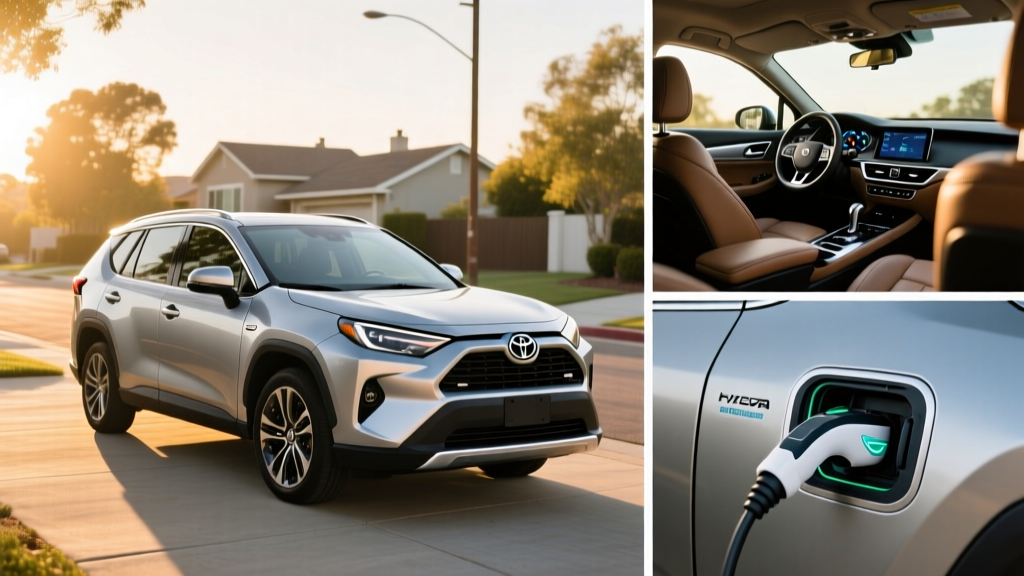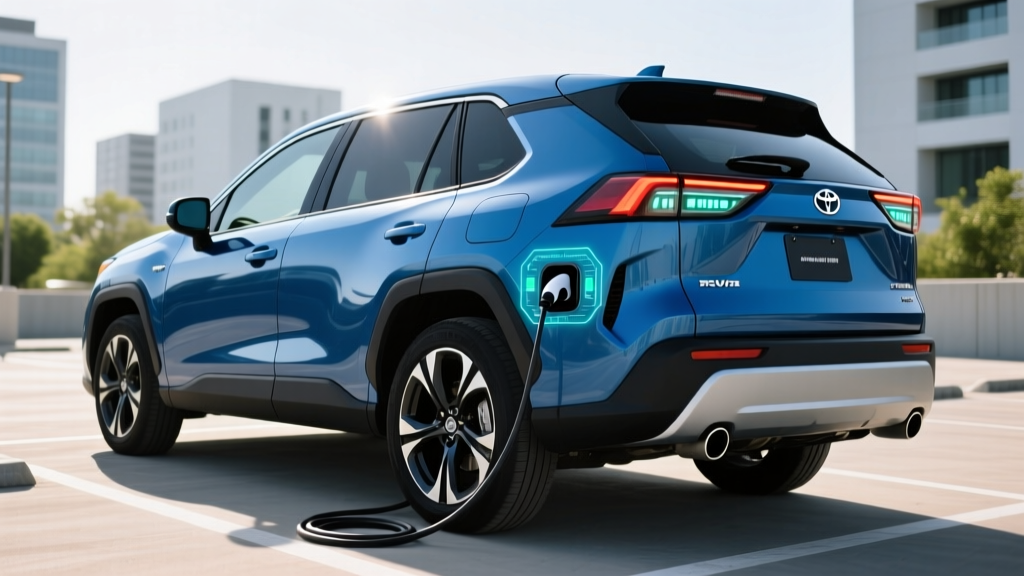
The Toyota RAV4 Prime plug-in hybrid SUV occupies a specific niche that frustrates many new-EV shoppers: you want electric daily driving without committing to full battery-electric ownership. With 42 miles of EPA-rated electric-only range, 302 combined horsepower, and the cargo versatility of a compact SUV, the RAV4 Prime (officially rebranded as the RAV4 Plug-In Hybrid for 2026) attempts to be a bridge vehicle — one that commutes on electrons and road-trips on gasoline without compromise.
But does the math actually work? Below, we break down every number that matters: real-world MPG versus EPA estimates, charging realities, tax-credit eligibility under current IRS §30D rules, and who should buy this PHEV versus stepping into a full BEV like the Tesla Model Y or sticking with the conventional RAV4 Hybrid.
HEV vs PHEV: Which RAV4 Are You Actually Looking At?
Toyota sells two electrified RAV4 variants, and confusing them is the most common buyer mistake. Here is the fundamental difference:
| Attribute | RAV4 Hybrid (HEV) | RAV4 Plug-In Hybrid (PHEV / Prime) |
|---|---|---|
| Plug-in charging required? | No — self-charging via regen & engine | Yes — plug in for full electric range |
| Electric-only range | ~1 mile at low speed | 42 miles (EPA) |
| Battery capacity | 1.6 kWh (NiMH) | 18.1 kWh (lithium-ion) |
| Combined horsepower | 219 hp | 302 hp |
| EPA combined MPG (gas) | 41 MPG | 38 MPG (charge-sustaining) |
| MPGe (electric mode) | N/A | 94 MPGe |
| 0-60 mph | 7.4 sec | 5.7 sec |
| Starting MSRP (2026) | ~$33,500 | ~$44,500 |
| Federal tax credit | None | Up to $7,500 (§30D, if eligible) |
The HEV is a "gas car that sips fuel." It never plugs in; it recovers energy through regenerative braking and uses a small battery buffer to assist the gas engine. The PHEV (what Toyota historically called "Prime") is a "dual-powertrain vehicle" — a large enough battery to cover most commutes on electricity alone, plus a gas engine for longer trips. If you cannot plug in at home or work, the PHEV's advantage collapses, and you are carrying 500+ lbs of battery you never use.
Range, MPG, and MPGe: The Numbers That Matter
The EPA rates the 2026 RAV4 Plug-In Hybrid at 42 miles of electric-only range and 94 MPGe in combined driving when the battery is charged. Once the battery depletes to its charge-sustaining threshold (around 15-20% state of charge), the gas engine takes over, and the vehicle operates as a conventional hybrid rated at 38 MPG combined.
| Driving Mode | City | Highway | Combined |
|---|---|---|---|
| Electric-only (MPGe) | 105 MPGe | 83 MPGe | 94 MPGe |
| Charge-sustaining / gas (MPG) | 40 MPG | 36 MPG | 38 MPG |
| Total range (electric + gas) | ~600 miles | ||
Real-world expectations: The 42-mile electric range is achievable in mild weather (55-75°F) with mixed city/suburban driving at moderate speeds. In our experience and owner reports, expect 35-38 miles of real-world electric range in typical conditions. Highway driving at 70+ mph reduces electric range to roughly 28-32 miles due to aerodynamic drag. In freezing temperatures (below 32°F), the battery's usable capacity shrinks and cabin heating demands energy, dropping electric range to 25-30 miles. The RAV4 Plug-In Hybrid uses a heat pump on upper trims, which mitigates cold-weather HVAC losses compared to resistive heaters.
On the gas side, 38 MPG combined is realistic for suburban mixed driving. Highway-only trips at 75 mph yield closer to 34-35 MPG. City-heavy driving in warm weather can push 40+ MPG because the hybrid system recovers energy at every stop. According to fueleconomy.gov, the combined annual fuel cost for the PHEV is approximately $1,150 (assuming 15,000 miles/year and national-average electricity/gas prices), compared to $1,850 for the gas-only RAV4.
EPA Electric Range: 42 miles
Real-World Expectation: 35-38 mi (mild), 28-32 mi (highway), 25-30 mi (cold weather)
Total Combined Range: ~600 miles (14.5-gallon tank + full battery)
Powertrain and Performance: 302 HP in a Compact SUV
The RAV4 Plug-In Hybrid pairs a 2.5-liter four-cylinder Atkinson-cycle engine with two electric motors — one on the front axle and one on the rear (Toyota's Electronic On-Demand AWD). Combined system output is 302 horsepower, making it the quickest RAV4 in the lineup and one of the faster compact SUVs in its price bracket.
| Specification | 2026 RAV4 Plug-In Hybrid |
|---|---|
| Engine | 2.5L 4-cyl Atkinson-cycle |
| Engine output | 177 hp / 165 lb-ft |
| Front electric motor | 134 kW (180 hp) |
| Rear electric motor | 40 kW (54 hp) |
| Combined system output | 302 hp |
| 0-60 mph | 5.7 seconds |
| Drivetrain | AWD (electronic on-demand) |
| Transmission | eCVT (planetary gearset) |
| Towing capacity | 2,500 lbs |
| Cargo volume (behind rear seats) | 33.4 cu ft |
| Cargo volume (seats folded) | 63.2 cu ft |
The electric motors provide instant torque from a stop, which is why the PHEV feels significantly quicker than its 0-60 time alone suggests in city driving. The eCVT is a power-split device, not a belt-driven CVT, so it avoids the rubber-band drone associated with conventional CVTs. Under hard acceleration, the engine and both motors combine seamlessly; under light loads, the vehicle runs on the front motor alone in EV mode.
Battery, Charging, and What You Need at Home
The RAV4 Plug-In Hybrid carries an 18.1 kWh lithium-ion battery pack (NMC chemistry). Of that, approximately 14.5 kWh is usable — Toyota reserves a buffer at the top and bottom to protect long-term battery health.
Charging Speeds and Times
| Charging Level | Power | Connector | 0-100% Time | Miles of EV Range Per Hour |
|---|---|---|---|---|
| Level 1 (120V household outlet) | ~1.4 kW | J1772 | ~12-14 hours | ~3-4 mi/hr |
| Level 2 (240V, 16A) | 3.3 kW (onboard charger limit) | J1772 | ~4.5 hours | ~9-10 mi/hr |
| DC Fast Charge | N/A | N/A | Not supported | |
Critical limitation: The RAV4 Plug-In Hybrid's onboard charger is capped at 3.3 kW. Even if you plug into a 48-amp Level 2 home charger capable of delivering 11.5 kW, the RAV4 will only accept 3.3 kW. This means a full charge takes approximately 4.5 hours on any Level 2 connection. This is perfectly adequate for overnight charging — plug in at 10 PM, fully charged by 3 AM — but it means you cannot "top up" quickly during a midday stop the way a BEV can at a DC fast charger.
No DC fast charging. Toyota does not equip the RAV4 PHEV with a CCS or NACS DC fast-charge port. For a 42-mile-range PHEV, this is standard — DC fast charging is typically reserved for BEVs with 60+ kWh batteries. It does mean that on a road trip, once you burn through the initial 42 electric miles, you are running on gasoline for the remainder of the trip. You cannot fast-charge the battery at a highway rest stop.
Home charging setup: Most RAV4 PHEV owners install a Level 2 (240V) outlet or wall-mounted charger in their garage. A NEMA 14-50 outlet installation typically costs $500-$1,500 depending on panel proximity and local electrician rates. A dedicated Level 2 EVSE (charging unit) from brands like ChargePoint or Emporia adds $300-$600 in hardware. Because the RAV4 only pulls 3.3 kW, even a modest 16-amp Level 2 unit is sufficient — no need to overspend on a 48-amp charger.
Pricing, Trims, and Tax Credit Eligibility
For 2026, the RAV4 Plug-In Hybrid is offered in two trims:
| Trim | MSRP | Key Features |
|---|---|---|
| SE | ~$44,500 | 18.1 kWh battery, AWD, 9" touchscreen, heated front seats, SofTex upholstery |
| XSE | ~$48,500 | Panoramic glass roof, JBL premium audio, digital rearview mirror, heated rear seats, ambient lighting |
Federal tax credit (IRS §30D): The RAV4 Plug-In Hybrid has historically qualified for a portion of the federal plug-in vehicle credit. Under current 2026 rules, the credit amount depends on battery sourcing and critical-mineral requirements. The maximum credit is $7,500, but many vehicles qualify for $3,750 if they meet only one of the two sourcing thresholds (critical minerals OR battery components, but not both).
§30D Federal Tax Credit Requirements (2026):
- Buyer AGI must not exceed $150,000 (single), $225,000 (head of household), or $300,000 (joint)
- Vehicle MSRP must not exceed $80,000 for SUVs (RAV4 qualifies — well under the cap)
- Vehicle must undergo final assembly in North America (RAV4 is built in Japan — verify VIN at afdc.energy.gov)
- Battery components and critical minerals must meet sourcing thresholds for partial or full credit
- Credit can be applied at point of sale (dealer transfer) or claimed on your tax return
Important caveat: The RAV4 Plug-In Hybrid is assembled in Japan (Tahara plant). Under §30D, final assembly in North America is required for credit eligibility. Toyota's North American VIN checker and the DOE's AFDC tax credit tool should be consulted before purchase to confirm current eligibility, as sourcing and assembly rules are subject to manufacturer and regulatory changes. Do not assume the $7,500 credit applies — verify with your tax professional and the IRS at irs.gov.
Battery Longevity, Warranty, and Replacement Costs
Hybrid Battery Warranty: 10 years / 150,000 miles (whichever comes first), covering defects and capacity loss below a defined threshold. This applies in all 50 states under Toyota's current warranty terms (previously 8 years/100,000 miles in non-CARB states before Toyota extended coverage nationally).
Powertrain Warranty: 5 years / 60,000 miles
Bumper-to-Bumper: 3 years / 36,000 miles
Toyota's hybrid battery packs have a strong longevity track record. The lithium-ion pack in the RAV4 PHEV is larger and more heavily used than the small NiMH pack in the conventional RAV4 Hybrid, but Toyota's thermal management and conservative buffer strategy (keeping the battery between ~15% and ~95% state of charge) reduce degradation. Owner reports from high-mileage RAV4 Primes (the pre-2026 name) indicate 8-12% capacity loss over 100,000 miles — translating to roughly 3-5 miles of electric range loss after a decade of typical use.
Out-of-warranty replacement cost: If the hybrid battery fails after the warranty period, a new OEM replacement pack for the RAV4 PHEV currently costs between $6,000 and $8,500 including parts and labor at a Toyota dealer. Third-party refurbished packs are emerging in the $3,500-$5,000 range. This is a significant expense, but the 10-year/150,000-mile warranty covers the vast majority of ownership periods, and catastrophic battery failure in Toyota hybrids is statistically rare.
According to IIHS, the RAV4 Prime has earned top safety ratings, and Toyota's hybrid reliability data from Consumer Reports and J.D. Power consistently ranks the brand at or near the top for long-term dependability. The hybrid system itself (power-split device, electric motors, inverter) has fewer moving parts than a conventional transmission and requires no scheduled maintenance beyond standard coolant checks.
Real-World Ownership: Who Should Buy the RAV4 Plug-In Hybrid?
Pros
- 42-mile electric range covers most daily commutes gas-free
- 302 hp makes it genuinely quick (5.7s to 60 mph)
- Standard AWD with no mechanical driveshaft penalty
- 600+ mile total range eliminates road-trip range anxiety
- 10-year/150,000-mile hybrid battery warranty
- Strong resale value and Toyota reliability reputation
- No DC fast-charging dependency — Level 2 overnight is sufficient
Cons
- 3.3 kW onboard charger limits Level 2 speed (4.5 hr full charge)
- No DC fast charging — road trips run entirely on gas after 42 mi
- $44,500+ MSRP is a significant premium over the RAV4 Hybrid
- Federal tax credit eligibility uncertain due to Japan assembly
- Cargo floor slightly elevated vs. gas RAV4 (battery placement)
- EV range drops to ~25-30 mi in freezing weather
- Infotainment system trails competitors in responsiveness
Choose the RAV4 Plug-In Hybrid if:
- Your daily round-trip commute is under 40 miles and you can charge at home overnight — you will drive on electricity 80%+ of the time.
- You take regular road trips (200+ miles) where a full EV's charging infrastructure still feels unreliable in your region.
- You want AWD and quick acceleration without the fuel-economy penalty of a gas SUV.
- You are not ready for full EV ownership — apartment charging access is limited, or you have one vehicle and cannot risk charging-desert scenarios.
Choose a full BEV (like the Tesla Model Y or Hyundai Ioniq 5) if:
- Your daily driving exceeds 42 miles and you want zero gas usage.
- You have reliable home Level 2 charging and access to DC fast chargers for road trips.
- You want lower per-mile energy costs (electricity at $0.13/kWh = ~$0.04/mile vs. gas at $3.50/gal = ~$0.12/mile).
- You want the lowest possible maintenance costs (no oil changes, no spark plugs, fewer moving parts).
Choose the conventional RAV4 Hybrid (HEV) if:
- You cannot plug in at home — the PHEV's advantage requires regular charging.
- Your budget is closer to $33,000-$38,000 and the $10,000+ PHEV premium is hard to justify.
- Your daily commute is long (60+ miles), meaning you will spend most miles in gas mode regardless.
Frequently Asked Questions
How many MPG does the Toyota RAV4 Prime plug-in hybrid SUV get?
Once the battery is depleted, the RAV4 Plug-In Hybrid operates as a conventional hybrid rated at 40 MPG city / 36 MPG highway / 38 MPG combined (EPA). When driving on electricity, it achieves 94 MPGe combined. Real-world gas MPG varies: expect 34-35 MPG on sustained highway trips and 40+ MPG in stop-and-go city driving in warm weather.
How far can the RAV4 Plug-In Hybrid go on electric only?
The EPA rates it at 42 miles of electric-only range. Real-world results are typically 35-38 miles in mild conditions, 28-32 miles at highway speeds, and 25-30 miles in freezing temperatures. The total combined range (electric + gas) is approximately 600 miles.
Does the RAV4 Prime qualify for a federal tax credit?
Eligibility under IRS §30D depends on final assembly location (the RAV4 is built in Japan), battery sourcing requirements, and buyer income limits. The credit can be up to $7,500, but Japan assembly may disqualify it under current rules. Always verify using the DOE's VIN checker at afdc.energy.gov and consult a tax professional before relying on the credit.
Is the RAV4 hybrid battery reliable, and what does replacement cost?
Toyota's hybrid battery packs have an excellent longevity record. The PHEV battery is covered by a 10-year / 150,000-mile warranty. Typical degradation is 8-12% over 100,000 miles. Out-of-warranty replacement costs $6,000-$8,500 for a new OEM pack. Catastrophic failure is rare based on historical Toyota hybrid data.
Can the RAV4 Plug-In Hybrid DC fast charge?
No. The RAV4 PHEV only supports Level 1 (120V) and Level 2 (240V) AC charging via a J1772 connector. The onboard charger is limited to 3.3 kW, meaning a full Level 2 charge takes approximately 4.5 hours. There is no CCS or NACS DC fast-charge capability.
How does the RAV4 PHEV compare to the RAV4 Hybrid in cost savings?
If you charge daily and commute under 42 miles, the PHEV uses dramatically less gasoline — potentially saving $600-$900/year in fuel versus the HEV, depending on local electricity and gas prices. However, the PHEV carries a ~$10,000-$11,000 MSRP premium over the HEV. The breakeven point is roughly 8-12 years on fuel savings alone, making the PHEV more of a lifestyle/performance choice (302 hp, EV-mode quietness, reduced emissions) than a pure cost-saving play — unless the federal tax credit applies, which can shift the math significantly.
Hybrid vs PHEV vs EV — which fits me?
HEV (conventional hybrid): Best if you cannot plug in. No behavior change needed, ~40 MPG, lower price.
PHEV (plug-in hybrid): Best if you can plug in at home, commute under 40 miles, and want gas-free daily driving plus road-trip flexibility.
BEV (full electric): Best if you want zero gas, lowest per-mile cost, minimal maintenance, and have home charging plus DC fast-charger access for trips.