The Toyota RAV4 Hybrid has been America's best-selling hybrid SUV for years, and for good reason: it delivers genuine fuel savings without requiring a plug, a lifestyle change, or a premium price. The XLE Premium trim sits in the sweet spot of the lineup — adding comfort and tech upgrades over the base LE and XLE without jumping to the Limited's price tag. For 2026, Toyota has refined the formula further, making the RAV4 Hybrid XLE Premium one of the most compelling choices for buyers who want electrified efficiency without range anxiety or charging logistics.
This guide covers everything a prospective buyer needs: exact EPA fuel economy, real-world MPG expectations, the powertrain breakdown, how the XLE Premium compares to the RAV4 Prime (the plug-in variant), battery longevity and warranty details, pricing, and whether any tax credits apply. If you're weighing this hybrid against a full EV or a conventional gas SUV, we'll give you the data to decide.
2026 Toyota RAV4 Hybrid XLE Premium: Quick Specs
| Specification | Detail |
|---|---|
| Powertrain | 2.5L 4-cylinder + 3 electric motors (AWD) |
| Combined Horsepower | 219 hp |
| Drivetrain | Electronic On-Demand AWD (eAWD) |
| EPA MPG (City / Hwy / Combined) | 41 / 38 / 39 MPG |
| Hybrid Battery | ~1.6 kWh lithium-ion (self-charging HEV) |
| Plug-In Required? | No — regenerative braking and engine charge the battery |
| 0–60 mph | ~7.4 seconds |
| Fuel Tank | 14.5 gallons |
| Total Range | ~565 miles |
| Cargo Volume (behind rear seats) | 37.5 cu ft |
| Towing Capacity | 1,750 lbs |
| Hybrid Battery Warranty | 10 years / 150,000 miles |
| Base MSRP (XLE Premium, 2026) | ~$37,500 (est., incl. destination) |
Fuel Economy: EPA Ratings vs. Real-World MPG
The 2026 Toyota RAV4 Hybrid XLE Premium carries an EPA-estimated 41 MPG city, 38 MPG highway, and 39 MPG combined, according to fueleconomy.gov. These are carryover figures from the current-generation 2.5L hybrid powertrain, which Toyota has optimized across multiple model years.
| Driving Scenario | EPA Estimate | Real-World Expectation |
|---|---|---|
| City (stop-and-go) | 41 MPG | 38–44 MPG (hybrids often exceed EPA in city due to regen braking) |
| Highway (70+ mph) | 38 MPG | 34–37 MPG (less electric assist at sustained high speed) |
| Combined | 39 MPG | 36–40 MPG depending on terrain, climate, and driving style |
| Cold Weather (below 32°F) | N/A | 33–36 MPG (engine runs more for cabin heat, battery less efficient) |
The key insight for hybrid newcomers: unlike gas-only vehicles, hybrids are more efficient in city driving. The electric motors handle low-speed propulsion, and regenerative braking recaptures energy at every stop. On the highway, the gas engine does most of the work, which is why highway MPG is slightly lower. In our experience and consistent owner reports, the RAV4 Hybrid routinely meets or slightly exceeds its combined EPA rating in mixed suburban commuting — one of the few vehicles where the sticker number isn't optimistic.
Powertrain Breakdown: 219 hp with Electronic AWD
The RAV4 Hybrid uses Toyota's fourth-generation hybrid system, pairing a 2.5-liter Dynamic Force 4-cylinder engine (176 hp, 163 lb-ft torque) with three electric motor-generators:
- Front motor (MG2): Primary drive motor, 118 hp, delivers instant torque from 0 rpm
- Front generator (MG1): Starts the engine, generates electricity, acts as a starter-generator
- Rear motor (eAWD): 54 hp independent rear motor for all-wheel-drive traction
Combined system output is 219 horsepower. The eAWD system doesn't use a mechanical driveshaft to the rear wheels — instead, the rear electric motor engages automatically when the system detects slip, acceleration demand, or cornering forces. This means the RAV4 Hybrid operates as a front-wheel-drive vehicle under light loads (maximizing efficiency) and seamlessly adds rear-wheel torque when needed.
The hybrid battery is a compact lithium-ion pack (~1.6 kWh usable capacity). It's important to understand that this is a conventional hybrid (HEV), not a plug-in. The battery charges through regenerative braking and the gas engine — you never plug it in. The small battery enables short bursts of electric-only driving at low speeds (typically under 1 mile at parking-lot speeds), but the system is designed for continuous hybrid operation, not extended EV mode.
RAV4 Hybrid (HEV) vs. RAV4 Prime (PHEV): Which One Fits?
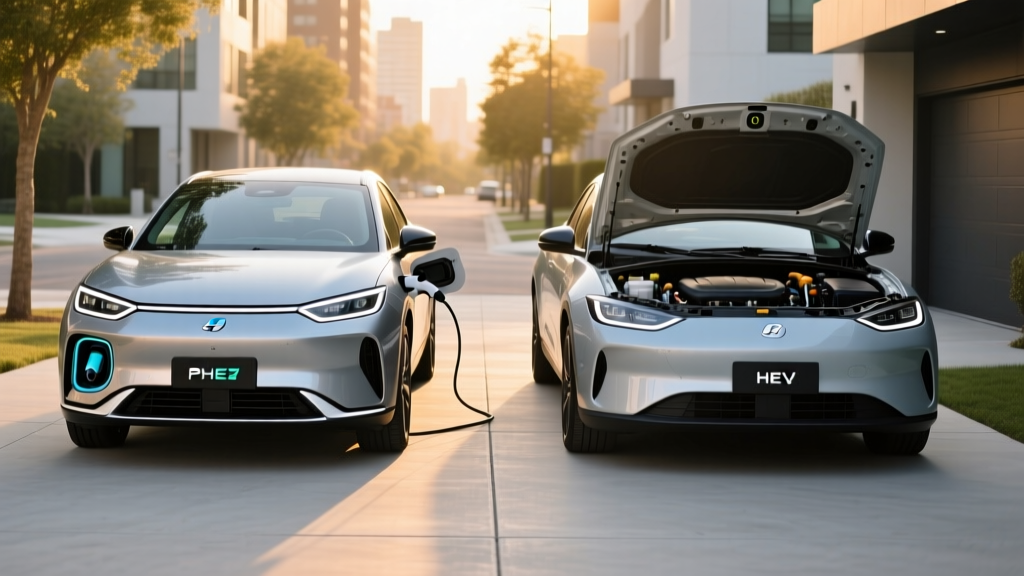
Toyota also sells the RAV4 Prime, a plug-in hybrid (PHEV) variant with a much larger battery and significantly more electric-only range. Here's how the two compare on the dimensions that matter most:
| Feature | RAV4 Hybrid (HEV) | RAV4 Prime (PHEV) |
|---|---|---|
| Drivetrain Type | Conventional hybrid (no plug) | Plug-in hybrid (charges from outlet) |
| Battery Capacity | ~1.6 kWh | 18.1 kWh |
| Electric-Only Range | <1 mile at low speed | 42 miles (EPA) |
| Total Range | ~565 miles | ~600 miles (EV + gas) |
| Combined MPG (after EV range depleted) | 39 MPG | 38 MPG (gas-only mode) |
| MPGe (charge-depleting mode) | N/A | 94 MPGe |
| Combined Horsepower | 219 hp | 302 hp |
| 0–60 mph | ~7.4 sec | ~5.7 sec |
| Level 2 Charge Time (240V) | N/A (no plug) | ~2.5 hours (6.6 kW onboard charger) |
| DC Fast Charging | N/A | Not supported |
| Federal Tax Credit (§30D) | Not eligible | Potentially eligible — see below |
| Approx. MSRP (mid-trim) | ~$37,500 (XLE Premium) | ~$45,000–$48,000 |
Choose the RAV4 Hybrid (HEV) if you don't have reliable access to a Level 2 home charger, want a lower purchase price, prefer simplicity (no charging routine), or drive mostly longer highway trips where the PHEV's electric range provides less benefit.
Choose the RAV4 Prime (PHEV) if you can charge at home every night, your daily commute is under 42 miles round-trip (meaning you'll rarely burn gas on weekdays), you want the 302 hp performance boost, and the higher MSRP makes financial sense after any applicable tax credits.
Pricing, Trims, and Tax Credit Eligibility
The 2026 RAV4 Hybrid XLE Premium carries an estimated MSRP of approximately $37,500 including destination charges. This positions it between the XLE (~$35,000) and the Limited (~$41,000). The XLE Premium adds notable upgrades over the XLE:
- SofTex synthetic leather-trimmed seats
- 10-way power-adjustable driver's seat
- Heated front seats
- Power tilt/slide moonroof
- Wireless smartphone charging pad
- 8-inch Toyota Audio Multimedia touchscreen with wireless Apple CarPlay and Android Auto
- Toyota Safety Sense 2.5+ (pre-collision, lane tracing, adaptive cruise, blind-spot monitor)
Federal Tax Credit Status
The RAV4 Prime (PHEV) may qualify for up to $7,500 under §30D depending on battery-component and critical-minerals sourcing, your adjusted gross income (caps: $150K single / $300K joint), and the vehicle's MSRP (must be ≤$80,000 for SUVs). However, sourcing requirements have tightened significantly — verify current-year eligibility on IRS.gov before assuming the full credit applies. As of 2026, point-of-sale transfer of the credit is available at participating dealers, reducing your out-of-pocket cost at purchase rather than waiting for a tax refund.
Battery Longevity, Warranty, and Replacement Costs
Hybrid battery anxiety is the single most common concern we hear from first-time hybrid buyers. Here's the data:
Warranty: Toyota covers the RAV4 Hybrid's battery with a 10-year / 150,000-mile hybrid battery warranty (whichever comes first). This covers defects and capacity loss below a specified threshold. The broader hybrid system components (inverter, control module, motor-generators) are covered under the same terms. The standard new-vehicle warranty is 3 years / 36,000 miles, and the powertrain warranty is 5 years / 60,000 miles.
Real-world longevity: Toyota's hybrid batteries have an exceptional track record. The Prius, which uses similar technology, routinely sees original batteries lasting 150,000–200,000+ miles. The RAV4 Hybrid's lithium-ion pack is less stressed than a PHEV or BEV battery because it operates in a narrow state-of-charge window (roughly 40–80% SoC), avoiding the deep cycles that accelerate degradation. Toyota's battery management system is deliberately conservative — it sacrifices some usable capacity to maximize lifespan.
Replacement cost: If the hybrid battery does eventually need replacement (typically well beyond the warranty period, at 150K+ miles), expect to pay approximately $2,000–$4,000 for a refurbished or new OEM battery pack plus labor at a dealership. Independent hybrid specialists often offer refurbished packs for $1,500–$2,500 installed. This is dramatically less than a BEV battery replacement ($8,000–$20,000+), reflecting the RAV4 Hybrid's much smaller pack.
Who Should Buy the RAV4 Hybrid XLE Premium?
✅ Pros
- 39 MPG combined — real-world city driving often exceeds 40 MPG
- No charging infrastructure needed — works with any gas station
- Standard AWD with no fuel-economy penalty vs. FWD
- 10-year / 150,000-mile hybrid battery warranty
- Strong Toyota reliability and resale value
- Comfortable XLE Premium features at a reasonable price
- 565+ mile total range — fewer fill-ups on road trips
❌ Cons
- No federal tax credit (HEV, not a plug-in)
- No meaningful electric-only driving range
- CVT drone under hard acceleration
- Towing limited to 1,750 lbs (not for boat/camper hauling)
- Infotainment screen smaller than some competitors
- High demand can mean dealer markups and limited inventory
Decision Framework: Is This the Right Electrified Vehicle for You?
Choose the RAV4 Hybrid XLE Premium if: You want 35–40+ MPG without changing your fueling habits, you lack access to home EV charging, your budget is under $40K, and you prioritize reliability and low cost of ownership over electric-only driving.
Consider the RAV4 Prime (PHEV) instead if: You can install a Level 2 charger at home, your weekday driving is under 42 miles, you want the performance boost (302 hp), and the $7K–$10K price premium is offset by fuel savings and any applicable tax credit.
Consider a full EV (like the Hyundai Ioniq 5 or Tesla Model Y) if: You have reliable home charging, you drive under 250 miles daily, you want zero tailpipe emissions, lower per-mile fuel costs, and access to the full $7,500 federal tax credit (subject to eligibility).
Stick with a gas-only SUV if: You regularly tow over 3,500 lbs, drive extremely low annual miles (where hybrid fuel savings won't offset a higher purchase price), or live in an area with no hybrid service infrastructure.
Hybrid vs. PHEV vs. EV: The Bigger Picture
The RAV4 Hybrid occupies a specific niche in the electrification spectrum. Here's how to think about the three categories:
- Conventional Hybrid (HEV): Small battery, charges itself, no plug. Best for buyers who want better MPG with zero lifestyle change. You'll save roughly $500–$800/year in fuel vs. a comparable gas-only RAV4 (at 15,000 miles/year and $3.50/gallon).
- Plug-in Hybrid (PHEV): Larger battery, charges from an outlet, 25–50 miles of electric-only range. Best for buyers with home charging and short commutes who want EV-like daily driving with a gas engine for road trips.
- Battery Electric Vehicle (BEV): Large battery, charges from an outlet or DC fast charger, 200–350+ miles of range. Best for buyers with home charging who want the lowest per-mile cost, zero tailpipe emissions, and minimal maintenance.
The RAV4 Hybrid's annual fuel cost, per the EPA, is approximately $1,450 (at 15,000 miles/year and current national average fuel prices). A comparable gas-only RAV4 AWD (28 MPG combined) would cost roughly $1,925/year — a savings of about $475 annually, or $2,375 over five years. That doesn't fully account for the Hybrid's modest price premium over the gas model, but the Hybrid's stronger resale value typically closes the gap.
Reliability and Ownership Track Record
Toyota's hybrid system is among the most proven in the automotive industry. The RAV4 Hybrid shares its core powertrain architecture with the Camry Hybrid, Highlander Hybrid, and Prius — a system that has accumulated billions of real-world miles globally. IIHS has consistently rated the RAV4 highly for safety, and Toyota's brand-level reliability rankings from Consumer Reports and J.D. Power remain near the top.
Common ownership notes from high-mileage RAV4 Hybrid drivers:
- Brake pads last 80,000–100,000+ miles thanks to regenerative braking handling most deceleration
- The hybrid system requires no scheduled maintenance beyond standard oil changes
- The eAWD rear motor is sealed and maintenance-free
- Hybrid battery cooling fan filter should be cleaned periodically (accessible behind the rear seat) to prevent overheating and extend battery life
Frequently Asked Questions
How many MPG does the 2026 Toyota RAV4 Hybrid XLE Premium get?
The EPA rates it at 41 MPG city, 38 MPG highway, and 39 MPG combined. In real-world city and suburban driving, many owners report 40–44 MPG thanks to frequent regenerative braking. Highway-only driving at 75+ mph typically yields 34–37 MPG. Cold weather reduces efficiency by roughly 10–15%.
Does the RAV4 Hybrid need to be plugged in?
No. The RAV4 Hybrid is a conventional hybrid (HEV). Its small battery charges automatically through regenerative braking and the gasoline engine. You fuel it at any gas station like a conventional car. If you want a RAV4 that plugs in, you're looking for the RAV4 Prime (PHEV).
Does the RAV4 Hybrid qualify for any federal tax credit?
No. The federal §30D Clean Vehicle Credit applies only to plug-in vehicles (BEVs and PHEVs). The RAV4 Hybrid is a conventional hybrid and does not qualify. The RAV4 Prime (PHEV) may qualify for up to $7,500, subject to IRS income caps, MSRP limits, and battery sourcing requirements — verify at irs.gov. Some states offer their own hybrid incentives; check your local programs.
How long will the RAV4 Hybrid battery last, and what does replacement cost?
Toyota warranties the hybrid battery for 10 years or 150,000 miles. In practice, Toyota hybrid batteries routinely last 150,000–200,000+ miles due to conservative state-of-charge management. If replacement is needed out of warranty, expect $2,000–$4,000 for a new or refurbished OEM pack — far less than a full EV battery replacement.
Is the RAV4 Hybrid XLE Premium worth the upgrade over the XLE?
The XLE Premium adds SofTex seats, heated front seats, a power moonroof, a 10-way power driver's seat, and wireless phone charging for roughly $2,000–$2,500 more than the XLE. If you plan to keep the vehicle 5+ years, the comfort and convenience upgrades are worthwhile and typically hold value well at resale. If budget is the priority, the XLE delivers identical fuel economy and powertrain performance.
Hybrid vs. PHEV vs. EV — which should I choose?
If you can't charge at home and want maximum simplicity: HEV (RAV4 Hybrid). If you can charge at home and commute under 40 miles: PHEV (RAV4 Prime). If you can charge at home, want the lowest running costs, and rarely exceed 250 miles in a day: BEV (consider the Ioniq 5, Model Y, or EV6). Each option has trade-offs in price, infrastructure needs, and daily driving patterns.
Sources: fueleconomy.gov (EPA estimates), Toyota Motor North America (manufacturer specifications), IRS.gov (§30D credit rules). Pricing and incentive data reflect 2026 model year estimates and current federal rules; state incentives and dealer pricing vary. Always verify with official sources before purchasing.