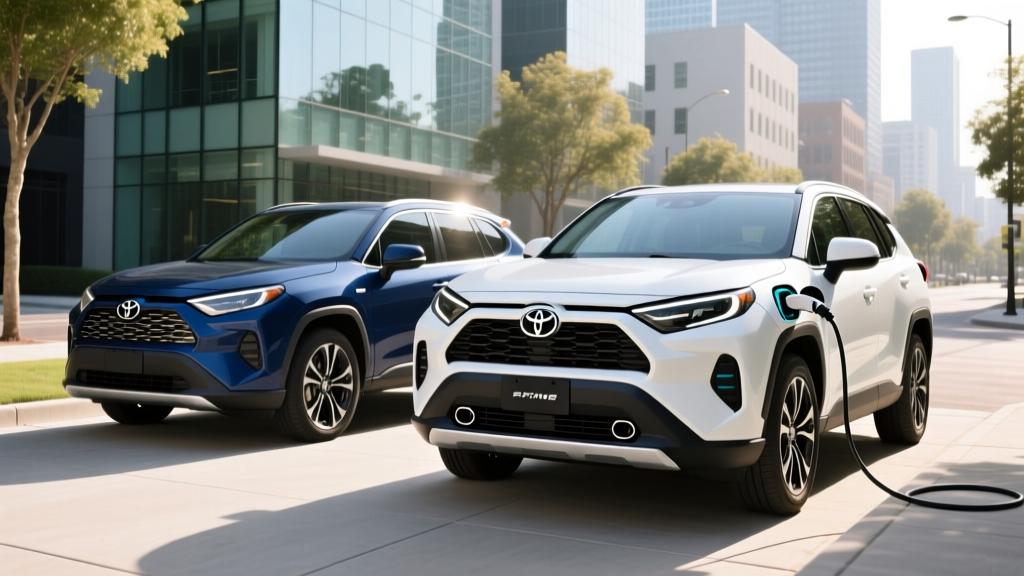
If you've searched for a Toyota RAV4 hybrid plug in, you've likely landed on two very different vehicles wearing the same badge. The conventional RAV4 Hybrid (HEV) never plugs in and sips gas through regenerative braking alone. The RAV4 Prime (PHEV) adds a larger battery, a charge port, and the ability to drive over 40 miles on electricity before the gas engine ever starts. They share a nameplate but serve fundamentally different use cases — and in 2026, with shifting federal tax credit rules and rising electricity costs, picking the right one matters more than ever.
This guide breaks down the exact specs, real-world efficiency, charging requirements, warranty coverage, and total cost math so you can decide which RAV4 electrified powertrain fits your driving life.
HEV vs PHEV: What the RAV4 Actually Offers
Before comparing trims, it's critical to understand the mechanical difference between Toyota's two hybrid approaches in the RAV4 lineup.
Conventional Hybrid (RAV4 HEV)
- No plug, no charging cable. The 1.6 kWh nickel-metal hydride battery recharges exclusively through regenerative braking and the gasoline engine.
- Always runs as a hybrid. The electric motor assists the 2.5L four-cylinder at low speeds and during acceleration, but you cannot drive on electricity alone for meaningful distances.
- Lower upfront cost. Base MSRP starts roughly $6,000–$7,000 below the Prime.
Plug-In Hybrid (RAV4 Prime)
- Has a charge port (J1772 connector). The 18.1 kWh lithium-ion battery charges from a wall outlet or Level 2 station.
- True electric-only driving. Up to 42 EPA-rated miles on battery power alone before the hybrid system engages.
- 302 combined horsepower. The most powerful RAV4 in the lineup, with a 5.7-second 0–60 mph time.
- Federal tax credit eligible (subject to §30D sourcing, income, and MSRP rules).
If you never want to think about plugging in, the HEV is the simpler play. If you have home charging access and a commute under 40 miles round-trip, the Prime can function as a daily EV with a gas backup for road trips.
Fuel Economy and Electric-Only Range: The Numbers
| Metric | RAV4 Hybrid (HEV) | RAV4 Prime (PHEV) |
|---|---|---|
| EV-Only Range | N/A | 42 miles |
| MPGe (EV+Gas combined) | N/A | 94 MPGe |
| City MPG (gas only) | 41 mpg | 40 mpg |
| Highway MPG (gas only) | 38 mpg | 36 mpg |
| Combined MPG (gas only) | 39 mpg | 38 mpg |
| Total Range (EV + gas tank) | ~580 miles | ~600 miles |
| Fuel Tank Capacity | 14.5 gal | 14.5 gal |
Source: EPA Fuel Economy
Real-World MPG vs. EPA Sticker
HEV: Toyota hybrids routinely exceed EPA city estimates in stop-and-go driving because regenerative braking recovers more energy at low speeds. Expect 42–45 mpg in urban traffic. Highway cruising at 75+ mph drops efficiency to 34–36 mpg. Combined real-world: 38–42 mpg depending on driving mix.
Prime (charge-depleting mode): On electricity alone, expect 38–42 real-world miles in moderate temperatures. Cold weather (below 35°F) and highway speeds (70+ mph) can reduce EV range to 30–35 miles. Once the battery depletes, the Prime operates as a conventional hybrid at 36–39 mpg combined.
Powertrain, Battery, and Charging Specs
| Specification | RAV4 Hybrid (HEV) | RAV4 Prime (PHEV) |
|---|---|---|
| Engine | 2.5L inline-4 | 2.5L inline-4 |
| Combined Horsepower | 219 hp | 302 hp |
| Electric Motors | Front + rear (AWD) | Front (134 kW) + rear (40 kW) |
| Battery Chemistry | NiMH (1.6 kWh) | Lithium-ion (18.1 kWh) |
| Drivetrain | Electronic AWD (AWD-e) | Electronic AWD |
| 0–60 mph | 7.4 seconds | 5.7 seconds |
| Charge Port | None | J1772 (Level 1/2) |
| DC Fast Charging | N/A | Not supported |
| Level 1 Charge Time (120V) | N/A | ~12 hours (10–100%) |
| Level 2 Charge Time (240V) | N/A | ~2.5 hours (6.6 kW onboard charger) |
| Towing Capacity | 1,500 lbs | 1,500 lbs |
A critical note for prospective Prime buyers: the RAV4 Prime does not support DC fast charging. The onboard charger maxes out at 6.6 kW on Level 2. This means public fast-charging stations (50–350 kW) are useless to the Prime — you're limited to Level 2 destinations, workplace chargers, and home charging. For a PHEV with a small battery, this is typical and not a dealbreaker, but it's a common source of confusion.
The Prime's 18.1 kWh lithium-ion pack uses a chemistry optimized for cycle life and daily charge-discharge routines. Toyota's battery management system maintains a buffer at the top and bottom of the state-of-charge window to reduce degradation over time.
Pricing, Trims, and Federal Tax Credit Eligibility
The price gap between the RAV4 Hybrid and Prime is substantial, and tax credit rules can narrow or widen that gap depending on your situation.
| Trim | RAV4 Hybrid MSRP | RAV4 Prime MSRP |
|---|---|---|
| LE / Base | $33,425 | $44,515 |
| XLE / SE | $35,375 | $47,015 |
| XLE Premium / XSE | $38,075 | $49,515 |
| Limited / XSE Premium | $41,275 | $52,915 |
Prices include destination charge. Source: Toyota.com
§30D Federal Tax Credit — RAV4 Prime Eligibility (2026 Rules)
The RAV4 Prime may qualify for up to $7,500 under the IRS §30D Clean Vehicle Credit, but eligibility depends on multiple requirements:
- MSRP cap: SUVs must be at or below $80,000 — all Prime trims qualify.
- Buyer income cap: Modified AGI ≤ $150,000 (single), $225,000 (head of household), $300,000 (joint).
- Battery sourcing: A percentage of critical minerals and battery components must meet North American sourcing thresholds, which tighten annually. The credit may be split into $3,750 (minerals) + $3,750 (components) — partial credit is possible.
- Point-of-sale transfer: You can elect to transfer the credit to the dealer at purchase, reducing your out-of-pocket cost directly (dealer must be IRS-registered).
- RAV4 Hybrid (HEV): Does NOT qualify for §30D — the credit applies only to plug-in vehicles with ≥7 kWh battery capacity.
Always verify current eligibility at IRS.gov §30D page and consult a tax professional before purchase.
The math after credit: A base RAV4 Prime at $44,515 minus the full $7,500 credit nets $37,015 — within $3,590 of the RAV4 Hybrid LE. If you charge at home daily, the fuel savings close that gap in roughly 2–3 years depending on local electricity rates and driving patterns.
Reliability, Battery Warranty, and Replacement Costs
Toyota Hybrid Battery Warranty
- HEV (NiMH battery): 10 years / 150,000 miles (whichever comes first)
- Prime (Li-ion battery): 10 years / 150,000 miles
- Hybrid system components: 8 years / 100,000 miles
- Capacity retention guarantee: Toyota warrants the Prime battery against dropping below 70% of original capacity during the warranty period
- Replacement cost (out of warranty): HEV pack ~$3,000–$4,500; Prime pack ~$6,500–$9,000 (parts + labor, varies by dealer)
Toyota's hybrid powertrains have an exceptional reliability track record. The RAV4 Hybrid consistently earns top marks from IIHS and benefits from decades of hybrid system refinement dating back to the 1997 Prius. The HEV's nickel-metal hydride pack is a proven, conservative chemistry — degradation is minimal, and many Toyota hybrids exceed 200,000 miles on the original battery.
The Prime's lithium-ion pack operates under a more demanding charge-discharge cycle (daily full EV use), but Toyota's thermal management and state-of-charge buffering mitigate wear. Real-world data from earlier-model Primes shows typical degradation of 5–10% over the first five years — meaning your 42-mile EV range might become 38–40 miles by year five, which remains practical for most commutes.
Who Should Choose the HEV, the Prime, or a Full EV?
Choose the RAV4 Hybrid (HEV) if:
- You have no access to home or workplace charging (apartment, street parking).
- Your budget is firm below $38,000 and you don't qualify for the tax credit.
- You want a no-fuss ownership experience — no cables, no charging apps, no plug-in routines.
- You drive mostly city miles where the HEV's regenerative braking delivers peak efficiency.
Choose the RAV4 Prime (PHEV) if:
- You can install a Level 2 charger at home (240V, 30A+ circuit) and your daily commute is under 42 miles round-trip.
- You qualify for the full or partial §30D tax credit, narrowing the price gap with the HEV.
- You want the option of silent, zero-tailpipe-emission daily driving but need gas-engine range flexibility for road trips and towing.
- You value the 302-hp powertrain — the Prime is the quickest RAV4 Toyota makes.
Choose a Full EV (e.g., Tesla Model Y, Hyundai Ioniq 5) if:
- You want zero gasoline dependency and are ready to rely entirely on charging infrastructure.
- Your daily driving exceeds 42 miles but you have reliable fast-charging access for road trips.
- You want lower per-mile fuel costs — electricity at $0.14/kWh costs roughly $0.04/mile vs. $0.12–$0.15/mile for gas in the RAV4 HEV.
Real-World Ownership: Charging Costs and Efficiency
Let's run the numbers on what daily driving actually costs in each configuration, assuming 15,000 miles/year and a 60/40 city/highway mix:
| Scenario | Annual Cost | Cost Per Mile |
|---|---|---|
| RAV4 HEV at 40 mpg, $3.50/gal | $1,313 | $0.088 |
| RAV4 Prime (daily charge, 9,000 EV miles + 6,000 gas miles) | $822 | $0.055 |
| RAV4 Prime (never plugged in, gas only at 38 mpg) | $1,382 | $0.092 |
The Prime only saves money if you actually plug it in. Running a PHEV as a gas-only car is slightly less efficient than the lighter HEV due to the extra battery weight (~400 lbs more). At $0.14/kWh (national average home electricity), charging the Prime's 18.1 kWh pack costs about $2.53 for 42 miles — roughly $0.06/mile. Over a year of weekday commuting on electricity, you'd save $400–$600 versus the HEV, recouping the price premium in 4–6 years without the tax credit, or 1–2 years with it.
For home charging, a standard 120V outlet (Level 1) works but takes 12 hours for a full charge — adequate if you plug in overnight and drive less than 42 miles daily. A 240V Level 2 home station ($500–$800 for equipment, $800–$2,000 for electrician installation depending on panel capacity) cuts charge time to 2.5 hours, which is ideal for topping up mid-day or ensuring a full battery every morning.
Pros and Cons at a Glance
RAV4 Prime — Pros
- 42 miles EV-only covers most daily commutes
- 302 hp makes it the fastest RAV4 available
- 600+ miles total range eliminates range anxiety
- Eligible for up to $7,500 federal tax credit
- Standard AWD with strong traction in all conditions
- 10-year/150,000-mile battery warranty
RAV4 Prime — Cons
- $11,000+ premium over HEV before tax credit
- No DC fast charging — Level 2 only
- Cargo space reduced by ~2 cu ft vs HEV (battery placement)
- 2.5-hour Level 2 charge time is slower than some PHEV rivals
- Heavy — extra weight hurts gas-only efficiency
- Limited dealer inventory; waitlists common in some markets
Frequently Asked Questions
How many MPG does the Toyota RAV4 Hybrid get?
The RAV4 Hybrid (HEV) is EPA-rated at 41 city / 38 highway / 39 combined mpg. In real-world city driving with frequent stops, owners commonly see 42–45 mpg thanks to aggressive regenerative braking. Highway driving above 70 mph typically yields 34–36 mpg.
How far can the RAV4 Prime go on electric only?
The EPA rates the RAV4 Prime at 42 miles of electric-only range. Real-world results vary: 38–42 miles in mild weather at city speeds, 30–35 miles in cold weather or at sustained highway speeds above 65 mph. Once depleted, the gas engine engages seamlessly.
Does the RAV4 Prime qualify for a tax credit?
The RAV4 Prime may qualify for up to $7,500 under the IRS §30D Clean Vehicle Credit, subject to buyer income limits (≤$150K single / $300K joint), MSRP cap ($80K for SUVs — all trims qualify), and battery critical-mineral/component sourcing requirements that tighten each year. The conventional RAV4 Hybrid (HEV) does not qualify for this credit. Verify at IRS.gov before purchasing.
Is the RAV4 Hybrid reliable and what does battery replacement cost?
Toyota's hybrid systems are among the most reliable in the industry, with decades of proven performance. Both the HEV and Prime carry a 10-year/150,000-mile hybrid battery warranty. Out-of-warranty replacement runs $3,000–$4,500 for the HEV's NiMH pack and $6,500–$9,000 for the Prime's lithium-ion pack. Most owners never need a replacement within typical ownership periods.
Can I charge the RAV4 Prime at a public DC fast charger?
No. The RAV4 Prime only accepts Level 1 (120V) and Level 2 (240V) AC charging via its J1772 port. It has no DC fast-charge capability. This is standard for most PHEVs — the battery is small enough that Level 2 fully replenishes it in about 2.5 hours.
Hybrid vs PHEV vs full EV — which is right for me?
Choose the HEV if you lack charging access and want simplicity. Choose the Prime if you can charge at home, commute under 42 miles daily, and want gas-engine backup for long trips. Choose a full EV if you want zero gasoline costs, have reliable charging access, and are comfortable planning road trips around DC fast-charging infrastructure.
Does the RAV4 Prime have less cargo space than the Hybrid?
Yes, slightly. The Prime's larger battery pack reduces rear cargo volume by approximately 2 cubic feet. You'll find 33.5 cu ft behind the rear seats in the Prime versus 37.6 cu ft in the HEV. With rear seats folded, the difference narrows but remains noticeable for large cargo hauls.