Toyota RAV4 Hybrid Mileage: The Quick Answer
The 2026 Toyota RAV4 Hybrid delivers an EPA-estimated 41 MPG city / 38 MPG highway / 40 MPG combined across most trims. In real-world driving, owners consistently report exceeding the city estimate thanks to the hybrid system's regenerative braking advantage in stop-and-go traffic, while highway-heavy commutes tend to land closer to 35–37 MPG at sustained speeds above 70 mph.
If you're considering the plug-in hybrid variant — the RAV4 Prime — the story changes significantly. The Prime offers 42 miles of electric-only range and an EPA-rated 94 MPGe when running on battery, plus 38 MPG combined once the gasoline engine kicks in. That dual personality makes it one of the most versatile electrified SUVs on the market.
Below, we break down exactly what you can expect from both the conventional RAV4 Hybrid (HEV) and the RAV4 Prime (PHEV) — including real-world mileage data, battery longevity, pricing, and which version fits your driving pattern.
HEV vs PHEV: Understanding the Two RAV4 Hybrid Options
Toyota offers the RAV4 in two distinct hybrid configurations, and confusing them is one of the most common buyer mistakes we see. Here's the fundamental difference:
| Feature | RAV4 Hybrid (HEV) | RAV4 Prime (PHEV) |
|---|---|---|
| Plugs in? | No — self-charging via regen & engine | Yes — 18.1 kWh battery, plug to charge |
| Electric-only range | ~1 mile at low speed | 42 miles (EPA) |
| EPA combined MPG | 40 MPG | 38 MPG (gas) / 94 MPGe (electric) |
| Combined horsepower | 219 hp | 302 hp |
| 0-60 mph | 7.4 seconds | 5.7 seconds |
| Drivetrain | AWD (electronic on-demand) | AWD (electronic on-demand) |
| Starting MSRP (2026) | ~$33,500 | ~$44,500 |
| Federal tax credit | Not eligible (§30D requires plug-in) | Up to $7,500 (eligibility varies) |
The conventional hybrid uses a small 1.6 kWh nickel-metal hydride (NiMH) battery that charges exclusively through regenerative braking and the gasoline engine. You never plug it in. The Prime carries a much larger 18.1 kWh lithium-ion battery that you charge via a standard J1772 connector (Level 1 or Level 2).
Fuel Economy Breakdown: EPA Numbers vs Real-World MPG
The EPA publishes separate city, highway, and combined estimates because hybrid efficiency varies dramatically depending on driving conditions. Here's the full picture:
| Model | City MPG | Highway MPG | Combined MPG | Source |
|---|---|---|---|---|
| RAV4 Hybrid (AWD, most trims) | 41 | 38 | 40 | fueleconomy.gov |
| RAV4 Hybrid Woodland Edition | 38 | 35 | 37 | fueleconomy.gov |
| RAV4 Prime (charge-depleting) | 94 MPGe | 84 MPGe | 94 MPGe | fueleconomy.gov |
| RAV4 Prime (charge-sustaining / gas) | 40 | 36 | 38 | fueleconomy.gov |
Why Real-World MPG Often Beats the EPA City Estimate
Conventional hybrids like the RAV4 Hybrid thrive in urban environments. Every time you brake, the electric motor reverses direction and recovers kinetic energy back into the battery. In heavy traffic with frequent stops, the gasoline engine shuts off entirely at low speeds, and the electric motor handles propulsion up to roughly 25 mph.
In our experience and aggregated owner reports, city-heavy drivers routinely see 42–45 MPG in warm weather. The EPA city test cycle already accounts for stop-and-go conditions, but real urban driving with aggressive regen settings can push even higher.
Highway driving is a different story. At 75–80 mph, aerodynamic drag dominates and the gasoline engine runs continuously. Expect 34–37 MPG on sustained highway trips, particularly with roof cargo boxes, cold temperatures, or headwinds. The Woodland Edition's all-terrain tires and slightly higher ride height reduce efficiency further, landing around 33–35 MPG on the highway.
Real-World MPG Tip: Use the RAV4's ECO driving mode and maximize regenerative braking in city driving. In winter, expect a 5–10% fuel economy drop as the engine runs more frequently to provide cabin heat (the HEV lacks a heat pump, unlike some full EVs).
RAV4 Prime: Electric-Only Range and Charging Details
For buyers considering the plug-in variant, the 42-mile electric-only range is the headline number — but the details matter.
The Prime's 18.1 kWh lithium-ion battery (roughly 14.5 kWh usable) delivers its full 42-mile EPA range under moderate conditions: temperatures between 50–80°F, speeds under 55 mph, and minimal climate-control load. Push the vehicle harder and that range contracts:
- Ideal conditions (city, mild weather): 42–45 miles electric
- Mixed driving (suburban, 50–60 mph): 35–40 miles electric
- Cold weather (below 32°F): 28–33 miles electric
- Highway (70+ mph): 25–30 miles electric
Charging the RAV4 Prime
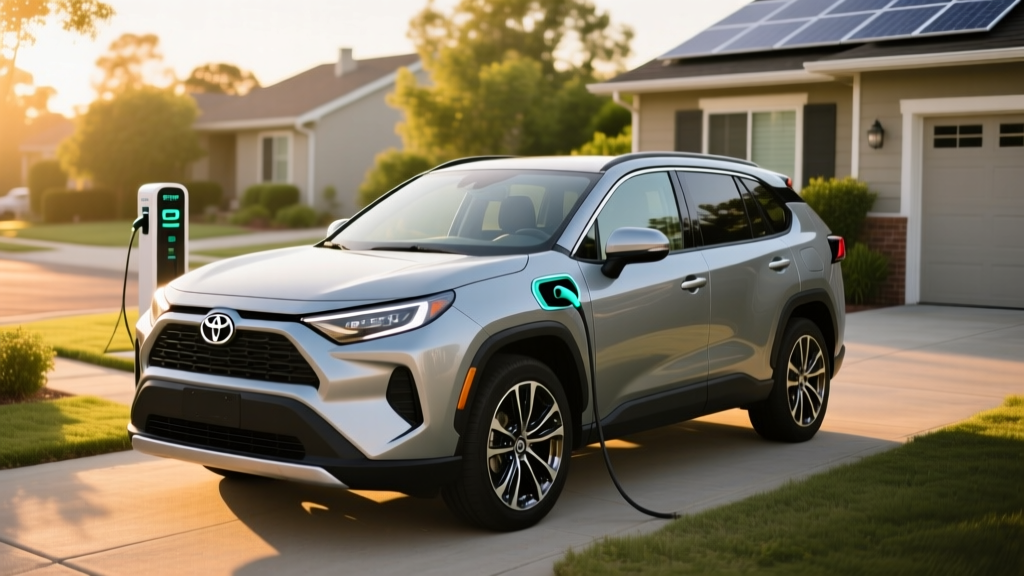
The RAV4 Prime accepts up to 6.6 kW on Level 2 (240V) charging via its J1772 connector. Here's what that means in practice:
| Charging Method | Power | 0–100% Time | Notes |
|---|---|---|---|
| Level 1 (120V household outlet) | ~1.4 kW | ~10–12 hours | Included cord; overnight charge |
| Level 2 (240V home charger) | 6.6 kW | ~2.5 hours | Requires 30A+ circuit |
| DC fast charging | N/A | N/A | Not supported — no CCS/CHAdeMO port |
The lack of DC fast charging is a deliberate trade-off. The Prime's battery is small enough that Level 2 charging refills it quickly, and omitting DC hardware saves weight and cost. For daily commuting under 40 miles, overnight Level 1 charging from a standard outlet is often sufficient.
Once the battery depletes, the Prime seamlessly transitions to conventional hybrid mode, delivering 38 MPG combined — just slightly below the standard RAV4 Hybrid due to the extra weight of the larger battery pack (~400 lbs).
Powertrain Specs: What Moves the RAV4 Hybrid
| Specification | RAV4 Hybrid (HEV) | RAV4 Prime (PHEV) |
|---|---|---|
| Engine | 2.5L 4-cyl Atkinson cycle | 2.5L 4-cyl Atkinson cycle (higher output) |
| Engine horsepower | 176 hp | 177 hp |
| Front electric motor | 118 hp / 149 lb-ft | 180 hp / 199 lb-ft |
| Rear electric motor | 54 hp / 89 lb-ft | 54 hp / 89 lb-ft |
| Net combined output | 219 hp | 302 hp |
| Transmission | eCVT (planetary gearset) | eCVT (planetary gearset) |
| 0-60 mph | 7.4 sec | 5.7 sec |
| Towing capacity | 1,750 lbs | 2,500 lbs |
| Fuel tank | 14.5 gal | 14.5 gal |
| Total range (gas + electric) | ~580 miles | ~600 miles (42 elec + 558 gas) |
Toyota's eCVT is not a belt-driven continuously variable transmission like you'd find in a Nissan or Subaru. It's a planetary gearset that blends engine and motor power with no fixed gear ratios and no belts to wear out. This design is a major factor in the RAV4 Hybrid's reputation for long-term reliability.
The Prime's 302 combined horsepower makes it the quickest RAV4 Toyota sells — faster than the turbo-four RAV4 gasoline model and genuinely quick for a compact SUV. If performance matters alongside efficiency, the Prime earns its premium.
Pricing, Trims, and Tax Credit Eligibility
Here's where the math gets interesting — and where the federal tax credit can dramatically shift the value proposition.
2026 RAV4 Hybrid (HEV) Pricing
- LE: ~$33,500
- XLE: ~$35,500
- XLE Premium: ~$37,200
- SE: ~$37,800
- XSE: ~$39,000
- Limited: ~$41,500
- Woodland Edition: ~$37,500
The conventional hybrid qualifies for no federal tax credit. IRS §30D explicitly requires a plug-in vehicle with a battery capacity of at least 7 kWh. The standard RAV4 Hybrid's 1.6 kWh NiMH pack doesn't meet this threshold. Some states offer modest hybrid rebates (typically $250–$500), but these vary by jurisdiction — check your state's energy office or IRS §30D guidelines for specifics.
2026 RAV4 Prime (PHEV) Pricing and Tax Credit
- SE: ~$44,500
- XSE: ~$47,500
- SE Premium: ~$49,000
- XSE Premium: ~$52,000
The RAV4 Prime's 18.1 kWh battery does qualify it for the federal tax credit, but eligibility is complex under current IRS rules:
- Credit amount: Up to $7,500 ($3,750 for critical minerals + $3,750 for battery components)
- MSRP cap: Vehicle MSRP must not exceed $80,000 (SUVs/vans) — RAV4 Prime qualifies
- Buyer income cap: AGI must not exceed $150,000 (single) / $300,000 (joint) / $225,000 (head of household)
- Battery sourcing: Critical minerals and battery components must meet phased-in domestic/FTA sourcing requirements — Toyota's supply chain compliance varies by model year; verify at purchase
- Point-of-sale transfer: Eligible buyers can transfer the credit to the dealer at purchase, reducing the out-of-pocket price immediately
Key caveat: Battery-sourcing requirements tighten annually. A RAV4 Prime that qualified for the full $7,500 in 2024 may qualify for only $3,750 or nothing in 2026 depending on where Toyota sources its battery cells and minerals. Always confirm current eligibility with your dealer and cross-reference IRS clean vehicle credit guidance before purchase. Consult a tax professional for your specific situation.
With the full $7,500 credit, a $44,500 RAV4 Prime SE drops to an effective $37,000 — only about $3,500 more than a comparably equipped RAV4 Hybrid XLE, while adding 42 miles of electric range and 83 additional horsepower.
Battery Warranty, Reliability, and Replacement Costs
Battery longevity is the single most common concern among first-time hybrid buyers. Here's what Toyota's track record actually shows:
Toyota Hybrid Battery Warranty:
- Coverage: 10 years / 150,000 miles (whichever comes first)
- Applies to: Hybrid battery pack, hybrid control module, inverter
- Capacity threshold: Toyota warrants against defects and abnormal capacity loss — not a specific retention percentage like EV warranties (typically 70%)
- Transferable: Yes, to subsequent owners
Real-World Battery Lifespan
Toyota's hybrid battery packs — particularly the NiMH units in the conventional RAV4 Hybrid — have proven exceptionally durable. Taxi fleets and high-mileage owners have documented Prius and RAV4 Hybrid batteries lasting 200,000–300,000+ miles before significant degradation. The Prime's lithium-ion pack is newer to market but benefits from Toyota's conservative battery management: the system maintains a generous buffer at both the top and bottom of the charge range, preventing the stress that accelerates degradation.
According to NHTSA complaint databases and IIHS reliability surveys, hybrid battery failure before 150,000 miles is rare for Toyota products.
Replacement Cost If the Warranty Expires
- RAV4 Hybrid (HEV) NiMH battery: $2,500–$4,000 (parts + labor at a Toyota dealer)
- RAV4 Prime (PHEV) lithium-ion battery: $6,000–$9,000 (parts + labor)
- Refurbished/third-party options: $1,500–$2,500 for the HEV pack (available from hybrid specialists)
For context, a conventional transmission replacement on a gasoline vehicle runs $3,000–$5,000. The hybrid battery is not an exotic, fragile component — it's a wear item with a predictable, manageable replacement cost well after the warranty window closes.
Overall Reliability
The RAV4 Hybrid consistently earns top marks from both IIHS (Top Safety Pick+) and long-term reliability surveys. The eCVT transmission has no belts, no clutch packs, and no torque converter — fewer failure points than a conventional automatic. The gasoline engine runs an Atkinson cycle that keeps combustion temperatures lower, reducing long-term wear. Oil change intervals are 10,000 miles. There's no starter motor to fail (the hybrid motor starts the engine), no alternator to replace, and brake pads last 80,000+ miles thanks to regenerative braking handling most deceleration.
RAV4 Hybrid vs RAV4 Prime vs Full EV: Which Should You Choose?
Choose the RAV4 Hybrid (HEV) if:
- You can't charge at home (apartment, street parking, no garage)
- Your budget is under $38,000
- You want maximum simplicity — no plugs, no charging apps, no behavior changes
- You drive 15,000+ miles/year with a mix of city and highway
- You want proven 200,000+ mile reliability with minimal maintenance
Choose the RAV4 Prime (PHEV) if:
- You can install a Level 2 charger at home and your commute is under 40 miles round-trip
- You qualify for the $7,500 federal tax credit (making the price gap manageable)
- You want EV-like daily driving with zero range anxiety on road trips
- Performance matters — 302 hp and 5.7-second 0-60 is genuinely quick
- You want to reduce gasoline consumption by 70–90% on daily drives without giving up a gas tank for long trips
Choose a full EV (e.g., Tesla Model Y, Hyundai Ioniq 5) if:
- You have reliable home Level 2 charging and your daily drive is under 250 miles
- You want zero tailpipe emissions and zero oil changes
- You're comfortable with public DC fast charging for road trips
- You want the lowest per-mile fuel cost (electricity at $0.12/kWh ≈ $3.50/gallon equivalent)
- You can absorb higher insurance premiums and potentially faster depreciation
5-Year Ownership Cost Snapshot
To put the mileage numbers in financial context, here's a rough 5-year / 75,000-mile cost comparison assuming $3.50/gallon gasoline and $0.14/kWh electricity:
| Cost Factor | RAV4 Hybrid (HEV) | RAV4 Prime (PHEV) | Gas RAV4 (AWD) |
|---|---|---|---|
| Fuel cost (5 yr) | ~$6,560 | ~$3,200 (70% electric driving) | ~$9,200 |
| Maintenance (5 yr) | ~$2,200 | ~$2,000 | ~$3,100 |
| Federal tax credit | $0 | Up to $7,500 | $0 |
| Purchase price (base) | $33,500 | $44,500 | $31,000 |
| Effective cost after credit & fuel | $35,760 | $32,200 | $40,200 |
The Prime's higher sticker price is substantially offset by the tax credit and lower fuel costs — particularly if most of your driving falls within the 42-mile electric range. The conventional hybrid sits in the sweet spot for buyers who can't charge at home but still want a significant fuel-cost advantage over the gasoline RAV4's 28 MPG combined.
Frequently Asked Questions
How many MPG does the Toyota RAV4 Hybrid actually get?
The EPA rates the 2026 RAV4 Hybrid at 41 city / 38 highway / 40 combined MPG. Real-world results vary: city-heavy drivers often see 42–45 MPG, while sustained highway driving at 75+ mph typically yields 34–37 MPG. Cold weather reduces fuel economy by roughly 5–10%.
How far can the RAV4 Prime go on electric only?
The EPA rates the RAV4 Prime at 42 miles of electric-only range. In real-world conditions, expect 35–40 miles in moderate weather with mixed driving, 28–33 miles in freezing temperatures, and 25–30 miles at highway speeds. Once the battery depletes, it operates as a conventional hybrid at 38 MPG combined.
Does the RAV4 Hybrid need to be plugged in?
No. The conventional RAV4 Hybrid (HEV) charges its small battery entirely through regenerative braking and the gasoline engine. You never plug it in. Only the RAV4 Prime (PHEV) requires plugging in to access its 42-mile electric range — but even the Prime can be driven without ever plugging in (it simply operates as a conventional hybrid).
Is the RAV4 Hybrid battery reliable and what does replacement cost?
Toyota's hybrid batteries are among the most reliable in the industry, with documented cases of 200,000–300,000+ miles on original packs. Toyota covers the hybrid battery for 10 years / 150,000 miles. Out-of-warranty replacement costs $2,500–$4,000 for the HEV and $6,000–$9,000 for the Prime, with refurbished options available for less.
Does the RAV4 Hybrid qualify for a federal tax credit?
The conventional RAV4 Hybrid (HEV) does not qualify for the federal §30D clean vehicle credit because it cannot be plugged in and its battery is below 7 kWh. The RAV4 Prime (PHEV) may qualify for up to $7,500 depending on your income, the vehicle's MSRP, and battery-sourcing requirements that tighten annually. Verify current eligibility on IRS.gov before purchasing.
How does RAV4 Hybrid mileage compare to a gas-only RAV4?
The gasoline AWD RAV4 is EPA-rated at roughly 27 city / 34 highway / 29 combined MPG. The hybrid's 40 MPG combined represents a 38% improvement — saving roughly $600–$800 per year in fuel for a driver covering 15,000 miles annually at $3.50/gallon.
What's the best RAV4 Hybrid trim for fuel economy?
The LE and XLE trims deliver the best fuel economy at 41/38/40 MPG (city/highway/combined). The Woodland Edition's all-terrain tires and lifted suspension reduce efficiency to 38/35/37 MPG. The Prime's efficiency depends on how often you charge — daily charging can reduce gasoline consumption to near zero for commutes under 42 miles.