Why the RAV4 Hybrid Dominates Lease Searches
The Toyota RAV4 Hybrid remains one of the most leased compact SUVs in America, and for good reason: it delivers 39–41 MPG combined without ever needing a plug, pairs standard all-wheel drive across every trim, and carries Toyota's reputation for long-term reliability. If you're researching Toyota RAV4 Hybrid lease specials for the 2026 model year, you're likely weighing monthly payments against real-world fuel savings — and possibly wondering whether the plug-in RAV4 Prime might be a better financial move.
This guide breaks down every 2026 RAV4 Hybrid and RAV4 Prime trim with exact EPA fuel economy figures, powertrain specs, pricing, tax-credit eligibility, and a decision framework to help you choose the right lease. We'll also separate the conventional hybrid (HEV) from the plug-in hybrid (PHEV) so you know precisely what you're signing for.
HEV vs. PHEV: Which RAV4 Hybrid Are You Leasing?
Toyota sells two electrified RAV4 variants, and confusing them is the most common mistake lease shoppers make. Here's the fundamental difference:
| Feature | RAV4 Hybrid (HEV) | RAV4 Prime (PHEV) |
|---|---|---|
| Plug-in required? | No — self-charging via regenerative braking and engine | Yes — plug in to access electric-only driving |
| Electric-only range | N/A (electric motor assists engine only) | 42 miles (EPA) |
| Battery size | 1.6 kWh (small buffer) | 18.1 kWh usable |
| Combined horsepower | 219 hp | 302 hp |
| EPA combined MPG / MPGe | 39–41 MPG | 94 MPGe (electric) / 38 MPG (gas-only) |
| Federal tax credit (§30D) | Not eligible | Up to $7,500 (eligibility varies) |
| DC fast charging | N/A | No — Level 2 AC only |
| 0–60 mph | 7.4 seconds | 5.7 seconds |
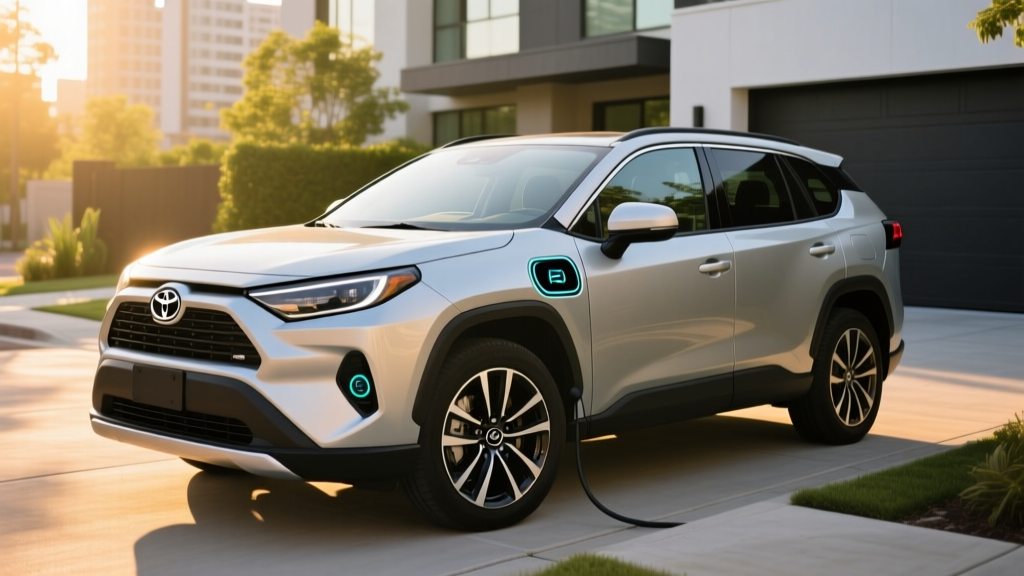
The conventional RAV4 Hybrid generates its own electricity through regenerative braking and the gasoline engine. You never plug it in — just fill up with gas and drive. The RAV4 Prime, by contrast, has a much larger battery that you charge via a standard outlet or Level 2 charger, enabling 42 miles of pure electric driving before the gas engine takes over. This distinction directly affects lease pricing, tax-credit eligibility, and your daily driving experience.
Fuel Economy: Real-World MPG vs. EPA Stickers
The EPA publishes official fuel economy ratings, but hybrid owners frequently report exceeding those numbers in city driving — where regenerative braking recaptures the most energy. Here's what the 2026 lineup delivers:
| Model / Trim | City MPG | Highway MPG | Combined MPG |
|---|---|---|---|
| RAV4 Hybrid LE / XLE | 41 | 38 | 40 |
| RAV4 Hybrid XLE Premium / Woodland | 41 | 38 | 40 |
| RAV4 Hybrid SE / XSE | 41 | 38 | 40 |
| RAV4 Hybrid Limited | 41 | 38 | 40 |
| RAV4 Prime SE / XSE (gas-only mode) | 40 | 36 | 38 |
Source: EPA Fuel Economy.
Powertrain, Battery, and Charging Specs
| Specification | RAV4 Hybrid (HEV) | RAV4 Prime (PHEV) |
|---|---|---|
| Engine | 2.5L 4-cyl Atkinson cycle | 2.5L 4-cyl Atkinson cycle |
| Electric motors | Front + rear (eAWD) | Front (higher output) + rear |
| Net system horsepower | 219 hp | 302 hp |
| Battery type / capacity | NiMH, ~1.6 kWh | Lithium-ion, 18.1 kWh usable |
| Charge time (120V Level 1) | N/A | ~12 hours (0–100%) |
| Charge time (240V Level 2) | N/A | ~2.5 hours (0–100%) |
| DC fast charge capable | N/A | No |
| Total range (gas + electric) | ~580 miles | ~600 miles (42 EV + 558 gas) |
| Towing capacity | 1,750 lbs | 2,500 lbs |
The RAV4 Prime's lack of DC fast charging is a deliberate Toyota decision — the 18.1 kWh battery is small enough that Level 2 charging at 6.6 kW fills it in roughly 2.5 hours, which covers most overnight or workplace-charging scenarios. If you rely exclusively on public DC fast chargers, the Prime's AC-only limitation is worth noting.
2026 Pricing and Lease Specials Breakdown
Lease payments depend on MSRP, negotiated selling price, money factor (interest rate), residual value, and any applicable incentives. Here's where 2026 RAV4 Hybrid trims stand at MSRP:
| Trim | MSRP (approx.) | Typical Lease Range* |
|---|---|---|
| RAV4 Hybrid LE | $33,500 | $350–$420/mo |
| RAV4 Hybrid XLE | $35,200 | $370–$440/mo |
| RAV4 Hybrid XLE Premium | $37,800 | $400–$475/mo |
| RAV4 Hybrid Woodland Edition | $38,500 | $410–$490/mo |
| RAV4 Hybrid SE | $38,000 | $405–$480/mo |
| RAV4 Hybrid Limited | $42,000 | $450–$540/mo |
| RAV4 Prime SE | $45,500 | $480–$580/mo |
| RAV4 Prime XSE | $48,500 | $510–$620/mo |
*Lease estimates assume 36-month term, 12,000 miles/year, tier-1 credit, and no down payment beyond drive-off fees. Actual payments vary by dealer, region, and current Toyota Financial Services incentives. Always negotiate the selling price (cap cost) before discussing monthly payments.
Finding the best lease specials: Toyota Financial Services periodically offers lease cash (dealer incentives) on RAV4 Hybrid trims, typically $500–$1,500, which reduces the capitalized cost. Check Toyota's national offers page and your regional dealer association. The RAV4 Prime, due to high demand and limited allocation, rarely sees lease cash incentives — expect to pay close to MSRP.
Tax Credits: What Actually Applies to Your Lease
This is where HEV vs. PHEV makes a major financial difference:
- RAV4 Hybrid (HEV): Does NOT qualify for the federal §30D clean vehicle credit. Conventional hybrids are not eligible — only plug-in vehicles with ≥7 kWh battery capacity qualify.
- RAV4 Prime (PHEV): Potentially eligible for up to $7,500, but eligibility depends on:
- Battery component and critical mineral sourcing requirements (IRA rules)
- Buyer income caps: $150K single / $225K head of household / $300K joint
- MSRP cap: $80,000 for SUVs (RAV4 Prime qualifies)
- Vehicle must be assembled in North America
- Lease loophole (§45W commercial credit): When you lease (rather than buy) a RAV4 Prime, the leasing company (Toyota Financial Services) is the legal owner and may pass through the commercial clean vehicle credit as a lease incentive — even if your personal income exceeds §30D caps. Ask the dealer whether current lease programs include a pass-through credit.
For current IRS rules, consult IRS.gov Clean Vehicle Credits. State incentives vary widely — check your state energy office or the AFDC incentive database for local rebates.
Battery Warranty, Reliability, and Replacement Costs
Hybrid battery longevity is the top concern for prospective lessees and buyers. Here's what Toyota covers:
- Duration: 10 years / 150,000 miles (whichever comes first)
- Coverage: Defects and capacity loss below a defined threshold
- Applies to: Both RAV4 Hybrid (HEV) and RAV4 Prime (PHEV) traction batteries
- Hybrid system warranty: 8 years / 100,000 miles on hybrid-specific components (inverters, converters, control modules)
Real-world reliability: Toyota's hybrid system, refined over 25+ years since the original Prius, is among the most proven in the industry. The RAV4 Hybrid's NiMH battery is deliberately small and operates within a narrow state-of-charge window, which dramatically reduces degradation stress. Many Toyota hybrid owners report 150,000–200,000+ miles with no battery issues.
Replacement cost if out of warranty: A RAV4 Hybrid traction battery replacement currently ranges from $2,500–$4,000 (parts and labor). The RAV4 Prime's larger lithium-ion pack is more expensive, estimated at $5,000–$8,000. However, given the 10-year/150,000-mile warranty and Toyota's track record, most lessees (on a 36-month lease) will never approach this concern.
For safety ratings, the 2026 RAV4 Hybrid carries top marks from IIHS and NHTSA.
Who Should Lease the RAV4 Hybrid vs. Prime vs. Full EV?
- You want maximum MPG without changing your refueling habits — no plugs, no charging apps
- You live in an apartment or lack home/workplace charging access
- You want the lowest monthly lease payment in the RAV4 lineup
- Your daily commute is longer than 42 miles and you prefer not to manage charge scheduling
- You can charge at home (even a standard 120V outlet works overnight for 42 miles)
- Your daily round-trip commute is under 42 miles — you could drive months without using gas
- You want the 302 hp performance boost and 2,500-lb towing capacity
- You can leverage the §30D tax credit or §45W lease pass-through to offset the higher MSRP
- You have reliable Level 2 home charging and want zero tailpipe emissions
- Your daily driving stays within 250–300 miles and you're comfortable with road-trip DC charging
- You want the lowest per-mile "fuel" cost (electricity at $0.12/kWh ≈ $0.04/mile vs. gas at $3.50/gal ≈ $0.09/mile at 40 MPG)
Pros and Cons at a Glance
- 40 MPG combined — no plug required
- Standard AWD on every trim
- Lowest lease payments in the lineup
- Proven 25-year hybrid reliability
- 10-year/150,000-mile battery warranty
- No federal tax credit eligibility
- 219 hp is adequate, not sporty
- 1,750-lb towing limit
- CVT drone under hard acceleration
- 42 miles electric-only range
- 302 hp — quickest RAV4 ever
- Potential $7,500 tax credit or lease pass-through
- 2,500-lb towing capacity
- ~$12,000 higher MSRP than Hybrid LE
- No DC fast charging
- Limited dealer allocation — long waits common
- Cargo floor slightly higher due to battery
Frequently Asked Questions
How many MPG does the 2026 Toyota RAV4 Hybrid get?
The EPA rates the 2026 RAV4 Hybrid at 41 city / 38 highway / 40 combined MPG across most trims. In real-world city driving with frequent stops, many owners report 42–44 MPG thanks to aggressive regenerative braking. Highway-only driving at higher speeds typically yields 35–37 MPG.
How far can the RAV4 Prime go on electric only?
The EPA rates the 2026 RAV4 Prime at 42 miles of electric-only range on a full charge. In mild weather with moderate speeds, some drivers achieve 45–48 miles. Cold weather (below freezing) and highway-speed driving can reduce this to 32–36 miles.
Does the RAV4 Hybrid qualify for any tax credit?
The conventional RAV4 Hybrid (HEV) does not qualify for the federal §30D clean vehicle tax credit — it lacks the minimum 7 kWh battery and plug-in capability. The RAV4 Prime (PHEV) may qualify for up to $7,500 depending on battery sourcing, buyer income, and MSRP caps. When leasing a Prime, the lessor may pass through a commercial credit (§45W) as a lease incentive regardless of your personal income.
Is the RAV4 Hybrid reliable, and what does battery replacement cost?
Toyota's hybrid system has over 25 years of proven reliability. The hybrid battery is warranted for 10 years / 150,000 miles. Out-of-warranty replacement runs $2,500–$4,000 for the HEV and $5,000–$8,000 for the Prime. Most lessees on a 36-month term will never face this expense.
Do I need to plug in the RAV4 Hybrid?
No. The conventional RAV4 Hybrid (HEV) is a self-charging system. It recovers energy through regenerative braking and generates electricity via the gasoline engine. You simply fill up at any gas station. Only the RAV4 Prime (PHEV) requires plugging in to access its 42-mile electric-only range.
What's the best RAV4 Hybrid trim to lease in 2026?
For value, the XLE ($35,200 MSRP) offers the best balance of features (blind-spot monitoring, dual-zone climate, smart key) to lease payment. For the RAV4 Prime, the SE trim ($45,500) provides the most accessible entry point to the PHEV powertrain. Always negotiate the capitalized cost before discussing monthly payments.