The Toyota RAV4 Hybrid remains one of the best-selling electrified vehicles in the United States for a straightforward reason: it delivers genuine fuel savings without requiring any change in driving habits. If you've searched for a "RAV4 Hybrid automatic" and landed here, you're likely weighing this SUV against a plug-in hybrid (PHEV), a full battery-electric vehicle (BEV), or a conventional gas model. This guide breaks down the 2026 RAV4 Hybrid's efficiency, powertrain, real-world ownership costs, and where it fits in the broader electrified-vehicle landscape.
What the RAV4 Hybrid Actually Is (and Isn't)
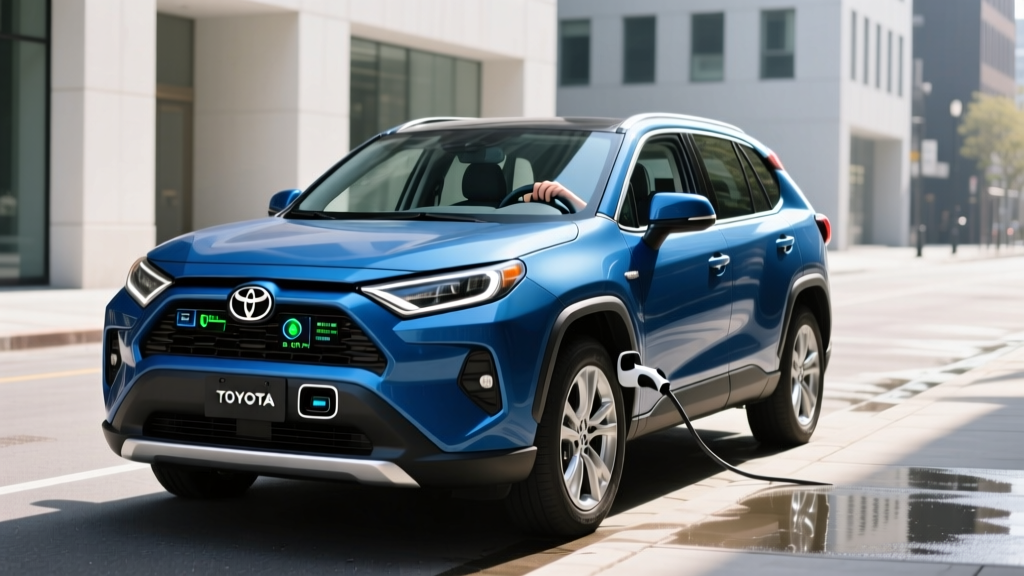
The Toyota RAV4 Hybrid is a conventional hybrid electric vehicle (HEV). It pairs a 2.5-liter four-cylinder gasoline engine with electric motors and a small battery pack that recharges through regenerative braking and the engine itself. You never plug it in. There is no charging port, no electric-only driving mode of meaningful distance, and no dependency on public or home charging infrastructure.
This is fundamentally different from the RAV4 Prime, which is Toyota's plug-in hybrid (PHEV) variant. The RAV4 Prime has a larger battery, a charge port, and roughly 42 miles of electric-only range. We'll compare the two later, but it's critical not to confuse them — their pricing, efficiency profiles, and tax-credit eligibility are entirely different.
RAV4 Hybrid (HEV) vs. RAV4 Prime (PHEV) at a Glance
| Attribute | RAV4 Hybrid (HEV) | RAV4 Prime (PHEV) |
|---|---|---|
| Plug-in required? | No — self-charging | Yes — 120V or 240V outlet |
| Electric-only range | ~1 mile at low speed | 42 miles (EPA) |
| Battery capacity | 1.6 kWh (nominal) | 18.1 kWh (usable) |
| Combined horsepower | 219 hp | 302 hp |
| EPA combined MPG / MPGe | 39 MPG | 94 MPGe (electric) / 38 MPG (gas) |
| Starting MSRP (2026 est.) | ~$33,500 | ~$44,500 |
| Federal tax credit (§30D) | Not eligible | Up to $7,500 (eligibility varies) |
| DC fast charging | N/A | Not available |
Fuel Economy: EPA Ratings and Real-World MPG
The 2026 Toyota RAV4 Hybrid with all-wheel drive (AWD) carries the following EPA fuel economy ratings:
| Driving Cycle | EPA Rating |
|---|---|
| City | 41 MPG |
| Highway | 38 MPG |
| Combined | 39 MPG |
Those numbers apply to the AWD configuration, which is standard on all RAV4 Hybrid trims in the U.S. market. A front-wheel-drive-only variant is not offered for the hybrid in recent model years.
Real-World MPG: What Owners Actually See
Hybrids tend to outperform their EPA estimates in stop-and-go city driving, where regenerative braking recaptures energy most aggressively. In our experience and across aggregated owner reports, the RAV4 Hybrid routinely delivers 40–44 MPG in mixed city driving. Highway-only trips at 75+ mph tend to dip to 34–37 MPG, since the electric motors contribute less at sustained high speeds and the gasoline engine carries the load.
Cold weather reduces efficiency — expect a 5–10% drop in winter months due to increased engine idling for cabin heat and reduced battery efficiency at low temperatures. This is far less severe than the 20–30% range loss a full EV experiences in cold weather, but it's measurable.
Battery Warranty and Longevity
Toyota covers the RAV4 Hybrid's battery pack under its Hybrid Battery Warranty: 10 years or 150,000 miles (whichever comes first), applicable to models from 2020 onward in all 50 states. Prior to 2020, coverage was 8 years/100,000 miles (10 years/150,000 miles in CARB states). If the hybrid battery fails outside warranty, replacement costs typically range from $2,500 to $4,000 including labor at a dealership, with refurbished options available for $1,500–$2,500. In practice, Toyota hybrid batteries have proven highly durable — many exceed 200,000 miles without replacement.
Powertrain and Performance Specs
The RAV4 Hybrid uses Toyota's fourth-generation hybrid system (THS IV), pairing a naturally aspirated 2.5-liter Dynamic Force engine with front and rear electric motors for electronic on-demand AWD.
| Specification | Value |
|---|---|
| Engine | 2.5L inline-4 (176 hp, 163 lb-ft) |
| Front electric motor | 88 kW (118 hp) |
| Rear electric motor | 40 kW (54 hp) |
| Net combined system output | 219 hp |
| Transmission | Electronic continuously variable (eCVT) |
| Drivetrain | Electronic AWD (AWD-i) |
| 0–60 mph | 7.4 seconds |
| Towing capacity | 1,750 lbs |
| Battery type | Nickel-metal hydride (NiMH), 1.6 kWh nominal |
| Fuel tank | 14.5 gallons |
| Total driving range | ~565 miles (EPA combined) |
The eCVT is not a traditional belt-and-pulley CVT. It uses a planetary gearset to blend engine and motor power, which eliminates the "rubber-band" feel associated with older CVTs. Acceleration is linear and adequate for merging, though the RAV4 Hybrid is tuned for efficiency, not sportiness. The AWD-i system engages the rear motor automatically when slip is detected or during hard acceleration — there's no mechanical driveshaft connecting the front and rear axles.
Pricing, Trims, and Tax Credit Eligibility
The 2026 RAV4 Hybrid is offered across multiple trims. Estimated MSRPs (including destination charge) are:
- LE: ~$33,500
- XLE: ~$35,500
- XLE Premium: ~$37,500
- SE: ~$38,000
- Woodland Edition: ~$37,500
- XSE: ~$39,500
- Limited: ~$42,000
Does the RAV4 Hybrid Qualify for a Federal Tax Credit?
No. Under IRS §30D rules, the federal Clean Vehicle Credit applies only to plug-in electric vehicles — battery-electric vehicles (BEVs) and plug-in hybrids (PHEVs) with at least 7 kWh of battery capacity. Conventional hybrids like the RAV4 Hybrid do not have a charge port and do not qualify for the $7,500 federal credit or the $4,000 used-EV credit.
Some states offer their own hybrid incentives, but these are increasingly rare as state programs shift toward plug-in vehicles. Check your state's energy office or department of environmental quality for current programs. The RAV4 Hybrid's value proposition rests on fuel savings and a modest purchase price, not incentive stacking.
RAV4 Hybrid vs. RAV4 Prime vs. Full EV: Which Fits You?
Choosing between a conventional hybrid, a plug-in hybrid, and a battery-electric vehicle depends on your driving patterns, charging access, and budget. Here's a practical decision framework:
Choose the RAV4 Hybrid (HEV) if:
- You don't have access to home or workplace charging
- You want maximum simplicity — no plugs, no charging apps, no route planning
- Your budget tops out around $35,000–$40,000
- You drive 12,000–15,000 miles/year and want to cut fuel costs ~35% vs. a gas-only RAV4
- You frequently take long road trips and don't want to plan around charging stops
Choose the RAV4 Prime (PHEV) if:
- You can install a Level 2 (240V) charger at home
- Your daily commute is under 40 miles round-trip (you'll drive mostly on electricity)
- You want the option of electric commuting but gas-powered road trips
- You qualify for the federal §30D credit (income and sourcing requirements apply)
- You value the 302 hp performance bump
Choose a full EV (e.g., Tesla Model Y, Hyundai Ioniq 5) if:
- You have reliable home Level 2 charging
- You want the lowest per-mile "fuel" cost and minimal maintenance
- Your daily driving is under 250 miles and you're comfortable with DC fast charging on road trips
- You want to maximize federal and state incentives
5-Year Fuel Cost Comparison
At 15,000 miles/year and $3.50/gallon regular unleaded, the RAV4 Hybrid (39 MPG combined) costs roughly $1,346/year in fuel. A gas-only RAV4 AWD (28 MPG combined) costs about $1,875/year. That's approximately $2,645 saved over five years — enough to offset a meaningful portion of the hybrid's price premium over the gas model.
Reliability, Maintenance, and Long-Term Ownership
Toyota's hybrid powertrain is among the most proven in the industry, with over two decades of real-world deployment since the original Prius. The RAV4 Hybrid specifically benefits from a relatively simple system: the eCVT has no belts, clutches, or traditional friction components to wear out. There is no alternator, no starter motor, and no accessory belt — these are all replaced by the hybrid motor-generator system.
Routine maintenance is straightforward: oil changes (typically every 10,000 miles with synthetic), cabin air filters, brake fluid, and tire rotations. Brake pad life is often extended significantly — many owners report 80,000+ miles on original pads because regenerative braking handles most deceleration.
The primary long-term cost risk is hybrid battery replacement outside warranty. As noted above, expect $2,500–$4,000 at a dealer. However, long-term reliability data from Consumer Reports and owner communities shows that catastrophic hybrid battery failure before 150,000 miles is uncommon. Individual cell modules can sometimes be replaced by specialized shops for $500–$1,000 rather than replacing the entire pack.
Pros, Cons, and the Bottom Line
Pros
- 39 MPG combined EPA — frequently exceeded in city driving
- No charging infrastructure needed — works with any gas station
- 10-year/150,000-mile hybrid battery warranty
- Standard AWD on all trims
- Proven reliability with low maintenance costs
- ~565 miles of total range per tank
- Strong resale value
Cons
- Not eligible for federal §30D tax credit
- No electric-only driving mode for zero-emission commuting
- 1,750-lb towing capacity limits utility
- eCVT drone under hard acceleration
- Highway MPG drops noticeably above 75 mph
- Rear cargo space slightly reduced vs. gas model (battery placement)
Frequently Asked Questions
How many MPG does the RAV4 Hybrid automatic get?
The EPA rates the 2026 RAV4 Hybrid AWD at 41 MPG city, 38 MPG highway, and 39 MPG combined. Real-world city driving often yields 40–44 MPG, while sustained highway driving at higher speeds may return 34–37 MPG.
Does the RAV4 Hybrid need to be plugged in?
No. The RAV4 Hybrid is a conventional (self-charging) hybrid. The battery recharges through regenerative braking and the gasoline engine. There is no plug or charge port on the vehicle.
How far can the RAV4 Hybrid go on electric only?
Effectively less than one mile at very low speeds (under 25 mph in ideal conditions). The hybrid system uses the electric motor to assist acceleration and enable brief engine-off coasting, but it is not designed for meaningful electric-only driving. If electric-only range is a priority, look at the RAV4 Prime PHEV (42 miles EV range) or a full BEV.
Is the RAV4 Hybrid reliable? What does a battery replacement cost?
Toyota's hybrid system has an extensive reliability track record. The hybrid battery is warranted for 10 years/150,000 miles. Out-of-warranty replacement runs $2,500–$4,000 at a dealership, though many batteries last well beyond 200,000 miles. Overall maintenance costs are lower than a gas-only vehicle due to reduced brake wear and fewer mechanical components.
Does the RAV4 Hybrid qualify for any tax credit?
The conventional RAV4 Hybrid does not qualify for the federal §30D Clean Vehicle Credit, which requires a plug-in vehicle with at least 7 kWh of battery capacity. The RAV4 Prime (PHEV) may qualify for up to $7,500, subject to IRS income limits, MSRP caps, and battery-sourcing requirements. Consult a tax professional for your specific eligibility.
Is the RAV4 Hybrid automatic or does it have a traditional transmission?
The RAV4 Hybrid uses an electronically controlled continuously variable transmission (eCVT). It is fully automatic — there is no clutch, no gear lever to shift, and no driver input required. The eCVT uses a planetary gearset rather than a belt-driven system, providing smooth and durable operation.
How does the RAV4 Hybrid compare to a full EV for daily commuting?
For a 30-mile round-trip commute, the RAV4 Hybrid will burn roughly 0.77 gallons of gas per day (~$2.70 at $3.50/gal). A comparable EV using 3.5 miles/kWh would consume about 8.6 kWh (~$1.12 at $0.13/kWh national average). The EV saves roughly $1.58/day in fuel, but requires home charging access and a higher upfront purchase price. The hybrid offers a middle ground: meaningful fuel savings with zero infrastructure requirements.