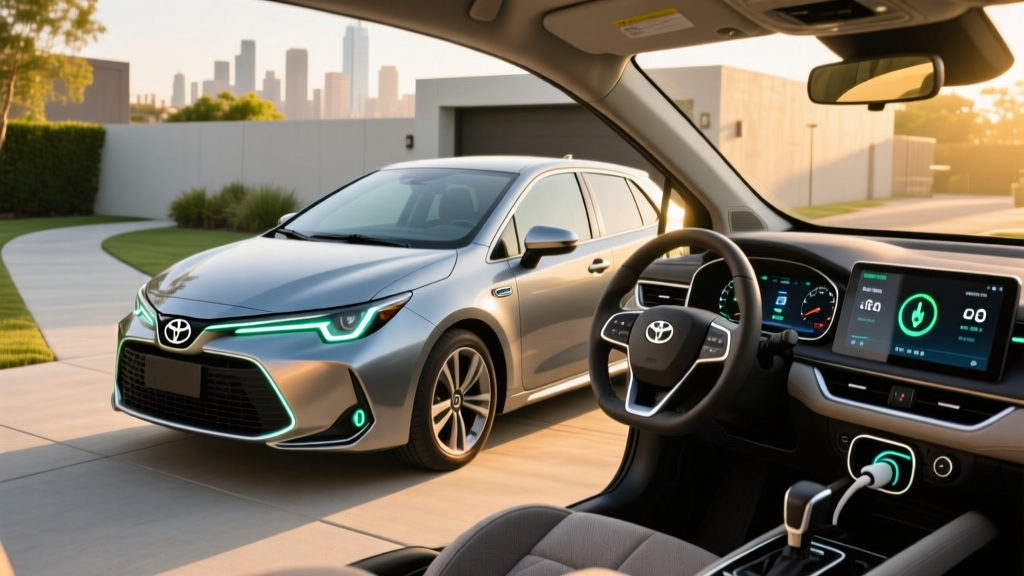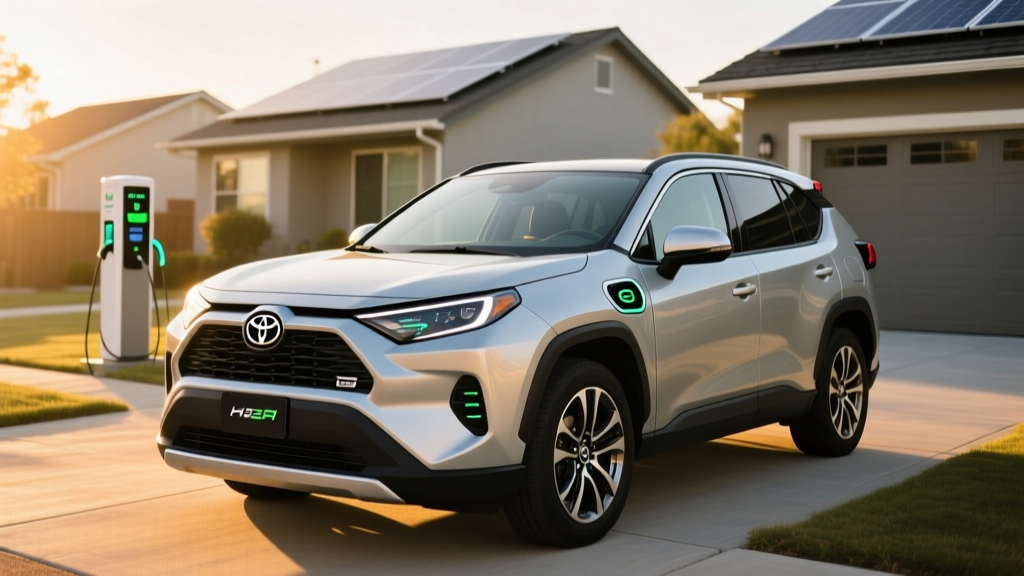
The Toyota RAV4 Hybrid has held the top spot among compact hybrid SUVs for good reason: it pairs a proven hybrid automatic powertrain with standard all-wheel drive, competitive cargo space, and fuel economy that routinely beats its EPA sticker in real-world city driving. For 2026, Toyota has refreshed the RAV4 Hybrid lineup with updated infotainment, revised trim pricing, and the continuation of its 2.5-liter four-cylinder hybrid system that produces a combined 219 horsepower.
If you're researching whether a hybrid automatic SUV fits your commute, budget, and lifestyle — or whether you should step up to the RAV4 Prime plug-in hybrid or go full EV — this guide breaks down every number that matters.
2026 RAV4 Hybrid Automatic: Quick Spec Overview
| Spec | Value |
|---|---|
| Powertrain | 2.5L 4-cyl + 3 electric motors (AWD) |
| Combined Horsepower | 219 hp |
| Transmission | eCVT (hybrid automatic) |
| EPA MPG (City / Hwy / Combined) | 41 / 38 / 40 MPG |
| Fuel Tank | 14.5 gallons |
| Total Range | ~580 miles |
| 0-60 mph | 7.4 seconds |
| Cargo Volume | 37.5 cu ft (rear seats up) |
| Towing Capacity | 1,750 lbs |
| Hybrid Battery | 1.6 kWh NiMH (sealed, self-charging) |
| Base MSRP (LE AWD) | $33,575 |
| Hybrid Battery Warranty | 10 years / 150,000 miles |
Sources: EPA Fuel Economy — Toyota RAV4 Hybrid AWD, Toyota RAV4 Hybrid Official Specs.
HEV vs. PHEV: Which RAV4 Hybrid Is Right for You?
Toyota offers the RAV4 in two electrified flavors, and the distinction matters enormously for your wallet and daily routine. The conventional RAV4 Hybrid (HEV) never plugs in — it generates electricity through regenerative braking and its gasoline engine. The RAV4 Prime (PHEV) has a much larger battery, an electric-only driving mode, and requires plugging in to unlock its full efficiency advantage.
| Attribute | RAV4 Hybrid (HEV) | RAV4 Prime (PHEV) |
|---|---|---|
| Plug-in Required? | No — self-charging | Yes — plug in for EV mode |
| Electric-Only Range | N/A (motor assists engine) | 42 miles (EPA) |
| Combined Horsepower | 219 hp | 302 hp |
| Battery Capacity | 1.6 kWh (NiMH) | 18.1 kWh (Li-ion) |
| Level 2 Charge Time | N/A | ~2.5 hours (6.6 kW onboard) |
| DC Fast Charge | N/A | Not supported |
| EPA Combined MPG / MPGe | 40 MPG | 94 MPGe (EV) / 38 MPG (gas) |
| Total Range | ~580 miles | ~600 miles (EV + gas) |
| Base MSRP | $33,575 | $44,975 |
| Federal Tax Credit (§30D) | Not eligible | Up to $7,500 (subject to eligibility) |
The HEV is the right pick if you lack access to a charging outlet at home or work. You simply fill up with gas and drive — the hybrid system handles the rest. The PHEV makes sense if you can charge nightly at home and your daily commute falls under 42 miles round-trip, effectively making it an EV for weekday driving with a gas engine for weekend road trips.
Real-World MPG: What RAV4 Hybrid Owners Actually Report
| Driving Scenario | EPA Estimate | Real-World Expectation |
|---|---|---|
| City | 41 MPG | 42-46 MPG (regen braking excels in stop-and-go) |
| Highway (70 mph) | 38 MPG | 35-38 MPG (aero drag reduces hybrid advantage) |
| Combined | 40 MPG | 38-43 MPG (varies by route mix) |
| Cold Weather (below 30°F) | — | 34-37 MPG (engine runs more for cabin heat) |
Toyota's hybrid automatic system — officially an electronically controlled continuously variable transmission (eCVT) — is fundamentally different from a belt-driven CVT found in some competitors. It uses a planetary gearset to blend power from the gasoline engine and electric motors with zero shifting, delivering seamless acceleration and exceptional low-speed efficiency.
The RAV4 Hybrid actually exceeds its EPA city rating in real-world stop-and-go driving because regenerative braking recovers energy that a conventional car wastes as heat. On the highway, where regenerative braking has less opportunity to work and aerodynamic drag dominates, expect numbers closer to — or slightly below — the 38 MPG sticker.
In cold climates, hybrid fuel economy drops 10-15%. The engine must run more frequently to provide cabin heat (the RAV4 Hybrid lacks a heat pump, which is reserved for the all-electric bZ4X) and to keep the catalytic converter at operating temperature. If you live in the upper Midwest or Northeast, budget for 34-37 MPG in January and February.
Powertrain Deep Dive: How the Hybrid Automatic System Works
The 2026 RAV4 Hybrid uses Toyota's fourth-generation hybrid synergy drive. Here's what's under the hood:
- Engine: 2.5-liter Dynamic Force 4-cylinder, 176 hp / 163 lb-ft on its own
- Front Electric Motor: 118 hp / 149 lb-ft (MG2 — primary drive motor)
- Rear Electric Motor: 54 hp / 89 lb-ft (independent rear axle for AWD)
- Combined System Output: 219 hp (engine + motors don't simply add — peak outputs occur at different RPMs)
- Transmission: eCVT with planetary gearset — no belts, no fixed gears, no shift shock
- Drivetrain: Electronic on-demand AWD (rear motor engages automatically under acceleration or slip)
The rear electric motor is the key to the RAV4 Hybrid's standard AWD. Unlike mechanical AWD systems that use a driveshaft and add weight and friction, the RAV4 Hybrid's rear axle is entirely electric — it activates in milliseconds when the front wheels lose traction and shuts off during steady cruising to maximize efficiency.
The 0-60 mph time of 7.4 seconds puts the RAV4 Hybrid ahead of the Honda CR-V Hybrid (8.0 sec) and on par with the Hyundai Tucson Hybrid (7.3 sec). Electric motor torque fills in the low-RPM gap that makes small-displacement engines feel sluggish off the line.
Pricing, Trims, and Tax Credit Eligibility
The 2026 RAV4 Hybrid is available in five trims, all with standard AWD and the hybrid automatic eCVT:
| Trim | MSRP (incl. destination) | Key Features |
|---|---|---|
| LE | $33,575 | Toyota Safety Sense 3.0, 8" touchscreen, wireless CarPlay/Android Auto |
| XLE | $35,075 | Blind-spot monitor, dual-zone climate, smart key, 18" alloy wheels |
| XLE Premium | $37,325 | SofTex seats, sunroof, power liftgate |
| SE | $38,075 | Sport-tuned suspension, 19" wheels, paddle shifters |
| XSE | $39,575 | 12.3" digital cluster, JBL audio (9 speakers), heated front seats |
Does the RAV4 Hybrid Qualify for a Federal Tax Credit?
No. The conventional RAV4 Hybrid (HEV) does not qualify for the IRS §30D Clean Vehicle Credit. Federal tax credits under §30D apply only to plug-in electric vehicles (BEVs and PHEVs) with sufficient battery capacity. Since the RAV4 Hybrid cannot plug in and has a battery under 4 kWh, it is ineligible.
The RAV4 Prime (PHEV) may qualify for up to $7,500 in federal tax credits, but eligibility depends on several factors that change regularly:
- Buyer income cap: Modified AGI must not exceed $150,000 (single), $225,000 (head of household), or $300,000 (joint filing)
- MSRP cap: SUVs/vans must have an MSRP at or below $80,000 (RAV4 Prime clears this easily)
- Battery sourcing: Critical minerals and battery components must meet phased-in domestic-sourcing thresholds — verify current-year compliance on the IRS qualified vehicles list
- Point-of-sale transfer: As of 2024+, buyers can transfer the credit to the dealer for an immediate price reduction at purchase, subject to dealer registration
Always confirm eligibility with a tax professional and check the latest IRS qualified vehicle list before purchasing. State incentives may also apply — consult your state energy office or the AFDC incentive database for local programs.
Battery Warranty, Reliability, and Replacement Cost
2026 RAV4 Hybrid Battery Warranty: 10 years or 150,000 miles (whichever comes first), covering capacity loss below a defined threshold. This applies to all 50 states. The hybrid battery is a sealed NiMH pack that requires zero maintenance.
Toyota's hybrid battery longevity is among the best-documented in the industry. Data from fleet operators and long-term owners shows that the RAV4 Hybrid's 1.6 kWh NiMH battery routinely lasts 150,000-200,000+ miles before significant degradation. The battery management system keeps the state of charge in a narrow 40-80% window during normal operation, which dramatically extends cycle life compared to batteries that are regularly charged to 100% or drained to zero.
If replacement is needed out of warranty, expect to pay $2,500-$4,000 for a new OEM hybrid battery pack installed at a Toyota dealer. Refurbished packs are available from third-party suppliers for $1,500-$2,500. This is a fraction of the cost of a full EV battery replacement ($8,000-$20,000+), which is one reason risk-averse buyers gravitate toward conventional hybrids.
Toyota's hybrid system reliability is well-established. The eCVT has no clutch packs, torque converters, or belts to wear out — the planetary gearset is essentially bulletproof under normal use. Consumer Reports and J.D. Power consistently rank the RAV4 Hybrid among the most reliable vehicles in the compact SUV segment.
RAV4 Hybrid vs. RAV4 Prime vs. Full EV: Decision Framework
Choose the RAV4 Hybrid (HEV) if:
- You don't have reliable access to a home charger (apartment, street parking, no garage outlet)
- You want maximum simplicity — no charging cables, no plug-in routine, no range planning
- Your budget is under $40,000 and you need AWD
- You drive 12,000-18,000 miles/year with a mix of city and highway
Choose the RAV4 Prime (PHEV) if:
- You can install a Level 2 charger at home or have workplace charging
- Your daily round-trip commute is under 42 miles (you'll rarely burn gas on weekdays)
- You want the performance bump (302 hp, 5.7-sec 0-60) and still need road-trip flexibility
- You qualify for the §30D tax credit, which can offset the $11,400 price premium over the HEV
Choose a full EV (e.g., Tesla Model Y, Hyundai Ioniq 5) if:
- You have home Level 2 charging and your daily driving is under 250 miles
- You want to eliminate gasoline entirely and minimize maintenance (no oil changes, no engine)
- You're ready to plan longer road trips around DC fast-charging stops
- Local electricity rates make per-mile fuel costs significantly lower than gas
Pros and Cons of the 2026 RAV4 Hybrid
Pros
- 41 MPG city EPA; often exceeds 43 MPG in real-world stop-and-go driving
- Standard AWD at no price premium — rare in the segment
- No plug-in required; zero behavior change from a gas car
- 10-year / 150,000-mile hybrid battery warranty
- Toyota Safety Sense 3.0 standard on every trim (adaptive cruise, lane-keeping, auto emergency braking)
- Strong resale value — RAV4 Hybrid retains ~58% of value at 5 years (Kelley Blue Book)
Cons
- No federal tax credit for the HEV version
- Engine drone under hard acceleration (eCVT holds RPMs steady)
- 1,750-lb towing capacity is below the Hyundai Tucson Hybrid (2,000 lbs)
- Highway MPG drops to 35-36 in cold weather and at sustained 75+ mph speeds
- Base LE interior uses hard plastics; must go XLE or above for premium feel
- No DC fast charging (not applicable to HEV, but worth noting for PHEV comparison)
Frequently Asked Questions
How many MPG does the 2026 RAV4 Hybrid actually get?
The EPA rates the RAV4 Hybrid AWD at 41 city / 38 highway / 40 combined. In real-world driving, city commuters frequently report 42-46 MPG thanks to aggressive regenerative braking. Highway-only drivers should expect 35-38 MPG, especially at speeds above 70 mph or in cold weather.
Does the RAV4 Hybrid need to be plugged in?
No. The RAV4 Hybrid is a conventional hybrid (HEV). It charges its own 1.6 kWh battery through regenerative braking and the gasoline engine. You never plug it in. If you want plug-in capability with 42 miles of electric-only range, look at the RAV4 Prime (PHEV).
Is the RAV4 Hybrid reliable, and what does battery replacement cost?
Toyota's hybrid system has over 25 years of proven reliability across millions of vehicles. The hybrid battery is covered for 10 years / 150,000 miles. Out-of-warranty replacement runs $2,500-$4,000 for an OEM pack, or $1,500-$2,500 for a refurbished unit. Most owners never need a replacement during the vehicle's life.
Does the RAV4 Hybrid qualify for any tax credit?
The conventional RAV4 Hybrid (HEV) does not qualify for the federal §30D Clean Vehicle Credit — only plug-in vehicles are eligible. The RAV4 Prime PHEV may qualify for up to $7,500 depending on your income, the vehicle's battery sourcing compliance, and current IRS rules. Some states offer additional hybrid or PHEV rebates — check the AFDC database for your area.
How does the hybrid automatic transmission differ from a regular automatic?
The RAV4 Hybrid uses an eCVT (electronically controlled continuously variable transmission) based on a planetary gearset rather than fixed gears or a torque converter. It blends engine and electric motor power seamlessly with no shift points. The result is smooth, linear acceleration and higher efficiency than a conventional geared automatic, though it can produce a steady-RPM drone under hard throttle.
Should I buy the RAV4 Hybrid or the RAV4 Prime PHEV?
If you can charge at home and your daily commute is under 42 miles, the RAV4 Prime lets you drive on electricity most weekdays while keeping the gas engine for road trips — and it may qualify for up to $7,500 in federal tax credits. If you lack charging access, prefer a lower purchase price, or don't want to think about plugging in, the conventional Hybrid is the simpler and still very efficient choice.
Editor's note: Pricing and tax credit rules reflect 2026 model-year data available at publication. IRS §30D eligibility criteria — including critical-mineral sourcing thresholds and income caps — are subject to legislative change. Always verify current rules at irs.gov and confirm MSRP with your dealer before purchasing.