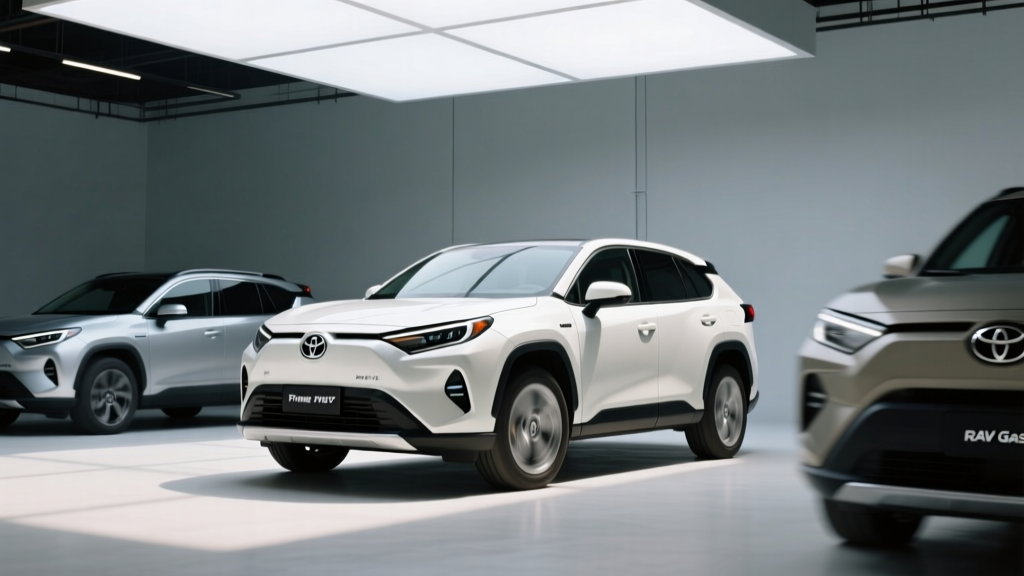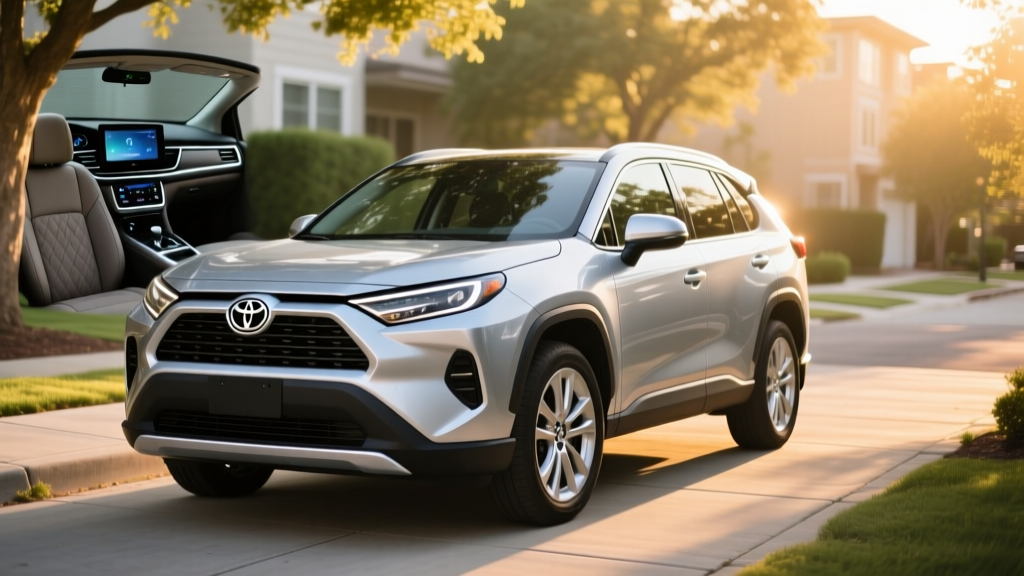
The compact crossover segment is crowded, but few nameplates carry the weight of the Toyota RAV4. For the 2024 model year, the RAV4 Hybrid continues to dominate as one of the best-selling electrified vehicles in the United States—not because it's flashy, but because it delivers measurable efficiency without requiring a lifestyle change. No plug, no range anxiety, no charging apps. Just a 2.5-liter four-cylinder paired with three electric motors, an electronically controlled CVT, and standard all-wheel drive.
If you're researching the 2024 Toyota RAV4 Hybrid, you're likely weighing it against the RAV4 Prime (the plug-in variant), a full battery-electric vehicle like the Tesla Model Y or Hyundai Ioniq 5, or a conventional gas-only crossover. This guide breaks down every number that matters—EPA MPG, real-world fuel economy, powertrain specs, pricing, battery longevity, and tax-credit eligibility—so you can make a spec-driven decision.
HEV vs PHEV: Understanding the Two RAV4 Electrified Options
Toyota offers the RAV4 in two electrified flavors, and confusing them is one of the most common buyer mistakes. Here's the fundamental distinction:
RAV4 Hybrid (HEV): A self-charging conventional hybrid. You never plug it in. A small 1.6 kWh nickel-metal hydride (NiMH) battery captures energy from regenerative braking and the gas engine. The electric motors assist during acceleration and enable brief low-speed electric-only driving (typically under 1 mile). You fuel it exclusively at the gas pump.
RAV4 Prime (PHEV): A plug-in hybrid with an 18.1 kWh lithium-ion battery. You plug it in to access up to 42 miles of EPA-rated electric-only range. Once the battery depletes, it operates as a conventional hybrid with 38 MPG combined. It qualifies for a federal tax credit (details below).
This article focuses on the conventional RAV4 Hybrid (HEV). If you need plug-in electric range and have access to home or workplace charging, the RAV4 Prime is the stronger electrified play—but it starts roughly $11,000 higher and has limited availability.
Fuel Economy: EPA Ratings and Real-World MPG
The 2024 RAV4 Hybrid carries identical EPA ratings across all trims because the powertrain is unchanged. According to fueleconomy.gov:
| Metric | EPA Rating |
|---|---|
| City | 41 MPG |
| Highway | 38 MPG |
| Combined | 39 MPG |
| Fuel Tank | 14.5 gallons |
| Total Range | ~565 miles |
Real-World MPG: What Owners Actually See
The RAV4 Hybrid is one of those rare vehicles where real-world results frequently match or exceed the EPA sticker—particularly in city driving, where regenerative braking recovers energy at every stoplight. Owner-reported data on Fuelly and similar platforms clusters between 37–43 MPG combined depending on driving style and climate.
Expect the lower end (35–37 MPG) on sustained highway trips above 75 mph, in sub-freezing winter conditions, or with heavy cargo loads. City-heavy commutes in mild weather regularly yield 42–44 MPG. The hybrid system's efficiency advantage is most pronounced in stop-and-go traffic, where the gas engine shuts off entirely at low speeds and during coasting.
Powertrain Specs: 219 HP with Standard AWD
Every 2024 RAV4 Hybrid uses Toyota's fourth-generation hybrid system. Here's the complete spec breakdown:
| Specification | Value |
|---|---|
| Engine | 2.5L 4-cylinder Atkinson-cycle |
| Engine Output | 176 HP / 163 lb-ft torque |
| Front Electric Motor | 88 kW (118 HP) |
| Rear Electric Motor (AWD) | 40 kW (54 HP) |
| Net Combined Horsepower | 219 HP |
| Transmission | eCVT (electronically controlled) |
| Drivetrain | Electronic On-Demand AWD (standard) |
| 0–60 mph | ~7.4 seconds |
| Hybrid Battery | 1.6 kWh NiMH (sealed) |
| Towing Capacity | 1,750 lbs |
| Cargo Volume (behind rear seats) | 37.6 cu ft |
The rear motor is key: it provides electronic all-wheel drive without a mechanical driveshaft, engaging only when the system detects slip or during hard acceleration. This keeps weight down and efficiency high. The 219 combined horsepower puts the RAV4 Hybrid ahead of most non-turbo compact crossovers and makes highway merging effortless.
Pricing by Trim and Tax-Credit Eligibility
The 2024 RAV4 Hybrid is offered in six trims. All include standard AWD and Toyota Safety Sense 2.5+. MSRPs below include the $1,350 destination charge:
| Trim | MSRP (incl. destination) |
|---|---|
| LE | $33,075 |
| XLE | $34,585 |
| XLE Premium | $37,485 |
| SE | $36,960 |
| Woodland Edition | $37,635 |
| Limited | $41,160 |
Federal Tax Credit: Does the RAV4 Hybrid Qualify?
No. The conventional RAV4 Hybrid (HEV) does not qualify for the federal §30D Clean Vehicle Credit. That credit applies only to plug-in electric vehicles (BEVs and PHEVs) with battery capacities of at least 7 kWh and meeting critical-mineral and battery-component sourcing requirements per IRS guidelines.
However, some states and utilities offer rebates or HOV-lane access for conventional hybrids. Check your state energy office and local utility for current programs. If a federal tax credit is a dealbreaker, the RAV4 Prime (PHEV) may qualify for up to $7,500 depending on your income, the vehicle's MSRP cap compliance, and battery-sourcing requirements—consult a tax professional for your specific situation.
Battery Longevity, Warranty, and Replacement Cost
Toyota Hybrid Battery Warranty: 10 years / 150,000 miles (whichever comes first), transferable to subsequent owners. This covers the hybrid battery pack against defects and capacity loss below a defined threshold.
Hybrid System Components Warranty: 8 years / 100,000 miles for the inverter, converter, and electric motors.
How Long Do RAV4 Hybrid Batteries Actually Last?
Toyota's hybrid battery packs are among the most proven in the industry. The NiMH chemistry in the RAV4 Hybrid is less energy-dense than the lithium-ion packs in full EVs, but it's exceptionally durable under shallow charge/discharge cycling—the hybrid system never fully depletes or fully charges the pack, keeping it in a longevity-friendly state of charge window.
Real-world data from high-mileage Prius and RAV4 Hybrid fleets shows many original battery packs lasting 150,000–200,000+ miles before significant degradation. Failure before 100,000 miles is uncommon. If replacement is needed out of warranty, expect to pay between $2,500 and $4,000 for a new OEM pack, with refurbished options available for $1,500–$2,500. Individual module replacement (a fraction of the pack) is sometimes possible for $300–$600 at specialized hybrid repair shops.
The 10-year/150,000-mile warranty provides strong coverage. For context, this exceeds the powertrain warranty on most gas-only competitors and aligns with or surpasses hybrid warranties from Honda and Hyundai.
RAV4 Hybrid vs RAV4 Prime vs Full EV: Which Fits You?
Choosing between a conventional hybrid, a plug-in hybrid, and a battery-electric vehicle depends on your daily driving, charging access, and budget. Here's a practical decision framework:
Choose the RAV4 Hybrid (HEV) if:
- You lack access to home or workplace charging (apartment, street parking)
- Your budget is under $35,000
- You want maximum simplicity—no plug, no new electrical circuits, no charging apps
- You drive 12,000–15,000 miles/year and want to cut fuel costs 30–40% vs a gas-only crossover
- You frequently take long road trips and don't want to plan around charging stops
Choose the RAV4 Prime (PHEV) if:
- You can install a Level 2 charger at home (240V, ~$500–$1,500 install cost)
- Your daily commute is under 42 miles round-trip (you'll drive mostly on electricity)
- You want the $7,500 federal tax credit (subject to income and sourcing eligibility)
- You still want gas-engine flexibility for weekend road trips
Choose a Full EV (Model Y, Ioniq 5, etc.) if:
- You have reliable home Level 2 charging
- You want the lowest per-mile fuel cost (~$0.04–$0.06/mi on home electricity vs ~$0.14/mi for the RAV4 Hybrid at 39 MPG and $3.50/gal)
- You want zero tailpipe emissions and minimal maintenance (no oil changes, no transmission fluid)
- Your typical trips fall within 250–300 miles, or you're comfortable with DC fast-charging stops on road trips
Pros and Cons at a Glance
Pros
- 39 MPG combined EPA; real-world often 40+ in city driving
- Standard AWD across all trims at no extra cost
- 219 HP provides confident highway merging
- No plug-in charging required—zero infrastructure investment
- 10-year/150,000-mile hybrid battery warranty
- Strong resale value; RAV4 Hybrid holds value better than most competitors
- Toyota Safety Sense 2.5+ standard (adaptive cruise, lane tracing, auto emergency braking)
- 37.6 cu ft cargo volume competitive with gas-only rivals
Cons
- No federal tax credit eligibility
- eCVT drone under hard acceleration (no simulated gear shifts)
- 1,750-lb towing capacity trails turbocharged gas rivals (some tow 3,500 lbs)
- Infotainment system functional but not class-leading in responsiveness
- No spare tire (tire-inflation kit standard; full-size spare not available)
- Limited EV-only driving—electric assist only at very low speeds for short distances
- Dealer markups common on popular trims (XLE, Woodland) due to high demand
Frequently Asked Questions
How many MPG does the 2024 Toyota RAV4 Hybrid get?
The EPA rates it at 41 city / 38 highway / 39 combined MPG. In real-world driving, owners commonly report 37–43 MPG combined depending on conditions. City-heavy driving tends to yield higher numbers due to regenerative braking; sustained highway speeds above 75 MPH and cold weather reduce efficiency to the mid-30s.
Does the RAV4 Hybrid need to be plugged in?
No. The RAV4 Hybrid is a conventional hybrid (HEV). Its small battery charges exclusively through regenerative braking and the gasoline engine. You fuel it at the gas station like any other car. If you want plug-in capability, you need the RAV4 Prime (PHEV).
How far can the RAV4 Hybrid drive on electric power alone?
Less than 1 mile, and only at very low speeds (typically under 25 mph). The HEV system uses electric motors to assist the gas engine, not to replace it. For meaningful electric-only range, the RAV4 Prime PHEV offers 42 EPA-rated electric miles.
Is the RAV4 Hybrid reliable, and what does a battery replacement cost?
The RAV4 Hybrid carries Toyota's reputation for long-term reliability, backed by a 10-year/150,000-mile hybrid battery warranty. Hybrid battery packs routinely last 150,000–200,000+ miles. Out-of-warranty replacement runs $2,500–$4,000 for a new OEM pack, with refurbished options from $1,500. Toyota's warranty portal provides full coverage details.
Does the 2024 RAV4 Hybrid qualify for any tax credits?
It does not qualify for the federal §30D Clean Vehicle Credit, which is reserved for plug-in vehicles (BEVs and PHEVs). Some states, municipalities, and utilities offer hybrid-specific rebates or incentives—check your local programs. The RAV4 Prime PHEV may qualify for up to $7,500 federally, subject to income caps, MSRP limits, and battery-sourcing rules.
How does the RAV4 Hybrid compare to the gas-only RAV4?
The gas-only 2024 RAV4 (2.5L, 203 HP) gets 30 MPG combined EPA. The Hybrid costs roughly $1,500–$2,000 more upfront but saves approximately $500–$700 per year in fuel at 15,000 miles driven and $3.50/gallon gas. The payback period is typically 2.5–4 years, after which the Hybrid is strictly cheaper to operate. The Hybrid also delivers more horsepower (219 vs 203) and standard AWD.
Is the RAV4 Hybrid a good choice for cold climates?
Yes, with a caveat. Standard electronic AWD provides confident traction in snow and ice. However, expect fuel economy to drop 3–6 MPG in sustained sub-freezing temperatures because the gas engine runs more frequently to provide cabin heat and maintain battery temperature. This is common to all hybrids. A block heater is not required but available as an accessory.
The Verdict: A Spec-Driven Summary
The 2024 Toyota RAV4 Hybrid earns its sales volume through numbers, not marketing. At 39 MPG combined with standard AWD, 219 HP, a starting price near $33,000, and a decade-long battery warranty, it occupies a narrow lane: genuine fuel savings with zero behavioral change. You don't plug in, you don't plan charging stops, and you don't sacrifice cargo space or ground clearance.
Its limitations are real—no tax credit, modest towing, eCVT character that won't excite enthusiast drivers—but for the commuter, the family hauler, and the high-mileage driver who wants to reduce fuel spend without adopting EV infrastructure, the RAV4 Hybrid remains the default recommendation in the compact crossover segment. If your budget allows and you have home charging access, the RAV4 Prime or a full BEV will save more per mile. But if you need one vehicle to do everything, everywhere, with minimal fuss, the data supports the RAV4 Hybrid as one of the most rational purchases on the market.