The Toyota RAV4 Prime has been one of America's best-selling plug-in hybrids since its 2021 debut, and the 2026 model year brings incremental updates to what is already a benchmark PHEV. If you're researching the Toyota RAV4 2026 PHEV, you likely want hard numbers — not marketing gloss. Below, we break down the real-world electric range, actual fuel economy, charging behavior, powertrain output, and whether the federal tax credit still applies under current IRS §30D rules.
2026 RAV4 Prime: PHEV vs. Conventional Hybrid Explained
Toyota sells two electrified RAV4 variants, and confusing them is the most common buyer mistake:
RAV4 Hybrid (HEV)
- No plug required — the battery recharges via regenerative braking and the engine
- 1.6 kWh battery (small, not grid-chargeable)
- 39 MPG combined (EPA)
- No electric-only driving beyond very low-speed creep
- Starts ~$33,000 MSRP
- No federal tax credit
RAV4 Prime (PHEV)
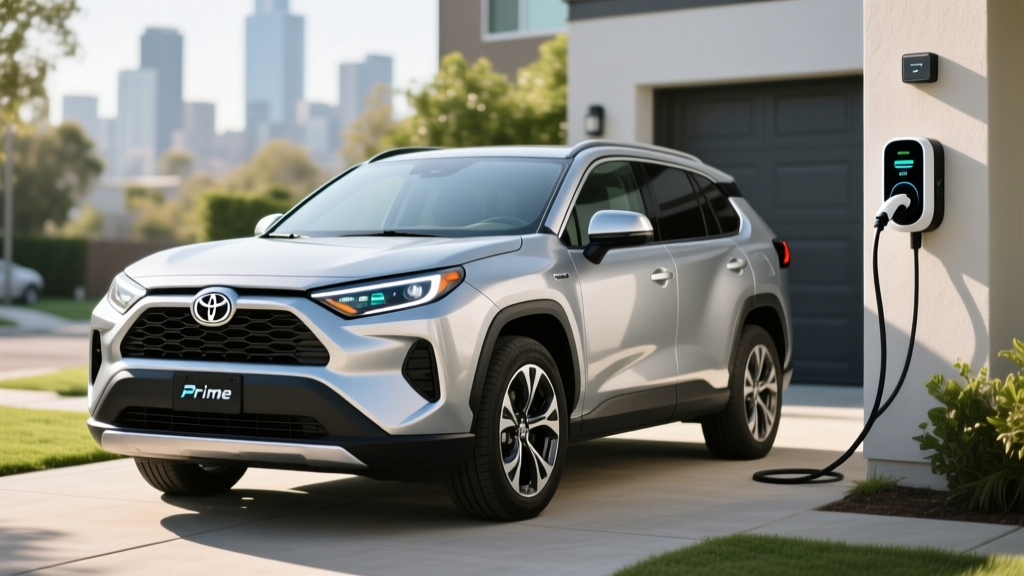
- Plugs in — 18.1 kWh battery charges via Level 1 or Level 2
- 42 miles EPA electric-only range
- 94 MPGe (electric+gas blended); 38 MPG gas-only
- 302 combined hp — quickest RAV4 in the lineup
- Starts ~$45,000 MSRP
- Tax credit eligibility is restricted (see below)
Both are excellent, but they serve different needs. The HEV is for buyers who want zero behavior change and strong MPG. The PHEV is for buyers who can charge at home and want to drive most weekdays without burning gas.
Fuel Economy and Electric-Only Range
| Metric | EPA Rating | Real-World Expectation |
|---|---|---|
| MPGe (blended electric+gas) | 94 MPGe | 90–100 MPGe (varies with charge frequency) |
| MPG (gas-only, battery depleted) | 38 combined (40 city / 36 hwy) | 36–40 combined (city often exceeds EPA) |
| Electric-only range | 42 miles | 35–40 mi highway; 40–44 mi city/mild weather |
| Total range (full tank + full charge) | ~600 miles | 550–620 mi depending on driving mix |
| Electric-only top speed | 84 mph | Sustained highway EV mode is viable |
A critical ownership insight: the RAV4 Prime's gas engine is a 2.5-liter four-cylinder running the Atkinson cycle. In city driving with a depleted battery, you'll often exceed the 40 MPG city EPA rating because regenerative braking recaptures energy at low speeds — the same principle that makes all Toyota hybrids city-thrifty.
Powertrain, Battery, and Charging Specs
| Specification | 2026 RAV4 Prime |
|---|---|
| Combined horsepower | 302 hp |
| Engine | 2.5L 4-cyl Atkinson (177 hp) + front & rear electric motors |
| Front motor output | 134 kW (180 hp) |
| Rear motor output | 40 kW (54 hp) — electronic AWD |
| Battery capacity (gross / usable) | 18.1 kWh / ~14.9 kWh usable |
| Battery chemistry | Lithium-ion (NMC) |
| Level 1 charging (120V, 1.4 kW) | ~12 hours (0–100%) |
| Level 2 charging (240V, 3.3 kW) | ~5.5 hours (0–100%) |
| Level 2 charging (240V, 6.6 kW — XSE w/ Premium pkg) | ~2.5 hours (0–100%) |
| DC fast charging | Not available |
| 0–60 mph | 5.7 seconds |
| Drivetrain | AWD (electronic rear motor) |
| Towing capacity | 1,500 lbs |
Charging Reality Check
The RAV4 Prime does not support DC fast charging — a limitation that surprises some buyers. This is common for PHEVs with smaller batteries; Toyota designed the Prime for overnight home charging, not highway pit stops. Here's what matters:
- Standard 3.3 kW onboard charger (SE trim): Adds about 14 miles of EV range per hour on Level 2. A full charge takes roughly 5.5 hours.
- Optional 6.6 kW onboard charger (XSE with Premium Package): Cuts charge time to ~2.5 hours. This is the option we recommend if you can spec it — it makes midday top-ups practical.
- Level 1 (standard wall outlet): Technically works, but at 1.4 kW, a full charge takes overnight and then some. Fine if your daily EV use is under 20 miles and you plug in every night.
The 18.1 kWh battery uses NMC (nickel-manganese-cobalt) chemistry, which offers higher energy density than LFP but is more sensitive to sustained 100% state-of-charge. Toyota's battery management system includes a top and bottom buffer, so the usable capacity is closer to 14.9 kWh — this protects long-term health.
Pricing, Trims, and Tax Credit Eligibility
The 2026 RAV4 Prime is offered in two trims:
| Trim | MSRP (est.) | Onboard Charger | Key Features |
|---|---|---|---|
| SE | ~$45,000 | 3.3 kW | SofTex seats, 8" touchscreen, heated front seats, power liftgate |
| XSE | ~$49,000 | 3.3 kW (6.6 kW w/ Premium pkg ~$5,500) | Sport-tuned suspension, panoramic roof available, JBL audio available |
Federal Tax Credit (§30D) — Current 2026 Rules
The RAV4 Prime's federal tax credit status is restricted under current IRS rules. Here's the breakdown:
- Maximum credit: Up to $7,500 if all requirements are met
- Battery sourcing requirement: A percentage of critical minerals and battery components must be sourced from the US or free-trade-agreement countries. Toyota has historically sourced batteries from Panasonic plants in Japan, which may not meet the 2026 critical-minerals threshold for full credit eligibility.
- MSRP cap: SUVs must be under $80,000 — the RAV4 Prime clears this easily.
- Income cap: Buyer AGI must not exceed $150,000 (single) / $300,000 (joint).
- Point-of-sale transfer: If eligible, the credit can be applied as a down-payment reduction at the dealer.
Bottom line: Check the latest IRS clean vehicle credit page and fueleconomy.gov's credit lookup tool for the specific VIN before purchasing. Credit eligibility for Japanese-assembled PHEVs has been volatile under the sourcing rules.
Battery Warranty, Reliability, and Replacement Cost
Toyota Hybrid Battery Warranty
- Hybrid battery warranty: 10 years / 150,000 miles (whichever comes first)
- Capacity retention guarantee: Toyota warrants that the hybrid battery will retain sufficient capacity for normal PHEV operation during the warranty period
- Hybrid system components: 8 years / 100,000 miles (inverter, control module, motors)
- Standard vehicle warranty: 3 years / 36,000 miles bumper-to-bumper; 5 years / 60,000 miles powertrain
Toyota's hybrid reliability record is arguably the strongest in the industry. The company has produced over 25 million hybrid vehicles globally since 1997, and the RAV4 Prime uses a well-proven transaxle and motor design shared across Toyota's PHEV lineup.
Battery Degradation Reality
PHEV batteries face more charge cycles than HEV batteries because they're regularly drained and recharged. However, Toyota's conservative buffer strategy (hiding roughly 3.2 kWh at the top and bottom of the pack) significantly reduces calendar degradation. Based on owner data from 2021–2025 model-year Primes:
- Typical 5-year degradation: 8–12% capacity loss
- Expected 10-year degradation: 15–20% (meaning ~34 miles of EV range instead of 42)
- Out-of-warranty replacement cost: $4,000–$6,500 for the battery pack, plus labor (~$500–$800)
For context, most owners will have replaced the vehicle before needing a battery swap. The 10-year/150,000-mile warranty covers the vast majority of ownership timelines. Toyota's hybrid batteries are also remanufactured and available through Toyota's parts network, which keeps replacement costs lower than full BEV battery packs.
Real-World Ownership: What It's Actually Like
Numbers tell only part of the story. Here's what daily ownership of the 2026 RAV4 Prime looks like in practice:
The Ideal Weekday
You plug in at home overnight (a standard 120V outlet adds ~14 miles in 10 hours; a Level 2 home charger fully replenishes the battery). Your 30-mile round-trip commute is entirely electric. You burn zero gas Monday through Friday. Weekend errands use a mix of EV and hybrid mode. Total weekly gas consumption: maybe a gallon or two for a longer Saturday trip.
The Road Trip Scenario
On a 400-mile highway drive, the EV range is exhausted after ~35 miles (highway speeds reduce it). The remaining 365 miles run on the hybrid powertrain at approximately 36–37 MPG. That's roughly 10 gallons, or about $35 at current prices. No charging stops needed, no range anxiety. This is the PHEV's killer advantage over a full EV on road trips.
Cold-Weather Behavior
In sub-freezing temperatures, expect EV range to drop to 32–36 miles. The RAV4 Prime uses a heat pump for cabin heating in EV mode (a significant efficiency advantage over resistive heaters), but extreme cold still impacts battery chemistry and increases cabin energy demand. The gas engine may also activate to provide supplemental heat even when battery charge remains.
Pros
- 42-mile EV range covers most commutes
- 302 hp makes it genuinely quick (5.7s 0–60)
- Standard AWD via rear electric motor
- 38 MPG even with a dead battery
- No range anxiety on road trips
- Proven Toyota hybrid reliability
- 10-year/150k-mile battery warranty
- Can tow 1,500 lbs
Cons
- No DC fast charging
- 3.3 kW base charger is slow (6.6 kW costs extra)
- ~$12,000 premium over the RAV4 Hybrid
- Federal tax credit eligibility uncertain (sourcing rules)
- Dealer markups still common due to high demand
- Cargo space slightly reduced vs. non-Prime (battery under floor)
- Infotainment UI trails competitors
RAV4 Prime vs. Full EV vs. Gas: Which Fits You?
Choose the RAV4 Prime (PHEV) if:
- You can install a Level 2 charger at home or have reliable workplace charging
- Your daily driving is under 45 miles but you take road trips monthly
- You want to reduce gas consumption by 70–80% without committing to full electric
- You live in an area with sparse public DC fast-charging infrastructure
- You need AWD and cargo versatility year-round
Choose a full EV (e.g., Tesla Model Y, Hyundai Ioniq 5) if:
- Your daily driving is under 250 miles and you rarely exceed 300 miles between overnight stops
- You have home charging and want near-zero maintenance (no oil changes, no engine)
- You want to maximize fuel cost savings and your electricity rate is under $0.18/kWh
- You want access to the full $7,500 federal tax credit (more BEVs qualify than PHEVs)
Choose the RAV4 Hybrid (HEV) if:
- You cannot charge at home (apartment, street parking, no garage)
- You want strong MPG (39 combined) with zero behavior change
- Your budget is closer to $33,000–$38,000
- You drive more than 50 miles daily and wouldn't benefit from a 42-mile EV range
Frequently Asked Questions
How many MPG does the 2026 RAV4 Prime get?
When the battery is depleted and the vehicle operates as a conventional hybrid, the EPA rates it at 38 MPG combined (40 city / 36 highway). When regularly charged, the blended rating is 94 MPGe. Real-world city driving often exceeds the EPA city figure thanks to regenerative braking; highway driving at sustained 75+ mph typically yields 35–37 MPG.
How far can the RAV4 Prime go on electric only?
The EPA rates the 2026 RAV4 Prime at 42 miles of electric-only range. In real-world conditions, expect 35–40 miles at highway speeds and 40–44 miles in city driving with mild temperatures. Cold weather (below 30°F) reduces EV range to approximately 32–36 miles.
Can the RAV4 Prime DC fast charge?
No. The RAV4 Prime supports Level 1 (120V) and Level 2 (240V) AC charging only. There is no DC fast-charging port. The standard onboard charger is 3.3 kW; the available upgrade is 6.6 kW (XSE with Premium Package). This is typical for PHEVs — the smaller battery is designed for overnight home charging, not rapid highway top-ups.
Is the RAV4 Prime reliable?
Toyota's hybrid powertrains have an industry-leading reliability track record spanning over 25 years and 25+ million vehicles. The RAV4 Prime's e-CVT transaxle has no conventional transmission components to fail. The hybrid battery is warranted for 10 years / 150,000 miles. IIHS and NHTSA safety ratings for the RAV4 platform have historically been strong.
What does a RAV4 Prime battery replacement cost?
Out-of-warranty hybrid battery replacement runs approximately $4,000–$6,500 for the pack plus $500–$800 in labor. However, the 10-year/150,000-mile warranty covers the vast majority of ownership periods, and Toyota's conservative buffer management means severe degradation before 150,000 miles is uncommon.
Does the 2026 RAV4 Prime qualify for the federal tax credit?
Eligibility is uncertain and depends on current IRS §30D battery-sourcing and critical-minerals requirements. The RAV4 Prime is assembled in Japan, and its battery sourcing has historically not met the thresholds for the full $7,500 credit. Check the IRS clean vehicle credits page and the specific VIN on fueleconomy.gov before purchasing. Income caps ($150K single / $300K joint) and the $80K SUV MSRP cap also apply.
Should I get the 3.3 kW or 6.6 kW charger?
If you plan to charge exclusively overnight at home, the 3.3 kW charger is adequate — it fully replenishes the battery in about 5.5 hours. If you want to top up during the workday or at a shopping-center Level 2 station, the 6.6 kW option (available on the XSE with the Premium Package) cuts charge time to ~2.5 hours and makes midday EV-range recovery practical.