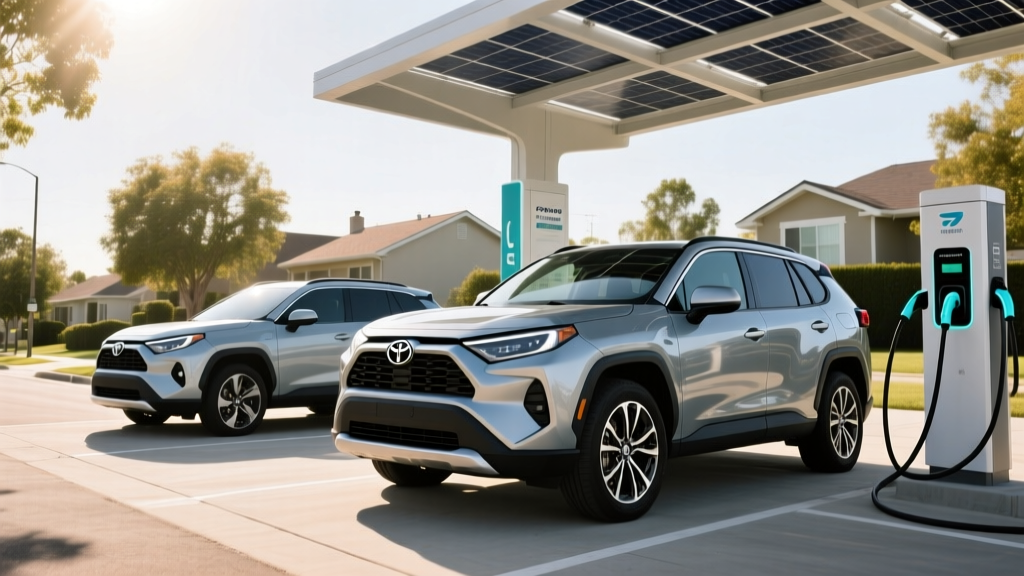
The Toyota RAV4 remains America's best-selling non-truck, and for 2024, the electrified variants — the conventional RAV4 Hybrid and the plug-in RAV4 Prime — account for a growing share of that volume. If you've been searching for a Toyota RAV4 2024 hybrid, you're looking at two very different powertrains sharing one body: a self-charging hybrid (HEV) that needs no plug, and a plug-in hybrid (PHEV) that delivers 42 miles of electric-only driving before the gas engine kicks in. This guide breaks down the real numbers — MPG, range, pricing, battery longevity, and tax-credit eligibility — so you can pick the right RAV4 for your driving pattern.
RAV4 Hybrid vs. RAV4 Prime: Understanding the Two Powertrains
Toyota sells the RAV4 in two electrified flavors for 2024, and confusing them is the single most common buyer mistake. Here's the essential distinction:
RAV4 Hybrid (HEV)
No plug required. The 1.6 kWh nickel-metal hydride (NiMH) traction battery charges itself through regenerative braking and the gasoline engine. You fuel it like any conventional car. Electric motors assist the 2.5-liter four-cylinder for a combined 219 horsepower, delivering strong city MPG with zero behavior change.
RAV4 Prime (PHEV)
Plug-in capable. An 18.1 kWh lithium-ion battery provides 42 miles of EPA-rated electric-only range. Plug into a standard 120V outlet (Level 1) or a 240V Level 2 charger to replenish. Once the battery depletes, it operates as a conventional hybrid with 38 combined MPG and a combined 302 horsepower.
EPA Fuel Economy: Real MPG Numbers for Both Models
Fuel economy is the headline reason buyers choose the RAV4 Hybrid lineup. Here's the EPA-rated data, sourced from fueleconomy.gov:
| Model | City MPG | Highway MPG | Combined MPG | Total Range |
|---|---|---|---|---|
| RAV4 Hybrid AWD (LE/XLE/XLE Premium/Woodland/Limited) | 41 | 38 | 39–40 | ~580 mi |
| RAV4 Hybrid FWD (LE only) | 41 | 38 | 40 | ~590 mi |
| RAV4 Prime (PHEV) — Charge-Depleted (hybrid mode) | 40 | 36 | 38 | ~560 mi gas + 42 mi electric |
| RAV4 Prime — Charge-Sustaining MPGe (electric + gas) | 94 MPGe combined (electric phase) | 42 mi EV range | ||
Real-world MPG reality check: Toyota hybrids consistently exceed their EPA city ratings in stop-and-go traffic because regenerative braking recaptures energy that gas cars waste as heat. Owners regularly report 42–45 MPG in urban driving. Highway efficiency, however, tends to fall 2–4 MPG below the EPA sticker at sustained 75+ mph speeds, especially with roof cargo boxes or in cold weather. Expect ~35–36 MPG on the highway at 80 mph in winter — still excellent for an AWD compact SUV.
RAV4 Prime PHEV: Electric-Only Range and Charging Specs
The RAV4 Prime's 42-mile electric range covers most daily commutes entirely on electricity. Here are the exact charging specifications:
| Specification | RAV4 Prime PHEV |
|---|---|
| Battery capacity (gross / usable) | 18.1 kWh / ~14.5 kWh usable |
| Battery chemistry | Lithium-ion (NMC) |
| EPA electric-only range | 42 miles |
| Level 1 charging (120V / 12A) | ~12 hours (0–100%) |
| Level 2 charging (240V / 16A, 3.3 kW onboard) | ~5.5 hours (0–100%) |
| Level 2 charging (240V / 32A, 6.6 kW onboard — Premium/XSE/XSE Premium) | ~2.5 hours (0–100%) |
| DC fast charging | Not available — no DC fast-charge port |
| Charging connector | J1772 (Level 1/2 AC only) |
| Combined system horsepower | 302 hp (2.5L engine + 3 electric motors) |
Critical charging note: The RAV4 Prime cannot DC fast charge. It uses a J1772 AC port only. This means public fast-charging networks (Tesla Supercharger, Electrify America, EVgo) are irrelevant for the Prime — your charging strategy is home Level 1 or Level 2, plus opportunistic Level 2 charging at workplaces or shopping centers. If your daily drive exceeds 42 miles round-trip and you lack home charging, the Prime's advantage over the standard Hybrid narrows considerably.
The onboard charger matters: base SE trim gets a 3.3 kW charger (5.5-hour fill), while XSE and above get the 6.6 kW charger (2.5-hour fill). If you're buying the Prime, the 6.6 kW upgrade is worth prioritizing — it's the difference between waking up fully charged every morning on a standard overnight cycle and needing 5+ hours.
Powertrain Performance: Horsepower and Drivetrain
Both RAV4 hybrids use Toyota's 2.5-liter Dynamic Force four-cylinder paired with electric motors, but the output difference is substantial:
- RAV4 Hybrid (HEV): 219 combined hp (176 hp engine + 118 hp front motor + 54 hp rear motor for AWD). 0–60 mph in approximately 7.4 seconds. Electronic on-demand AWD with a dedicated rear axle motor — no mechanical driveshaft.
- RAV4 Prime (PHEV): 302 combined hp (177 hp engine + 180 hp front motor + 54 hp rear motor). 0–60 mph in approximately 5.7 seconds — making it the quickest RAV4 and one of the quickest compact SUVs in its class. Standard electronic AWD.
The Prime's extra power comes from its larger, more powerful front electric motor and the ability to draw heavily from the 18.1 kWh battery. In EV mode, the Prime delivers smooth, silent acceleration up to 84 mph before the engine engages. In hybrid mode, the transition is nearly imperceptible — Toyota's Hybrid Synergy Drive system is among the most refined in the industry.
Pricing, Trims, and Tax Credit Eligibility
Here's where the math gets interesting — and where many buyers get tripped up on incentives:
| Model / Trim | 2024 MSRP (incl. destination) |
|---|---|
| RAV4 Hybrid LE (FWD) | $32,895 |
| RAV4 Hybrid LE (AWD) | $34,395 |
| RAV4 Hybrid XLE (AWD) | $35,895 |
| RAV4 Hybrid XLE Premium (AWD) | $37,295 |
| RAV4 Hybrid Woodland Edition (AWD) | $38,145 |
| RAV4 Hybrid Limited (AWD) | $41,495 |
| RAV4 Prime SE (AWD) | $44,490 |
| RAV4 Prime XSE (AWD) | $48,390 |
Federal Tax Credit: What You Actually Qualify For
The federal incentive landscape differs sharply between the two models under current IRS §30D rules:
- RAV4 Hybrid (HEV): Does NOT qualify for the §30D New Clean Vehicle Credit. Conventional hybrids are excluded — only BEVs, PHEVs, and FCEVs with sufficient battery capacity are eligible.
- RAV4 Prime (PHEV): Technically eligible for up to $7,500 under §30D, BUT — as of 2024 — the RAV4 Prime fails the critical-minerals and battery-component sourcing requirements. Toyota manufactures the Prime in Japan, and the battery supply chain does not meet the domestic-sourcing thresholds. As a result, the RAV4 Prime currently qualifies for $0 in federal tax credit. This could change with future supply-chain adjustments or rule revisions.
Income and MSRP caps still apply even if sourcing were met: modified adjusted gross income must not exceed $150,000 (single) / $300,000 (joint), and the PHEV MSRP cap is $80,000 (RAV4 Prime clears this). Always consult a tax professional and check the latest IRS guidance before purchasing based on credit expectations.
State incentives may help: Several states offer their own PHEV rebates (e.g., California's CVRP was restructured but local utility rebates persist; Colorado offers a state credit). Check your state's energy office or utility provider for current programs.
Battery Longevity, Warranty, and Replacement Cost
Toyota Hybrid Battery Warranty
Hybrid Battery: 10 years / 150,000 miles (whichever comes first) — applies to both the RAV4 Hybrid (NiMH) and RAV4 Prime (Li-ion) for 2024 models.
Hybrid System Components: 8 years / 100,000 miles — covers the inverter, converter, and electric motors.
Basic Warranty: 3 years / 36,000 miles. Powertrain: 5 years / 60,000 miles.
How long do RAV4 hybrid batteries actually last? Toyota's hybrid battery track record is among the best in the industry. The Prius, which shares similar Hybrid Synergy Drive architecture, routinely sees original batteries lasting 200,000+ miles. The RAV4 Hybrid's NiMH pack is less energy-dense than a full EV battery but also less stressed — it operates in a narrow state-of-charge window (roughly 40–80%), which dramatically reduces degradation.
The RAV4 Prime's lithium-ion pack sees deeper cycles (0–100% when plugged in), but Toyota engineers in a substantial buffer — the 18.1 kWh gross capacity yields only ~14.5 kWh usable, protecting the cells from extreme states of charge.
Replacement cost if out of warranty:
- RAV4 Hybrid NiMH battery: $3,000–$4,500 (parts + labor at a dealer; refurbished units available for $1,500–$2,500)
- RAV4 Prime Li-ion battery: $6,000–$9,000 (parts + labor; higher cost due to larger capacity and lithium-ion chemistry)
For context, at 15,000 miles/year, the 10-year/150,000-mile warranty covers most owners through the vehicle's primary ownership life. Toyota's hybrid reliability data, as tracked by IIHS and long-term owner surveys, consistently ranks the RAV4 Hybrid among the most dependable compact SUVs.
Hybrid vs. PHEV vs. Full EV: Which RAV4 Fits You?
Decision Framework
Choose the RAV4 Hybrid (HEV) if:
- You don't have access to home or workplace charging
- Your budget is $32,000–$42,000 and you want maximum fuel savings with zero behavior change
- You drive 12,000–15,000 miles/year in mixed city/highway conditions
- You want Toyota's proven reliability with minimal complexity
Choose the RAV4 Prime (PHEV) if:
- You have reliable Level 2 home charging (240V, ideally 32A+)
- Your daily commute is under 40 miles round-trip (most days are pure electric)
- You want 302 hp and the quickest acceleration in the RAV4 lineup
- You take frequent road trips and need gas-engine range flexibility
Choose a full EV (e.g., Tesla Model Y, Hyundai Ioniq 5, Ford Mustang Mach-E) if:
- You want zero tailpipe emissions and access to the full $7,500 federal tax credit (on qualifying models)
- You have home charging and your daily driving is predictable
- You want lower per-mile "fuel" costs (electricity vs. gasoline) and minimal drivetrain maintenance
- You're comfortable with DC fast charging for road trips (20–30 minute stops)
Pros and Cons at a Glance
Pros — RAV4 Hybrid & Prime
- Class-leading real-world city MPG (42–45 observed)
- Standard electronic AWD with no fuel-economy penalty vs. FWD (Hybrid)
- Prime offers 42 mi EV range — covers most commutes gas-free
- Prime's 302 hp makes it genuinely quick (5.7s 0–60)
- 10-year / 150,000-mile hybrid battery warranty
- Strong resale value; high demand keeps used prices firm
- Spacious cargo area (37.6 cu ft behind rear seats for Hybrid)
Cons — RAV4 Hybrid & Prime
- Neither model qualifies for the $7,500 federal tax credit (sourcing rules)
- Prime has no DC fast charging — home charging is essential
- Prime cargo space reduced to 33.5 cu ft (battery packaging)
- Prime pricing starts at $44,490 — a $12,000+ premium over Hybrid LE
- Hybrid highway MPG drops to ~35–36 at 80 mph in cold weather
- Infotainment system functional but not class-leading in UI speed
- Prime availability remains constrained at many dealers; markups common
Frequently Asked Questions
How many MPG does the 2024 Toyota RAV4 Hybrid get?
The 2024 RAV4 Hybrid AWD achieves an EPA-rated 41 city / 38 highway / 39–40 combined MPG depending on trim. The FWD LE variant rates at 40 combined. Real-world city driving often yields 42–45 MPG due to aggressive regenerative braking. Highway driving at 75–80 mph typically returns 35–37 MPG.
How far can the RAV4 Prime go on electric only?
The 2024 RAV4 Prime delivers an EPA-rated 42 miles of electric-only range. In mild weather at moderate speeds (under 60 mph), some owners report 45–48 miles. In cold weather (below freezing) or at highway speeds, expect 32–37 miles before the gas engine engages.
Does the 2024 RAV4 Hybrid or Prime qualify for a federal tax credit?
The conventional RAV4 Hybrid does not qualify — §30D credits apply only to plug-in vehicles (BEV/PHEV/FCEV). The RAV4 Prime is technically eligible as a PHEV but currently fails the IRS battery-component and critical-minerals sourcing requirements, resulting in $0 federal credit as of 2024. State-level incentives may still apply. Always verify current rules at irs.gov.
Is the RAV4 Hybrid reliable, and what does battery replacement cost?
Toyota's hybrid system has over 25 years of proven reliability since the original Prius. The RAV4 Hybrid battery is covered for 10 years / 150,000 miles. Out-of-warranty replacement runs $3,000–$4,500 for the Hybrid (NiMH) and $6,000–$9,000 for the Prime (Li-ion). Most owners report no hybrid-battery issues within the warranty period, and Toyota's dealer network is extensive for service.
Should I get the RAV4 Hybrid, the Prime, or a full EV?
If you lack home charging or want the simplest ownership experience, the RAV4 Hybrid is the clear pick — excellent MPG with no plug needed. If you have Level 2 home charging and a sub-40-mile commute, the Prime lets you drive mostly electric while keeping gas flexibility for road trips. If you want maximum fuel savings, access to the $7,500 federal credit, and don't mind DC fast-charging on road trips, a full EV like the Model Y or Ioniq 5 may be a better financial choice. The right answer depends on your charging access, daily mileage, and budget.
Can the RAV4 Prime tow?
The RAV4 Prime has a maximum towing capacity of 1,500 pounds when properly equipped — adequate for a small utility trailer or a pair of dirt bikes but not a camper. The RAV4 Hybrid also rates at 1,500–1,750 pounds depending on trim. Neither is a serious towing vehicle; for that, Toyota points buyers to the Highlander Hybrid or the Sequoia.