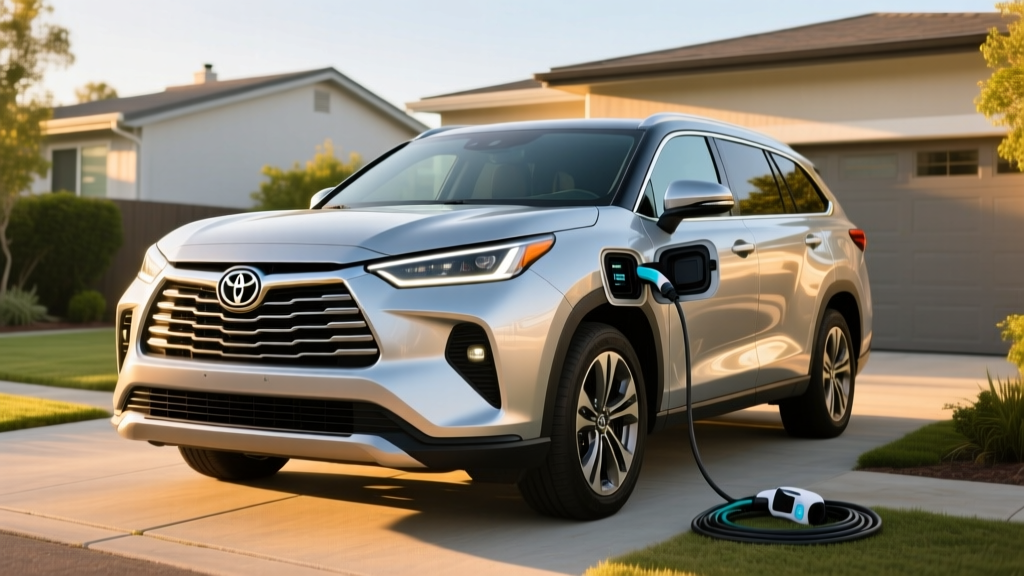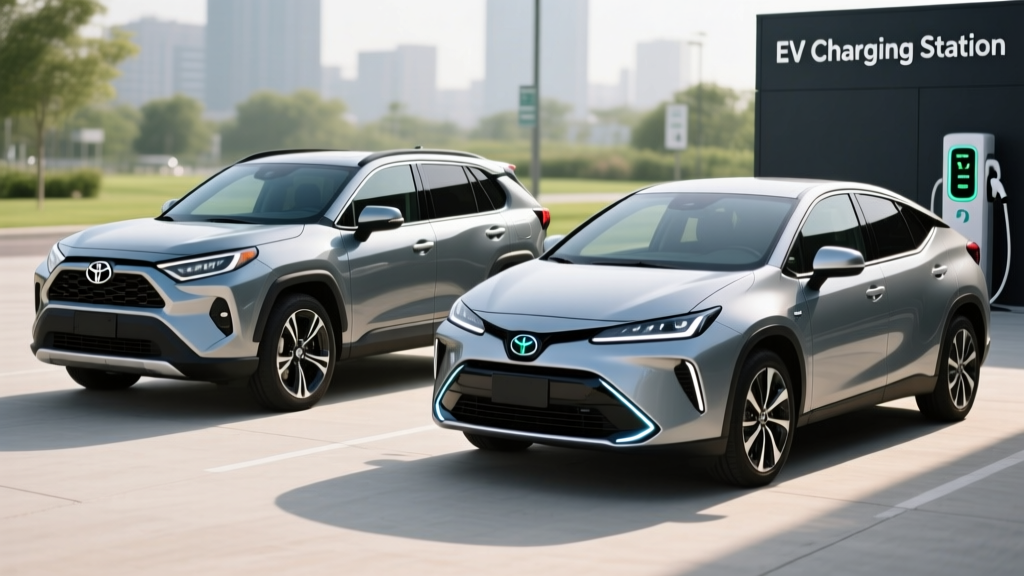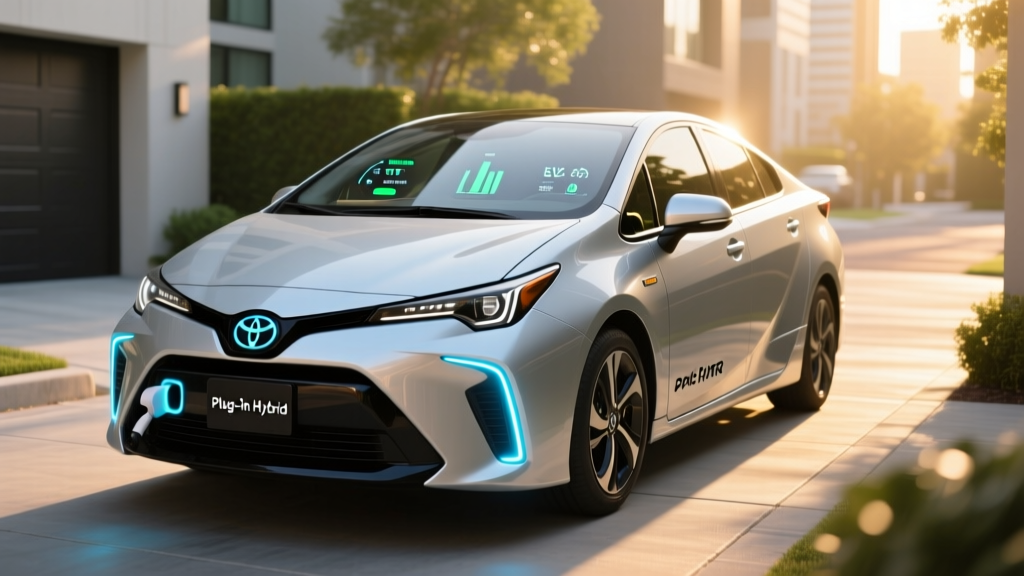
The Toyota Prius Prime plug-in hybrid occupies a specific niche: drivers who want electric commuting without committing to a full battery-electric vehicle. For 2026, Toyota continues the fifth-generation Prius Prime with the same 2.0-liter plug-in hybrid powertrain introduced in 2023, delivering up to 44 miles of electric-only range and a combined 220 horsepower. This guide breaks down the real numbers — EPA efficiency, charging logistics, battery longevity, and whether the §30D federal tax credit still applies — so you can decide if the Prius Prime fits your driving pattern.
What Is the Toyota Prius Prime? HEV vs PHEV Explained
Toyota sells two versions of the Prius. Understanding the distinction is essential before visiting a dealer:
Toyota Prius (HEV — Conventional Hybrid)
- No plug — charges itself via regenerative braking and the gas engine
- 1.1 kWh battery, electric motor assists the engine at low speeds
- EPA: 57 city / 56 highway / 57 combined MPG
- Cannot drive on electric power alone beyond brief low-speed bursts
- No federal tax credit eligibility
Toyota Prius Prime (PHEV — Plug-In Hybrid)
- Plugs in to a wall outlet or Level 2 charger to fill a 13.6 kWh battery
- Up to 44 miles of pure electric driving before the gas engine engages
- EPA: 52 MPGe (electric + gas combined) / 48 MPG (gas-only after battery depletion)
- Eligible for up to $3,750 federal tax credit (subject to §30D rules)
The conventional Prius HEV never needs a charging cable. The Prius Prime PHEV benefits enormously from nightly plug-in charging — if you never plug it in, you're just carrying around 280 pounds of battery for a marginal efficiency gain over the standard Prius. This guide focuses exclusively on the Toyota Prius Prime plug-in variant.
Electric-Only Range, Total Range, and Real-World Efficiency
The 2026 Prius Prime carries a 13.6 kWh lithium-ion battery pack. Usable capacity is approximately 11.3 kWh, with the remainder held as a buffer to protect long-term battery health. Here's what that translates to in real driving:
| Metric | EPA Rating | Real-World Expectation |
|---|---|---|
| Electric-only range | 44 miles (SE trim) | 38–42 miles (mixed); 30–35 miles (highway/cold) |
| Electric-only range (XSE/XSE Premium) | 40 miles | 35–38 miles (mixed) |
| MPGe (electric + gas) | 127 MPGe (SE) | Varies heavily by charge frequency |
| MPG (gas-only, battery depleted) | 48 combined (52 city / 45 hwy) | 50–55 city; 42–46 highway |
| Total combined range (full tank + full charge) | ~480 miles (SE) | ~440–470 miles depending on conditions |
| Fuel tank capacity | 10.6 gallons | — |
Real-world note: Like all PHEVs, the Prius Prime's electric range drops significantly in cold weather. Expect 25–30% range loss below freezing, as battery chemistry slows and cabin heating draws power. In mild weather with city driving and frequent regenerative braking, some owners report exceeding the 44-mile EPA estimate. Highway driving at 70+ mph depletes the battery faster — plan on 30–35 electric miles on a road trip before the engine kicks in.
Charging the Prius Prime: Level 1, Level 2, and What to Expect
The 2026 Prius Prime uses a standard J1772 connector for AC charging. It does not support DC fast charging — a limitation shared with most plug-in hybrids, as their smaller batteries aren't designed for high-power DC input.
| Charging Level | Power (kW) | 0–100% Time | Practical Notes |
|---|---|---|---|
| Level 1 (120V household outlet) | ~1.4 kW | ~11 hours | Included cord; works overnight for most commutes |
| Level 2 (240V home/public) | ~3.3 kW (onboard charger limit) | ~4 hours | Requires J1772 home station; full charge during workday |
| DC Fast Charge | Not supported | N/A | No CCS or CHAdeMO capability |
The Prius Prime's onboard charger is limited to 3.3 kW. Even if you plug into a 7.2 kW or 11.5 kW Level 2 station, the car will only accept 3.3 kW. This means a full charge always takes about 4 hours on Level 2 — adequate for overnight home charging or topping up during a workday, but not something you'd rely on during a quick stop.
kW vs kWh reminder: kW (kilowatts) measures the rate of energy flow — like water pressure from a hose. kWh (kilowatt-hours) measures total energy stored — like the size of the bucket. The Prius Prime's battery holds 13.6 kWh and charges at a peak rate of 3.3 kW.
Powertrain and Performance: 220 HP Is a Different Prius
The fifth-generation Prius Prime shed the sluggish reputation of earlier models. Here's what's under the hood:
| Specification | 2026 Toyota Prius Prime |
|---|---|
| Engine | 2.0L 4-cylinder Atkinson cycle |
| Engine output | 150 hp / 139 lb-ft torque |
| Electric motor output | 161 hp (front-mounted) |
| Combined net system horsepower | 220 hp |
| 0–60 mph | 6.6 seconds (Toyota estimate) |
| Drivetrain | Front-wheel drive (AWD available on non-Prime Prius only) |
| Transmission | Electronically controlled CVT (eCVT) |
| Drive modes | EV Mode, HV Mode, Auto EV/HV, Sport, Normal, Eco |
In EV Mode, the Prius Prime runs exclusively on battery power up to approximately 84 mph. In HV (hybrid vehicle) Mode, the gas engine and electric motor work together for maximum efficiency. Auto EV/HV mode lets the car decide based on driving conditions — useful for mixed commutes where you want to save battery for city traffic.
The 6.6-second 0–60 time won't challenge a Tesla Model 3, but it's a dramatic improvement over the prior-generation Prime's 9.8 seconds. Highway merging and passing feel confident, and the low center of gravity from the floor-mounted battery gives the Prius Prime surprisingly composed handling for an efficiency-focused vehicle.
Pricing, Trims, and Federal Tax Credit Eligibility
The 2026 Toyota Prius Prime is offered in three trims. Pricing below reflects MSRP before any incentives or destination charges:
| Trim | MSRP | EPA Electric Range | Key Features |
|---|---|---|---|
| SE | $33,445 | 44 miles | 17" alloy wheels, heated front seats, 8" touchscreen, TSS 3.0 |
| XSE | $36,695 | 40 miles | 19" alloy wheels, SofTex seats, 12.3" touchscreen, wireless CarPlay |
| XSE Premium | $39,970 | 40 miles | Panoramic roof, heated/ventilated front seats, JBL audio, HUD |
Federal Tax Credit (§30D) — Does the Prius Prime Qualify?
Under current IRS §30D rules, the Toyota Prius Prime qualifies for up to $3,750 in federal tax credit — not the full $7,500. Here's why:
- Critical minerals requirement ($3,750): The Prius Prime's battery meets the critical-minerals sourcing threshold for 2026.
- Battery components requirement ($3,750): The battery cell and module assembly does not currently meet the North American manufacturing threshold, disqualifying the second $3,750 portion.
- MSRP cap: PHEV sedans must be under $55,000 MSRP. All Prius Prime trims qualify.
- Buyer income cap: Modified AGI must not exceed $150,000 (single) / $225,000 (head of household) / $300,000 (joint).
- Point-of-sale transfer: You can transfer the credit to the dealer at purchase for an immediate price reduction, rather than waiting to claim it on your tax return.
Important: Tax credit rules — especially battery sourcing requirements — tighten annually. Verify current eligibility at fueleconomy.gov before purchasing, and consult a tax professional for your specific situation.
Battery Warranty, Reliability, and Replacement Cost
10 years / 150,000 miles (whichever comes first) for the hybrid battery pack.
Covers defects and capacity loss below a defined threshold (typically ~70% state of health).
Transferable to subsequent owners.
Source: Toyota Warranty Guide
Toyota's hybrid battery track record is among the strongest in the industry. The Prius has been in production since 1997 (Japan) and 2000 (US), giving Toyota decades of real-world degradation data. Key facts:
- Typical degradation: Toyota PHEV/HEV batteries generally lose 10–15% capacity over 10 years under normal use. The Prius Prime's conservative buffer strategy (using only ~83% of total capacity) extends cell life.
- Replacement cost: If the battery fails out of warranty, a new OEM Prius Prime battery pack costs approximately $4,500–$6,500 including labor. Refurbished/remanufactored packs are available for $2,000–$3,500.
- Individual module repair: The Prius Prime battery consists of multiple modules. In some cases, a single failed module can be replaced for $500–$1,200 rather than replacing the entire pack.
- Reliability ratings: Toyota consistently ranks at or near the top of J.D. Power and Consumer Reports reliability surveys. The Prius powertrain has fewer moving parts than a conventional transmission, reducing failure points.
For comparison, a conventional gas car's transmission replacement averages $3,000–$7,000, and timing belt/water pump service runs $800–$1,500 every 60,000–100,000 miles — maintenance the Prius doesn't require.
Prius Prime vs Full EV vs Gas Car: Which Fits You?
Choose the Toyota Prius Prime PHEV if:
- Your daily commute is under 40 miles round-trip and you can charge at home nightly
- You take regular road trips (200+ miles) and don't want to plan around DC fast chargers
- You live in an apartment or area where reliable public charging is limited
- You want EV-like commuting with the safety net of a gas engine for longer drives
Choose a full battery EV (e.g., Tesla Model 3, Hyundai Ioniq 6) if:
- You have reliable home Level 2 charging and your daily driving rarely exceeds 200 miles
- You want zero tailpipe emissions and minimal maintenance (no oil changes, no gas engine)
- You qualify for the full $7,500 federal tax credit on eligible BEV models
- You're comfortable with DC fast charging on road trips
Choose the standard Prius HEV (non-plug-in) if:
- You cannot charge at home or work — no garage, no outlet access
- You want maximum simplicity with no charging cables or routines
- Your budget is tighter (Prius HEV starts ~$2,500 less than the Prime)
- You still want outstanding 57 MPG combined efficiency without plug-in complexity
The Prius Prime's advantage is flexibility. On a Tuesday commute, it's a silent electric car. On a Saturday road trip, it's a 48-MPG hybrid that fills up at any gas station in three minutes. You never have to choose between electric and gas — the car manages both.
Pros, Cons, and the Bottom Line
Pros
- 44-mile electric range covers most daily commutes without gasoline
- 48 MPG combined as a hybrid after battery depletion — class-leading
- 220 hp provides confident acceleration; 6.6s 0–60 is quick for the segment
- 10-year / 150,000-mile hybrid battery warranty
- Up to $3,750 federal tax credit reduces effective price
- Excellent reliability history; low long-term maintenance costs
- Standard Toyota Safety Sense 3.0 (adaptive cruise, lane-keeping, AEB)
Cons
- No DC fast charging — Level 2 at 3.3 kW only (4-hour full charge)
- Only $3,750 tax credit, not the full $7,500 (battery component sourcing)
- 44-mile electric range is shorter than competitors (RAV4 Prime: 42 mi but larger vehicle; some PHEVs offer 30–50 mi)
- AWD not available on Prius Prime (only on standard Prius HEV)
- Rear seat and cargo space tighter than crossover alternatives
- XSE and Premium trims reduce electric range to 40 miles due to larger wheels
The 2026 Toyota Prius Prime plug-in hybrid is the right tool for a specific job: electric commuting with gas-engine freedom. If that matches your lifestyle, it's one of the most efficient, reliable, and practical vehicles on the market. If you need more space, the RAV4 Prime offers similar PHEV mechanics in an SUV package. If you never plan to plug in, save the money and buy the standard Prius HEV.
Frequently Asked Questions
How many MPG does the Toyota Prius Prime get?
After the battery is depleted, the Prius Prime operates as a conventional hybrid and achieves an EPA-rated 48 MPG combined (52 city / 45 highway). In real-world city driving with frequent regenerative braking, many owners report 50–55 MPG. Highway cruising at 75+ mph typically yields 42–46 MPG. When operating in electric mode, efficiency is rated at 127 MPGe combined (SE trim).
How far can the Prius Prime go on electric only?
The EPA rates the SE trim at 44 miles of electric-only range and the XSE/XSE Premium at 40 miles (larger 19" wheels increase rolling resistance). In real-world conditions, expect 38–42 miles in mild weather with mixed driving. Cold weather (below 32°F) and sustained highway speeds reduce this to 30–35 miles. The Prius Prime can reach up to 84 mph in EV Mode before the engine engages.
Does the Prius Prime qualify for a federal tax credit?
Yes, but only $3,750 — not the full $7,500. Under current IRS §30D rules, the Prius Prime meets the critical-minerals sourcing requirement ($3,750) but does not meet the battery-component North American assembly requirement (second $3,750). Buyer income caps apply ($150K single / $300K joint), and the MSRP must be under $55,000 for sedans — all Prius Prime trims qualify. The credit can be transferred to the dealer at point of sale for an immediate price reduction. Verify current status at irs.gov.
Is the Prius Prime reliable, and what does battery replacement cost?
Toyota's hybrid powertrains have an industry-leading reliability record spanning 25+ years of Prius production. The hybrid battery is covered by a 10-year / 150,000-mile warranty. Typical degradation is 10–15% over a decade. If replacement is needed out of warranty, expect $4,500–$6,500 for a new OEM pack or $2,000–$3,500 for a refurbished unit. Individual module repair is sometimes possible for $500–$1,200. The eCVT transmission has no belts, chains, or traditional friction components, reducing failure risk compared to conventional automatics.
Do I need to plug in the Prius Prime every night?
You don't need to — the car operates perfectly as a hybrid without plugging in. But you should if you want to capture the PHEV's advantage. Without regular charging, you're carrying 280 lbs of battery you never use, and you'll get marginally worse fuel economy than the lighter standard Prius HEV. A standard 120V outlet (Level 1) provides a full charge in about 11 hours — sufficient for overnight charging. A 240V Level 2 home charger reduces this to approximately 4 hours.
Can the Prius Prime DC fast charge?
No. The Prius Prime only supports AC charging via a J1772 connector at up to 3.3 kW (Level 2). It has no CCS, CHAdeMO, or NACS DC fast-charging capability. This is standard for plug-in hybrids — their smaller batteries (13.6 kWh vs 60–100 kWh in full EVs) don't benefit from high-power DC charging, and the added hardware cost isn't justified.
Hybrid vs PHEV vs EV — which should I choose?
Choose the Prius HEV (conventional hybrid) if you have no charging access and want maximum simplicity. Choose the Prius Prime PHEV if you can charge at home and want electric commuting with gas-engine road-trip freedom. Choose a full BEV (battery electric) if you have home charging, rarely drive more than 200 miles in a day, and want zero tailpipe emissions with minimal maintenance. The PHEV is the bridge between the other two — ideal if you're not ready to commit fully to electric but want to reduce gas consumption significantly.