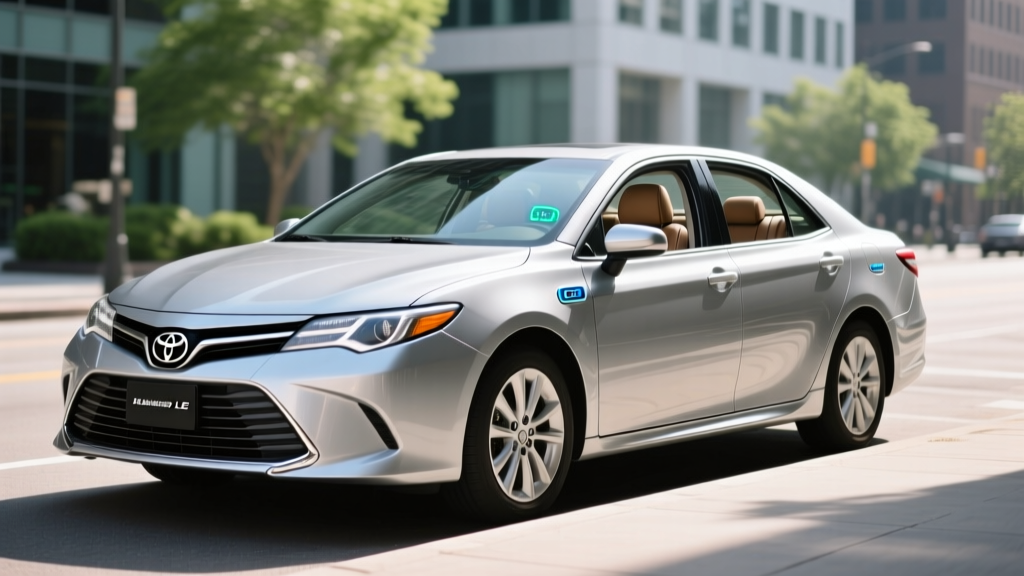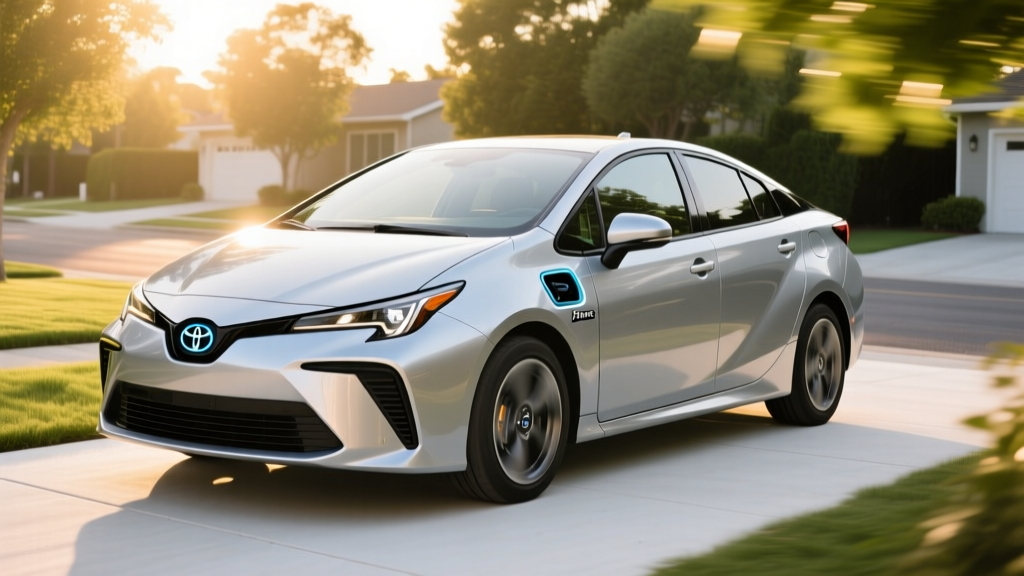
The Toyota Prius Prime plug-in hybrid has evolved from an efficiency appliance into a genuinely compelling daily driver. For the 2026 model year, Toyota carries forward the dramatic redesign introduced for 2023 — a sleeker fastback silhouette, a fifth-generation hybrid powertrain producing 220 combined horsepower, and a larger 13.6 kWh battery that pushes electric-only range to an EPA-estimated 44 miles. That combination covers most commutes on electricity alone while preserving a 480+ mile total range for road trips, making the Prius Prime one of the most practical bridge vehicles for drivers who aren't ready to commit to a full battery-electric vehicle (BEV).
This guide breaks down every number that matters — from real-world MPG and charging logistics to federal tax credit eligibility under current IRS §30D rules — so you can decide whether the Prius Prime fits your garage and your budget.
HEV vs PHEV: Which Prius Are We Talking About?
Toyota sells two distinct Prius models, and confusing them is the most common buyer mistake:
| Feature | Prius (HEV) | Prius Prime (PHEV) |
|---|---|---|
| Powertrain | Conventional hybrid — no plug | Plug-in hybrid — charges via outlet or station |
| Battery | ~1.0 kWh (small buffer) | 13.6 kWh usable (lithium-ion) |
| Electric-only driving | None (EV assist only, <1 mi at low speed) | EPA 44 miles EV-only |
| Combined MPG (gas mode) | 57 MPG combined | 52 MPG combined (after EV range depleted) |
| Charging required? | No — regenerates via braking/engine | Yes — plug in to access EV range |
| Starting MSRP (2026) | ~$29,445 | ~$34,595 |
Key takeaway: The standard Prius HEV never needs to be plugged in. It recovers energy through regenerative braking and the gasoline engine. The Prius Prime PHEV can be driven without plugging in (it functions as a regular hybrid once the battery is depleted), but you forfeit its primary advantage — 44 miles of zero-gas electric driving — if you never charge it.
Electric-Only Range and Total Driving Range
The 2026 Prius Prime's 13.6 kWh lithium-ion battery pack delivers an EPA-estimated 44 miles of electric-only range across all trims (SE, XSE, XSE Premium). In EV mode, the car runs purely on battery power at speeds up to roughly 84 mph, making it viable for highway merging and suburban driving — not just parking-lot crawls.
EPA EV Range: 44 miles
Real-world expectation: 36–42 miles in mixed driving; 30–35 miles in cold weather (below 40°F) or sustained highway speeds above 70 mph. Cabin heating in winter draws significant battery power, reducing EV range by 15–25%.
Once the battery depletes to its minimum state of charge, the Prius Prime seamlessly transitions to hybrid mode. In that mode, the EPA rates it at 52 MPG combined (53 city / 51 highway for the SE trim). With an 11.4-gallon fuel tank, total combined range exceeds 480 miles — enough for a full day of electric commuting plus a weekend road trip without a single gas station stop.
Fuel Economy Breakdown: MPG and MPGe
| Metric | Prius Prime SE | Prius Prime XSE | Prius Prime XSE Premium |
|---|---|---|---|
| EV-only range (EPA) | 44 mi | 40 mi | 40 mi |
| MPGe (EV mode) | 127 MPGe | 127 MPGe | 127 MPGe |
| Gas mode — City | 53 MPG | 50 MPG | 50 MPG |
| Gas mode — Highway | 51 MPG | 47 MPG | 47 MPG |
| Gas mode — Combined | 52 MPG | 48 MPG | 48 MPG |
| Fuel tank capacity | 11.4 gal | 11.4 gal | 11.4 gal |
Real-world MPG note: Toyota's hybrid system excels in city driving, where regenerative braking and frequent engine-off coasting boost efficiency. Many owners report exceeding the EPA city figure in stop-and-go traffic — 55–60 MPG is common in warm-weather urban driving. Highway MPG tends to run closer to the EPA estimate or slightly below, especially at speeds above 75 mph where aerodynamic drag dominates. The XSE and XSE Premium trims sacrifice 4 MPG combined and 4 miles of EV range due to larger 19-inch wheels and added weight from premium features.
For authoritative efficiency data, the EPA's fueleconomy.gov listing provides official test results for every Prius Prime trim.
Battery, Charging, and Powertrain Specs
| Specification | 2026 Prius Prime |
|---|---|
| Battery capacity | 13.6 kWh (lithium-ion, NMC chemistry) |
| EV-only range | 40–44 mi (EPA, trim-dependent) |
| Level 1 charging (120V) | ~11 hours (0–100%) |
| Level 2 charging (240V) | ~4 hours (0–100%) |
| DC fast charging | Not supported |
| Charge connector | J1772 (Level 1 & 2) |
| Combined horsepower | 220 hp |
| Engine | 2.0L 4-cylinder Atkinson-cycle (150 hp) |
| Electric motor | 161 hp (front-mounted) |
| 0–60 mph | 6.6 seconds |
| Drivetrain | FWD, eCVT |
| Curb weight | ~3,567 lbs (SE) |
The Prius Prime uses a standard J1772 connector for Level 1 (120V household outlet) and Level 2 (240V home or public charger) charging. It does not support DC fast charging — a deliberate engineering choice. The 13.6 kWh battery is small enough that Level 2 charging fully replenishes it in roughly four hours, which is sufficient for overnight home charging or topping off during a workday. Toyota includes a dual-voltage charging cable (120V/240V) with the vehicle.
The fifth-generation Toyota Hybrid System pairs a 2.0-liter Atkinson-cycle four-cylinder engine with a front-mounted electric motor for a combined output of 220 horsepower. That's a dramatic improvement over the previous-generation Prime's 121 hp, and it shows: the 0–60 mph time of 6.6 seconds makes this the quickest Prius ever built. The eCVT (electronically controlled continuously variable transmission) is smooth, with none of the rubber-band drone associated with older CVTs.
Pricing, Trims, and Federal Tax Credit Eligibility
The 2026 Toyota Prius Prime is offered in three trims:
- SE: ~$34,595 MSRP — 17-inch wheels, best EV range (44 mi), best MPG (52 combined)
- XSE: ~$37,995 MSRP — 19-inch alloy wheels, heated front seats, wireless charging pad
- XSE Premium: ~$40,795 MSRP — fixed glass roof, premium audio, heated/ventilated front seats, digital rearview mirror
Does the Prius Prime qualify for the federal §30D tax credit? Under current IRS rules, PHEV eligibility depends on several criteria:
- Battery capacity: Must be ≥7 kWh — the Prime's 13.6 kWh qualifies.
- MSRP cap: Vans, SUVs, and pickup trucks are capped at $80,000; sedans and other vehicles at $55,000. The Prius Prime (classified as a sedan) falls well under the $55,000 cap across all trims.
- Buyer income limits: AGI must not exceed $150,000 (single), $225,000 (head of household), or $300,000 (joint filers).
- Battery component and critical mineral sourcing: The vehicle must meet phased-in domestic-content requirements for battery components and critical minerals. These thresholds tighten annually. Check the latest IRS clean vehicle credit page for current sourcing compliance before purchasing.
- Point-of-sale transfer: Eligible buyers can transfer the credit to the dealer at purchase, reducing the sale price directly rather than waiting for a tax refund.
Critical caveat: The Prius Prime's battery sourcing has historically been a sticking point. Toyota's supply chain may or may not meet the current-year critical-mineral and component thresholds. Always verify the specific VIN's eligibility on the IRS qualified vehicles list at the time of purchase. Do not assume a flat $7,500 credit — the actual amount may be $3,750 (meeting one of two sourcing requirements), $7,500 (meeting both), or $0 (meeting neither).
Reliability, Battery Warranty, and Replacement Costs
Hybrid battery warranty: Toyota covers the Prius Prime's high-voltage battery for 10 years or 150,000 miles (whichever comes first) in all 50 states. This applies to capacity and defect coverage.
Powertrain warranty: 5 years / 60,000 miles.
Basic vehicle warranty: 3 years / 36,000 miles.
Toyota's hybrid systems have an exceptional reliability track record spanning over two decades. The Prius nameplate, in particular, has accumulated billions of real-world miles, and the hybrid battery packs routinely last well beyond their warranty period. Data from long-term fleet studies and owner surveys consistently show less than 5% of Toyota hybrid batteries requiring replacement within the first 10 years of service.
Battery replacement cost: If replacement is needed out of warranty, a new OEM Prius Prime battery pack currently costs between $4,500 and $6,500 including labor at a Toyota dealership. Third-party reconditioned or refurbished packs are available for $2,000–$3,500. For context, that's significantly less than the $10,000–$20,000+ replacement costs associated with large-battery BEVs.
The conventional 12V auxiliary battery (a standard lead-acill or AGM unit that powers electronics when the car is off) is a separate, inexpensive maintenance item — typically $150–$250 to replace every 4–6 years, same as any other car.
Who Should Choose the Prius Prime vs. a Full EV or Gas Car?
Choose the Prius Prime PHEV if:
- Your daily commute is under 40 miles round-trip and you have access to home or workplace Level 1/2 charging.
- You take regular road trips (200+ miles) and don't want to plan around DC fast-charging infrastructure.
- You live in an apartment or area with limited public charging and need the flexibility of a gas engine as backup.
- You want to reduce fuel consumption and emissions without committing to a full BEV.
Choose a full BEV (e.g., Tesla Model 3, Hyundai Ioniq 6) if:
- You have reliable home Level 2 charging and your daily driving rarely exceeds 250 miles.
- You want to eliminate gasoline purchases entirely and minimize maintenance (no oil changes, no spark plugs).
- You qualify for the full $7,500 federal tax credit on a BEV, which may offer greater savings than the Prius Prime's partial or zero credit.
Choose the standard Prius HEV (non-plug-in) if:
- You have no access to any plug-in charging at home or work.
- You want maximum MPG without any behavioral change — just drive and refuel normally.
- Your budget is tighter and the ~$5,000 price premium of the Prime over the HEV doesn't pencil out against your fuel savings.
The Prius Prime occupies a specific niche: it's the optimal vehicle for someone who can charge at home most nights but also needs the freedom to drive cross-country without range planning. If you charge nightly, you'll use almost zero gasoline on weekdays and only burn gas on longer weekend trips. Many Prime owners report visiting gas stations once every 6–8 weeks.
Pros, Cons, and Real-World Ownership Notes
Pros
- 44-mile EV range covers most daily commutes without gasoline
- 52 MPG combined in hybrid mode — best-in-class for a PHEV sedan
- 220 hp / 6.6-second 0–60 — genuinely quick for a Prius
- 10-year/150,000-mile hybrid battery warranty
- No range anxiety — 480+ total miles, gas stations everywhere
- Proven Toyota reliability and low cost of ownership
Cons
- No DC fast charging — irrelevant for a 13.6 kWh battery, but limits future-proofing
- XSE/Premium trims lose 4 MPG and 4 miles of EV range vs. SE
- Rear headroom is tight for taller passengers due to fastback roofline
- Cargo space (20.3 cu ft behind rear seats) is modest for a hatchback
- Federal tax credit eligibility is uncertain — verify before purchasing
- All-wheel drive is not available on the Prime (only on the standard Prius HEV)
Charging in practice: Most Prius Prime owners charge on a standard 120V household outlet overnight. At roughly 1 kW of charge power, you'll recover about 4 miles of EV range per hour — enough to fully recharge the 44-mile battery in 11 hours. If your daily EV commute is 20–30 miles, a 120V outlet is sufficient and requires no electrical upgrade. A 240V Level 2 home charger cuts that to 4 hours, which is convenient if you want faster mid-day top-ups or have a longer commute.
Cold-weather reality: In freezing temperatures, expect EV range to drop to roughly 30–35 miles. The Prius Prime uses a heat pump for cabin heating (on XSE and above), which is more efficient than resistive heating and helps mitigate range loss. The SE trim uses a conventional heater. Either way, the gas engine will activate more frequently in extreme cold to maintain cabin temperature, which is normal PHEV behavior.
Frequently Asked Questions
How many MPG does the Toyota Prius Prime get?
In hybrid mode (after the EV battery is depleted), the 2026 Prius Prime SE achieves an EPA-estimated 53 city / 51 highway / 52 combined MPG. The XSE and XSE Premium trims are rated at 50 city / 47 highway / 48 combined. Real-world city driving often exceeds these figures — many owners report 55+ MPG in warm-weather stop-and-go traffic. Highway driving at 75+ mph typically yields 45–50 MPG.
How far can the Prius Prime go on electric only?
The EPA rates the Prius Prime SE at 44 miles of electric-only range, while the XSE and XSE Premium trims achieve 40 miles (due to larger wheels and added weight). In real-world conditions, expect 36–42 miles in moderate temperatures and 30–35 miles in freezing weather or sustained highway driving above 70 mph.
Does the Prius Prime qualify for a federal tax credit?
It may qualify for up to $7,500 under the IRS §30D clean vehicle credit, but eligibility depends on current battery-sourcing and critical-mineral requirements that change annually. The Prius Prime meets the battery-capacity threshold (≥7 kWh) and the MSRP cap (under $55,000 for sedans). Buyer income limits also apply. Always verify the specific vehicle's qualification on the fueleconomy.gov tax credit page and consult a tax professional before relying on the credit.
Is the Prius Prime reliable, and what does a battery replacement cost?
Toyota's hybrid systems are among the most reliable powertrains on the market. The high-voltage battery is warranted for 10 years / 150,000 miles, and most packs last well beyond that period. Out-of-warranty replacement costs $4,500–$6,500 for a new OEM pack, or $2,000–$3,500 for a refurbished unit. For comparison, a full BEV battery replacement can cost $10,000–$20,000+.
Do I need to install a home charger for the Prius Prime?
No. The included 120V charging cable will fully recharge the battery overnight (~11 hours), which is sufficient for most daily commutes. A 240V Level 2 home charger reduces charge time to ~4 hours and is recommended if you have a longer commute or want faster mid-day replenishment. Installation costs for a Level 2 charger typically range from $500 to $2,000 depending on your electrical panel's capacity and the distance from panel to charger location.
Can the Prius Prime charge at public DC fast chargers?
No. The Prius Prime does not have DC fast-charging capability. It charges exclusively via Level 1 (120V) or Level 2 (240V) using a J1772 connector. Given the small 13.6 kWh battery, Level 2 charging fully replenishes it in about 4 hours, so DC fast charging is unnecessary for this vehicle's use case.
Hybrid vs PHEV vs EV — which is right for me?
A conventional hybrid (HEV) like the standard Prius is best if you have no charging access and want maximum MPG with zero behavior change. A plug-in hybrid (PHEV) like the Prius Prime is ideal if you can charge at home and want electric commuting with gas-engine backup for road trips. A full EV (BEV) is the right choice if you have reliable home charging, rarely drive more than 250 miles in a day, and want to eliminate gasoline costs and powertrain maintenance entirely. See the decision framework above for a detailed breakdown.
Sources: EPA fuel economy data via fueleconomy.gov; IRS §30D clean vehicle credit rules via irs.gov; Toyota USA specifications via toyota.com.