Quick Verdict: The Bridge Between Hybrid and Full EV
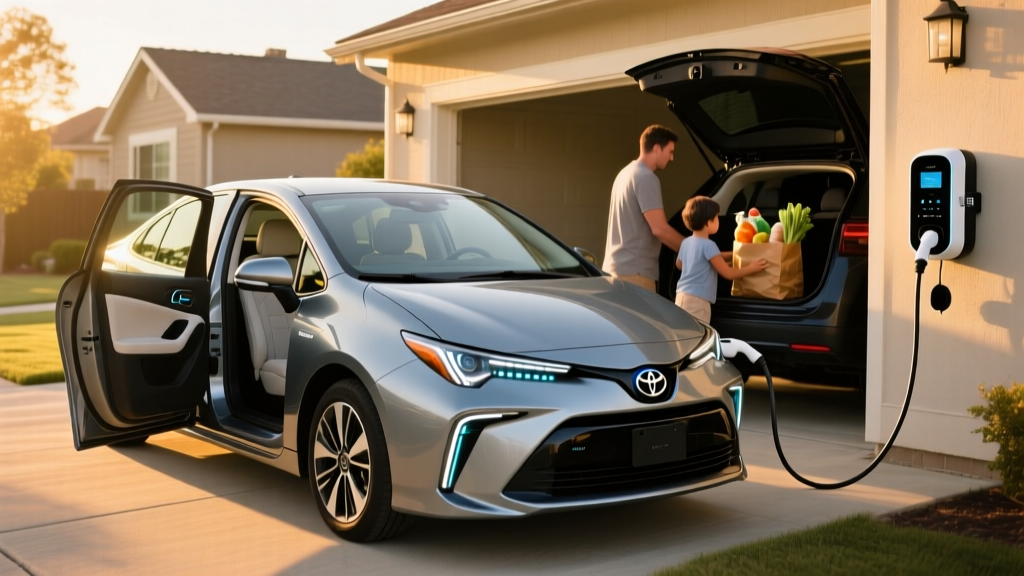
The 2026 Toyota Prius Plug-In Hybrid (formerly known as the Prius Prime) occupies a specific and increasingly crowded niche: a vehicle that commutes on electricity alone yet eliminates range anxiety for road trips. With an EPA-rated 44 miles of electric-only range and a combined 127 MPGe, it covers most daily driving without burning a drop of gasoline. When the battery depletes, a proven 2.0-liter hybrid powertrain takes over at 52 MPG combined. For buyers who want EV-like commuting but aren't ready to commit to a full battery-electric vehicle, this is one of the most compelling options on the market.
But the Prius Plug-In Hybrid isn't for everyone. Its 13.6 kWh battery doesn't support DC fast charging, and the cargo area is compromised compared to the standard Prius HEV. Let's break down the exact numbers so you can decide whether this PHEV fits your life.
HEV vs. PHEV: What's the Difference on the Prius?
Toyota sells two distinct versions of the Prius, and confusing them is a common mistake among first-time hybrid shoppers.
| Feature | Prius HEV (Standard Hybrid) | Prius Plug-In Hybrid (PHEV) |
|---|---|---|
| Plug-in charging required? | No — self-charging via regenerative braking and engine | Yes — plugs in to maximize electric-only range |
| Battery size | ~1.0 kWh (small buffer) | 13.6 kWh usable |
| Electric-only range | Under 1 mile at low speeds | 44 miles (EPA) |
| Combined MPG (charge-depleted) | 57 MPG | 52 MPG |
| MPGe (electric mode) | N/A | 127 MPGe |
| Combined horsepower | 194 HP (AWD) / 196 HP (FWD) | 220 HP |
| 0–60 mph | 7.0 sec (FWD) | 6.6 sec |
| Starting MSRP (2026) | ~$29,450 | ~$34,695 |
| Federal §30D tax credit | Not eligible | Up to $3,750 (see eligibility below) |
The core trade-off: the standard Prius HEV delivers slightly better fuel economy once the PHEV's battery is depleted (57 vs. 52 MPG) because it carries less weight. The PHEV's advantage is those 44 electric-only miles, which for a typical commuter means zero gasoline use Monday through Friday.
Fuel Economy & Electric Range: The Numbers That Matter
According to fueleconomy.gov, the 2026 Prius Plug-In Hybrid posts the following figures:
| Metric | EPA Rating | Real-World Expectation |
|---|---|---|
| Electric-only range | 44 miles | 38–42 mi (highway); 44–48 mi (city/low-speed) |
| MPGe (electric mode) | 127 MPGe | Varies with climate and terrain |
| MPG (charge-depleted, combined) | 52 MPG | 50–56 MPG (city often exceeds EPA) |
| MPG city | 53 MPG | 54–58 MPG (regen braking favors stop-and-go) |
| MPG highway | 50 MPG | 47–51 MPG |
| Total combined range | ~440 miles | ~400–450 miles depending on conditions |
Real-world note: Toyota's hybrid system excels in city driving because regenerative braking recaptures energy at every stop. Owners frequently report exceeding the EPA city rating in stop-and-go traffic. Highway driving at 75+ mph, however, will reduce both electric range and gasoline MPG by roughly 5–10%. In cold weather (below 32°F), expect electric-only range to drop to approximately 32–36 miles due to battery chemistry limitations and cabin heating demands.
Powertrain & Performance Specs
| Specification | 2026 Prius Plug-In Hybrid |
|---|---|
| Engine | 2.0L 4-cylinder Atkinson-cycle |
| Electric motor | Permanent-magnet synchronous (front axle) |
| Combined system output | 220 HP |
| Transmission | Electronically controlled CVT (eCVT) |
| Drivetrain | Front-wheel drive |
| 0–60 mph | 6.6 seconds |
| Battery chemistry | Lithium-ion (NMC) |
| Battery capacity (usable) | 13.6 kWh |
| Top speed | 112 mph |
| Curb weight | ~3,450 lbs |
The 220 HP combined output makes this the quickest Prius Toyota has ever built. The 6.6-second 0–60 time is a full half-second ahead of the standard HEV, thanks to the larger, more powerful electric motor. Highway passing is confident, and the eCVT delivers smooth, linear acceleration without the rubber-band feel of older Prius generations.
Charging: Level 1, Level 2, and What You Can't Do
Here's a critical limitation that catches some PHEV buyers off guard: the Prius Plug-In Hybrid does not support DC fast charging. There is no CCS or NACS port. All charging happens via the J1772 AC connector.
| Charging Level | Power (kW) | Time to Full Charge | Miles of EV Range Added per Hour |
|---|---|---|---|
| Level 1 (120V household outlet) | ~1.2 kW | ~11 hours | ~4 miles/hr |
| Level 2 (240V home/public charger) | ~3.3 kW (onboard charger limit) | ~4 hours | ~11 miles/hr |
The onboard charger is capped at approximately 3.3 kW, meaning even if you plug into a 7.2 kW or 11.5 kW Level 2 station, the Prius will only accept 3.3 kW. This is standard for PHEVs with smaller batteries — a full charge overnight on Level 1 is realistic, and a Level 2 home charger fills the battery before you wake up.
Practical tip: Most Prius PHEV owners charge on a standard 120V outlet overnight and never install a Level 2 charger. With a depleted battery needing only ~13.6 kWh, a 10-hour overnight session at 1.2 kW adds roughly 12 kWh — nearly a full charge. A dedicated Level 2 circuit is convenient but not essential for this vehicle.
Pricing, Trims & Tax Credit Eligibility
The 2026 Toyota Prius Plug-In Hybrid is offered in three trims:
- SE: ~$34,695 MSRP — 17-inch alloy wheels, Toyota Safety Sense 3.0, 8-inch touchscreen
- XSE: ~$37,695 MSRP — 19-inch wheels, SofTex seats, 12.3-inch display, heated front seats
- XSE Premium: ~$40,695 MSRP — Panoramic glass roof, JBL audio, digital rearview mirror, ventilated seats
Federal Tax Credit (§30D)
The Prius Plug-In Hybrid qualifies for a partial federal tax credit — up to $3,750 — under current IRS §30D rules. The credit amount depends on whether the vehicle's battery meets critical-mineral and battery-component sourcing thresholds set by the Inflation Reduction Act. As of the 2026 tax year, Toyota's battery supply chain qualifies for the $3,750 battery-component portion of the credit, but not the additional $3,750 critical-minerals portion.
- MSRP cap: Vehicle must be under $55,000 (sedan cap). All Prius PHEV trims qualify.
- Buyer income cap: Modified AGI must not exceed $150,000 (single) / $300,000 (joint).
- Point-of-sale transfer: You can transfer the credit to the dealer at purchase to reduce the sale price immediately, rather than waiting to claim it on your tax return.
- Assembly: Must be assembled in North America (the Prius is assembled in Japan — this may affect eligibility; confirm with your tax professional and the dealer).
Important caveat: Because the Prius is assembled in Japan (Toyota's Tsutsumi plant), it may not meet the North American final-assembly requirement of §30D. Some buyers have successfully claimed the credit depending on model year and VIN verification through the IRS portal. Always check your specific VIN at fueleconomy.gov and consult a tax professional before relying on the credit in your purchase decision.
Battery Longevity, Warranty & Replacement Cost
• Coverage: 10 years / 150,000 miles (whichever comes first)
• Applies to: Hybrid traction battery and hybrid system components
• Capacity threshold: Toyota warrants the battery against defects and abnormal loss of capacity
• Transferable: Yes, to subsequent owners
Toyota's hybrid battery track record is among the best in the industry. The original Prius, launched in the U.S. in 2000, has documented examples of batteries lasting 200,000+ miles. The modern lithium-ion pack in the Prius PHEV is more energy-dense but follows the same conservative thermal-management philosophy — Toyota limits the usable state-of-charge window to reduce degradation.
Battery replacement cost: If the battery does fail outside of warranty, expect to pay between $3,500 and $5,500 for a new OEM replacement including labor. Refurbished or reconditioned packs are available from third-party shops for $1,500–$2,800. Given Toyota's warranty coverage and historical reliability data, unplanned battery replacement within the first 10–12 years of ownership is uncommon.
Who Should Buy the Prius PHEV — And Who Shouldn't
- Your daily round-trip commute is under 44 miles and you can charge at home overnight
- You want EV commuting but take road trips where charging infrastructure is sparse
- You live in an apartment or area where reliable public DC fast charging isn't available
- You want the lowest total cost of ownership in a plug-in vehicle
- You value Toyota's long-term reliability and resale track record
- You want DC fast charging for road-trip convenience (consider a full BEV like the Hyundai Ioniq 5)
- You need maximum cargo space — the PHEV's larger battery reduces trunk volume vs. the HEV
- Your commute exceeds 50 miles one-way — you'll burn gas daily and may be better served by a long-range BEV
- You want AWD — the Prius PHEV is front-wheel drive only (the HEV offers AWD)
- You need the full $7,500 federal credit — the Prius PHEV may not qualify due to Japan assembly
Choose the Prius HEV if you can't charge at home and want maximum MPG with zero behavior change.
Choose the Prius Plug-In Hybrid if you can charge at home, commute under 44 miles, and want the flexibility for gas-free weekdays and road-trip weekends.
Choose a full BEV (like the Tesla Model 3 or Chevrolet Equinox EV) if you have reliable home charging, your daily drive exceeds 44 miles, and you want zero gasoline costs and access to DC fast-charging networks.
Ownership Economics: What You'll Actually Spend
The financial case for the Prius PHEV hinges on your electricity cost, commute distance, and how often you charge. Here's a realistic 5-year outlook assuming 15,000 miles/year, $3.50/gallon gasoline, and $0.14/kWh electricity:
| Cost Category | Prius PHEV (charged nightly) | Prius HEV | Comparable Gas Sedan (30 MPG) |
|---|---|---|---|
| Purchase price (after credit) | ~$30,945* | ~$29,450 | ~$28,000 |
| Fuel/electricity (5 years) | ~$2,100 | ~$5,050 | ~$8,750 |
| Maintenance (5 years) | ~$1,800 | ~$2,000 | ~$3,200 |
| Insurance (5 years) | ~$7,500 | ~$7,000 | ~$6,800 |
| Estimated 5-year total | ~$42,345 | ~$43,500 | ~$46,750 |
*Assumes $3,750 federal credit applied. Actual cost varies by state incentives and dealer pricing.
The PHEV's fuel savings are substantial if you charge regularly. If you never plug it in, you're carrying 300+ pounds of dead battery weight and getting 52 MPG instead of the HEV's 57 MPG — making the standard hybrid the smarter buy. The Prius PHEV only makes financial sense if you plug it in.
Frequently Asked Questions
How many MPG does the Toyota Prius Plug-In Hybrid get?
The EPA rates it at 52 MPG combined (53 city / 50 highway) when operating as a hybrid after the battery is depleted. In electric-only mode, it achieves 127 MPGe. Real-world city driving often exceeds the EPA rating thanks to Toyota's efficient regenerative braking system — many owners report 54–58 MPG in stop-and-go traffic.
How far can the Prius Plug-In Hybrid go on electric only?
The EPA rates it at 44 miles of electric-only range. In real-world conditions, expect 38–42 miles at highway speeds and 44–48 miles in city driving at lower speeds. Cold weather (below freezing) can reduce electric range to approximately 32–36 miles due to battery efficiency loss and cabin heating demand.
Does the Prius Plug-In Hybrid qualify for a tax credit?
Under current IRS §30D rules, it may qualify for up to $3,750 in federal tax credit. However, because the Prius is assembled in Japan, it may not meet the North American final-assembly requirement. Always verify your specific VIN on the IRS/fueleconomy.gov portal and consult a tax professional. Many state and utility incentives also apply to PHEVs — check your local programs.
Is the Prius Plug-In Hybrid reliable? What about battery replacement?
Toyota's hybrid systems have an exceptional reliability track record spanning over two decades. The hybrid battery is warranted for 10 years/150,000 miles. Battery replacement, if needed outside warranty, costs approximately $3,500–$5,500 for an OEM pack. Historical data suggests most Toyota hybrid batteries last well beyond the warranty period with normal use.
Can the Prius PHEV use DC fast chargers?
No. The Prius Plug-In Hybrid only accepts AC charging via the J1772 connector, at a maximum rate of approximately 3.3 kW. A full charge takes about 4 hours on Level 2 (240V) or about 11 hours on a standard 120V household outlet. DC fast charging (CCS/NACS) is not available on any Prius model.
What's the difference between the Prius HEV and the Prius Plug-In Hybrid?
The standard Prius HEV is a self-charging conventional hybrid — it never plugs in and has a very small battery (~1 kWh) that assists the gasoline engine. The Plug-In Hybrid has a much larger 13.6 kWh battery that provides 44 miles of electric-only driving before the gasoline engine takes over. The PHEV costs more upfront but can eliminate gasoline use for short commutes.
Should I buy the Prius PHEV or a full electric vehicle?
If you have reliable home charging, a commute under 44 miles, and regularly take road trips to areas with limited charging infrastructure, the Prius PHEV offers the best of both worlds. If your daily driving exceeds 44 miles, you have consistent access to charging, and you want zero gasoline costs, a full BEV with 250+ miles of range and DC fast charging may serve you better long-term.
Sources: EPA fuel economy data from fueleconomy.gov, IRS clean vehicle credit rules from irs.gov, manufacturer specifications from Toyota USA.