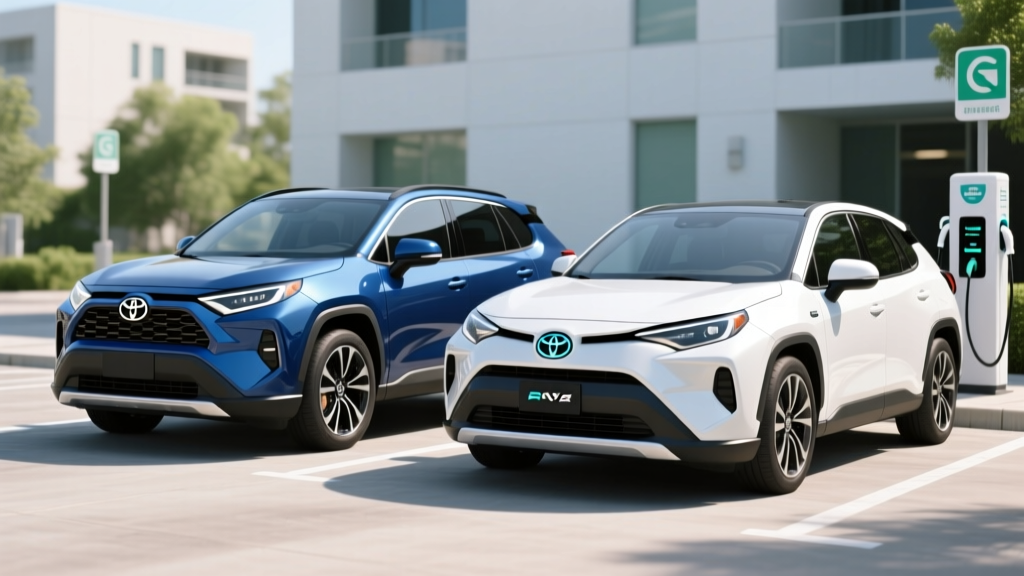
If you want electric commuting without range anxiety, Toyota plug-in hybrids offer a compelling middle ground. For 2026, Toyota fields two PHEV models: the RAV4 Prime (a compact SUV) and the Prius Prime (a sleek hatchback). Both pair a gasoline engine with a larger battery and electric motor than conventional hybrids, enabling genuine electric-only driving for daily commutes while retaining a gas tank for longer trips.
This guide breaks down exact EPA numbers, real-world efficiency, charging logistics, tax credit eligibility, and long-term ownership costs so you can decide which Toyota PHEV fits your driving pattern — or whether a conventional hybrid or full EV makes more sense.
HEV vs. PHEV: What's the Actual Difference?
Toyota sells both conventional hybrids (HEVs) and plug-in hybrids (PHEVs), and the distinction matters for your wallet and daily routine.
| Feature | Conventional Hybrid (HEV) | Plug-In Hybrid (PHEV) |
|---|---|---|
| Battery size | ~1.0–1.6 kWh | 13.6–18.1 kWh |
| Electric-only range | None (motor assists only) | 39–44 miles EPA |
| Plug in to charge? | No — regenerates via braking/engine | Yes — Level 1 or Level 2 |
| Federal tax credit | None | Potentially up to $7,500 (§30D) |
| Price premium over gas model | ~$1,500–$2,500 | ~$5,000–$9,000 |
| Best for | Drivers who can't charge at home | Drivers with home charging + short commutes |
The core trade-off: PHEVs cost more upfront but can run purely on electricity for 39–44 miles, potentially eliminating gasoline use on commutes. HEVs require zero behavior change — you fuel up like any gas car and get excellent MPG without plugging in.
2026 Toyota RAV4 Prime: Specs, Range, and Efficiency
The RAV4 Prime is Toyota's most powerful RAV4 variant, combining a 2.5-liter four-cylinder engine with front and rear electric motors for a combined 302 horsepower. It uses an 18.1 kWh lithium-ion battery (usable capacity approximately 14.9 kWh) and comes standard with electronic all-wheel drive (eAWD).
| Specification | 2026 RAV4 Prime |
|---|---|
| EPA electric-only range | 42 miles |
| Total combined range (electric + gas) | ~600 miles |
| MPGe (electric + gas combined) | 94 MPGe |
| Gas-only MPG (after battery depletes) | 38 city / 35 hwy / 36 combined |
| Battery capacity | 18.1 kWh (lithium-ion) |
| Combined horsepower | 302 hp |
| 0–60 mph | 5.7 seconds |
| Level 1 charging (120V) | ~12 hours (full charge) |
| Level 2 charging (240V, 3.3 kW) | ~4.5 hours |
| Level 2 charging (240V, 6.6 kW optional) | ~2.5 hours |
| DC fast charging | Not available |
| Base MSRP (SE trim) | $46,290 |
| XSE trim MSRP | $49,790 |
Real-world range note: The EPA's 42-mile electric estimate assumes moderate temperatures and mixed driving. In summer highway conditions at 70+ mph, expect roughly 34–37 electric miles. In freezing weather with cabin heat active, that can drop to 28–32 miles. Once the battery depletes, the 36 MPG combined gas figure holds fairly consistently — the RAV4 Prime operates as a conventional hybrid at that point, and Toyota's hybrid system is notably efficient at highway speeds.
2026 Toyota Prius Prime: Specs, Range, and Efficiency
Redesigned for the 2023 model year and carried forward into 2026, the Prius Prime shed its econobox image with a dramatically restyled body and a serious performance upgrade. It pairs a 2.0-liter four-cylinder engine with electric motors for a combined 220 horsepower — a massive leap from the prior generation's 121 hp. The 13.6 kWh lithium-ion battery delivers up to 44 miles of electric-only range in the SE trim.
| Specification | 2026 Prius Prime SE | 2026 Prius Prime XSE/XSE Premium |
|---|---|---|
| EPA electric-only range | 44 miles | 40 miles |
| Total combined range | ~510 miles | ~480 miles |
| MPGe (electric + gas) | 127 MPGe | 114 MPGe |
| Gas-only MPG (charge-depleted) | 53 city / 51 hwy / 52 combined | 50 city / 47 hwy / 48 combined |
| Battery capacity | 13.6 kWh (lithium-ion) | |
| Combined horsepower | 220 hp | |
| 0–60 mph | 6.6 seconds | |
| Level 1 charging (120V) | ~11 hours | |
| Level 2 charging (240V, 3.3 kW) | ~4 hours | |
| DC fast charging | Not available | |
| Base MSRP | $33,445 | $36,945 / $40,145 |
Real-world efficiency insight: Toyota's hybrid system excels in city driving, where regenerative braking recovers energy constantly. Many owners report exceeding the EPA's 52 MPG combined in stop-and-go urban commutes — 55–58 MPG is achievable. Highway cruising at 75 mph will yield closer to 46–48 MPG in the SE. The 44-mile electric range is realistic for suburban commutes under 45 mph; sustained highway speeds reduce it to roughly 35–38 miles.
Charging Logistics: What You Need at Home
Neither Toyota PHEV supports DC fast charging — this is a deliberate engineering choice. PHEV batteries are small enough that Level 2 charging fully replenishes them in 2.5–4.5 hours, making overnight home charging the primary refueling strategy.
| Charging Level | Power | Miles of EV Range Added Per Hour | Full Charge Time (RAV4 Prime) | Full Charge Time (Prius Prime) |
|---|---|---|---|---|
| Level 1 (standard 120V outlet) | ~1.2 kW | ~4–5 miles | ~12 hours | ~11 hours |
| Level 2 (240V, standard 3.3 kW onboard) | 3.3 kW | ~12–14 miles | ~4.5 hours | ~4 hours |
| Level 2 (240V, 6.6 kW onboard — RAV4 Prime optional) | 6.6 kW | ~22–24 miles | ~2.5 hours | N/A |
Home setup requirements: Level 1 charging works with any standard 120V household outlet on a dedicated 15-amp circuit. For most PHEV owners who drive under 40 miles daily, Level 1 overnight charging is sufficient — you plug in when you get home and wake up fully charged.
If your commute exceeds 40 miles or you want faster turnaround, a Level 2 home charger (240V) requires a NEMA 14-50 outlet or hardwired station installed by a licensed electrician. Expect $500–$1,800 for installation depending on your electrical panel's proximity to the parking spot and whether a panel upgrade is needed. (Have a licensed electrician assess your panel capacity before committing.)
Public charging reality: Because these PHEVs lack DC fast charging, public charging is impractical as a primary strategy. You can use public Level 2 stations (ChargePoint, EVgo L2, etc.), but a 3–4 hour session is rarely convenient away from home. The Prius Prime and RAV4 Prime are designed to be charged where you park overnight.
Federal Tax Credit and Incentive Eligibility
Under the current IRS §30D Clean Vehicle Credit rules, plug-in hybrids with sufficient battery capacity can qualify for up to $7,500 in federal tax credits. However, eligibility depends on several factors that change frequently.
- MSRP caps: SUVs (RAV4 Prime) must have an MSRP under $80,000; sedans/hatchbacks (Prius Prime) under $55,000. Both models currently fall well under these limits.
- Buyer income limits: Modified adjusted gross income must not exceed $150,000 (single), $225,000 (head of household), or $300,000 (joint filing).
- Battery component sourcing: A percentage of battery components must be manufactured or assembled in North America, and critical minerals must meet sourcing thresholds. These percentages increase annually, and eligibility can shift mid-year.
- Point-of-sale transfer: As of 2024, buyers can transfer the credit to the dealer for an immediate price reduction at purchase, rather than waiting to claim it on their tax return.
As of early 2026, the Prius Prime qualifies for a portion of the federal credit (typically $3,750), while the RAV4 Prime's eligibility has fluctuated based on battery sourcing compliance. Check the latest IRS guidance at irs.gov or ask your dealer for the current credit status before purchasing. State incentives vary widely — some states (California, Colorado, New York) offer additional rebates of $1,000–$4,000 for PHEVs.
Reliability, Battery Warranty, and Replacement Costs
Toyota's hybrid systems have proven exceptionally durable over two decades of Prius production. The PHEV powertrain adds complexity (larger battery, more electric-only operation), but Toyota's track record remains strong.
Hybrid battery warranty: Toyota covers the hybrid battery and key hybrid components for 10 years or 150,000 miles (whichever comes first) on 2020 and newer models. This applies to both the RAV4 Prime and Prius Prime. The broader powertrain warranty covers 5 years/60,000 miles, and the basic limited warranty covers 3 years/36,000 miles.
Battery degradation reality: PHEV batteries undergo more charge cycles than conventional hybrid batteries because they cycle through a deeper portion of their capacity daily. Toyota engineers a buffer into the battery (you never use 100% of the cells' capacity) to slow degradation. Based on data from earlier Prius Prime models, owners typically see 5–10% range loss over the first 5 years — meaning a 44-mile range might become 40–42 miles. This is modest and covered under warranty if it exceeds Toyota's capacity retention threshold.
Replacement cost: If the hybrid battery fails outside warranty, replacement costs range from approximately $4,000–$7,500 depending on the model and whether you use a new OEM battery or a refurbished unit. Independent hybrid specialists can sometimes replace individual battery modules for $1,500–$2,500 rather than the full pack. Given the 10-year/150,000-mile warranty, most owners will never face this expense during their ownership period.
Overall reliability: According to IIHS and long-term owner surveys, the RAV4 and Prius platforms consistently rank among the most reliable vehicles in their segments. The eAWD system in the RAV4 Prime has no mechanical driveshaft — the rear motor operates independently — reducing mechanical wear points compared to traditional AWD systems.
Toyota PHEV vs. Full EV vs. Conventional Hybrid: Which Fits You?
Choose a Toyota PHEV (RAV4 Prime or Prius Prime) if:
- Your daily commute is under 40 miles round-trip and you can charge at home
- You take road trips several times a year and don't want to plan around charging stations
- You live in an area with limited public DC fast charging infrastructure
- You want to reduce gasoline consumption by 60–80% without eliminating it entirely
- You're not ready to commit to a full EV but want electric driving experience
Choose a conventional Toyota hybrid (RAV4 Hybrid, Prius, Camry Hybrid) if:
- You cannot install a home charger (apartment, street parking, no garage)
- Your daily driving exceeds 50+ miles with no predictable charging opportunity
- You want the lowest possible purchase price while still getting excellent fuel economy
- You don't want any plug-in routine or charging-cord management
Choose a full EV (Tesla Model Y, Hyundai Ioniq 5, Chevrolet Equinox EV) if:
- You have reliable home Level 2 charging and want zero gasoline expenses
- Your daily driving is under 250 miles and you're comfortable with DC fast charging on road trips
- You want to maximize the $7,500 federal tax credit and minimize per-mile fuel cost
- You want the lowest maintenance costs (no oil changes, no engine, fewer moving parts)
Pricing, Ownership Costs, and Value Comparison
| Metric | Prius Prime SE | RAV4 Prime SE | Prius (HEV) | RAV4 Hybrid (HEV) |
|---|---|---|---|---|
| Base MSRP | $33,445 | $46,290 | $28,345 | $33,445 |
| Est. tax credit (2026) | ~$3,750 | Varies (check IRS) | $0 | $0 |
| Effective price after credit | ~$29,695 | ~$42,540–$46,290 | $28,345 | $33,445 |
| Annual fuel cost (15K mi/yr) | ~$350–$700* | ~$500–$900* | ~$950 | ~$1,200 |
| 5-year fuel cost estimate | ~$1,750–$3,500 | ~$2,500–$4,500 | ~$4,750 | ~$6,000 |
*Annual fuel cost range depends on how often you drive within electric-only range and your local electricity vs. gasoline rates. If 80% of your miles are electric, fuel costs approach the low end; if you frequently exceed 44 miles daily, costs trend higher.
The 5-year math for Prius Prime vs. conventional Prius: The Prius Prime costs approximately $5,100 more upfront than the standard Prius LE. After a ~$3,750 tax credit, the net premium is roughly $1,350. If you save $600/year on fuel by running electric, the payback period is about 2.3 years. After that, you're saving money — and you've been driving on electricity the entire time. Data from fueleconomy.gov confirms the Prius Prime's 127 MPGe translates to significantly lower per-mile energy costs versus the standard hybrid's 57 MPG.
Pros
- 40–44 miles of real electric commuting eliminates most gasoline use
- No range anxiety — gas tank provides 480–600 miles total range
- Excellent gas-only MPG (36–52) when battery is depleted
- 10-year/150,000-mile hybrid battery warranty
- RAV4 Prime's 302 hp makes it genuinely quick (5.7s to 60)
- Level 1 overnight charging sufficient for most commutes
- Strong resale value and Toyota reliability reputation
Cons
- No DC fast charging — public charging is slow and impractical
- RAV4 Prime's $46K+ MSRP is steep for a compact SUV
- Electric range drops to 28–35 miles in cold weather or highway driving
- Prius Prime's 13.6 kWh battery limits electric range vs. competitors
- Federal tax credit eligibility varies and may not reach full $7,500
- Level 2 charging still takes 2.5–4.5 hours (slow by EV standards)
- RAV4 Prime cargo space slightly reduced vs. standard RAV4 Hybrid
Frequently Asked Questions
How many MPG do Toyota plug-in hybrids get?
Once the electric battery is depleted, the 2026 Prius Prime achieves an EPA-rated 52 MPG combined (53 city / 51 highway) in the SE trim, and 48 MPG combined in the XSE. The RAV4 Prime delivers 36 MPG combined (38 city / 35 highway) in gas-only operation. In real-world city driving, the Prius Prime often exceeds its EPA rating, with many owners reporting 55–58 MPG in stop-and-go traffic thanks to aggressive regenerative braking.
How far can Toyota PHEVs go on electric only?
The 2026 Prius Prime SE delivers 44 miles of EPA-rated electric-only range (40 miles for the heavier XSE trim). The RAV4 Prime provides 42 miles of electric range. In real-world conditions — highway speeds, cold weather, or hilly terrain — expect 30–38 miles from the Prius Prime and 32–37 miles from the RAV4 Prime. For most Americans with commutes under 35 miles round-trip, this covers daily driving entirely on electricity.
Do Toyota plug-in hybrids qualify for a tax credit?
Yes, but the amount varies. Under current IRS §30D rules, the Prius Prime typically qualifies for approximately $3,750 in federal tax credit, while the RAV4 Prime's eligibility fluctuates based on battery sourcing requirements that tighten annually. Both models fall under the MSRP caps ($55,000 for cars, $80,000 for SUVs). Buyer income limits apply ($150K single / $300K joint). The credit can be transferred to the dealer at point of sale for an immediate price reduction. Always verify current eligibility at irs.gov before purchasing.
Is the hybrid battery reliable and what does replacement cost?
Toyota's hybrid batteries are among the most proven in the industry, backed by a 10-year/150,000-mile warranty. Real-world data from Prius models spanning two decades shows most hybrid batteries last well beyond 150,000 miles with only modest capacity loss (5–10% over 5 years for PHEVs). If replacement is needed outside warranty, expect $4,000–$7,500 for a new OEM battery, or $1,500–$2,500 for module-level repair at a hybrid specialist. Most original owners will never face this cost.
Can I charge a Toyota PHEV at a regular outlet?
Yes. Both the Prius Prime and RAV4 Prime come with a Level 1 charging cable that plugs into a standard 120V household outlet. A full charge takes approximately 11–12 hours, which works well for overnight charging if your daily driving is under 40 miles. For faster replenishment, a 240V Level 2 charger reduces charge time to 2.5–4.5 hours depending on the onboard charger specification.
How does a Toyota PHEV compare to a full EV like the Tesla Model Y or Hyundai Ioniq 5?
A full EV offers 250–320 miles of range, zero gasoline use, and lower per-mile fuel costs, but requires reliable home charging and comfort with DC fast charging on road trips. A Toyota PHEV gives you 40–44 electric miles for commuting and a gas engine for longer trips — ideal if you lack consistent charging access or frequently drive to areas with sparse charging infrastructure. The PHEV is the lower-risk electrification choice; the full EV is the lower-operating-cost choice if your charging situation supports it.
Toyota plug-in hybrids occupy a specific and practical niche: they electrify your daily commute without requiring the infrastructure commitment of a full EV. If you can charge at home and your commute fits within 40 miles, the Prius Prime or RAV4 Prime can cut your gasoline consumption by 60–80% while keeping the flexibility to drive anywhere without route planning. For 2026, they remain the most accessible entry point into plug-in driving for buyers who aren't ready to go fully electric.