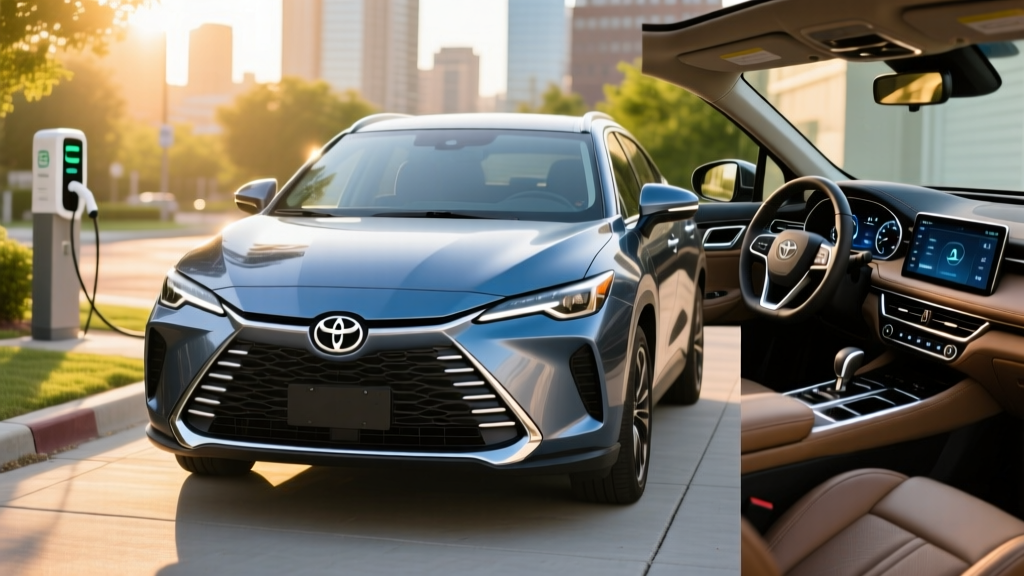
Quick Verdict: The Toyota Hybrid Venza in 2026
The Toyota Venza has occupied a specific niche since its reintroduction: a midsize crossover that pairs standard all-wheel drive with hybrid efficiency, targeting buyers who want better fuel economy without plugging in. For the 2025 model year — the final year before Toyota restructured its midsize hybrid lineup around the Highlander Hybrid and RAV4 Hybrid — the Venza delivered 39 MPG combined with 219 combined horsepower and a starting MSRP around $35,070.
If you're searching for a Toyota hybrid Venza in 2026, you're likely evaluating the used and certified pre-owned market, or comparing what the Venza offered against current Toyota hybrid alternatives. This guide covers every spec that matters — EPA fuel economy, real-world MPG, the hybrid powertrain, battery longevity, warranty coverage, and whether a conventional hybrid like the Venza fits your driving life better than a plug-in hybrid or full battery-electric vehicle.
Fuel Economy: EPA Ratings and Real-World MPG
The Venza's headline number is its fuel efficiency. Toyota's fourth-generation hybrid system squeezes impressive mileage from a midsize, AWD crossover. Here's the official EPA breakdown:
| Metric | EPA Estimate |
|---|---|
| City MPG | 40 MPG |
| Highway MPG | 37 MPG |
| Combined MPG | 39 MPG |
| Annual Fuel Cost (15,000 mi) | ~$1,550 |
| Fuel Type | Regular Unleaded (87 octane) |
Source: fueleconomy.gov
Real-World MPG: What Owners Actually See
Conventional hybrids like the Venza tend to perform very close to — and sometimes slightly above — their EPA estimates in city driving, where regenerative braking recaptures the most energy. In mixed real-world use, most owners report 37–41 MPG combined, depending on driving style and climate.
Where you'll see variation:
- Highway-heavy commutes: Expect 34–37 MPG at sustained 70–80 mph speeds. Hybrids lose their city advantage on the open road, where the engine runs continuously and aerodynamic drag dominates.
- Cold weather (below 32°F): Fuel economy can drop 5–10% because the engine runs more often to generate cabin heat and warm the catalytic converter. Expect 33–36 MPG in winter.
- City stop-and-go: This is the Venza's sweet spot. Drivers in urban environments regularly report 41–43 MPG on routes with frequent stops.
Compared to a non-hybrid midsize AWD crossover averaging 24–26 MPG combined, the Venza cuts fuel consumption by roughly 35%. Over 15,000 miles annually at $3.40/gallon, that's approximately $700–$900 in yearly fuel savings.
Powertrain: 219 HP with Standard AWD
Every Venza uses the same powertrain — there are no engine options or FWD-only trims to sort through.
| Component | Specification |
|---|---|
| Engine | 2.5L 4-cylinder Dynamic Force (A25A-FXS) |
| Engine Output | 176 hp / 163 lb-ft torque |
| Front Electric Motor | 88 kW (118 hp) |
| Rear Electric Motor | 40 kW (54 hp) |
| Combined System Output | 219 hp |
| Drivetrain | Electronic On-Demand AWD (standard) |
| Transmission | eCVT (planetary gearset, no belt) |
| 0–60 mph | ~7.6 seconds |
| Towing Capacity | Not rated for towing |
The electronic AWD system is worth explaining. Unlike mechanical AWD with a driveshaft, the Venza uses a dedicated rear electric motor that engages the rear wheels only when slip is detected or during hard acceleration. This means zero parasitic drivetrain loss during normal cruising — the rear motor simply freewheels. It's a key reason the Venza achieves nearly identical MPG to FWD-only hybrid competitors.
The eCVT is Toyota's planetary gearset design, not a traditional belt-and-cone CVT. There's no rubber band effect. Acceleration is linear, and the system has proven extremely durable over millions of miles across Toyota's hybrid fleet.
Hybrid Battery: Size, Chemistry, Warranty, and Replacement Cost
The Venza's hybrid battery is small by EV standards — approximately 1.6 kWh usable — because it doesn't need to store energy for electric-only driving. Its job is to buffer energy between the engine, motors, and regenerative braking system.
Toyota covers the Venza's hybrid battery for 10 years or 150,000 miles (whichever comes first) from date of first use. This applies to all 2020+ model year Toyota hybrids. The warranty guarantees the battery will retain sufficient capacity for normal hybrid operation. Emissions-related hybrid components carry an additional 8-year/80,000-mile federal emissions warranty.
Battery Chemistry and Longevity
The Venza uses a nickel-metal hydride (NiMH) battery pack in most trims — Toyota's most battle-tested chemistry, with over 25 years of field data from Prius, Camry Hybrid, and Highlander Hybrid fleets. NiMH is less energy-dense than lithium-ion but extremely tolerant of the shallow charge-discharge cycles that define hybrid operation.
Real-world degradation data is encouraging:
- Toyota hybrid batteries routinely exceed 200,000 miles before needing replacement.
- Individual cell replacement (rather than full pack) is often possible, costing $500–$1,500 at independent hybrid specialists.
- Full pack replacement from a Toyota dealer runs $3,000–$4,500 including labor, though this is rarely needed within the vehicle's normal service life.
- Refurbished/remanufactured packs are available for $1,500–$2,500 from third-party suppliers.
The key insight: hybrid batteries live an easier life than EV batteries. They operate in a narrow state-of-charge window (roughly 40–80% SoC), never deep-cycle, and never see DC fast charging stress. This is why Toyota's NiMH packs routinely outlast their vehicles.
Pricing, Trims, and Tax Credit Eligibility
The Venza was offered in three trims for its final model years. Here's the MSRP breakdown:
| Trim | MSRP | Key Features |
|---|---|---|
| LE | $35,070 | Toyota Safety Sense 2.5, 8" touchscreen, wireless CarPlay/Android Auto, LED headlights |
| XLE | $37,070 | SofTex seats, power liftgate, 12.3" touchscreen, ambient lighting, heated front seats |
| Limited | $40,370 | Panoramic fixed-glass roof, 10-speaker JBL audio, ventilated front seats, digital rearview mirror, HUD |
Does the Venza Qualify for Any Federal Tax Credit?
No. The Toyota Venza is a conventional hybrid (HEV), and the federal §30D Clean Vehicle Credit applies exclusively to plug-in electric vehicles — battery-electric vehicles (BEVs) and plug-in hybrids (PHEVs) with a minimum battery capacity of 7 kWh.
Because the Venza cannot be plugged in and its battery is far below the 7 kWh threshold, it does not qualify for:
- The $7,500 new clean vehicle credit
- The $4,000 used clean vehicle credit (§25E)
- The commercial clean vehicle credit (§45W)
Some states offer modest incentives for conventional hybrids, but these are increasingly rare as incentive programs shift toward plug-in vehicles. Check your state's energy office or department of environmental quality for current programs.
HEV vs PHEV vs EV: Which Powertrain Fits Your Life?
The Venza sits at one end of the electrification spectrum. Here's how it compares to the alternatives:
| Factor | HEV (Venza) | PHEV (RAV4 Prime) | BEV (bZ4X) |
|---|---|---|---|
| Plug in to charge? | No | Yes (Level 1/2) | Yes (Level 1/2/DC) |
| Electric-only range | ~0.5 mi at low speed | 42 mi EPA | 222–252 mi EPA |
| Combined efficiency | 39 MPG | 94 MPGe / 38 MPG gas | 114–119 MPGe |
| Fuel cost per mile | ~$0.09 | ~$0.04 electric / $0.09 gas | ~$0.04–$0.06 |
| Home charging needed? | No | Recommended | Essential |
| Federal tax credit | None | Up to $7,500* | Up to $7,500* |
| Base MSRP (approx.) | ~$35,070 | ~$43,690 | ~$37,070 |
| Best for | No home charging, simplicity | Short commute + road trips | Home charging, low running cost |
*§30D credit eligibility depends on MSRP caps, buyer income limits, battery sourcing requirements, and point-of-sale transfer rules. Verify current-year eligibility at irs.gov.
Choose the Toyota Hybrid Venza (HEV) If:
- You don't have access to home or workplace charging
- You want lower fuel costs with zero behavioral change
- You take frequent long road trips and don't want to plan around charging stops
- You want AWD and prioritize simplicity over maximum electrification
- Your annual mileage is moderate (10,000–15,000 mi), so fuel savings alone justify the hybrid premium over a gas model
Look at a PHEV (RAV4 Prime) or BEV Instead If:
- You have home Level 2 charging and a commute under 40 miles (PHEV covers it on electricity)
- You want the lowest possible per-mile cost and qualify for the $7,500 federal credit
- You're willing to plan DC fast charging stops on road trips (BEV)
- You want to maximize emissions reduction in daily driving
Reliability, Safety, and Ownership Costs
Toyota's hybrid powertrain is among the most proven in the industry. The Venza shares its core hybrid architecture with the RAV4 Hybrid and Camry Hybrid — systems with extensive long-term reliability data.
Key ownership considerations:
- IIHS Safety: The Venza earned Top Safety Pick recognition with Good ratings across crashworthiness tests. Toyota Safety Sense 2.5 includes pre-collision braking, lane departure alert, dynamic radar cruise control, and lane tracing assist — all standard.
- Maintenance: Hybrid-specific maintenance is minimal. The inverter cooling system requires periodic fluid checks. Brake pads last significantly longer than on gas-only vehicles because regenerative braking handles most deceleration — 80,000+ miles on original pads is common.
- Insurance: Typically 5–10% higher than comparable gas crossovers due to hybrid component repair costs, but lower than EVs.
- Depreciation: Toyota hybrids hold value well. The Venza's discontinuation may create some near-term uncertainty, but Toyota's hybrid reputation supports strong resale.
✓ Pros:
• 39 MPG combined with standard AWD — no compromise
• Proven hybrid powertrain with 10-year/150,000-mi battery warranty
• No plug-in required — zero lifestyle change vs. a gas car
• Strong standard safety suite (TSS 2.5)
• Smooth, linear acceleration from eCVT
✗ Cons:
• No federal tax credit eligibility
• Limited cargo space (28.8 cu ft behind rear seats) vs. RAV4 Hybrid
• Panoramic glass roof (Limited trim) adds weight, no opening function
• Discontinued — available only on used/CPO market in 2026
• Not rated for towing
Frequently Asked Questions
How many MPG does the Toyota Hybrid Venza get?
The EPA rates the Venza at 40 MPG city, 37 MPG highway, and 39 MPG combined. In real-world mixed driving, owners typically see 37–41 MPG. City-heavy routes push it above 40 MPG, while sustained highway driving at 75+ mph drops it to the mid-30s.
Does the Toyota Venza need to be plugged in?
No. The Venza is a conventional hybrid (HEV). Its small battery recharges through regenerative braking and the gasoline engine. You fuel it like any other car — just less often.
Is the Toyota Venza hybrid reliable, and what does battery replacement cost?
Toyota's hybrid system is one of the most reliable powertrains on the market, with decades of field data. The hybrid battery is warrantied for 10 years/150,000 miles. Full replacement, rarely needed before 200,000 miles, costs $3,000–$4,500 at a dealer. Independent hybrid shops can often replace individual cells for $500–$1,500.
Does the Venza qualify for a federal tax credit?
No. The federal §30D Clean Vehicle Credit only applies to plug-in vehicles (BEVs and PHEVs). The Venza, as a conventional hybrid, does not qualify. Check your state's energy office for any local hybrid incentives, though these are uncommon.
How does the Venza compare to the RAV4 Hybrid?
The RAV4 Hybrid offers more cargo space (37.6 cu ft vs. 28.8), slightly better fuel economy (40 MPG combined), and is still in production. The Venza trades practicality for a more car-like ride, a slightly more upscale interior, and a standard panoramic glass roof on higher trims. If cargo space matters, the RAV4 Hybrid is the more versatile choice. If you prefer a smoother, more refined driving experience, the Venza has an edge.
Can I still buy a new Toyota Venza in 2026?
The Venza was discontinued after the 2024 model year as Toyota consolidated its hybrid SUV lineup. In 2026, it's available on the certified pre-owned and used market. Toyota's current hybrid alternatives include the RAV4 Hybrid, Highlander Hybrid, and Crown Signia. CPO models retain the balance of Toyota's 10-year/150,000-mile hybrid battery warranty.
What's the difference between the Venza and a plug-in hybrid like the RAV4 Prime?
The RAV4 Prime is a PHEV with a larger 18.1 kWh battery that provides 42 miles of electric-only range before the gas engine engages. You plug it in to charge. The Venza is a conventional hybrid — no plug, no electric-only range to speak of, but also no charging infrastructure requirement. The Prime qualifies for up to $7,500 in federal tax credits (subject to eligibility); the Venza does not.