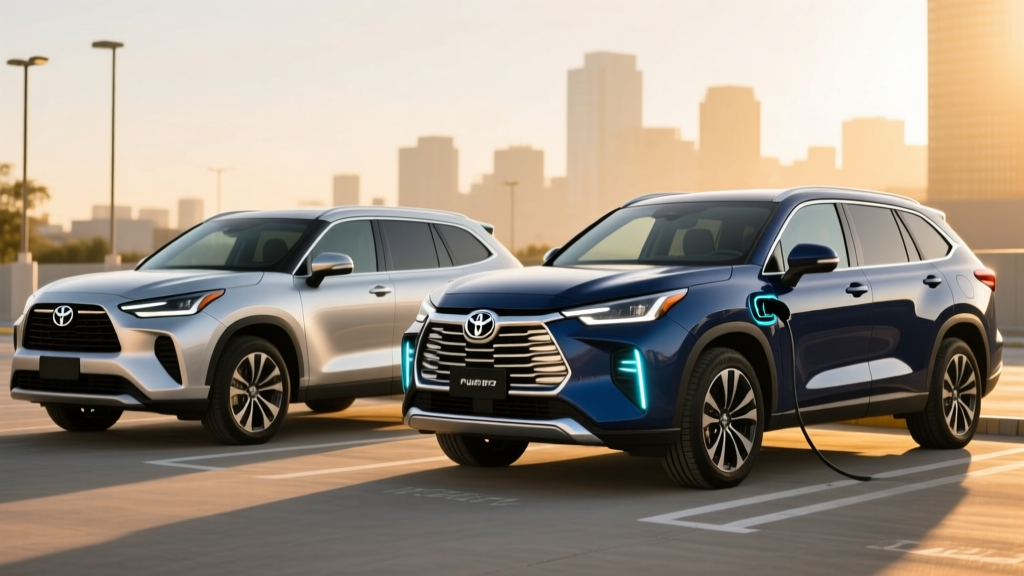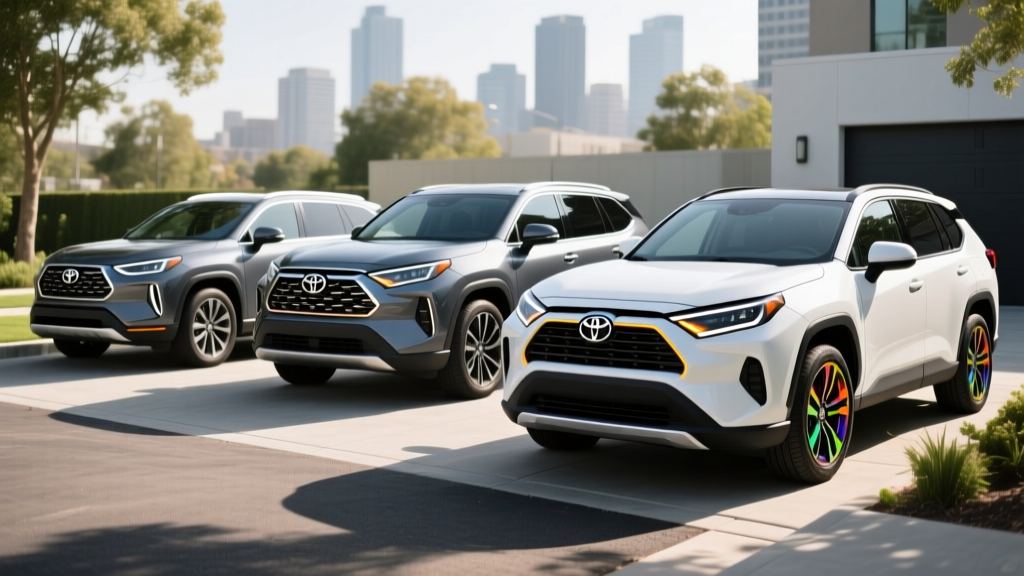
If you want the fuel savings of electrification without the charging logistics of a full battery-electric vehicle, Toyota's hybrid SUV lineup remains the segment benchmark. For 2026, Toyota offers four core hybrid SUV options spanning compact to midsize three-row territory: the RAV4 Hybrid (conventional HEV), the RAV4 Prime (plug-in hybrid PHEV), the Highlander Hybrid (three-row HEV), and the Venza (midsize two-row HEV). Each pairs a gasoline engine with electric motors — but they solve very different problems for very different buyers.
This guide breaks down every 2026 Toyota hybrid SUV by the numbers: EPA MPG, electric-only range (for the Prime), real-world efficiency, powertrain output, battery warranty, pricing, and tax-credit eligibility. No marketing fluff — just the data you need to decide.
HEV vs. PHEV: What's the Difference in Toyota's Lineup?
Before comparing models, it's essential to understand the two hybrid architectures Toyota uses:
Conventional Hybrid (HEV) — RAV4 Hybrid, Highlander Hybrid, Venza
- No plug required. The battery recharges through regenerative braking and the gasoline engine.
- Battery capacity: ~1.6 kWh (small, acts as a buffer).
- Electric-only driving: limited to low-speed, short-distance creep (under ~1 mile).
- Primary benefit: significantly improved MPG vs. gas-only equivalents, zero behavior change required.
Plug-In Hybrid (PHEV) — RAV4 Prime
- Plugs in to charge. Larger battery enables meaningful electric-only driving.
- Battery capacity: 18.1 kWh usable.
- Electric-only range: EPA-estimated 42 miles.
- Primary benefit: daily EV commuting with a gas engine for longer trips — best of both worlds if you can charge at home.
If you can't install a home charger or lack reliable workplace charging, an HEV delivers most of the fuel savings with none of the infrastructure requirements. If you can charge at home, the RAV4 Prime's 42-mile EV range covers the average American's daily commute entirely on electricity.
2026 Toyota Hybrid SUV Lineup: Full Spec Comparison
| Spec | RAV4 Hybrid | RAV4 Prime (PHEV) | Highlander Hybrid | Venza |
|---|---|---|---|---|
| Type | HEV | PHEV | HEV | HEV |
| Engine | 2.5L 4-cyl + 3 motors | 2.5L 4-cyl + 3 motors | 2.5L 4-cyl + 3 motors | 2.5L 4-cyl + 3 motors |
| Combined HP | 219 hp | 302 hp | 243 hp | 219 hp |
| 0-60 mph | 7.4 sec | 5.7 sec | 7.8 sec | 7.6 sec |
| EPA Combined MPG | 39 MPG | 94 MPGe / 38 MPG (gas) | 35 MPG | 39 MPG |
| EPA City / Hwy MPG | 41 / 38 | 40 / 36 (gas) | 36 / 35 | 40 / 37 |
| EV-Only Range (PHEV) | N/A | 42 mi (EPA) | N/A | N/A |
| Total Range | ~570 mi | ~600 mi (EV + gas) | ~630 mi | ~550 mi |
| Battery (kWh) | ~1.6 kWh (NiMH) | 18.1 kWh (Li-ion) | ~1.6 kWh (NiMH) | ~1.6 kWh (NiMH) |
| Charging (PHEV) | N/A | Level 2: ~2.5 hrs; No DCFC | N/A | N/A |
| Drivetrain | AWD (electronic rear) | AWD (electronic rear) | AWD (electronic rear) | AWD (electronic rear) |
| Starting MSRP | $33,575 | $44,515 | $43,970 | $37,220 |
| Federal Tax Credit | None | Up to $3,750* | None | None |
*RAV4 Prime PHEV credit subject to IRS §30D rules including income caps, battery sourcing requirements, and MSRP limits. Verify current eligibility at irs.gov. Conventional HEVs do not qualify for the federal clean vehicle credit.
MPG Deep Dive: EPA Stickers vs. Real-World Driving
| Model | EPA City | EPA Hwy | EPA Combined | Real-World Expectation |
|---|---|---|---|---|
| RAV4 Hybrid | 41 | 38 | 39 | 37-43 (city-biased driving can exceed EPA) |
| RAV4 Prime (gas mode) | 40 | 36 | 38 | 35-39 (heavier due to larger battery) |
| Highlander Hybrid | 36 | 35 | 35 | 32-37 (varies with load and passengers) |
| Venza | 40 | 37 | 39 | 37-42 (similar to RAV4 Hybrid) |
Key insight for hybrid buyers: Toyota's hybrid system (THS II) shines in stop-and-go city driving, where regenerative braking constantly recaptures energy. It's common for RAV4 Hybrid owners to report 42-44 MPG in urban commuting — above the EPA city estimate. Conversely, sustained 75+ mph highway driving reduces the hybrid advantage, and you'll see numbers closer to 34-36 MPG. This is the opposite of gas-only vehicles, which typically get better highway mileage.
For the RAV4 Prime in EV mode, the EPA rates 94 MPGe combined when running on battery. In practice, expect 80-95 MPGe depending on temperature and driving style. Once the battery depletes, the Prime operates as a conventional hybrid at 38 MPG combined.
RAV4 Prime PHEV: Electric-Only Range, Charging, and Daily Use
Real-World Expectation: 35-42 miles depending on temperature and driving style. In cold weather (below 35°F), expect 28-35 miles due to cabin heating demands and reduced battery efficiency.
Total Combined Range: ~600 miles (42 EV + ~558 gas)
The RAV4 Prime's 18.1 kWh lithium-ion battery pack provides 42 miles of EPA-rated electric-only range — enough to cover roughly 70% of American daily commutes without using a drop of gasoline. Here's what you need to know about charging it:
- Level 1 (120V household outlet): ~10 hours for a full charge. Viable if you drive less than 42 miles daily and park for 10+ hours.
- Level 2 (240V, 3.3 kW onboard charger): ~2.5 hours from empty to full. This is the practical home-charging setup.
- DC Fast Charging: Not available. The RAV4 Prime does not support DCFC — it uses a J1772 connector for AC charging only.
The 3.3 kW onboard charger is the Prime's main limitation. While competitors like the Chrysler Pacifica PHEV offer 6.6 kW charging, Toyota's slower rate means you won't top up quickly at a public Level 2 station during a shopping trip. For overnight home charging, 2.5 hours is perfectly adequate.
Performance bonus: The Prime's larger battery and more powerful electric motors produce 302 combined horsepower — making it the quickest RAV4 at 5.7 seconds to 60 mph. That's a meaningful difference vs. the standard Hybrid's 7.4 seconds.
Pricing, Tax Credits, and Total Cost of Ownership
Here's how the 2026 lineup prices out, and which models can tap federal incentives:
Federal Tax Credit: Only the RAV4 Prime Qualifies
- ✅ RAV4 Prime qualifies as a plug-in hybrid with ≥7 kWh battery
- ⚠️ Credit amount: up to $3,750 (partial credit — depends on critical mineral and battery component sourcing compliance)
- ⚠️ Buyer income cap: $150K single / $225K head of household / $300K joint (MAGI)
- ⚠️ MSRP cap: $80,000 for SUVs (RAV4 Prime well under this)
- ❌ Conventional HEVs (RAV4 Hybrid, Highlander Hybrid, Venza) do not qualify for §30D — they have no plug and batteries under 7 kWh
- ✅ Point-of-sale transfer available — dealer applies credit at purchase if eligible
Verify current eligibility and sourcing compliance at irs.gov/credits-for-new-clean-vehicles. Credit rules and qualified vehicle lists update frequently.
5-Year Cost Comparison: Hybrid vs. Gas vs. EV
| 5-Year Cost Factor | RAV4 Hybrid ($33,575) | RAV4 Gas AWD (~$31,000) | RAV4 Prime PHEV ($44,515) |
|---|---|---|---|
| Purchase Price | $33,575 | $31,000 | $44,515 |
| Tax Credit | $0 | $0 | -$3,750 |
| Fuel (60K mi, $3.50/gal avg) | ~$5,385 | ~$7,350 | ~$3,100 (gas + electricity)* |
| Net 5-Year Fuel+Purchase | ~$38,960 | ~$38,350 | ~$43,865 |
*Prime fuel cost assumes 60% of driving on electricity at $0.15/kWh. Actual costs vary by local electricity and gas prices. Does not include insurance, maintenance, or depreciation. Source: fueleconomy.gov data.
The RAV4 Hybrid breaks even against the gas model within 2-3 years through fuel savings alone. The Prime's higher upfront cost takes longer to recoup — but if you can charge at home and your commute fits within 42 miles, your effective "fuel" cost drops dramatically.
Battery Longevity, Warranty, and Replacement Costs
• Coverage: 10 years / 150,000 miles (whichever comes first)
• Applies to: all hybrid battery packs (HEV and PHEV)
• Threshold: Toyota warrants the battery will retain sufficient capacity to operate the hybrid system normally
• Transferable: Yes, to subsequent owners
Battery longevity is consistently the top concern among hybrid buyers, and it's where Toyota's track record is strongest. The company has been refining its hybrid battery systems since the 1997 Prius, and real-world data supports the warranty:
- HEV batteries (RAV4 Hybrid, Highlander, Venza): These use nickel-metal hydride (NiMH) packs that rarely require replacement within the vehicle's normal lifespan. Toyota's hybrid system keeps the battery in a narrow state-of-charge window (roughly 40-80%), minimizing degradation stress. Reports of failures before 200,000 miles are uncommon.
- PHEV battery (RAV4 Prime): The 18.1 kWh lithium-ion pack faces more charge cycles but benefits from active thermal management. Expect 8-12% capacity loss over 10 years based on similar Toyota PHEV data. Even with degradation, the 42-mile EV range would drop to roughly 37 miles — still highly usable.
What Does Replacement Cost?
Out-of-warranty hybrid battery replacement costs in 2026:
- HEV (RAV4 Hybrid, Highlander, Venza): $3,000-$4,500 for a new OEM battery pack. Refurbished options run $1,500-$2,500.
- PHEV (RAV4 Prime): $8,000-$12,000 for the larger lithium-ion pack. This is a meaningful cost — but the 10-year/150K-mile warranty covers most ownership periods.
For context, a gas vehicle's transmission replacement can cost $4,000-$7,000 and happens more frequently than hybrid battery failures. The hybrid system also eliminates the alternator, starter motor, and reduces brake wear through regenerative braking.
Reliability Ratings and Safety
Toyota's hybrid powertrain is among the most proven in the industry. Key reliability indicators:
- NHTSA: The RAV4 Hybrid and RAV4 Prime carry 5-Star overall safety ratings. Check current scores at nhtsa.gov.
- IIHS: The RAV4 family has historically earned Top Safety Pick+ designations. Verify the latest crash-test results at iihs.org.
- Powertrain simplicity: Toyota's eCVT (planetary gearset, not a belt-driven CVT) has no clutch packs, torque converter, or traditional gear shifts to wear out. This is mechanically simpler than most automatic transmissions.
- Long-term owner data: Fleet and taxi operators have logged 300,000+ miles on Toyota hybrid systems with minimal powertrain issues.
Hybrid vs. PHEV vs. Full EV: Which Toyota SUV Fits You?
Choose a Toyota HEV (RAV4 Hybrid, Highlander Hybrid, Venza) if:
- You cannot install a home charger (apartment, street parking, no garage)
- You want zero behavior change — just gas up and go, with better MPG
- Your budget is under $40,000
- You drive a mix of city and highway and want 35-41 MPG combined
- You need a three-row SUV (Highlander Hybrid is the only option)
Choose the RAV4 Prime PHEV if:
- You can charge at home (Level 2, 240V) or at work
- Your daily round-trip commute is under 42 miles
- You want EV-mode driving for errands but gas flexibility for road trips
- You value the 302-hp performance upgrade (5.7 sec 0-60)
- You qualify for the partial $3,750 federal tax credit
Choose a Full EV (e.g., Tesla Model Y, Hyundai Ioniq 5) instead if:
- Your daily driving is under 250 miles and you can charge at home
- You want to eliminate gasoline entirely and reduce maintenance further
- You qualify for the full $7,500 federal EV credit
- You have access to reliable DC fast charging for road trips
Pros and Cons: Toyota Hybrid SUVs at a Glance
✅ Pros
- Class-leading reliability and 10-year/150K battery warranty
- RAV4 Hybrid achieves 39-43 MPG real-world with zero plug-in hassle
- RAV4 Prime's 42-mile EV range covers most commutes
- Standard AWD across all hybrid trims (electronic rear motor)
- Strong resale value — Toyota hybrids hold value better than most EVs
- No range anxiety — gas station infrastructure works everywhere
❌ Cons
- RAV4 Prime limited to 3.3 kW charging — no DC fast charging
- Conventional HEVs don't qualify for federal tax credits
- Highlander Hybrid's 35 MPG is good for its size but trails two-row options
- RAV4 Prime's $44,515 starting price is $11,000 more than the Hybrid
- eCVT drone under hard acceleration (engine RPM doesn't match road speed)
- Venza's discontinuation risk — lower sales volume may limit future availability
Frequently Asked Questions
How many MPG do Toyota hybrid SUVs get?
The RAV4 Hybrid and Venza both achieve an EPA-estimated 39 MPG combined (41 city / 38 highway for the RAV4 Hybrid; 40 city / 37 highway for the Venza). The three-row Highlander Hybrid rates 35 MPG combined (36 city / 35 highway). In real-world city driving, RAV4 Hybrid owners commonly report 42-44 MPG thanks to frequent regenerative braking.
How far can the RAV4 Prime go on electric only?
The RAV4 Prime delivers an EPA-estimated 42 miles of electric-only range. In real-world conditions, expect 35-42 miles depending on temperature, terrain, and driving style. Cold weather (below 35°F) can reduce this to 28-35 miles. Once the battery depletes, the Prime operates as a standard hybrid at 38 MPG combined.
Do Toyota hybrids need to be plugged in?
No — only the RAV4 Prime (PHEV) benefits from plugging in. The RAV4 Hybrid, Highlander Hybrid, and Venza are conventional hybrids that recharge their small batteries entirely through regenerative braking and the gasoline engine. You never plug them in; you simply refuel at a gas station as usual.
Is a Toyota hybrid reliable, and what does battery replacement cost?
Toyota's hybrid system has over 25 years of proven reliability dating to the 1997 Prius. All 2026 Toyota hybrid batteries carry a 10-year/150,000-mile warranty. Out-of-warranty HEV battery replacement runs $3,000-$4,500; the RAV4 Prime's larger PHEV battery costs $8,000-$12,000. In practice, failures before 200,000 miles are rare due to Toyota's conservative battery management strategy.
Does any Toyota hybrid SUV qualify for a federal tax credit?
Only the RAV4 Prime plug-in hybrid may qualify for a partial federal tax credit (up to $3,750) under IRS §30D rules. Conventional hybrids (RAV4 Hybrid, Highlander Hybrid, Venza) do not qualify because they lack a plug and have batteries under the 7 kWh minimum. Eligibility depends on buyer income limits, battery sourcing requirements, and MSRP caps — always verify at irs.gov before purchasing.
Can the RAV4 Prime DC fast charge?
No. The RAV4 Prime supports only AC charging: Level 1 (120V, ~10 hours) and Level 2 (240V at 3.3 kW, ~2.5 hours). There is no DC fast-charging capability. For a PHEV with a 42-mile EV range, overnight Level 2 home charging is sufficient for most owners.
Toyota hybrid SUV vs. a full EV — which should I buy?
Choose a Toyota hybrid if you can't charge at home, frequently drive over 300 miles between stops, or want to minimize upfront cost. Choose a full EV if you have home charging, drive under 250 miles daily, want the lowest per-mile fuel cost, and qualify for the $7,500 federal credit. The RAV4 Prime PHEV bridges both worlds — EV commuting with gas-engine road-trip flexibility.
Sources: EPA fuel economy data via fueleconomy.gov, Toyota Motor Corporation 2026 specification sheets, IRS §30D clean vehicle credit guidance at irs.gov. All pricing and specifications reflect 2026 model year and are subject to change. Verify tax credit eligibility with a tax professional.