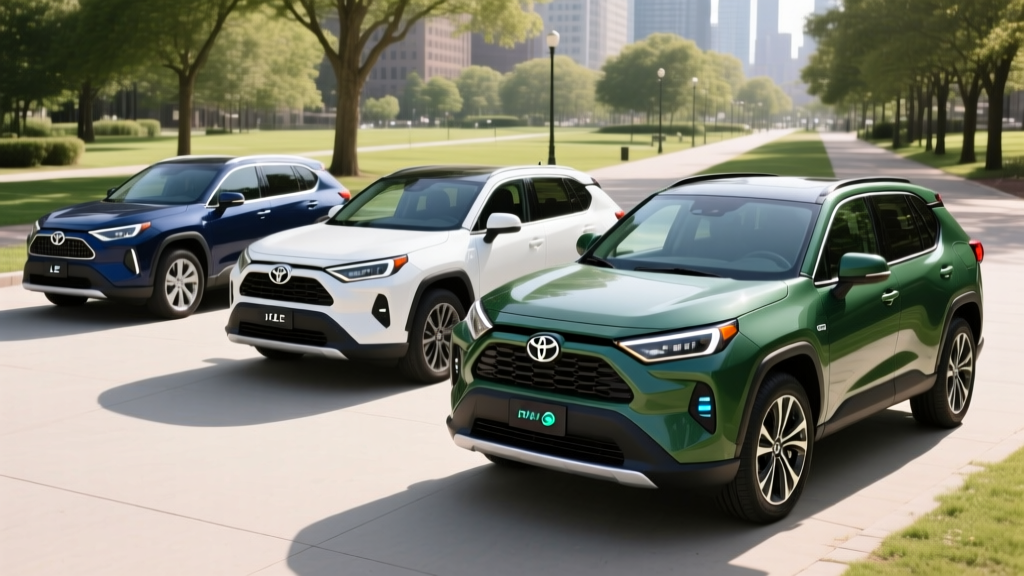
If you want the fuel savings of electrification without committing to a fully electric vehicle, Toyota's hybrid SUV lineup remains one of the broadest and most proven on the market. For 2026, Toyota offers five distinct hybrid SUV configurations across three nameplates, spanning compact crossovers to three-row family haulers — plus one plug-in hybrid (PHEV) that can handle most daily commutes on electricity alone.
This guide breaks down every current Toyota hybrid SUV option with exact EPA figures, real-world fuel economy expectations, powertrain specs, pricing, and tax credit eligibility so you can match the right model to your driving pattern.
HEV vs. PHEV: Understanding Toyota's Two Hybrid Approaches
Conventional Hybrid (HEV): Models like the RAV4 Hybrid and Highlander Hybrid use a small battery (typically 1.0–2.0 kWh) paired with a gasoline engine and electric motor(s). You never plug them in — the battery charges through regenerative braking and the engine. They deliver strong city MPG gains with zero change to your fueling routine.
Plug-In Hybrid (PHEV): The RAV4 Prime carries a much larger battery (18.1 kWh usable) that you charge via a wall outlet or Level 2 charger. It delivers a meaningful electric-only driving range before the gasoline engine engages, effectively functioning as a short-range EV for daily errands with a gas engine for longer trips.
The choice between them hinges on one question: Can you charge at home or work? If yes, a PHEV unlocks dramatically lower fuel costs for local driving. If not, a conventional HEV still delivers excellent efficiency with no infrastructure requirements.
2026 Toyota Hybrid SUV Lineup at a Glance
| Model | Type | Combined HP | EPA Combined MPG | EPA City / Hwy | EV Range (PHEV) | Starting MSRP |
|---|---|---|---|---|---|---|
| RAV4 Hybrid | HEV | 219 hp | 39 MPG | 41 / 38 | N/A | $33,575 |
| RAV4 Prime | PHEV | 302 hp | 94 MPGe / 38 MPG (gas) | 94 / 84 MPGe | 42 miles | $44,515 |
| Grand Highlander Hybrid | HEV | 245 hp (Hybrid) / 362 hp (Hybrid MAX) | 34 MPG / 27 MPG (MAX) | 36 / 32 (Hybrid) | N/A | $45,120 |
| Highlander Hybrid | HEV | 243 hp | 35 MPG | 35 / 35 | N/A | $42,320 |
| Venza (discontinued after 2024) | HEV | 219 hp | 39 MPG | 40 / 37 | N/A | Discontinued |
Sources: fueleconomy.gov, Toyota Motor Corporation. MSRP figures reflect base trim before destination charges. Verify current pricing with your local dealer.
RAV4 Hybrid: The Volume Leader
The RAV4 Hybrid is Toyota's best-selling electrified vehicle for good reason. Its 2.5-liter four-cylinder engine paired with front and rear electric motors produces a combined 219 horsepower and comes standard with electronic all-wheel drive (AWD). The EPA rates it at 41 MPG city, 38 MPG highway, and 39 MPG combined.
Real-world MPG: Toyota's hybrid system excels in stop-and-go traffic where the electric motor handles low-speed propulsion and regenerative braking recaptures energy. Expect to match or slightly exceed the EPA city figure in urban driving. Highway fuel economy tends to dip 2–4 MPG below the sticker at sustained 75+ MPH speeds, especially with roof cargo or in cold weather. A realistic blended expectation is 36–40 MPG year-round.
The RAV4 Hybrid starts at $33,575 for the LE trim and climbs to roughly $40,000 for the fully loaded Limited or Woodland Edition. No federal tax credit applies to conventional hybrids under current IRS §30D rules, which are reserved for plug-in vehicles with sufficient battery capacity.
RAV4 Prime: Toyota's Plug-In Hybrid Powerhouse
The RAV4 Prime is the performance and efficiency flagship of the lineup. With 302 combined horsepower from its 2.5-liter engine and more powerful electric motors, it hits 0–60 MPH in approximately 5.7 seconds — making it the second-quickest Toyota in the current lineup behind the GR Supra. But the real story is its 18.1 kWh lithium-ion battery, which delivers an EPA-rated 42 miles of electric-only range.
| Specification | RAV4 Prime Detail |
|---|---|
| Battery Capacity (Usable) | 18.1 kWh, lithium-ion |
| EPA Electric-Only Range | 42 miles |
| Total Range (EV + Gas) | ~600 miles |
| Level 1 Charging (120V) | ~12 hours (0–100%) |
| Level 2 Charging (240V, 3.3 kW onboard) | ~4.5 hours (0–100%) |
| Level 2 Charging (240V, optional 6.6 kW onboard) | ~2.5 hours (0–100%) |
| DC Fast Charging | Not supported |
| Gas MPG After Battery Depletes | 38 MPG combined |
| Combined Horsepower | 302 hp |
| Starting MSRP | $44,515 |
Charging reality check: The RAV4 Prime does not support DC fast charging — a common limitation of PHEVs due to their smaller batteries. On a standard 120V household outlet (Level 1), a full charge takes roughly 12 hours, which works if you plug in overnight. With a 240V Level 2 home charger and the optional 6.6 kW onboard charger, you can fully replenish in about 2.5 hours. The standard 3.3 kW onboard charger extends that to roughly 4.5 hours.
Real-world EV range: The EPA's 42-mile electric range assumes moderate temperatures and mixed driving. In cold weather (below 40°F), expect that to drop to 32–36 miles as battery efficiency decreases and cabin heating draws power. Highway-speed electric driving at 70+ MPH will also reduce range to approximately 34–38 miles. For most commuters with a sub-35-mile round trip, the Prime can operate as a daily EV with the gas engine reserved for weekend road trips.
Grand Highlander Hybrid: Three-Row Efficiency
Introduced for the 2024 model year and continuing into 2026, the Grand Highlander Hybrid fills the gap for families who need genuine third-row space with hybrid efficiency. Toyota offers two distinct powertrains:
- Standard Hybrid: A 2.5-liter four-cylinder hybrid system producing 245 combined horsepower, rated at 36 city / 32 highway / 34 combined MPG. This is the efficiency-oriented choice.
- Hybrid MAX: A turbocharged 2.4-liter hybrid powertrain delivering 362 combined horsepower and 400 lb-ft of torque, paired with a 6-speed automatic (no CVT). Rated at 26 city / 27 highway / 27 combined MPG. This trades some efficiency for substantially more acceleration and towing capability (5,000 lbs vs. 3,500 lbs).
Real-world MPG: The standard Hybrid's 34 MPG combined holds up well in mixed driving. City-heavy commuters often see 35–37 MPG thanks to the hybrid system's regenerative braking advantage. Highway-only trips at 75 MPH typically yield 30–32 MPG. The Hybrid MAX, tuned for performance, averages 25–27 MPG in real-world use — still meaningfully better than comparable non-hybrid three-row SUVs in the 18–22 MPG range.
Starting at $45,120, the Grand Highlander Hybrid occupies a premium position but undercuts most luxury three-row alternatives while delivering superior fuel economy.
Highlander Hybrid: The Proven Midsize Choice
The midsize Highlander Hybrid soldiers on with its 2.5-liter hybrid powertrain producing 243 combined horsepower. Its EPA rating of 35 MPG across the board (35 city / 35 highway / 35 combined) is remarkably balanced — unusual for a vehicle of its size. Starting MSRP is $42,320.
Real-world MPG: Owners consistently report 33–37 MPG in mixed driving. The Highlander Hybrid's relatively flat city-highway split means it doesn't benefit as dramatically from urban stop-and-go as smaller hybrids, but it also doesn't suffer as much on the highway. Expect 32–34 MPG on long road trips at interstate speeds.
The Highlander Hybrid seats up to eight (vs. seven in the Grand Highlander) and offers a slightly lower entry price, making it a strong value pick for families who don't need the Grand Highlander's extra cargo length.
Battery Reliability, Warranty, and Replacement Costs
Toyota Hybrid Battery Warranty: All 2026 Toyota hybrids and PHEVs carry a hybrid battery warranty of 10 years or 150,000 miles (whichever comes first), transferable to subsequent owners. This covers capacity loss below a defined threshold and any manufacturing defects.
Longevity data: Toyota's hybrid battery track record is among the strongest in the industry. The Prius, which shares core hybrid technology, has documented examples of original batteries lasting 200,000+ miles. Nickel-metal hydride (NiMH) batteries used in most Toyota HEVs degrade gradually rather than failing suddenly, and individual cell replacement is sometimes possible.
Out-of-warranty replacement cost: If a hybrid battery fails after the warranty period, replacement costs typically range from $2,000 to $4,000 for HEV models (RAV4 Hybrid, Highlander Hybrid) and $5,000 to $8,000 for the RAV4 Prime's larger lithium-ion pack. Refurbished and aftermarket options are increasingly available at 30–50% below OEM pricing.
Toyota's hybrid system is fundamentally simpler than a full EV powertrain — there's no large battery pack to worry about, and the gasoline engine serves as a failsafe. For buyers whose primary concern is long-term reliability and predictable maintenance costs, Toyota hybrids remain a benchmark.
Tax Credits and Incentives: What Applies in 2026?
Under current IRS §30D clean vehicle credit rules, only plug-in vehicles with a battery capacity of at least 7 kWh qualify for federal tax credits. This means:
- RAV4 Prime (PHEV): Qualifies in principle with its 18.1 kWh battery, but eligibility depends on meeting critical mineral and battery component sourcing requirements that have tightened significantly. As of 2026, many Toyota PHEVs face reduced or zero federal credit due to battery sourcing rules. Check the latest fueleconomy.gov tax credit listings before purchasing. The credit can be up to $7,500 if all requirements are met, and can be transferred to the dealer as a point-of-sale rebate.
- RAV4 Hybrid, Highlander Hybrid, Grand Highlander Hybrid (HEV): Do not qualify for the federal §30D credit. These are conventional hybrids with no plug-in capability.
State and local incentives: Some states offer additional rebates or HOV lane access for PHEVs. California's CVRP program, for example, has historically offered rebates for qualifying PHEVs. These vary by jurisdiction and income — check your state's energy office or the Alternative Fuels Data Center for current programs.
Income and MSRP caps: The §30D credit phases out for buyers with modified adjusted gross income above $150,000 (single) or $300,000 (joint). The vehicle MSRP cap for SUVs is $80,000. All Toyota hybrid SUVs fall well under the MSRP cap.
Toyota Hybrid SUV vs. Full EV vs. Gas: Which Fits Your Life?
Choose a Toyota HEV (RAV4 Hybrid, Highlander Hybrid) If:
- You cannot charge at home or work
- You want maximum simplicity — no plugs, no apps, no range planning
- Your budget is under $45,000
- You drive 12,000–15,000 miles/year and want to cut fuel costs 30–40% vs. a gas equivalent
- You plan to own the vehicle 8–10+ years and value Toyota's reliability record
Choose the RAV4 Prime (PHEV) If:
- You have access to Level 1 or Level 2 charging at home
- Your daily round-trip commute is under 40 miles
- You want EV-like daily driving with gas-engine freedom for road trips
- You value performance (302 hp, 5.7s 0–60)
- You want to minimize gasoline use without committing to a full EV
Consider a full EV instead if: You have reliable home charging, drive under 250 miles daily, want zero tailpipe emissions, and are ready to leave gasoline behind entirely. Vehicles like the Hyundai Ioniq 5 or Tesla Model Y offer 300+ miles of range and lower per-mile energy costs, but require a lifestyle shift around charging.
Frequently Asked Questions
How many MPG does the Toyota RAV4 Hybrid get in real driving?
The EPA rates the RAV4 Hybrid at 41 city / 38 highway / 39 combined MPG. In real-world driving, most owners report 36–40 MPG in mixed use. City-heavy driving often exceeds the EPA city estimate, while sustained highway driving at 75+ MPH typically drops to 35–37 MPG.
How far can the RAV4 Prime go on electric power alone?
The EPA rates the RAV4 Prime at 42 miles of electric-only range. In real-world conditions, expect 34–38 miles at highway speeds and 32–36 miles in cold weather (below 40°F). For daily commutes under 35 miles round-trip, you may use little to no gasoline on most days.
Do Toyota hybrid batteries need to be replaced, and what does it cost?
Toyota hybrid batteries are designed to last the life of the vehicle. The hybrid battery is warrantied for 10 years or 150,000 miles. If replacement is needed out of warranty, HEV battery replacements run $2,000–$4,000, while the RAV4 Prime's larger PHEV battery costs $5,000–$8,000. Many hybrid batteries exceed 200,000 miles without issue.
Does the RAV4 Prime qualify for the $7,500 federal tax credit?
The RAV4 Prime meets the battery capacity requirement (18.1 kWh) but must also satisfy critical mineral and battery component sourcing rules under §30D. As of 2026, sourcing requirements have tightened considerably, and many Toyota PHEVs may receive a partial or zero federal credit. Always verify current eligibility on fueleconomy.gov before purchasing. The credit can be transferred to the dealer at point of sale if eligible.
Can I charge the RAV4 Prime at a DC fast charger?
No. The RAV4 Prime does not support DC fast charging. It charges via Level 1 (120V, ~12 hours for a full charge) or Level 2 (240V, ~2.5–4.5 hours depending on whether you have the optional 6.6 kW onboard charger). This is standard for PHEVs, whose smaller batteries aren't designed for high-power DC charging.
Which Toyota hybrid SUV gets the best fuel economy?
The RAV4 Hybrid and the now-discontinued Venza both achieve 39 MPG combined, making them the most fuel-efficient Toyota hybrid SUVs. Among three-row options, the Grand Highlander Hybrid (standard powertrain) leads at 34 MPG combined.
Is a Toyota hybrid more reliable than a full EV?
Toyota's hybrid powertrains have two decades of proven reliability data, and the systems are mechanically simpler than full EVs in some respects (smaller battery, proven engine). Full EVs have fewer moving parts overall (no engine, no transmission) but carry higher battery replacement costs if something goes wrong post-warranty. For buyers prioritizing long-term predictability and widespread service network access, Toyota hybrids have a strong track record.